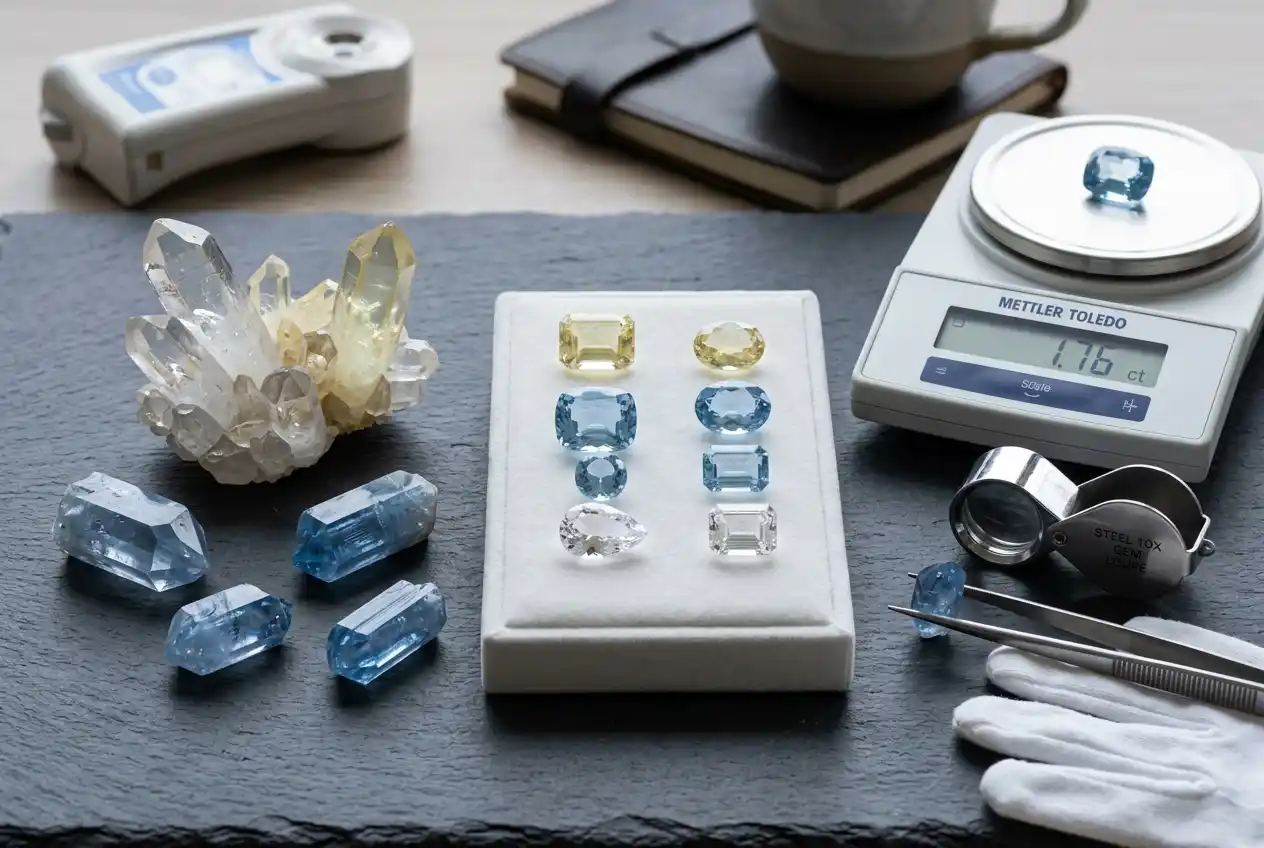
Jeremejevite Price Per Carat: 10 Rarity Factors Driving Top Dollar
Jeremejevite price per carat can reach hundreds or several thousand dollars because transparent facetable crystals are exceptionally scarce compared with most familiar jewelry gemstones. Small pale or moderately included stones may trade around several hundred dollars per carat, while fine transparent blue gems can move into roughly $1,500 to $5,000 per carat. Exceptional stones with unusually strong blue color, clean transparency, several carats of finished weight, fine cutting, excellent condition, and documented provenance can rise above those levels because the combination of useful size and genuine gem quality is difficult to replace.
Jeremejevite is a rare aluminum borate mineral containing fluorine and hydroxyl, commonly represented by the formula Al₆B₅O₁₅(F,OH)₃. It can occur colorless, pale yellow, yellowish, pale blue, blue, and occasionally in other subtle tones, but transparent blue crystals are especially desirable in the gem market. The mineral was first described from Russia, yet Namibia became the source most strongly associated with important gem-quality crystals, including specimens and rough capable of producing transparent faceted stones.
The high Price does not result from color alone. Jeremejevite is rare at the mineral-species level, and only a small fraction of recovered crystals combine transparency, attractive color, sufficient size, low fracture density, and a shape suitable for faceting. Large natural crystals may also be worth more as intact collector specimens than as cutting rough when their crystal form, termination, provenance, or association with other minerals is exceptional.
10 Rarity Factors Driving Jeremejevite Value
- Transparent gem quality versus translucent or included crystal quality
- Strength and attractiveness of blue body color
- Clarity, internal transparency, and freedom from distracting inclusions
- Carat weight and rarity of larger faceted gems
- Cut quality, symmetry, polish, and face-up brilliance
- Natural crystal form, termination, and specimen quality
- Namibia or other documented geographic provenance
- Natural identity and separation from similar pale blue gems
- Structural condition, fractures, chips, and durability
- Laboratory documentation, collector demand, and market availability
These ten factors explain why two pieces of jeremejevite of similar weight can have completely different values. A flawless-looking but pale one-carat faceted gem belongs to a different market from a richly blue three-carat stone, while a sharp intact crystal with outstanding termination may attract mineral collectors even if cutting it would yield a transparent gemstone. Jeremejevite therefore needs to be valued both as a rare gem and as a rare collectible mineral, depending on the form in which it occurs.
Typical Jeremejevite Price Per Carat
Jeremejevite is too scarce for a standardized international pricing grid, and transactions can vary substantially according to color, weight, clarity, cutting, provenance, and whether the piece is being sold as a faceted gem or natural crystal. The following ranges provide broad orientation rather than a fixed schedule.
| Jeremejevite Quality | Approximate Price Per Carat | Typical Characteristics |
|---|---|---|
| Commercial or included gem quality | $300 to $1,000 | Pale color, moderate inclusions, smaller size |
| Good transparent quality | $1,000 to $2,500 | Clean face-up appearance, pale blue to blue color |
| Fine blue quality | $2,000 to $5,000 | Stronger blue, high transparency, fine cutting |
| Exceptional larger faceted stones | $4,000 to $8,000+ | Rare size, attractive color, high clarity, excellent finish |
| Important natural crystals | Highly variable | Sharp crystal form, large size, important provenance, collector significance |
A price table is particularly approximate for jeremejevite because one additional carat can represent a dramatic increase in rarity when transparency and color remain fine. A two-carat pale stone and a five-carat bright blue gem cannot be compared through a simple linear multiplier, and important natural crystals may command a collector premium that makes per-carat arithmetic almost meaningless.
Transparent Gem Quality Is Far Rarer Than the Mineral Name Suggests
Jeremejevite is rare in general, but rarity alone does not make every specimen highly valuable. Many crystals contain fractures, internal veils, cloudy regions, attached matrix, or surface damage that reduce their suitability for faceting. Transparent rough must survive cutting while retaining enough weight and favorable orientation to produce a finished gemstone with attractive proportions.
This distinction creates a strong market divide between specimen-grade and facet-grade jeremejevite. A translucent crystal may be scientifically interesting and collectible, yet a transparent crystal capable of yielding an eye-clean gemstone occupies a much scarcer category. When the finished stone also has noticeable blue color, the rarity multiplies because many transparent crystals are colorless or only faintly tinted.
Fine transparency should therefore be judged before carat weight. A small clean gem can command a stronger per-carat Price than a much larger cloudy piece because the transparent category is more difficult to replace.
Blue Color Can Create a Major Premium
Jeremejevite is often associated with pale blue to medium blue gem crystals, and stronger attractive blue generally receives a market premium over colorless or very pale yellow stones when clarity and size are similar. The most desirable blue is usually clean and luminous rather than gray, overly dark, or muddy.
Because the mineral is scarce, collectors may still value colorless or pale yellow crystals highly when they possess exceptional form, size, or provenance. In faceted gems, however, blue usually creates stronger visual identity and helps distinguish jeremejevite from more common colorless minerals.
Tone and saturation need to remain balanced. A pale sky-blue stone can look exceptionally bright and transparent, while a slightly deeper blue gem may offer greater color strength. The best choice depends on whether increased saturation preserves the clean luminous appearance expected from fine transparent jeremejevite.
Clarity Strongly Influences Faceted Jeremejevite
Fine faceted jeremejevite is most valuable when internal inclusions are limited enough that the gem appears clean and bright from normal viewing distance. Natural crystals can contain veils, fluid-related features, fractures, mineral inclusions, or growth structures, and these features become increasingly important as transparency improves.
A small inclusion near the girdle can have little effect, while a reflective fracture beneath the table may disrupt light return across a large part of the face. Surface-reaching cracks deserve even more attention because they can affect both cutting yield and jewelry durability.
The rarity of clean rough means some minor inclusions can be accepted in larger stones without removing them from the fine category. A three- or four-carat stone with one small internal feature may still be exceptional if color, transparency, and cutting remain strong because replacing it with an equally large flawless gem may be extremely difficult.
Carat Weight Can Produce a Nonlinear Rarity Premium
Jeremejevite is usually encountered in relatively small faceted sizes, and larger clean gemstones become dramatically less common. This creates a nonlinear relationship between carat weight and Price when quality remains high.
A fine two-carat stone can already be rare, while a clean transparent gem several carats larger belongs to a much smaller supply pool. The Price per carat can therefore increase rather than remain constant as size rises, especially when blue color and excellent clarity survive through the larger volume.
The same principle applies to rough. A large crystal may contain only a small transparent section suitable for faceting, and cutting around fractures can reduce the final yield substantially. A finished gemstone’s weight therefore represents not just crystal size but the amount of clean, usable jeremejevite that survived the cutting process.
Cut Quality Matters Because Every Carat of Rough Is Valuable
Rare rough encourages cutters to retain as much weight as possible, but severe weight retention can create deep pavilions, thick girdles, windowing, asymmetry, or inefficient outlines. A high-value jeremejevite should still be judged according to how well it performs face-up rather than how many carats were preserved beneath the girdle.
A well-cut stone should distribute light across the face while maintaining useful spread. Shallow cutting can produce a transparent central window that makes the gem look less lively, whereas excessive depth can reduce visible size and create unnecessary dark areas.
Precision cutting may command a substantial premium because the cutter accepts economic risk when removing scarce rough to improve brilliance and symmetry. An unusual outline can remain appropriate if it follows the natural crystal intelligently and produces better optical performance than a standardized shape.
Polish and facet junctions also matter because pale transparent jeremejevite reveals workmanship readily. Fine stones should display smooth surfaces and crisp reflections without distracting chips or polishing marks.
Natural Crystal Form Can Be More Valuable Than a Faceted Gem
Jeremejevite is collected not only as a gemstone but also as a rare mineral species, and sharp natural crystals can have substantial specimen value. Long prismatic crystals with good termination, attractive color, transparency, and minimal damage may be especially desirable when their locality is documented.
Cutting such a specimen can destroy the characteristics mineral collectors value most. A crystal that might yield a modest faceted gem could therefore be worth more intact when its natural form is exceptional.
This dual market complicates jeremejevite pricing because the highest-value use of a crystal depends on whether its gem potential exceeds its specimen rarity. Dealers and collectors should consider crystal aesthetics, completeness, provenance, and association before assuming faceting will always increase value.
Namibian Provenance Has Strong Collector Recognition
Jeremejevite was first discovered in Russia, but Namibia became famous for producing important blue and transparent crystals that transformed the mineral from an obscure rarity into a recognized collector gemstone. Certain Namibian localities have supplied crystals suitable for faceting as well as exceptional mineral specimens.
Documented provenance can increase value when the locality is historically significant or associated with a notable period of production. This is particularly important for natural crystals because the mine or region forms part of the specimen’s scientific identity.
Origin should still follow visible quality in ordinary faceted valuation. A weakly colored fractured stone does not become top quality simply because it comes from a celebrated locality, but provenance can strengthen an already fine gem or specimen and make it more desirable to collectors.
Correct Identification Is Essential in Such a Rare Gem
Pale blue jeremejevite can resemble aquamarine, blue topaz, topazolite-colored alternatives, pale sapphire, tourmaline, beryl, glass, and other transparent gems depending on hue. Colorless crystals can be even easier to confuse visually with common transparent minerals.
Gemological identification can use refractive properties, birefringence, specific gravity, optic character, spectroscopy, inclusions, and other diagnostic observations. For a gemstone whose value is driven heavily by mineral rarity, natural identity should be established confidently before a major premium is paid.
Laboratory documentation becomes especially useful in multi-carat faceted stones or exceptional blue crystals because the report supports the claim that the gem is natural jeremejevite rather than a visually similar mineral.
Structural Condition Can Override Color and Size
Jeremejevite has useful jewelry hardness, commonly reported around the upper 6 to lower 7 range on the Mohs scale, but fractures and internal weaknesses can reduce practical durability. Hardness measures resistance to scratching rather than resistance to breaking, so a clean-looking large stone still needs inspection around the girdle, corners, and internal fracture systems.
Chips and abrasions reduce value because replacement stones of matching quality are difficult to source. Natural crystals should also be examined for repaired tips or broken terminations, since collector value depends strongly on original condition.
Pendants and earrings can be particularly suitable for rare faceted jeremejevite because they expose the stone to less impact than an everyday ring. When used in rings, protective settings and careful wear help preserve a gemstone that may be difficult to replace at any Price.
Conclusion
Jeremejevite price per carat is driven by transparency, blue color, clarity, carat weight, cutting, natural crystal quality, provenance, identity, structural condition, documentation, and collector demand. Included or pale stones may remain within the hundreds of dollars per carat, while fine transparent blue gems can reach several thousand dollars per carat and exceptional larger examples may command considerably more.
The strongest values occur when rarity and beauty overlap. A gem needs more than a rare mineral name to justify top Price. Fine jeremejevite combines clean transparency, attractive blue color, useful size, precision cutting, sound condition, and credible provenance, while important natural crystals can achieve their own high value through intact form and mineralogical significance.
FAQs About Jeremejevite Price Per Carat
How much does jeremejevite cost per carat?
Included or pale faceted jeremejevite may begin in the hundreds of dollars per carat, while good transparent stones can move into roughly $1,000 to $2,500 per carat. Fine blue stones may reach approximately $2,000 to $5,000 per carat, and exceptional larger gems can rise higher when color, clarity, size, cutting, and provenance are unusually strong.
Why is jeremejevite so expensive?
Jeremejevite is rare as a mineral and even rarer in transparent facetable crystals. Most recovered pieces do not combine strong clarity, attractive color, sufficient size, structural integrity, and cutting yield, so fine finished gems occupy a very small supply category.
What color jeremejevite is most valuable?
Transparent blue jeremejevite generally receives the strongest gem-market premium, especially when the color is attractive without reducing brightness. Colorless and pale yellow crystals can still be valuable when they are large, transparent, sharply formed, or historically important mineral specimens.
Does size strongly affect jeremejevite value?
Yes. Larger clean faceted stones are much rarer than small gems, so the Price per carat can rise as weight increases when transparency, color, and cutting remain strong. A large included crystal does not receive the same premium because usable gem quality is the scarce characteristic.
Is Namibian jeremejevite more valuable?
Namibia has strong recognition for producing important transparent and blue jeremejevite, so documented locality can add collector interest. Origin alone does not determine value, but it can strengthen the desirability of an already fine gemstone or natural crystal.
Should jeremejevite be eye-clean?
Eye-clean transparency is highly desirable in faceted stones and commands a premium, particularly at larger weights. Minor inclusions may be acceptable because clean rough is scarce, but central fractures or heavy clouds generally reduce value substantially.
Is a natural jeremejevite crystal worth more than a cut stone?
Sometimes. A sharp, complete, transparent crystal with strong color, excellent termination, and documented provenance may be worth more intact than the faceted gem it could produce because mineral collectors value original crystal form.
Is jeremejevite suitable for jewelry?
Yes, but rare faceted stones deserve careful handling. Existing fractures, exposed corners, and strong impact can create damage, so pendants and earrings are lower-risk choices while rings benefit from protective settings.
Does jeremejevite need a laboratory report?
A report is especially useful for expensive faceted gems and unusually valuable crystals because natural identity is central to the rarity premium. Reliable documentation can also strengthen confidence in provenance and condition claims.
What makes jeremejevite collector quality?
Collector-quality jeremejevite combines verified natural identity, high transparency, attractive blue or other desirable natural color, significant size, minimal damage, fine crystal form or precision cutting, and credible provenance. Exceptional specimens and faceted gems can both be highly collectible, but they are judged according to different strengths.