Jeremejevite Quality Grading: 8 Key Signs of Exceptional Crystals
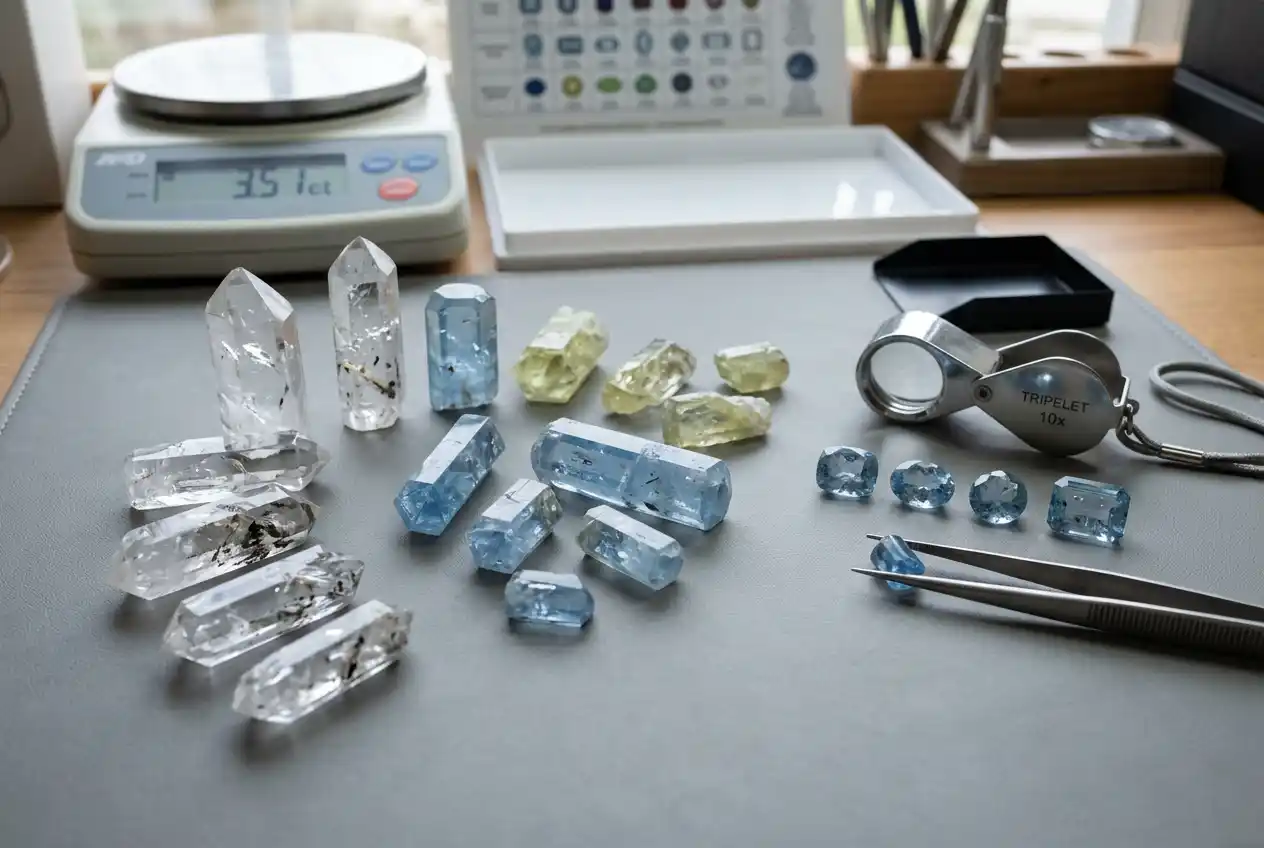
Jeremejevite quality grading should begin by distinguishing transparent gem quality from specimen quality because the rare mineral can be valuable in two very different forms. Fine faceted jeremejevite needs clean transparency, attractive blue or other desirable natural color, efficient cutting, useful carat weight, and sound structural condition. Exceptional natural crystals are judged differently, with crystal completeness, termination, transparency, color, damage, associated minerals, and documented locality becoming just as important as whether the specimen could ever be faceted.
Jeremejevite is a rare aluminum borate containing fluorine and hydroxyl, commonly represented as Al₆B₅O₁₅(F,OH)₃. It occurs in colorless, pale yellow, yellowish, pale blue, and blue crystals, with transparent blue examples particularly prized in the gem market. The mineral was first recognized in Russia, while later Namibian discoveries supplied many of the crystals that established jeremejevite as both a collector gemstone and a coveted mineral specimen.
There is no universal AAA or AAAA grading scale for jeremejevite. Its supply is too limited and its forms too diverse for simplistic commercial labels to explain quality reliably. A meaningful grade should describe natural identity, transparency, color, clarity, size, cut or crystal form, structural condition, provenance, and documentation directly so that a faceted gem is not confused with a specimen being valued for completely different reasons.
8 Key Signs of Exceptional Jeremejevite Crystals
- Verified natural jeremejevite identity
- High transparency and clean internal appearance
- Attractive blue or other desirable natural color
- Strong clarity with limited distracting fractures or inclusions
- Rare size within transparent gem or crystal quality
- Fine cut quality or exceptional natural crystal form
- Excellent structural condition with minimal chips, repairs, or damage
- Credible provenance, documentation, and overall collector rarity
These eight signs provide a practical framework that works for both faceted gemstones and natural crystals without forcing them into one artificial standard. A transparent crystal with sharp termination can be exceptional even if it remains uncut, while a faceted stone can be outstanding because the cutter preserved clarity, size, and blue color from rough that had little specimen value.
Natural Identity Must Be Established Before Quality Is Assigned
Rare mineral names carry significant premiums, making accurate identification essential. Pale blue jeremejevite can resemble aquamarine, tourmaline, topaz, sapphire, and glass, while colorless crystals can overlap visually with quartz, beryl, topaz, and numerous other transparent minerals.
Professional testing can examine refractive index, birefringence, specific gravity, optic character, spectroscopy, inclusions, and other diagnostic properties. These observations are more reliable than judging a crystal solely by habit or color, particularly when a cut gemstone no longer displays its original natural form.
For expensive faceted stones and exceptional specimens, laboratory documentation is valuable because the rarity premium depends fundamentally on correct mineral identity. A beautiful pale blue stone can still be valuable if it belongs to another species, but it should not receive jeremejevite-level scarcity pricing unless the identification is secure.
Transparency Is One of the Strongest Quality Separators
Transparent jeremejevite is substantially more desirable for faceting than cloudy or strongly included material because light needs to pass through the crystal cleanly enough to reveal brilliance and body color. Fine stones should look open and luminous rather than hazy.
Natural crystals also benefit from transparency, but specimen grading allows a wider range of internal features. A sharp complete crystal with attractive internal zoning or inclusions can remain highly collectible even if it would not produce an eye-clean gemstone.
The highest-grade pieces combine transparency with enough structural integrity to survive cutting or handling. A crystal that looks transparent but contains major hidden fractures may have less gem potential than its surface appearance suggests.
This distinction is especially important at larger sizes because finding substantial transparent crystal without damaging internal breaks is much more difficult than finding small clean fragments.
Blue Color Adds a Major Gemological Premium
Jeremejevite can be colorless or yellowish, but blue is the color most strongly associated with high-value faceted material. Fine blue should look clear and attractive rather than gray or muddy, and it should remain visible under neutral lighting rather than appearing only in one carefully selected environment.
Pale sky blue can grade very highly when transparency and brilliance are exceptional, while medium blue may receive a stronger color premium when brightness remains intact. The ideal balance therefore depends on the complete gemstone rather than maximum saturation alone.
Natural crystals follow a slightly different rule because unusual color can combine with excellent crystal form to create collector interest. A colorless or pale yellow crystal with extraordinary termination and provenance can be more important mineralogically than a damaged blue crystal.
Color should therefore be interpreted according to whether the object is being graded mainly as a gemstone or as a specimen.
Clarity Requires Attention to Both Beauty and Structure
In faceted jeremejevite, fine clarity means inclusions do not interfere significantly with transparency or face-up brilliance. Small internal features visible only under magnification may be acceptable, especially in multi-carat stones, while central clouds, reflective fractures, or dark inclusions lower quality more strongly.
Natural crystals may contain growth features, internal veils, or mineral inclusions that contribute to scientific interest. The important distinction is whether those features are natural and aesthetically compatible with the specimen or whether they weaken the structure severely.
Surface-reaching fractures deserve careful attention in both categories. A gemstone with a crack reaching the girdle may be difficult to set safely, while a specimen with a fracture crossing the termination may be vulnerable to future damage.
High quality therefore combines optical cleanliness with sound physical integrity rather than treating clarity as a purely visual measure.
A Practical Jeremejevite Clarity Framework
| Face-Up or Crystal Appearance | Practical Quality Interpretation |
|---|---|
| Transparent and eye-clean | Exceptional faceted-gem quality |
| Transparent with minor inclusions | Fine |
| Good transparency with visible but limited inclusions | Good |
| Translucent or noticeably fractured | Commercial gem or specimen quality |
| Major breaks, heavy clouding, or repaired damage | Lower gem quality, specimen value depends on rarity |
This framework is descriptive rather than standardized. Its purpose is to distinguish rare transparent faceting quality from crystals that may still be collectible for form, locality, or scientific importance even when they would not produce top-grade gemstones.
Larger Transparent Crystals Receive a Strong Rarity Premium
Small transparent fragments can occasionally yield faceted stones, but finding enough clean crystal for a large finished gem is substantially more difficult. Each increase in size raises the chance that fractures, cloudy zones, color irregularities, or unsuitable shape will reduce cutting yield.
A larger transparent crystal can therefore command a disproportionate premium when it also has strong color and good condition. This applies both to rough and to finished gems because the cutter may need to remove a significant part of the original crystal to avoid internal defects.
Specimen collectors apply a related principle. A large crystal with sharp natural faces and complete termination becomes especially desirable because crystal size, clarity, and lack of damage rarely survive together.
The grade should still remain quality-driven. A large broken or cloudy specimen does not automatically outrank a smaller but exceptionally complete crystal.
Cut Quality and Natural Crystal Form Need Separate Standards
Faceted jeremejevite should be evaluated for proportions, symmetry, polish, brilliance, face-up spread, and efficient use of scarce rough. Windowing lowers quality because a shallow center allows the observer to see through the stone, while excessive depth preserves weight but reduces visible size.
Minor asymmetry can be understandable when the cutter is preserving rare clean areas or avoiding a major fracture. Precision remains valuable, but cutting decisions need to reflect the extraordinary scarcity of the rough rather than follow a rigid diamond-like model.
Natural crystals require a completely different standard. Sharp prism faces, clean terminations, natural luster, attractive proportions, minimal contact damage, and visible crystal habit can make a specimen exceptional even though none of those characteristics matter once the stone is faceted.
A crystal should not be cut automatically simply because it is transparent. Fine natural form can be rarer than the faceted gemstone that would result.
Structural Condition Is Critical in a Rare Mineral
Damage carries an unusually strong penalty in jeremejevite because replacement pieces of similar quality are difficult to find. In faceted gems, chips, abraded edges, open fractures, or repair work reduce both appearance and durability.
Natural crystals should be examined for broken terminations, restored tips, glued sections, contact marks, and concealed repairs. Minor contact points can be normal in mineral specimens, but a repaired termination should not be represented as completely natural.
Condition grading must also consider future stability. Internal fractures that appear harmless may reach surfaces or exposed edges, creating greater risk during setting or handling.
The finest pieces therefore combine rarity with preservation. A well-kept gem or crystal allows the buyer to appreciate the mineral in a form close to its best natural or lapidary potential.
Provenance Strengthens Exceptional Jeremejevite
Because jeremejevite is rare and strongly associated with a small number of famous occurrences, provenance can contribute significantly to collector quality. Russian discovery history and later Namibian production give certain specimens an identifiable place in mineralogical history.
Old labels, reliable collection records, dealer documentation, and laboratory reports can strengthen confidence in locality and identity. Provenance is especially useful for natural crystals because specimen value often depends partly on the deposit and period from which they were recovered.
A locality name should not replace physical grading. A heavily damaged specimen from a famous mine can still be less desirable than a flawless crystal from another source, but documented origin adds another layer of rarity when the piece is already exceptional.
Jeremejevite Crystal Quality Versus Faceted Gem Quality
The highest-quality natural crystal and the highest-quality cut stone are not necessarily the same object. A complete transparent prism with sharp termination may be worth more to mineral collectors if left intact, while irregular transparent rough with damaged surfaces may be better suited to faceting.
The faceted gem is judged primarily by color, transparency, clarity, cutting, weight, and condition. The crystal specimen is judged by those features plus natural morphology, termination, surface quality, associations, and locality.
Understanding this distinction prevents one of the most common mistakes in rare-mineral valuation: assuming that cutting always adds value. In jeremejevite, preserving an exceptional natural crystal can be the more valuable decision.
Common Jeremejevite Grading Mistakes
A common mistake is assuming that every jeremejevite deserves exceptional pricing simply because the species is rare. Mineral rarity creates the opportunity for value, but transparent quality, attractive color, size, and condition determine whether an individual piece belongs at the high end of the market.
Another mistake is judging only color. Blue is desirable, but a cloudy fractured blue gem can grade below a colorless stone with exceptional transparency and cutting. Size can also mislead when a large crystal contains little usable transparent volume.
The final mistake is ignoring specimen value. Cutting a complete crystal can destroy natural features that collectors consider irreplaceable, so the highest quality assessment should consider the form in which the mineral is most exceptional before any irreversible decision is made.
Conclusion
Jeremejevite quality grading should evaluate natural identity, transparency, color, clarity, size, cut or crystal form, structural condition, provenance, and documentation together. Fine faceted stones combine clean transparency with attractive blue color, useful size, good proportions, and excellent condition, while exceptional natural crystals may achieve equally high status through completeness, termination, luster, rarity, and documented origin.
The mineral’s scarcity should not be confused with automatic quality. Exceptional jeremejevite is rare because several difficult characteristics occur at the same time. When a piece is transparent, attractively colored, structurally sound, unusually large, and either precision cut or naturally well formed, it represents one of the most distinctive categories in the rare-gem and mineral-collector market.
FAQs About Jeremejevite Quality Grading
What is the most important factor in jeremejevite quality?
Transparency is one of the strongest quality separators because truly clean facetable jeremejevite is extremely scarce. Color, clarity, size, condition, and cut then determine how exceptional a transparent stone becomes, while natural crystals also need to be judged for completeness and termination.
What color jeremejevite is considered best?
Transparent blue generally receives the strongest faceted-gem demand, especially when the color remains luminous rather than gray or overly dark. Colorless and pale yellow crystals can still be exceptional mineral specimens when size, form, condition, and provenance are outstanding.
Should fine jeremejevite be eye-clean?
Eye-clean clarity is highly desirable in faceted stones, but minor inclusions can be acceptable in larger gems because transparent rough is so scarce. Fractures that affect durability carry a stronger penalty than tiny inclusions visible only under magnification.
Does a larger jeremejevite automatically receive a higher grade?
No. Larger transparent stones receive a strong rarity premium only when color, clarity, structural condition, and cutting remain fine. A smaller clean blue gem can grade above a much larger cloudy or heavily fractured stone.
Is natural crystal form important?
Yes, especially for mineral specimens. Sharp faces, complete termination, transparency, natural luster, and minimal damage can make an intact crystal more valuable than the faceted gem it might produce.
Is Namibian jeremejevite considered high quality?
Namibia is famous for producing important transparent and blue jeremejevite, and documented provenance can add collector appeal. Individual quality still depends on transparency, color, size, condition, and crystal form rather than locality alone.
Does jeremejevite need laboratory identification?
Laboratory confirmation is strongly useful for valuable faceted gems and exceptional crystals because natural identity is the foundation of the rarity premium. Similar-looking pale blue or colorless minerals can otherwise be confused visually.
Are AAA jeremejevite grades standardized?
No. AAA, premium, investment grade, and similar terms are not universal standards. A reliable assessment should describe identity, transparency, color, clarity, size, condition, cutting or crystal form, and provenance directly.
What makes a jeremejevite crystal exceptional?
An exceptional jeremejevite crystal combines verified natural identity, strong transparency, attractive natural color, significant size, sharp natural form, excellent termination, minimal damage, credible provenance, and strong overall aesthetics. If the piece is faceted instead, precision cutting and face-up performance replace crystal morphology as the main craftsmanship criteria.