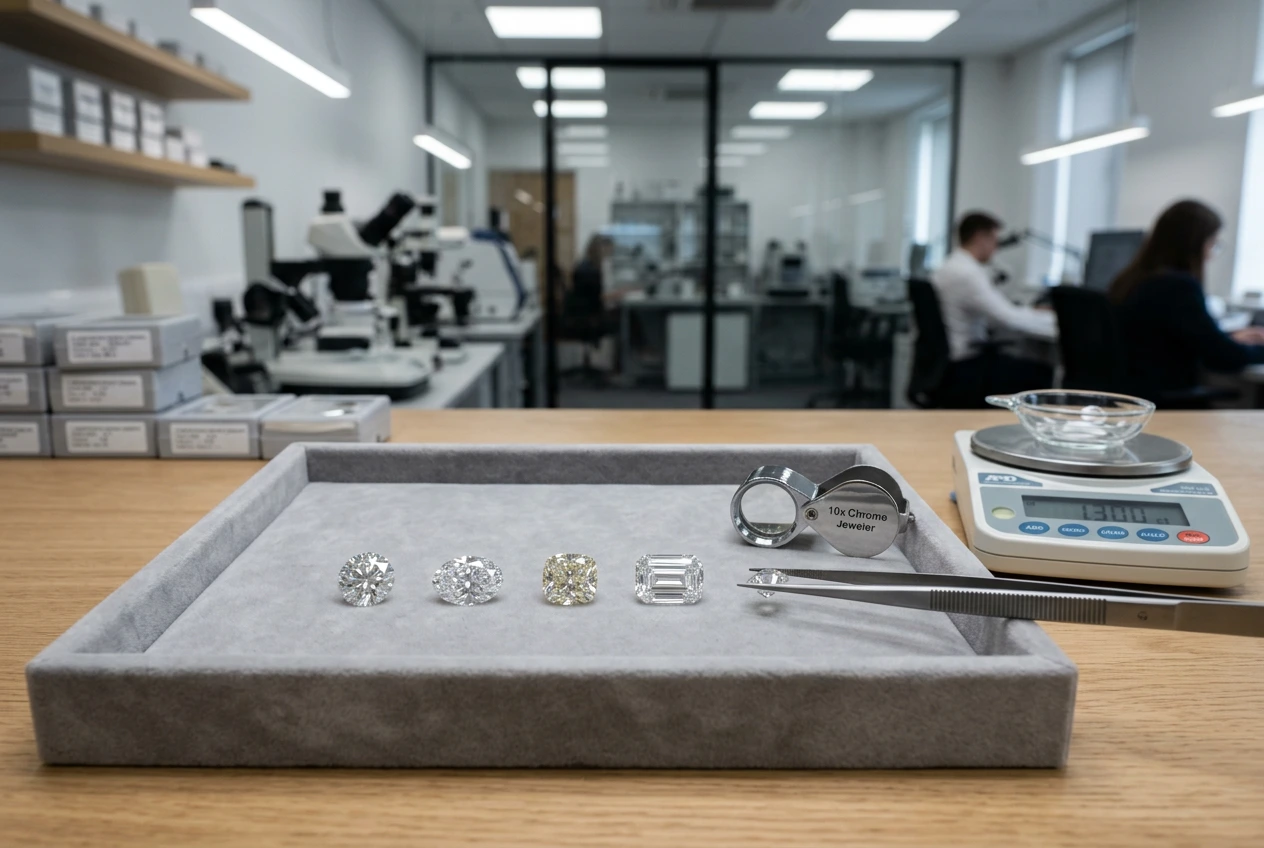
Lab Diamond Quality Grading: 9 Key Standards for Cut & Clarity
Lab diamond quality grading uses many of the same fundamental standards applied to natural diamonds because laboratory-grown diamonds share the same diamond crystal structure and can be evaluated for cut, color, clarity, and carat weight. High quality is not determined by whether the stone was grown by HPHT or CVD alone. A well-grown diamond can still look ordinary after poor cutting, while a lower-color stone with excellent proportions can appear much brighter and more attractive than a higher-color diamond whose cut leaks light.
The first grading task is to establish that the stone is laboratory-grown diamond and identify any relevant growth or post-growth characteristics. Once identity is confirmed, cut quality, color, clarity, dimensions, polish, symmetry, fluorescence or other optical behavior, growth method, post-growth treatment, and documentation can be evaluated in a consistent sequence. Laboratory-grown diamonds can receive very high grades, but the grade still describes the individual finished stone rather than the manufacturing technology in general.
There is also an important difference between laboratory grading and retail language. Terms such as premium, super ideal, hearts and arrows, investment grade, or luxury lab diamond may be used commercially, but they are not substitutes for measurable proportions and visual performance. A useful quality assessment should explain exactly how the stone performs and what its report records instead of relying on promotional wording.
9 Key Standards for Lab Diamond Quality Grading
- Confirm laboratory-grown diamond identity
- Evaluate cut proportions and overall light performance
- Grade body color
- Assess clarity and inclusion visibility
- Measure carat weight and face-up dimensions
- Evaluate polish and surface finish
- Judge symmetry and facet alignment
- Assess fluorescence, phosphorescence, transparency, and growth-related visual effects
- Review HPHT or CVD origin, post-growth treatment, grading report, inscription, and condition
These nine standards provide a complete framework without treating one certificate grade as the entire quality story. Fine laboratory-grown diamonds combine strong light return, attractive face-up color, appropriate clarity, efficient spread, crisp finishing, and reliable documentation. A stone that looks excellent should perform well across several of these characteristics rather than relying on a high color or clarity grade while ignoring cut.
Laboratory-Grown Diamond Identity Comes Before the 4Cs
Laboratory-grown diamonds are not cubic zirconia, moissanite, glass, or another diamond simulant. They are diamond crystals produced through controlled growth rather than geological formation, which means many conventional diamond tests identify them correctly as diamond.
Separating lab-grown from natural diamond requires specialized examination because both share many basic properties. Professional laboratories may use growth structures, fluorescence patterns, spectroscopy, trace defects, phosphorescence, inclusions, and advanced imaging to establish origin.
HPHT-grown diamonds can show metallic inclusions or distinctive growth zoning, while CVD stones may display layered growth structures, strain patterns, or other diagnostic characteristics. These features are not necessarily defects visible during normal wear, but they can provide evidence of origin.
A complete grade therefore begins with correct identification and only then moves into the familiar cut, color, clarity, and carat categories.
Cut Quality Determines How Much Beauty the Diamond Delivers
Cut should not be confused with shape. Round, oval, cushion, pear, emerald, radiant, and marquise describe outline and faceting style, while cut quality describes how effectively the chosen proportions and workmanship create brightness, fire, scintillation, and balanced contrast.
For round brilliants, pavilion angle, crown angle, table size, total depth, girdle thickness, symmetry, polish, and facet relationships can be assessed through well-established proportion systems. Small changes in these variables can alter how much light returns through the crown.
Fancy shapes require more visual judgment because their proportion standards are less uniform. Oval and pear diamonds can show bow-tie effects, while emerald cuts can reveal windowing or excessive darkness through broad step facets. Cushion and radiant cuts vary widely in facet pattern, producing dramatically different face-up appearances even when certificates look similar.
A high-quality lab diamond should therefore be examined for actual light performance rather than assuming that a high color and clarity grade guarantees brilliance.
Color Is Graded the Same Way as White Natural Diamond
Colorless to light-yellow or brown laboratory-grown diamonds can be graded using the familiar D-to-Z system. D represents the colorless end, while increasing letters indicate progressively more visible body color.
Higher color grades generally receive stronger market preference, but the difference between adjacent grades can be subtle. A G or H diamond can appear very white in normal jewelry, particularly when the cut is strong, while a D or E stone may cost more without creating an equally large visual difference.
Fancy shapes can reveal color more readily because their facet patterns concentrate body color differently. Larger stones can also make warmth easier to detect because light travels through more diamond.
The ideal grade therefore depends on the shape, setting, and buyer’s sensitivity to color rather than on the assumption that D is automatically necessary for high quality.
Clarity Grading Should Focus on Visibility and Placement
Clarity grades describe inclusions and blemishes observed under standardized magnification. Laboratory-grown diamonds can contain growth-related inclusions, metallic remnants, graphite-like features, clouds, pinpoints, graining, feathers, or other structures depending on growth conditions.
A very high clarity grade indicates fewer or less noticeable inclusions, but face-up beauty depends strongly on whether those features can actually be seen during normal wear. A VS diamond may look completely clean without magnification, while paying for VVS or internally flawless clarity can provide limited visible benefit.
Inclusion placement matters. A dark feature beneath the center of the table is more noticeable than a similar inclusion near the edge where reflections or a setting may disguise it.
Structural significance also matters. Certain feathers or surface-reaching features deserve more attention than harmless internal pinpoints because they may influence durability or setting considerations.
Carat Weight Should Always Be Read With Measurements
Carat weight describes mass, not visible diameter. Two diamonds weighing exactly two carats can have different face-up dimensions because one is deeper or because their shapes distribute weight differently.
A well-proportioned diamond should carry enough depth for light performance without hiding excessive weight below the girdle. Comparing length, width, total depth, and millimeter spread allows buyers to understand whether the stone looks appropriately large for its carat weight.
Fancy shapes complicate this comparison because elongated ovals and marquises can appear larger than compact cushions at equal weight. Emerald cuts can also distribute weight differently depending on length-to-width ratio and pavilion construction.
Quality grading should therefore consider whether the proportions use carat weight efficiently instead of rewarding weight alone.
Polish Controls the Quality of Individual Facet Surfaces
Polish describes how smoothly the facets were finished during cutting. Fine polish allows reflections to remain crisp, while polishing lines, burns, abrasions, pits, or other surface features can reduce optical sharpness.
In ordinary jewelry viewing, the difference between high polish grades can be subtle, but poor polish can become obvious under magnification and may reduce the performance of otherwise strong proportions.
A premium laboratory-grown diamond should generally have finishing consistent with its overall quality level. Paying for exceptional color and clarity makes little sense if surface finishing is noticeably weaker.
Polish should therefore be considered together with cut and symmetry rather than treated as an isolated technical detail.
Symmetry Determines How Precisely the Facets Work Together
Symmetry refers to the alignment, size, shape, and placement of facets relative to one another. Problems can include an off-center table, uneven girdle, misaligned facets, irregular outlines, or distorted facet relationships.
Strong symmetry supports balanced light return because corresponding facets interact more predictably. In round brilliants, precise optical symmetry can produce distinctive patterns such as hearts-and-arrows effects when proportions and facet alignment are suitable.
A hearts-and-arrows appearance should not be treated automatically as proof of the best diamond, however. Overall light performance, color, clarity, spread, and visual preference still matter.
Fancy shapes require a more flexible symmetry judgment because slight differences may be acceptable when the overall outline remains attractive and the stone performs well.
Fluorescence, Phosphorescence, and Growth Features Need Visual Evaluation
Some laboratory-grown diamonds respond strongly to ultraviolet light, and HPHT or CVD stones can display fluorescence or phosphorescence patterns related to crystal defects and impurities. These reactions can help laboratories identify growth origin, but they do not automatically make a diamond poor quality.
The practical question is whether any growth-related effect influences normal appearance. Strong strain can occasionally create haziness, graining, or unusual transparency, while certain diamonds remain perfectly attractive despite distinctive laboratory reactions.
Phosphorescence, which is continued emission after the light source is removed, can occur in some lab-grown diamonds and may be noticeable in particular lighting environments. For most jewelry buyers, however, normal face-up transparency and brilliance matter more than the technical presence of fluorescence or phosphorescence.
A quality assessment should therefore distinguish diagnostic laboratory behavior from visible defects that actually reduce beauty.
HPHT and CVD Diamonds Can Both Receive Excellent Grades
HPHT and CVD describe growth methods rather than fixed quality categories. HPHT growth uses high pressure and temperature to crystallize diamond around a seed, while CVD growth deposits carbon from a gas phase onto a diamond substrate under controlled low-pressure conditions.
Both methods can produce colorless, high-clarity diamond suitable for precision cutting. Both can also produce stones with visible growth features or color issues if the growth conditions are less favorable.
Post-growth treatment is relatively common in some parts of the lab-grown market, especially when HPHT processing is used to improve the color of certain CVD diamonds. The existence of treatment should be disclosed when detected, but the stone’s final beauty still depends on the same practical characteristics of cut, color, clarity, and transparency.
Choosing between CVD and HPHT should therefore be secondary to evaluating the actual diamond and its grading report.
A Practical Lab Diamond Quality Framework
| Quality Level | Typical Characteristics |
|---|---|
| Exceptional | Excellent light performance, high color, high clarity, strong spread, precise polish and symmetry |
| Fine | Excellent or very good cut, near-colorless appearance, eye-clean clarity, good proportions |
| Good | Attractive cut, minor visible warmth or inclusions, competent finishing |
| Commercial | Weaker proportions, noticeable color or inclusions, ordinary polish or symmetry |
| Lower quality | Poor light return, obvious inclusions, haziness, weak proportions, significant damage |
This framework is descriptive rather than a replacement for laboratory grading. It emphasizes that overall quality comes from the combination of characteristics rather than one isolated letter or number.
Grading Reports and Laser Inscriptions Strengthen Buyer Confidence
A reputable grading report can document whether the diamond is laboratory grown and record its major quality characteristics. Depending on the issuing laboratory, the report may include shape, carat weight, measurements, color, clarity, cut information, polish, symmetry, fluorescence, growth method, treatment information, and identifying comments.
Many lab-grown diamonds are laser inscribed on the girdle with a report number or laboratory-grown designation. The inscription is microscopic and normally invisible during wear, but it helps match the stone to documentation.
A report should still be read critically. Two diamonds with identical grades can have different face-up performance, especially among fancy shapes, so documentation works best when combined with direct visual comparison.
Condition Matters Even When the Diamond Was Perfectly Graded Originally
Diamond is the hardest natural or laboratory-grown gem material on the Mohs scale, but hardness refers to scratch resistance rather than complete immunity from damage. Diamonds have cleavage and can chip if struck in certain directions.
A pre-owned lab diamond should therefore be examined for girdle chips, facet abrasions, damaged points, scratches on mounting surfaces, or setting-related wear. These problems can reduce current quality even when an older grading report recorded excellent condition.
Cleaning can usually be more robust than for softer gemstones, but jewelry settings and any filled fractures or unusual treatments still need appropriate care. A gemstone’s present condition should always be evaluated rather than assuming the original certificate describes every aspect of the stone forever.
Conclusion
Lab diamond quality grading should evaluate identity, cut, color, clarity, carat weight, measurements, polish, symmetry, fluorescence or other growth-related optical features, growth method, treatment, documentation, and present condition together. Laboratory-grown diamonds can achieve extremely high gemological grades, but a high certificate grade does not automatically guarantee the most attractive face-up performance.
The strongest buying decisions usually begin with cut and visual appearance. A diamond with excellent light return, appealing color, eye-clean clarity, efficient spread, and reliable documentation can provide outstanding quality without requiring the highest possible color or clarity grade. HPHT and CVD growth methods should be understood as origins of production rather than simple rankings of gemstone quality.
FAQs About Lab Diamond Quality Grading
Are lab diamonds graded like natural diamonds?
Yes. Laboratory-grown diamonds can be graded for cut, color, clarity, and carat weight using many of the same scales applied to natural diamonds. Their reports also identify them as laboratory grown and may include information about growth method or post-growth treatment.
What is the most important quality factor in a lab diamond?
Cut is usually the strongest visible factor because it controls brightness, fire, scintillation, and overall light return. A superbly cut diamond can appear more attractive than a higher-color or higher-clarity stone with mediocre proportions.
What clarity grade is considered high quality?
VVS grades are very high clarity, but many VS diamonds appear completely eye-clean and can offer excellent visual quality. The best choice depends on inclusion type, placement, stone size, and shape rather than the letter grade alone.
What color grade is considered good for a lab diamond?
D through F are colorless grades, while G through J are commonly described as near-colorless. Many buyers find near-colorless stones very white face-up, particularly when the cut is strong and the setting is chosen appropriately.
Is CVD better quality than HPHT?
No. Both CVD and HPHT can produce exceptional or lower-quality diamonds. The finished stone should be judged through cut, color, clarity, transparency, carat weight, treatment, and overall appearance rather than growth method alone.
Can lab diamonds be treated after growth?
Yes. Some laboratory-grown diamonds receive post-growth treatment to improve color or create fancy colors. Treatment should be disclosed when identified, but the diamond remains laboratory-grown diamond rather than becoming a simulant.
Does fluorescence reduce lab diamond quality?
Not automatically. Fluorescence and phosphorescence can be useful diagnostic characteristics and may have little effect on normal appearance. Quality is affected more when a growth-related feature produces visible haze, unusual transparency, or another distracting optical effect.
Does carat weight determine quality?
No. Carat measures weight rather than beauty. A smaller well-cut diamond with efficient face-up dimensions can look larger and brighter than a heavier stone whose depth hides weight and reduces light return.
Are lab diamond reports important?
Yes. A reputable grading report helps confirm laboratory-grown identity and records important specifications such as carat weight, color, clarity, measurements, polish, symmetry, and other characteristics. It is most useful when combined with visual inspection rather than treated as the entire quality assessment.
What makes a lab diamond exceptional?
An exceptional lab-grown diamond combines verified identity, excellent light performance, high-quality cutting, attractive color, strong clarity, efficient dimensions, precise polish and symmetry, clean transparency, sound condition, and reliable grading documentation.