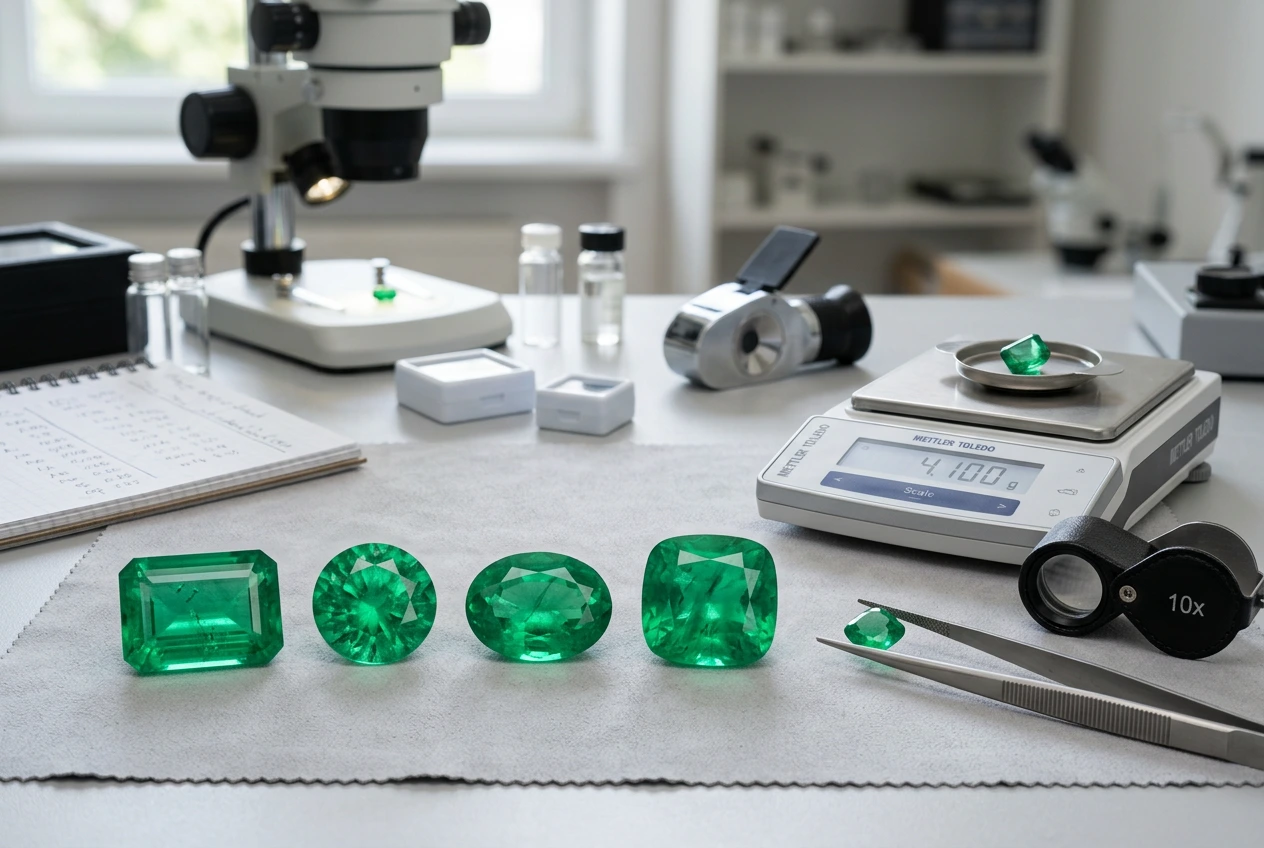
Lab Emerald Price Per Carat: 8 Value & Cost Factors Explained
Lab emerald price per carat is usually far lower than the Price of comparable fine natural emerald because laboratory growth can produce additional gem-quality crystals without depending on rare geological deposits. Commercial synthetic emerald may sell for roughly $20 to $100 per carat, while attractive jewelry-quality stones with strong green color, good transparency, and competent cutting can move into approximately $100 to $300 per carat. Fine hydrothermal or flux-grown gems with vivid color, larger clean size, strong cutting, and respected documentation can reach several hundred dollars per carat, while premium branded or highly selective stones may move higher depending on production method, retailer positioning, and craftsmanship.
A laboratory-grown emerald is synthetic emerald, meaning it has essentially the same beryl crystal structure and major chemical composition as natural emerald, Be₃Al₂Si₆O₁₈, with chromium, vanadium, or a combination of coloring elements producing the green appearance. The crucial difference is origin. Natural emerald crystallizes through geological processes, while lab emerald is grown under controlled conditions using methods such as hydrothermal growth or flux growth. It is therefore not the same as green glass, cubic zirconia, or another imitation that simply resembles emerald.
The lower Price comes primarily from supply economics rather than from the synthetic stone being chemically unrelated to emerald. Fine natural emerald owes much of its market value to geological rarity, limited yield, origin, natural inclusion patterns, and the difficulty of finding clean saturated crystals of useful size. Laboratory production reduces that rarity constraint, making strong color and high clarity available at much lower cost while preserving the optical character and durability of the beryl species.
8 Value and Cost Factors Behind Lab Emerald Price Per Carat
- Green hue, saturation, and tone
- Transparency, clarity, and inclusion appearance
- Hydrothermal versus flux growth characteristics
- Carat weight and availability of larger clean stones
- Cut quality, symmetry, polish, and face-up spread
- Post-growth treatment, fillers, or other enhancement
- Laboratory identification, documentation, and brand positioning
- Manufacturing cost, retail margin, market demand, and resale value
These eight factors explain why lab emeralds of similar weight can have noticeably different Prices even though manufacturing removes much of the scarcity premium associated with natural emerald. A richly colored hydrothermal stone with excellent proportions and attractive growth features may command more than a pale commercially cut synthetic emerald, while branding, laboratory reporting, and precision cutting can sometimes add more to the final retail Price than the crystal growth cost itself.
Typical Lab Emerald Price Per Carat
There is no universal international Price list for synthetic emerald because manufacturers use different growth technologies, production times, quality controls, cutting standards, and retail strategies. The following ranges provide broad orientation for loose laboratory-grown emeralds rather than fixed market rules.
| Lab Emerald Quality | Approximate Price Per Carat | Typical Characteristics |
|---|---|---|
| Commercial quality | $20 to $100 | Pale to medium green, ordinary cutting, visible growth features |
| Good jewelry quality | $100 to $300 | Attractive green, strong transparency, competent cut |
| Fine quality | $250 to $600 | Rich color, high transparency, fine polish, selective production |
| Premium branded or precision-cut | $500 to $1,000+ | Strong color, refined cutting, quality control, documentation |
| Specialty collector synthetic | Highly variable | Historic growth method, unusual producer, experimental or technically significant crystal |
These figures overlap because synthetic emerald is not valued through scarcity in exactly the same way as natural emerald. A stone with exceptional color may still command a premium, but a large clean lab emerald can usually be produced more predictably than a comparable natural gem, keeping the size premium much more restrained.
Green Color Drives the Strongest Visible Premium
Fine lab emerald should show an attractive green to slightly bluish-green appearance with enough saturation to look unmistakably emerald-like while remaining bright. Very pale stones may be inexpensive even when clean, while excessively dark gems can lose transparency and appear nearly black in low light.
Color is influenced by the concentrations and interactions of chromium, vanadium, and iron within the synthetic beryl structure. Different manufacturers can produce distinct shades, ranging from bright bluish green to warmer yellowish green, and some growth runs are deliberately adjusted to achieve particular market preferences.
The strongest retail demand generally favors medium to medium-dark tone with vivid saturation and limited gray or brown influence. Fine color should remain attractive under ordinary daylight-equivalent illumination rather than looking vivid only under a strongly colored display lamp.
Color uniformity also matters. Obvious zoning can reduce conventional quality when it breaks up the face, while subtle natural-looking growth variation may be visually appealing and can help the gemstone avoid looking unnaturally flat.
Clarity Standards Differ From Natural Emerald Expectations
Natural emerald is commonly included, and its familiar jardin can be tolerated even in very valuable stones because geological growth often produces fissures, crystals, and multiphase inclusions. Lab emerald can be grown much cleaner, so buyers generally expect higher transparency for the Price.
A synthetic emerald does not need to be completely flawless to be attractive. Hydrothermal and flux-grown crystals can contain characteristic growth structures, flux residues, veils, seed-related features, or other inclusions that help gemologists identify laboratory origin.
The important distinction is whether those features reduce visible beauty. A small growth inclusion near the girdle may have little effect, while a broad cloudy region beneath the table can weaken transparency and brilliance. Fine stones should remain lively face-up, with enough internal cleanliness that the green color dominates rather than the inclusions.
Hydrothermal and Flux Growth Create Different Internal Characteristics
Hydrothermal growth uses high-temperature, high-pressure water-based solutions to transport dissolved components and grow emerald on a seed crystal. The process can produce highly transparent crystals with distinctive growth zoning, seed-related structures, and inclusion patterns that trained gemologists can recognize.
Flux growth uses a molten chemical solvent that allows emerald components to crystallize gradually. Flux-grown stones can contain wispy veils, fingerprints, flux residues, or other features that may resemble some natural inclusions superficially while remaining diagnostic under careful examination.
Neither method is automatically better. A fine hydrothermal emerald can outperform a mediocre flux-grown stone, and an exceptionally colored flux-grown gem can be more desirable than a pale hydrothermal one.
Growth method can influence production time and cost, but consumers should still judge the finished gemstone according to visible color, transparency, cutting, durability, and documentation rather than assuming one laboratory process guarantees superior quality.
Larger Lab Emeralds Carry a Smaller Scarcity Premium
Natural emerald becomes increasingly expensive as size rises because large crystals with strong color and useful clarity are difficult to find and often lose substantial weight during cutting. Laboratory growth changes this relationship because larger synthetic crystals can be produced intentionally and repeatedly.
A five-carat lab emerald therefore does not carry the same nonlinear rarity premium as a five-carat fine natural emerald. Total Price still increases with weight because more crystal and cutting labor are involved, but the per-carat rate may remain relatively stable across several size categories.
Large stones can still cost more per carat when strong saturation, transparency, and excellent cutting are maintained together. A larger crystal may take longer to grow and can present greater risks of zoning, stress, or growth irregularities, so size is not completely irrelevant.
Face-up dimensions should be compared alongside weight because deep cutting can hide carats below the girdle. A slightly lighter emerald with efficient proportions can look larger and more attractive once mounted.
Cut Quality Strongly Affects Lab Emerald Appearance
The emerald cut is common because its truncated corners and step facets suit beryl’s physical properties and can create an elegant transparent appearance. Ovals, cushions, rounds, pears, and custom cuts are also possible, especially when manufacturers produce rough in shapes that allow better yield.
A high-quality cut should balance color with brightness. Excessive depth can concentrate green but hide weight, while a shallow pavilion can create windowing and allow the background to show through the center. Both problems reduce visual value even when the certificate or product description emphasizes excellent color.
Symmetry and polish also matter because clean lab-grown crystals reveal workmanship readily. Poor facet alignment, uneven girdles, polishing marks, and thick bulky proportions can make high-quality synthetic rough look ordinary.
Precision cutting can therefore account for a substantial part of retail Price. When the crystal itself is comparatively affordable, skilled lapidary work can become one of the biggest reasons one lab emerald costs more than another.
Treatment and Filling Need Clear Disclosure
One advantage of laboratory-grown emerald is that manufacturers can often produce crystals with fewer surface-reaching fractures than those found in natural emerald. This reduces the need for routine clarity enhancement, although synthetic stones can still be treated, filled, coated, or otherwise modified.
Oil or resin filling is strongly associated with natural emerald because fissures are common, but buyers should not assume every synthetic emerald is automatically untreated. If a lab-grown stone has been filled or coated, that information should be disclosed because it affects durability, care, and confidence in the purchase.
Post-growth processes can also influence color in some synthetic gems, depending on the manufacturer and growth chemistry. The final Price should therefore reflect not just the green appearance but also how that appearance was achieved and how stable it is expected to remain.
Documentation Helps Separate Synthetic Emerald From Imitations
A laboratory-grown emerald is chemically and structurally emerald, whereas green glass, synthetic spinel, green cubic zirconia, and other simulants only imitate the color or appearance. Accurate identification therefore matters when a seller charges a synthetic-emerald Price rather than an imitation-gem Price.
Professional gemological testing can use refractive index, specific gravity, spectroscopy, inclusions, growth structures, and other properties to establish laboratory-grown beryl identity. Growth features can also help distinguish hydrothermal or flux synthesis from natural formation.
A reputable report is particularly useful for larger or premium stones because it confirms that the gem is synthetic emerald rather than a lower-cost substitute. Documentation can also record treatments or other identifying characteristics when relevant.
Manufacturing Economics Control More of the Price Than Geological Rarity
The long-term Price behavior of lab emerald differs from natural emerald because manufacturers can increase production as technology improves and demand grows. Production still requires equipment, energy, chemical control, growth time, crystal selection, cutting, and quality control, but supply is not limited by the chance discovery of a geological deposit.
This means retail Prices can fall as manufacturing becomes more efficient or as competition expands. Brand reputation, cutting quality, certification, and jewelry design may therefore make up a larger share of the final Price than raw crystal rarity.
Buyers should also be realistic about resale. A pre-owned lab emerald may compete with newly manufactured stones available at current production costs, so secondary-market recovery is often limited compared with fine natural emerald. The financial appeal is primarily the ability to obtain vivid color and larger size at a lower upfront Price rather than an expectation of strong long-term resale appreciation.
Lab Emerald and Natural Emerald Share Physical Properties but Not Rarity
Both natural and laboratory-grown emerald belong to the beryl species and can display comparable hardness, refractive properties, and green coloration. Both can be cut into fine jewelry and both require sensible care because emerald has a Mohs hardness around 7.5 to 8 but can still fracture when inclusions or internal stress are present.
The economic distinction comes from origin and supply. Natural emerald represents a rare geological product whose value can be influenced strongly by mine origin, historical provenance, natural inclusions, and limited availability. Lab emerald can reproduce the crystal species under controlled conditions and therefore offers a similar visual experience without carrying the same natural rarity premium.
This difference allows a buyer to choose according to priorities. Someone seeking large vivid green appearance for jewelry may find lab emerald highly attractive, while a collector focused on geological rarity, mine origin, and natural formation may place greater value on natural emerald.
Conclusion
Lab emerald price per carat is influenced by color, clarity, hydrothermal or flux growth, carat weight, cut quality, treatment, documentation, manufacturing cost, brand positioning, and market demand. Commercial synthetic emerald can be very affordable, while premium stones with vivid green color, high transparency, fine cutting, and strong documentation can reach several hundred dollars per carat or more.
The best value comes from understanding what the Price actually represents. Laboratory growth removes much of the geological rarity premium, allowing buyers to prioritize face-up color, transparency, size, and craftsmanship instead. A well-cut lab emerald with strong green saturation and reliable identification can deliver impressive beauty at a fraction of the Price of a comparably attractive fine natural emerald, but resale expectations should remain realistic because new synthetic supply can continue entering the market.
FAQs About Lab Emerald Price Per Carat
How much does a lab emerald cost per carat?
Commercial lab emerald may sell for roughly $20 to $100 per carat, while good jewelry-quality stones can move into approximately $100 to $300 per carat. Fine or premium stones with rich color, high transparency, precision cutting, and recognized documentation can reach several hundred dollars per carat or more.
Is a lab emerald a real emerald?
A laboratory-grown emerald is synthetic emerald with essentially the same beryl crystal structure and green-color chemistry as natural emerald. Its difference is that it formed through controlled laboratory growth rather than geological processes inside the Earth.
Why are lab emeralds cheaper than natural emeralds?
Laboratory production allows additional crystals to be grown without depending on rare mineral deposits. This reduces the scarcity premium that makes fine natural emerald expensive, particularly in larger sizes and cleaner clarity grades.
Is hydrothermal emerald better than flux-grown emerald?
Not automatically. Both methods can produce attractive genuine synthetic emerald, and the better stone is the one with stronger color, transparency, cutting, and structural quality. Growth method influences inclusions and manufacturing characteristics but does not create a universal quality ranking by itself.
Does larger lab emerald cost more per carat?
Larger stones generally cost more in total, but their per-carat premium is usually much smaller than that of natural emerald. Laboratory production makes larger clean crystals more accessible, so size should be judged together with color, transparency, and cutting.
Are lab emeralds usually clearer than natural emeralds?
They often can be because laboratory conditions allow crystals to grow with fewer of the fractures and complex inclusions common in geological emerald. Fine synthetic stones are therefore generally expected to show strong transparency, although growth features can still be present.
Can lab emerald be treated?
Yes, treatments such as filling, coating, or other post-growth processes are possible even though many lab emeralds require less clarity enhancement than natural stones. Any meaningful treatment should be disclosed because it can affect value, durability, and care.
Do lab emeralds have good resale value?
Resale value is often limited because new lab emeralds can continue to be produced and manufacturing costs can change over time. Their strongest financial advantage is the lower initial Price for attractive color and size rather than an expectation of strong resale appreciation.
What makes a lab emerald expensive?
Fine color, high transparency, larger size, precision cutting, premium growth quality, reliable identification, respected branding, and strong craftsmanship can all raise The Price. In premium synthetic stones, cutting and retail positioning may contribute as much to the final cost as the grown crystal itself.