Lab Ruby Price Per Carat: 9 Major Drivers of Value & Savings
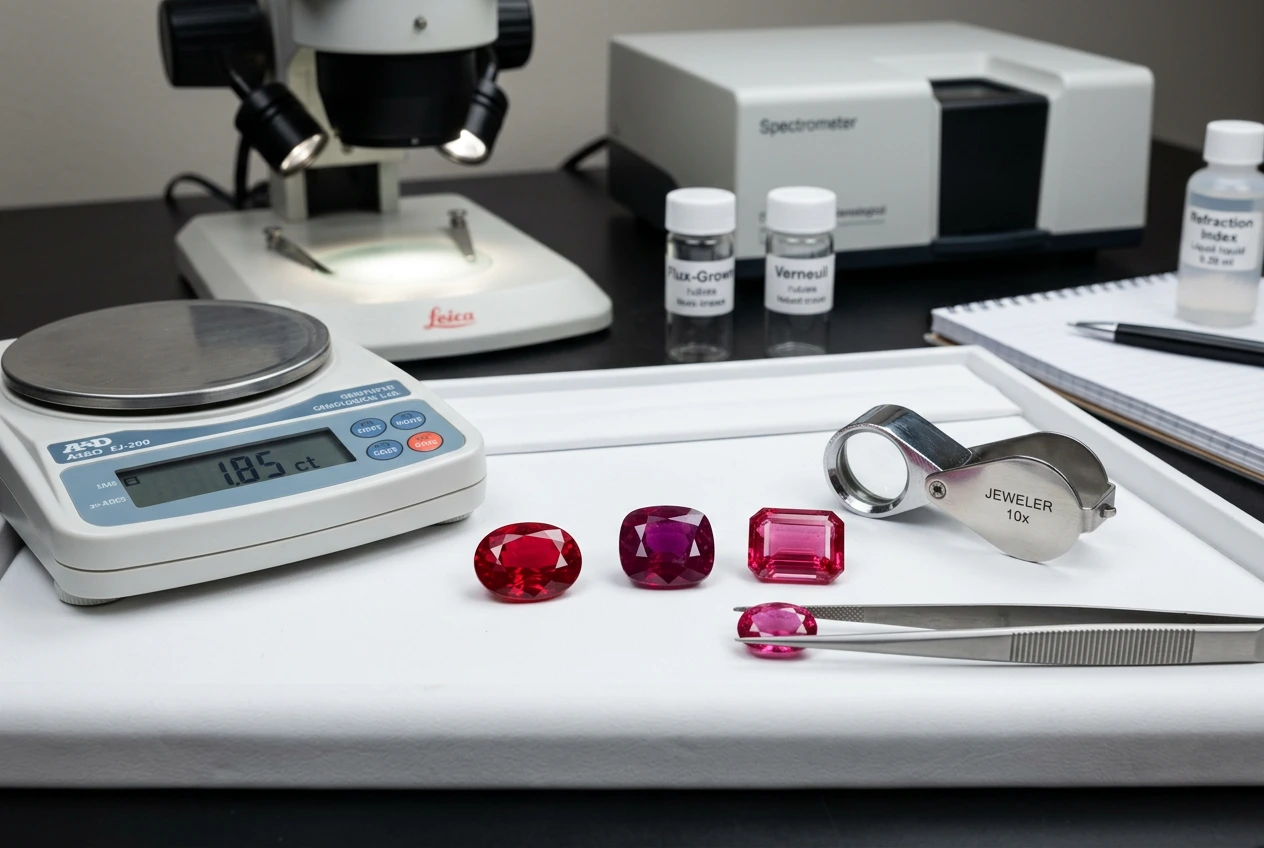
Lab ruby price per carat is usually far lower than the Price of comparable natural ruby because laboratory growth can produce additional gem-quality corundum without depending on rare geological deposits. Commercial flame-fusion ruby may cost only a few dollars to a few tens of dollars per carat, while attractive jewelry-quality synthetic ruby with stronger red color, cleaner transparency, and better cutting can move into roughly $20 to $100 per carat. Fine flux-grown, specialty-grown, branded, or precision-cut stones may reach roughly $100 to $300 per carat or more, especially when production is slow, the crystal is unusually large, or the finished gem receives premium craftsmanship and documentation.
A lab-grown ruby is synthetic ruby, meaning it is corundum, Al₂O₃, colored red primarily by chromium. Its basic crystal structure, hardness, refractive properties, and optical behavior belong to the same mineral species as natural ruby. The difference is origin. Natural ruby forms through geological processes, while synthetic ruby is grown under controlled conditions using techniques such as flame fusion, flux growth, or other crystal-growth methods. A synthetic ruby is therefore fundamentally different from red glass, red cubic zirconia, or another imitation that simply resembles ruby.
The large savings come mainly from rarity economics. Fine natural ruby is scarce because geological formation must produce strong red color, useful transparency, limited fractures, and sufficient crystal size at the same time. Laboratory production removes much of that geological scarcity and allows attractive red corundum to be made more consistently. Buyers can therefore obtain larger sizes, cleaner clarity, and stronger color for much less, but resale expectations are usually lower because additional synthetic supply can continue entering the market.
9 Major Drivers of Lab Ruby Value and Savings
- Red hue, saturation, and tone
- Transparency, clarity, and inclusion appearance
- Flame-fusion, flux-grown, or other growth method
- Carat weight and availability of larger clean stones
- Cut quality, symmetry, polish, and face-up spread
- Fluorescence and overall visual brightness
- Post-growth treatment, filling, coating, or other enhancement
- Laboratory identification, documentation, and brand positioning
- Manufacturing cost, retail margin, market demand, and resale value
These nine factors explain why synthetic rubies of equal carat weight can sell at very different Prices. A mass-produced flame-fusion stone with basic cutting may be inexpensive, while a slower-grown flux ruby with strong color, refined transparency, precision cutting, and respected documentation can command a much larger premium even though both are synthetic corundum.
Typical Lab Ruby Price Per Carat
Synthetic ruby does not have one universal Price chart because manufacturing method, growth time, cutting quality, brand, and retail positioning vary widely. The following ranges are broad orientation for loose lab-grown rubies rather than fixed valuation rules.
| Lab Ruby Quality | Approximate Price Per Carat | Typical Characteristics |
|---|---|---|
| Commercial flame-fusion quality | $5 to $25 | Strong red, mass-produced, ordinary cutting |
| Good jewelry quality | $20 to $100 | Attractive color, good transparency, competent cut |
| Fine specialty-grown quality | $75 to $200 | Better color control, high transparency, strong finish |
| Premium flux-grown or precision-cut | $150 to $300+ | Slower growth, refined clarity, premium cutting, documentation |
| Historic, branded, or collector synthetic | Highly variable | Important maker, unusual growth method, technical or historical significance |
These ranges overlap because the crystal itself may represent only part of the final retail cost. Precision cutting, jewelry design, brand reputation, laboratory documentation, and setting labor can raise the Price significantly above the manufacturing cost of the rough synthetic ruby.
Red Color Is the Strongest Visible Value Driver
Fine lab ruby should display an attractive red to slightly purplish-red body color with enough saturation to look unmistakably ruby-like while remaining bright. Very dark stones can appear nearly black under ordinary lighting, while overly pink stones may fall closer to pink sapphire terminology depending on saturation and market convention.
Chromium creates the classic red coloration and can also produce strong red fluorescence, which may make some rubies appear brighter in daylight or ultraviolet-rich environments. The most appealing synthetic rubies often combine strong saturation with enough transparency and fluorescence to create a vivid internal glow rather than a flat dark red.
Color consistency also matters. Synthetic growth can produce zoning, curved striae, or uneven chromium distribution depending on method and conditions. Subtle variation may be unobtrusive, but obvious color bands crossing the face can reduce conventional quality.
The best color should therefore look rich and balanced under neutral illumination rather than depending on one warm display lamp to appear redder than it is.
Growth Method Can Influence Cost Without Automatically Determining Quality
Flame fusion, also called the Verneuil process, is one of the oldest and most efficient ways to produce synthetic ruby. Powdered chemicals are melted in a flame and crystallized into a boule, allowing large quantities of usable red corundum to be produced economically. This efficiency explains why many flame-fusion rubies are inexpensive.
Flux growth is much slower. Corundum components dissolve in a molten flux and crystallize gradually over time, often producing stones with internal features that can resemble aspects of natural ruby more closely than flame-fusion material. Longer growth cycles, lower yields, and more complex production can make flux-grown ruby considerably more expensive.
Other techniques, including pulled-crystal and specialized industrial methods, can also produce synthetic corundum. The buyer should not assume that one method always creates a better-looking gem, because final color, clarity, cut, and condition remain more important than growth technology alone.
Clarity Standards Are Higher Than for Many Natural Rubies
Natural ruby commonly contains inclusions, silk, healed fractures, crystals, and other internal features, and fine natural stones can remain extremely valuable despite visible inclusions because clean geological ruby is scarce. Synthetic ruby can be produced much cleaner, so buyers generally expect stronger transparency at much lower Prices.
This does not mean every lab ruby should be flawless. Flame-fusion stones may show curved growth striae or gas bubbles, while flux-grown ruby can contain flux residues, veils, or other diagnostic inclusions. These features can help gemologists establish laboratory origin and may have little effect on appearance when they remain microscopic.
The quality grade should fall when inclusions create visible clouding, interrupt transparency, or weaken structural integrity. A synthetic ruby with obvious central haze has less rarity-based justification for poor clarity than a natural ruby from an important geological source.
Carat Weight Carries a Smaller Scarcity Premium Than in Natural Ruby
Large natural ruby becomes dramatically more expensive when fine color and transparency survive at higher weights because suitable geological crystals are exceptionally uncommon. Laboratory growth changes that relationship by allowing manufacturers to produce larger crystals intentionally.
A five-carat lab ruby can therefore remain affordable compared with a natural ruby of similar apparent quality. Total cost still rises because larger stones require more usable crystal and more cutting, but the per-carat increase is usually much less severe.
Size should still be judged with face-up dimensions because deep cutting can hide weight beneath the girdle. A slightly lighter ruby with efficient proportions can look larger and brighter than a heavier stone cut primarily to preserve carats.
Cut Quality Can Become One of the Biggest Retail Premiums
Synthetic ruby rough can be inexpensive enough that skilled cutting becomes a major part of the final Price. A well-proportioned stone should return light evenly while preserving strong red color and avoiding excessive extinction.
Deep stones can look dark and carry unnecessary hidden weight, while shallow stones may window and allow the background to show through the center. Both problems reduce visual quality even when the rough itself has excellent color.
Ovals and cushions are common, but rounds, pears, emerald-style cuts, and custom designs can also work well. Fine polish and crisp facet junctions are especially important because clean lab-grown corundum exposes workmanship easily.
Precision cutting can therefore justify a substantial premium even when the underlying crystal was not expensive. In premium synthetic jewelry, the lapidary work may contribute more to the retail Price than the raw lab-grown ruby.
Fluorescence Can Make a Lab Ruby Look More Vivid
Chromium-bearing ruby often fluoresces red under ultraviolet-rich light, and this effect can enhance apparent brightness in certain environments. Strong fluorescence is not automatically proof of quality, but it can contribute to the lively red appearance many buyers associate with fine ruby.
The effect varies according to chemistry and iron content. Lower iron generally allows stronger chromium fluorescence, while higher iron can suppress it. Synthetic growth conditions can be controlled in ways that produce vivid fluorescence and strong visual color.
A grader should therefore evaluate fluorescence as part of overall appearance rather than as a stand-alone Price factor. A strongly fluorescent but poorly cut ruby may still look less attractive than a better-proportioned stone with slightly weaker fluorescence.
Treatment and Filling Should Be Disclosed Separately From Synthetic Origin
Synthetic origin does not automatically mean a ruby is untreated after growth. Lab-grown corundum can still be heated, filled, coated, diffused, or otherwise modified depending on the product and manufacturer.
Fracture filling is less necessary in clean synthetic stones than in heavily fractured natural ruby, but it can still occur. Surface coating can also alter color without changing the underlying corundum, and diffusion processes can modify near-surface coloration.
These treatments should be disclosed when known because synthetic origin and treatment history answer different questions. A stone can be laboratory-grown and also post-growth treated, and buyers deserve to understand both aspects of its identity.
Documentation Helps Separate Synthetic Ruby From Simulants
Synthetic ruby and natural ruby are both corundum, whereas red glass, spinel, cubic zirconia, or other substitutes belong to different species. A trustworthy gemological report can help establish whether a stone is laboratory-grown ruby rather than a red imitation.
Gemologists use refractive index, birefringence, spectroscopy, fluorescence, microscopic inclusions, growth structures, and other observations to identify synthetic corundum. Curved striae can indicate flame-fusion growth, while flux inclusions can point toward flux synthesis.
For premium stones, documentation also supports more precise description of growth method or treatment when those features materially affect The Price.
Market Supply Explains Most of the Savings
The strongest financial advantage of lab ruby comes from repeatable production. Manufacturers can create additional synthetic corundum as technology, equipment, and demand allow, so the market is not limited to what mines happen to produce.
This expanded supply keeps the Price far below natural ruby even when the finished synthetic stone has vivid color and high clarity. Production is not free, and slower specialty growth can be expensive, but geological rarity no longer dominates the value structure.
Resale also reflects this supply. A pre-owned synthetic ruby may compete with newly produced stones available at current manufacturing costs, so secondary-market recovery is generally limited. Buyers should therefore view the savings mainly as an opportunity to obtain a larger or finer-looking ruby for jewelry rather than as a promise of long-term Price appreciation.
Lab Ruby and Natural Ruby Share Corundum Properties but Not Rarity
Both natural and laboratory-grown ruby are corundum and have a Mohs hardness of 9, making them excellent choices for rings, earrings, pendants, bracelets, and other frequently worn jewelry. Both can show strong luster, red fluorescence, and high durability when structurally sound.
Their market values diverge because origin and rarity differ. Natural ruby can carry premiums for mine origin, geological rarity, age, untreated status, natural inclusions, and historical provenance. Synthetic ruby offers similar fundamental physical properties without those geological scarcity factors.
The choice therefore depends on priorities. Buyers interested mainly in vivid red appearance, large size, and durability can obtain excellent value from lab ruby, while collectors focused on natural formation and rarity will usually prefer natural stones.
Conclusion
Lab ruby price per carat is driven by red color, clarity, growth method, carat weight, cutting, fluorescence, treatment, documentation, manufacturing cost, branding, and market demand. Mass-produced flame-fusion ruby can be extremely affordable, while premium flux-grown or precision-cut synthetic ruby can command substantially more because slower growth and craftsmanship raise production and finishing costs.
The strongest savings come from understanding where the Price premium is actually being spent. Fine color, strong transparency, precise cutting, accurate treatment disclosure, and trustworthy identification provide meaningful value, while geological rarity does not apply in the same way it does to natural ruby. Buyers should also keep resale expectations realistic because additional synthetic supply can continue entering the market.
FAQs About Lab Ruby Price Per Carat
How much does a lab ruby cost per carat?
Commercial flame-fusion ruby can cost only a few dollars to a few tens of dollars per carat, while good jewelry-quality synthetic ruby may move into roughly $20 to $100 per carat. Fine flux-grown, specialty-grown, precision-cut, or branded stones can reach roughly $100 to $300 per carat or more when growth cost and craftsmanship are substantially higher.
Is a lab ruby a real ruby?
Lab-grown ruby is synthetic ruby made of corundum and colored red primarily by chromium, so it belongs to the same mineral species as natural ruby. Its difference is origin, not basic mineral identity, which separates it from red glass or other simulants.
Why is lab ruby cheaper than natural ruby?
Laboratory production can create additional gem-quality corundum without depending on rare geological deposits. This greatly reduces the scarcity premium that drives fine natural ruby Prices, particularly in larger sizes and high clarity.
Is flux-grown ruby more valuable than flame-fusion ruby?
Flux-grown ruby is often more expensive because the growth process is slower, yields can be lower, and production is more complex. That does not mean every flux-grown stone is visually superior, because color, clarity, cut, and condition still determine the quality of the individual gem.
Does lab ruby fluoresce?
Many chromium-bearing lab rubies fluoresce strongly red under ultraviolet-rich light. Fluorescence can enhance apparent vividness in some environments, but it should be evaluated together with color, cut, and transparency rather than treated as proof of high quality by itself.
Does larger lab ruby cost much more per carat?
Larger stones usually cost more in total, but the per-carat increase is generally much smaller than in fine natural ruby because laboratory growth makes larger clean crystals more accessible. Strong color and fine cutting still create premiums at larger sizes.
Can synthetic ruby be treated after growth?
Yes. A laboratory-grown ruby can still be heated, filled, coated, diffused, or otherwise treated after growth. Synthetic origin and treatment status should therefore be disclosed separately.
Does lab ruby have good resale value?
Resale value is generally limited compared with fine natural ruby because new synthetic stones can continue to be produced. The financial advantage is primarily the lower initial Price and the ability to buy larger or cleaner red corundum for jewelry.
What makes a lab ruby expensive?
Premium synthetic ruby usually combines attractive red color, strong transparency, slower or specialty growth, larger clean size, precision cutting, fine polish, reliable identification, and respected branding or documentation. In many premium stones, craftsmanship and growth cost matter more than raw crystal scarcity.