Lab Ruby Quality Grading: 8 Key Signs of Exceptional Synthetic Gems
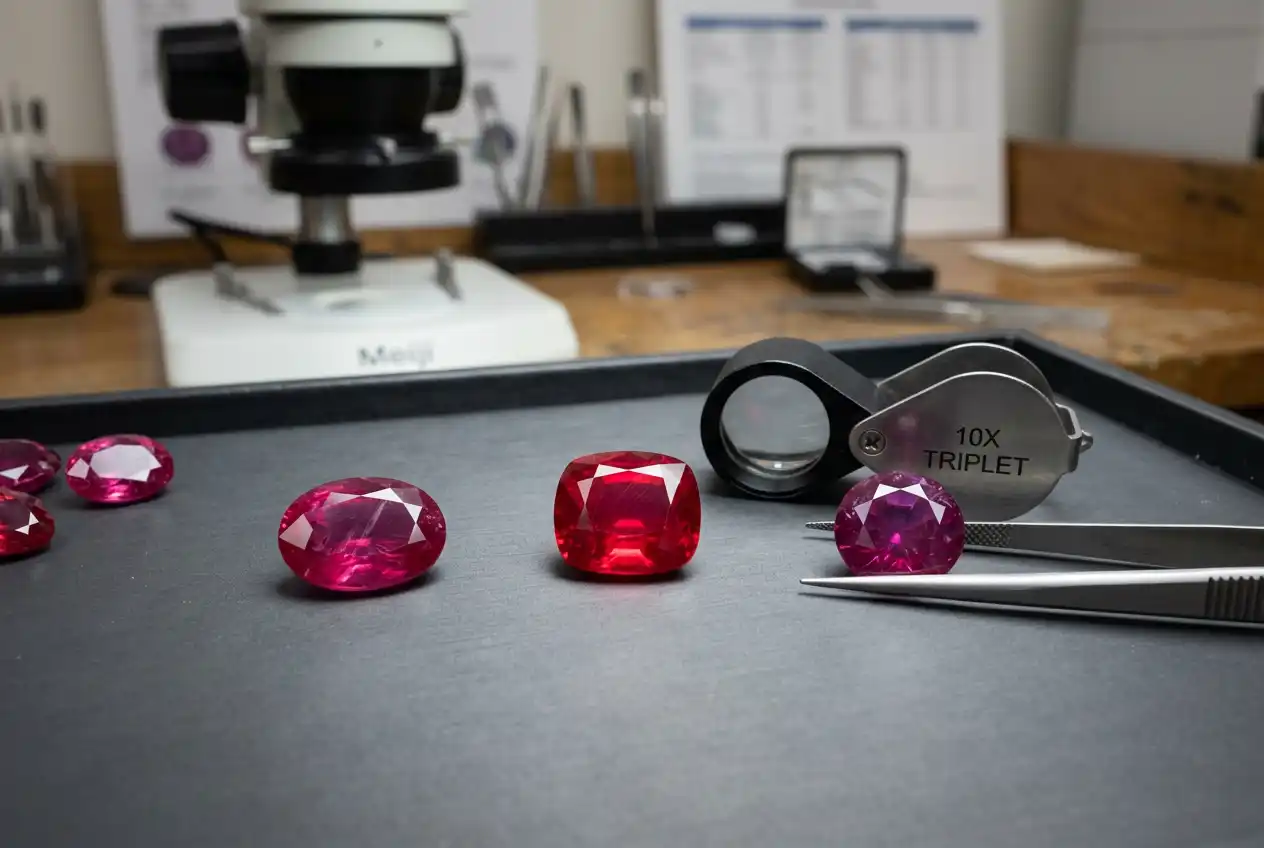
Lab ruby quality grading should focus on synthetic corundum identity, red color, transparency, growth features, cut, size, treatment, and documentation rather than judging a stone only by how flawless it appears. Fine laboratory-grown ruby should show an attractive red to slightly purplish-red face-up color, strong transparency, efficient proportions, and minimal visible growth defects. Because laboratory synthesis can create much cleaner corundum than geological formation often does, clarity expectations are generally higher than they are for natural ruby.
Lab ruby is synthetic corundum, Al₂O₃, with chromium responsible for most red coloration. It shares the same fundamental mineral species, Mohs hardness of 9, and many optical properties with natural ruby, but it forms through controlled manufacturing rather than geological processes. Flame fusion, flux growth, pulled-crystal methods, and other specialized techniques can all create synthetic corundum, and each method can leave diagnostic growth structures or inclusions.
There is no universal AAA or AAAA grading system specifically governing lab ruby. Commercial labels vary between sellers and can hide important differences in color, cutting, growth quality, or treatment. A useful grade should therefore describe the stone directly through hue, saturation, tone, transparency, inclusions, growth method, cutting, size, fluorescence, treatment, and condition.
8 Key Signs of Exceptional Lab Ruby Quality
- Confirmed laboratory-grown corundum identity
- Rich red or slightly purplish-red color
- Strong saturation with balanced tone and brightness
- High transparency with limited distracting growth features
- Fine cut quality, symmetry, polish, and light return
- Appropriate carat weight and efficient face-up dimensions
- Attractive fluorescence with stable visual appearance
- Accurate growth-method, treatment, condition, and documentation disclosure
These eight signs keep the grade focused on the finished gemstone rather than the manufacturing label alone. A flame-fusion ruby can look excellent when color and cutting are strong, while a costly flux-grown stone can still grade lower if it is dark, poorly proportioned, or heavily included. Exceptional quality comes from the total performance of the gem.
Synthetic Corundum Identity Must Be Established First
A transparent red gemstone can be natural ruby, synthetic ruby, red spinel, garnet, glass, cubic zirconia, or another imitation. The first grading step is therefore to establish that the stone is laboratory-grown corundum rather than assuming identity from red color.
Gemologists can use refractive index, birefringence, spectroscopy, fluorescence, inclusions, growth structures, and other observations to identify synthetic ruby. Flame-fusion stones may show curved striae or gas bubbles, while flux-grown material can contain flux remnants, veils, or other characteristic inclusions.
Advanced examination can also help separate synthetic ruby from natural corundum when ordinary gem properties overlap. This distinction is essential because natural and synthetic ruby can look nearly identical to an untrained observer while occupying very different rarity and Price categories.
Fine Red Color Needs Saturation Without Excessive Darkness
High-quality lab ruby should show a convincing red color rather than weak pink or overly dark maroon. Slightly purplish-red can be very attractive, while strong orange, brown, or gray modifiers generally reduce conventional quality.
Saturation should be rich enough that the gemstone remains unmistakably ruby-like in ordinary lighting. Excessive tone can make the stone look nearly black, particularly in deeper cuts, while a very light tone can move the appearance toward pink sapphire rather than ruby.
The best grading decision therefore considers hue, saturation, and tone together. A lively medium to medium-dark red often performs better visually than a heavier dark stone whose color appears strong only in transmitted light.
Color zoning should also be examined. Laboratory growth can create uneven chromium distribution or growth bands, and visible zoning across the face can lower the grade when it disrupts an otherwise even red appearance.
Fluorescence Can Enhance Ruby Color but Does Not Replace Good Tone
Chromium-bearing ruby commonly emits red fluorescence under ultraviolet-rich light. This can add apparent brightness and help the gemstone maintain a vivid red appearance in daylight.
Synthetic ruby can show particularly strong fluorescence when iron content is low, and some laboratory-grown stones display an intense glowing response. This can be visually attractive, but fluorescence should not be confused with body color itself.
A pale ruby that fluoresces strongly remains pale under lighting with little ultraviolet content, while a richly colored stone with balanced fluorescence can remain attractive across many environments.
Quality grading should therefore evaluate the body color first and then consider fluorescence as a supporting optical characteristic.
Clarity Should Be Evaluated Through Growth Features
Laboratory-grown ruby can contain features created by the synthesis process. Flame-fusion material may show curved growth lines, gas bubbles, or internal zoning, while flux-grown stones can contain flux residues, wispy veils, fingerprints, or crystal-like inclusions.
These features are not automatically low-quality defects. A microscopic curved stria or small flux inclusion may help confirm synthetic origin while having virtually no effect on beauty.
The grade should fall when growth features become obvious face-up, create clouding, interrupt transparency, or weaken structural integrity. Since very clean synthetic ruby is widely available, a heavily included lab-grown stone has less rarity-based justification for poor clarity than a natural ruby.
High transparency therefore remains one of the clearest signs of fine synthetic quality.
A Practical Lab Ruby Clarity Framework
| Face-Up Appearance | Practical Quality Interpretation |
|---|---|
| Highly transparent and eye-clean | Exceptional to fine |
| Minor diagnostic growth features under magnification | Very good |
| Small visible inclusions with limited brilliance loss | Good |
| Obvious clouding, bubbles, veils, or zoning | Commercial |
| Major fractures, severe haze, or poor structural integrity | Lower jewelry quality |
This framework is descriptive rather than a universal certification system. It recognizes that microscopic synthetic growth features can exist in excellent stones while still holding lab ruby to appropriately high transparency standards.
Cut Quality Determines Whether Red Color Looks Lively
Ruby’s high refractive index and strong luster allow properly cut stones to display attractive brightness. A well-cut lab ruby should use proportions that return light efficiently while preserving enough depth to maintain saturated red.
Shallow cutting can create a transparent window through the center, weakening color and allowing the background to show. Excessive depth can preserve carat weight but reduce face-up dimensions and create areas of dark extinction.
Ovals and cushions are common, but round, pear, radiant-style, and custom cuts can also perform well. Symmetry and polish matter because clean synthetic corundum reveals weak workmanship easily.
Precision cutting can substantially improve quality even when the original rough was inexpensive. Fine facet junctions, smooth polish, balanced contrast, and efficient dimensions can make a synthetic ruby look far more refined than a heavier mass-produced stone.
Carat Weight Should Be Judged Through Face-Up Performance
Synthetic ruby can be produced in large sizes much more reliably than natural fine ruby, so weight alone does not establish exceptional quality. A ten-carat lab ruby may be visually impressive without being extremely scarce.
The grading question is whether strong red color, high transparency, and good cutting survive at the larger size. A large stone that becomes overly dark or develops visible growth irregularities may grade lower than a smaller but more balanced gem.
Millimeter dimensions should always accompany carat weight because deep stones can hide substantial mass beneath the girdle. A well-spread four-carat ruby may appear larger than a five-carat gem with inefficient depth.
This makes size a supporting factor rather than the foundation of quality.
Growth Method Should Be Described, Not Used as an Automatic Rank
Flame fusion is efficient and economical, allowing high-quality synthetic ruby to be produced in large quantities. Flux growth is slower and often more expensive, creating different inclusion patterns and sometimes greater collector interest.
That production difference can affect retail Price, but it does not mean every flux ruby is superior to every flame-fusion ruby. A beautifully cut flame-fusion stone with ideal red color can be visually finer than a dark or included flux-grown gem.
Pulled-crystal and other specialized methods also exist, and they can produce excellent corundum. The correct grading approach is to describe the growth process when known and then judge the stone on its actual color, clarity, cut, and condition.
Treatment Status Must Be Kept Separate From Synthetic Origin
A synthetic ruby can undergo additional processes after growth. Heating, diffusion, fracture filling, coating, or other modifications may be used depending on the manufacturer and intended market.
These processes should be disclosed because they can influence color, durability, and value. A laboratory-grown origin statement alone does not reveal whether post-growth treatment has also occurred.
Fine quality is strengthened by transparent disclosure. Buyers should know both how the crystal was grown and whether later processes materially altered its appearance.
Condition and Durability Remain Important Despite Corundum Hardness
Ruby has a Mohs hardness of 9, making synthetic ruby highly suitable for rings and everyday jewelry. Hardness provides excellent scratch resistance, but no gemstone is immune to chipping or fracture.
Sharp corners, thin girdles, and existing fractures can still be damaged by hard impact. A pre-owned lab ruby should therefore be inspected for chipped facet edges, scratches, abrasions, or surface-reaching cracks.
Strong condition supports the final grade because recutting can remove weight and alter proportions even when the stone itself remains structurally recoverable.
Lab Ruby Quality Versus Natural Ruby Quality
Synthetic and natural ruby share the same corundum species, so both can be evaluated for color, clarity, cut, and condition. Their quality expectations differ because natural geological ruby is much scarcer and often more included.
A fine natural ruby can remain extraordinarily valuable with visible inclusions because the combination of natural origin, strong color, useful size, and geological rarity is difficult to replace. Synthetic ruby can be grown cleaner, so obvious inclusions deserve a stronger penalty within the lab-grown category.
This difference does not make lab ruby visually inferior. It means the two markets reward different forms of rarity. Synthetic quality emphasizes visual performance and manufacturing refinement, while natural value also includes geological scarcity, mine origin, and provenance.
Common Lab Ruby Grading Mistakes
One frequent mistake is assuming that the cleanest synthetic ruby must automatically be the finest. A nearly flawless stone can still look weak if its color is too pink, too dark, or poorly distributed, while a slightly included ruby with rich red color and excellent cutting may be much more attractive.
Another mistake is using growth method as the entire quality grade. Flux-grown stones can be costly, but growth technology does not compensate for weak color or poor cutting. Flame-fusion stones can also achieve excellent jewelry quality despite their lower production cost.
Buyers can also overpay for carat weight without checking face-up dimensions. Synthetic ruby is available in larger crystals, so inefficient cutting should not receive a large premium simply because it preserves extra weight.
Conclusion
Lab ruby quality grading should evaluate synthetic corundum identity, red hue, saturation, tone, fluorescence, transparency, growth features, cut, carat weight, growth method, treatment, condition, and documentation together. Fine stones display rich red color while remaining bright, clean, well proportioned, and free from distracting growth irregularities.
Exceptional synthetic ruby is not defined by flawless clarity or one expensive production method alone. The strongest gems combine attractive color, high transparency, skilled cutting, useful size, stable appearance, accurate treatment disclosure, and reliable identification. When those qualities work together, lab ruby can provide excellent durability and vivid red beauty at a fraction of the Price of comparable fine natural ruby.
FAQs About Lab Ruby Quality Grading
What is the most important quality factor in lab ruby?
Color is usually the strongest visible factor, but it should be judged together with transparency and cut. A richly saturated red lab ruby with strong brightness and clean proportions generally ranks higher than a technically flawless stone whose color is pale, brownish, or excessively dark.
Should high-quality lab ruby be flawless?
Not necessarily. Microscopic curved growth lines, flux remnants, or other diagnostic synthetic features can be present without reducing face-up beauty. The more important issue is whether any inclusion or growth feature creates visible haze, interrupts transparency, or affects structural integrity.
Is flux-grown ruby better than flame-fusion ruby?
Not automatically. Flux growth is slower and usually more expensive, but both methods can produce attractive synthetic ruby. Final quality depends on color, transparency, cutting, condition, and treatment rather than the manufacturing method alone.
What color is considered best in lab ruby?
Fine vivid red to slightly purplish-red is generally highly desirable when saturation remains strong and the stone does not become excessively dark. Obvious brown, gray, weak pink, or severe uneven zoning usually lowers conventional quality.
Does strong fluorescence mean higher quality?
Strong red fluorescence can enhance visual brightness, but it is only one part of the gemstone’s appearance. A poorly cut or weakly colored ruby does not become exceptional simply because it fluoresces intensely under ultraviolet light.
Does size determine lab ruby quality?
No. Laboratory growth makes large synthetic corundum much more accessible than large natural ruby, so size becomes meaningful only when strong color, clarity, cut, and condition remain fine. A smaller well-cut stone can grade higher than a much larger dark or poorly proportioned gem.
Can lab ruby be treated after growth?
Yes. Synthetic ruby can undergo heating, diffusion, filling, coating, or other post-growth processes. Treatment status should be disclosed separately from laboratory-grown origin because the two describe different aspects of the gemstone.
Are AAA lab ruby grades standardized?
No. AAA, premium, luxury, and similar commercial labels vary between sellers. A reliable quality assessment should describe identity, red color, transparency, growth features, cut, size, treatment, condition, and documentation directly.
What makes a lab ruby exceptional?
An exceptional lab ruby combines verified synthetic corundum identity, rich vivid red color, strong transparency, limited distracting growth features, precise cutting, efficient proportions, attractive fluorescence, sound condition, and accurate disclosure of growth method and treatment.