Labradorite Quality Grading: 8 Essential Steps to Rate Labradorescence
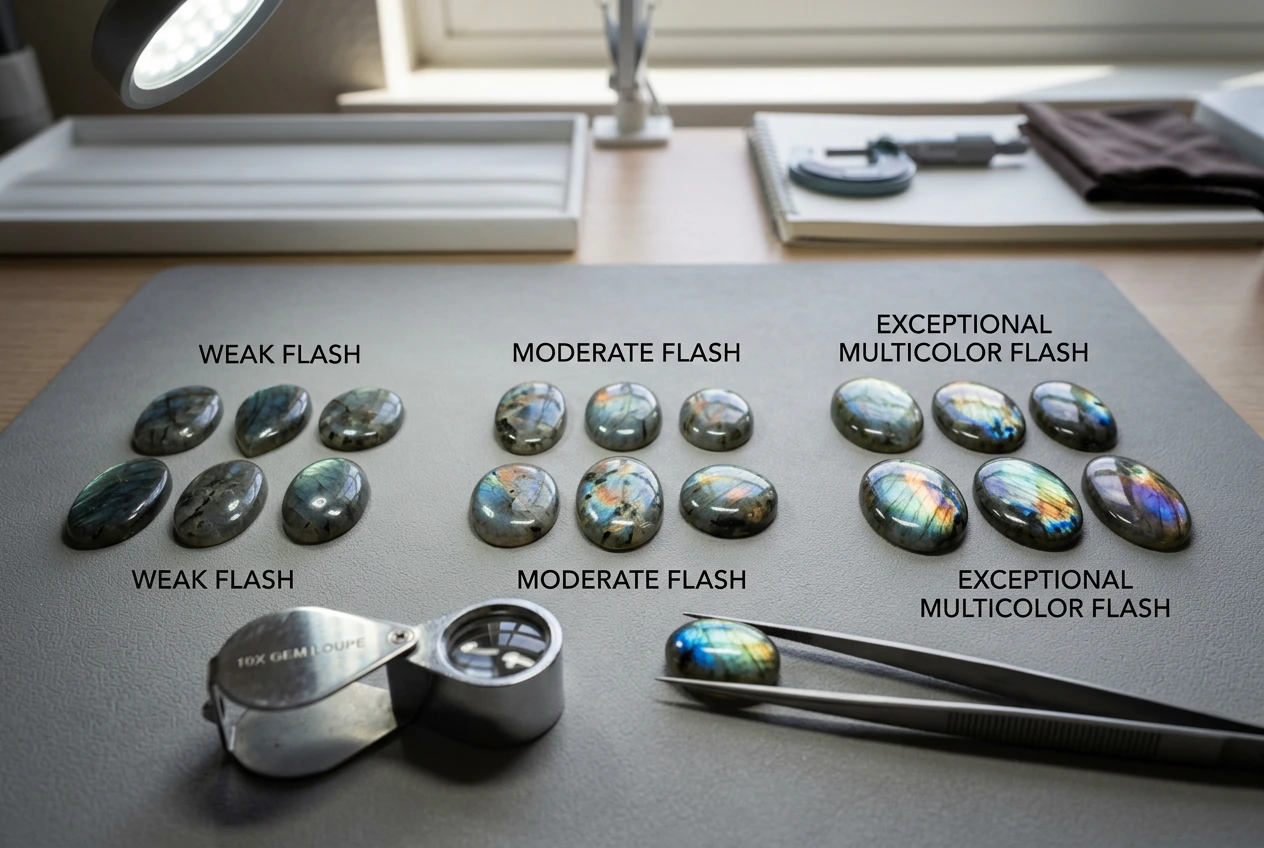
Labradorite quality grading should begin with the strength and coverage of labradorescence rather than with carat weight or ordinary clarity. Fine labradorite displays a vivid optical flash that appears strongly across a useful part of the face, often in blue, green, gold, orange, red, violet, or several colors together. The effect should be easy to reveal through normal movement rather than visible only at one extremely narrow angle, and the stone should be cut so that its strongest internal interference colors appear through the main polished surface.
Labradorite belongs to the plagioclase feldspar series and is commonly associated with compositions in the calcium-sodium range traditionally described as labradorite. Its famous optical phenomenon develops through extremely fine internal lamellar structures created by compositional separation within the feldspar. Light interacting with these layers produces interference colors, which is why the flash can change dramatically as the viewing angle changes even though the underlying body remains gray, brownish, greenish, or relatively colorless.
There is no universal AAA or AAAA grading system for labradorite. Commercial sellers may use letter grades to separate stock, but these labels do not describe how bright the flash is, what colors appear, how much of the face is covered, or whether fractures reduce durability. A useful grade therefore needs to evaluate the optical effect directly and then consider body quality, orientation, cutting, structural condition, size, and provenance.
8 Essential Steps to Rate Labradorite Labradorescence
- Measure flash brightness and overall intensity
- Identify flash colors and spectral variety
- Evaluate percentage of face covered by labradorescence
- Judge viewing angle and persistence of the optical effect
- Assess body color, transparency, and internal cleanliness
- Inspect fractures, cleavage, surface wear, and structural condition
- Evaluate orientation, cabochon shape, polish, and craftsmanship
- Consider size, special variety, provenance, matching, and overall aesthetics
These eight steps reflect the way labradorite is actually experienced in jewelry. The finest stone is not necessarily the clearest, darkest, or largest. It is the one in which the internal structure, cutting direction, body appearance, and polish work together to produce a strong optical display that remains visually satisfying as the stone moves.
Flash Brightness Is the First Quality Test
The intensity of labradorescence determines whether a stone looks dramatic or ordinary. A low-grade piece may reveal only a dim smoky sheen, while a fine cabochon can produce a vivid metallic-looking blue, green, gold, or multicolor flash that immediately dominates the face.
Brightness should be tested under a stable directional light source while the stone is tilted slowly. Extremely harsh spotlights can make almost any reflective effect look stronger, so grading should use lighting that resembles realistic jewelry viewing rather than theatrical illumination.
A high-quality stone should generate clear color with good contrast against the body. The flash should look crisp rather than muddy and should not depend on a wet surface, oil, or digital enhancement to appear impressive.
Brightness should also be distinguished from polish reflection. A smooth surface can produce white glare from the lamp, but true labradorescence comes from within the feldspar and displays colored interference rather than simple surface shine.
Flash Color Determines Character but Must Be Judged With Coverage
Blue is the most familiar labradorite flash and remains highly desirable, particularly when it appears electric or strongly saturated. Green and gold can also be attractive, while orange, red, violet, and multicolor combinations often receive collector attention because they are less common in fine broad coverage.
A rare color does not automatically create the highest grade. A narrow orange streak covering five percent of the stone may have less visual impact than an intense blue field covering nearly the entire cabochon.
The best grading approach therefore records both hue and area. Exceptional stones combine vivid colors with enough face coverage that the effect defines the gemstone rather than appearing as a minor accent.
Multicolor patterns can be especially valuable when colors transition cleanly across the surface and remain bright rather than blending into muddy gray or brown.
Face Coverage Separates Fine Cabochons From Ordinary Pieces
Coverage describes how much of the visible polished face displays labradorescence at the useful viewing angle. Full or near-full flash is often considered highly desirable because the effect becomes visually dominant.
Partial flash can still grade well when it forms a deliberate composition. A blue band crossing a dark body or a concentrated orange-red area can create an artistic effect that works beautifully in a freeform pendant.
The problem arises when most of the face remains dull and the flash is confined to a small poorly positioned corner. This usually indicates that the rough was cut for weight or shape rather than oriented specifically for the optical phenomenon.
Coverage should therefore be evaluated as part of the design rather than reduced to one percentage in isolation.
Viewing Angle Shows How Well the Stone Was Oriented
Labradorescence is directional, so every stone has angles at which the effect strengthens and weakens. Fine quality does not require flash from every possible position, but the effect should appear through a practical viewing range.
A broad useful angle means the wearer can see color during normal movement without carefully manipulating the gemstone. A narrow-angle stone may photograph beautifully in one position yet appear gray most of the time.
Cut orientation controls this behavior strongly. The cutter studies the rough, identifies the strongest interference plane, and positions the polished face to intersect that effect advantageously.
A stone whose strongest flash appears only through the edge has been oriented less effectively for conventional jewelry, even if the rough itself contained excellent labradorescence.
Body Quality Supports the Optical Effect
Classic labradorite often has a dark gray to charcoal body, which can provide strong contrast for electric blue or green flash. A clean body with limited cloudy white patches allows the colors to appear sharper.
Some stones are lighter, more transparent, or nearly colorless. Much of the material marketed as rainbow moonstone falls into this category and is valued for a clear body combined with blue or multicolor labradorescence.
Internal inclusions should be assessed according to whether they interfere with the optical effect. A small natural feature can be acceptable, while broad opaque zones, distracting dark inclusions, or cloudy areas can disrupt flash coverage and lower conventional quality.
Transparency is therefore not universally better. Dark-body labradorite and transparent rainbow-moonstone-type material belong to different visual categories, and each should be judged according to how well the body supports its characteristic optical display.
Fractures and Cleavage Need More Attention Than Buyers Often Give Them
Labradorite has a Mohs hardness around 6 to 6.5, which provides moderate scratch resistance but leaves it more vulnerable than harder jewelry stones. Feldspar cleavage adds another concern because impacts can produce chips or splitting along structural planes.
Natural rough commonly contains internal fractures, and some inexpensive cabochons are polished despite obvious surface-reaching cracks. These pieces can still be decorative, but they should not receive fine-quality grades when structural weaknesses are prominent.
A premium stone should have limited disruptive fractures, smooth edges, and a polished surface without severe scratching. Thin corners and elongated freeform points should be examined carefully because they are more vulnerable to damage.
For everyday jewelry, pendants and earrings are naturally safer than exposed rings, though protective ring settings can reduce risk considerably.
Cutting Orientation and Polish Are Part of the Grade
Cutting skill is central to labradorite because poor orientation can erase the value of excellent rough. A cutter must identify the labradorescent plane before shaping the stone and then preserve enough thickness to create a stable cabochon without losing the strongest flash.
The dome should be proportioned so that light reaches the internal layers effectively while the stone remains comfortable to set. Extremely thick backs may preserve weight unnecessarily, while very thin cuts can weaken durability or reduce visual depth.
Polish should be smooth and reflective because broad scratches scatter light and make the optical effect appear less crisp. Undercut pits, uneven edges, or dull surfaces reduce quality even when the internal flash is strong.
Freeform shapes can grade exceptionally well when they follow the natural pattern intelligently. A standardized oval is not automatically superior if an irregular outline preserves much better color coverage.
Spectrolite and Rainbow Moonstone Need Their Own Visual Expectations
Spectrolite is especially associated with Finnish labradorite showing strong multicolor labradorescence, often including a wider spectral range than ordinary commercial stones. Fine examples can show intense blue, green, yellow, orange, and red within one polished face.
Rainbow moonstone is a trade term commonly applied to lighter or transparent labradorite displaying blue or rainbow optical effects. In this category, clean body transparency becomes more important because dark inclusions or heavy clouding can reduce the delicate contrast between the color flash and colorless base.
These trade categories demonstrate why one grading standard cannot depend solely on dark body color or one preferred flash hue. The grade should consider what visual type the specimen represents and how effectively it expresses that type.
A Practical Labradorite Quality Framework
| Quality Level | Typical Characteristics |
|---|---|
| Exceptional | Very bright flash, broad coverage, multicolor or rare hues, excellent orientation, fine polish |
| Fine | Strong flash, good coverage, attractive blue or multicolor effect, limited fractures |
| Good | Clear optical effect over a moderate area, competent polish, acceptable condition |
| Commercial | Weak or narrow flash, ordinary body quality, visible fractures or basic cutting |
| Lower quality | Minimal labradorescence, poor orientation, major cracks, heavy surface wear |
This framework is descriptive rather than standardized. It emphasizes the characteristics that viewers actually notice and allows unusual stones to grade highly when their overall visual composition is exceptional even if they do not fit a simple commercial label.
Size Should Strengthen an Already Fine Stone
Large labradorite is available enough that weight is not a primary quality criterion. Slabs, palm stones, carvings, cabochons, and display specimens can reach substantial dimensions without becoming exceptionally rare.
What is rarer is broad, bright labradorescence continuing across a large unbroken surface. A large cabochon with edge-to-edge multicolor flash and limited fractures is therefore more impressive than a heavy stone whose optical effect occupies one small area.
Size should also be evaluated through dimensions rather than carat weight alone because cabochons vary greatly in thickness. An unnecessarily thick back adds weight without improving visible quality.
Treatment and Authenticity Still Matter
Natural labradorite requires no enhancement to produce its characteristic flash, and routine treatment is not central to the market. This makes the presence of convincing internal labradorescence an important feature when evaluating authenticity.
Inexpensive decorative products can still be coated, assembled, backed, dyed through fractures, or imitated with glass. Such modifications should be disclosed when they influence appearance.
The optical effect should move naturally within the stone as viewing angle changes rather than remain fixed like a painted surface. Experienced examination of body structure, cleavage, hardness, and optical behavior can help distinguish genuine feldspar from simple imitations.
Conclusion
Labradorite quality grading should evaluate flash brightness, color, coverage, viewing range, body appearance, fractures, orientation, polish, size, special variety, and overall aesthetics together. Fine stones reveal vivid labradorescence readily and use the polished surface to display the effect across a visually meaningful area.
The most important principle is that labradorite quality depends on optical performance rather than weight. A small precision-oriented cabochon with broad multicolor flash can outrank a much larger stone with weak or badly positioned labradorescence. When color, coverage, cutting, and structural condition align, labradorite can deliver one of the most dramatic optical effects found in feldspar.
FAQs About Labradorite Quality Grading
What is the most important factor in labradorite quality?
The strength and coverage of labradorescence are the most important factors because the optical flash defines the gemstone’s appeal. Fine quality combines bright color with enough face coverage and practical viewing range that the phenomenon can be enjoyed easily during normal wear.
What color flash is considered best?
There is no single best color, although electric blue is highly popular and broad multicolor flashes containing green, gold, orange, red, or violet can command stronger premiums. Brightness and coverage matter more than simply identifying one rare hue.
Does full-face flash mean higher quality?
Generally yes, especially when the effect remains vivid and well centered. Partial flash can still be high quality when the pattern is dramatic and intentionally positioned, but a tiny flash confined to an edge usually grades lower.
Why does labradorite look gray at some angles?
Labradorescence is directional because it results from light interference within oriented internal structures. When the viewing geometry changes, the reflected wavelengths no longer reach the eye as strongly, allowing the normal gray or dark body color to dominate.
Is transparent labradorite higher quality than dark labradorite?
Not automatically. Transparent rainbow-moonstone-type labradorite is valued for body clarity and clean blue or multicolor flash, while dark labradorite can be exceptional when vivid labradorescence contrasts strongly against the base. Each should be judged within its own visual category.
Are cracks common in labradorite?
Yes, natural fractures and cleavage-related features can occur frequently. Fine jewelry-quality stones should have limited surface-reaching cracks because serious fractures reduce polish, durability, and long-term wearability.
What makes Spectrolite special?
Spectrolite is especially associated with Finnish labradorite known for intense multicolor labradorescence and broad spectral flashes. The finest pieces combine vivid color variety, strong coverage, excellent polish, and sound structural condition.
Is labradorite commonly treated?
Routine enhancement is not central to labradorite because the valued optical phenomenon is naturally produced by its internal structure. Coatings, composites, dyed fractures, or imitations can occur, so unusual products should still be evaluated carefully.
What makes labradorite exceptional?
Exceptional labradorite combines intense natural flash, broad face coverage, attractive blue or multicolor spectral range, a useful viewing angle, good body quality, minimal fractures, precise orientation, smooth polish, and strong overall visual composition.