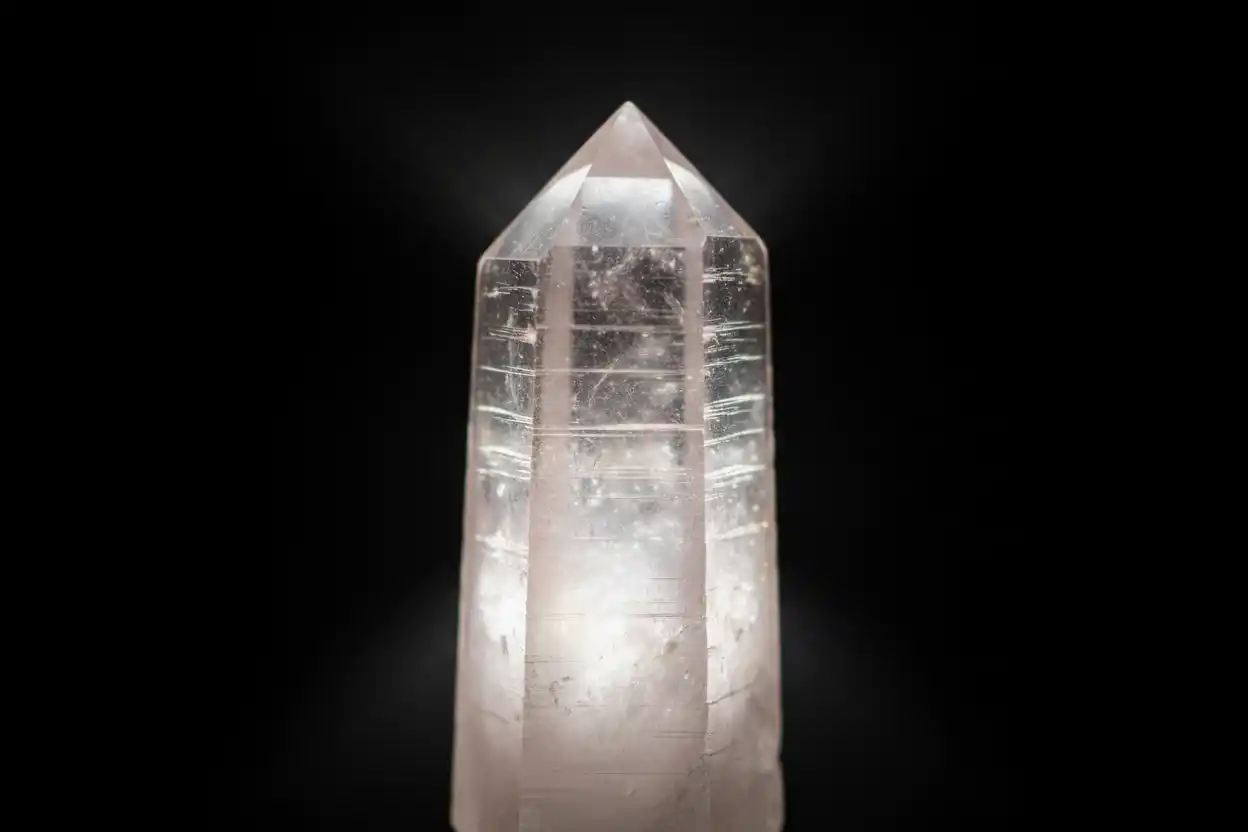
Lemurian Quartz: Meaning, Properties & Symbolism
Lemurian quartz is a modern trade name applied to natural quartz points with prominent horizontal growth steps or ladder-like striations across one or more prism faces. It is not a separate mineral species, and the surface lines do not prove that a crystal came from one deposit, an ancient civilization or a unique geological process.
Lemurian Quartz at a Glance
| Property | Lemurian Quartz Characteristics |
|---|---|
| Material type | Trade-named natural quartz crystal |
| Composition | Silicon dioxide, SiO₂ |
| Colors | Usually colorless, white or smoky; pink, golden, red-coated and included material is also marketed under the name |
| Crystal system | Trigonal |
| Habit or texture | Prismatic quartz points with natural growth steps, horizontal striations, etched faces or alternating surface relief |
| Luster | Vitreous |
| Transparency | Transparent to translucent |
| Mohs hardness | 7 |
| Cleavage | None |
| Tenacity | Brittle |
| Common uses | Natural crystal specimens, meditation objects, display points, pendants and collector pieces |
| Main care concern | Unstandardized naming, polished or artificially etched surfaces, chipped terminations and unsupported locality claims |
What Is Lemurian Quartz?
Mineralogically, Lemurian quartz is simply quartz.
It has the same SiO₂ composition, trigonal structure and physical properties as other natural rock-crystal points.
The Lemurian label belongs to the crystal and metaphysical trade rather than formal mineral classification.
Most sellers use the name for elongated quartz crystals with visible horizontal bars, ridges or staircase-like lines on their prism faces.
Those lines are natural surface-growth features. However, comparable striations occur on quartz crystals from many deposits and do not define a separate geological variety.
Some retailers use a narrow definition tied to particular Brazilian material. Others apply the name to striated quartz from Colombia, Peru, Arkansas, Russia and several other regions.
This inconsistent use is the article’s central identification issue.
The broader clear quartz guide should own general mineral properties and symbolism. Lemurian Quartz should remain focused on the trade name, surface features and authenticity claims.
Is Lemurian Quartz an Official Variety?
No recognized mineralogical authority treats Lemurian quartz as a separate species.
Mineral databases classify Lemurian Seed Crystal as a synonym or commercial label for quartz.
The term does not define a unique chemical composition, crystal structure, trace-element signature or formation environment.
This does not mean that every specimen is fake. A Lemurian quartz can be a completely natural quartz crystal with authentic surface growth features.
What is unscientific is the claim that the trade label establishes a mineral difference beyond ordinary quartz.
A careful description would read: natural quartz crystal with pronounced growth striations, sold under the trade name Lemurian quartz.
What Are Lemurian Lines?
Lemurian lines are horizontal or slightly inclined ridges and steps visible across one or more prism faces.
Quartz grows as silica-bearing fluid adds material to crystal surfaces. Growth does not always proceed at one uniform rate across an entire face.
Changes in fluid supply, temperature, pressure, impurity concentration and crystal orientation can create repeated microscopic or visible growth layers.
When one layer extends slightly beyond the next, the surface preserves a step. A series of steps produces the ladder-like pattern associated with the Lemurian trade name.
These features belong to the crystal’s natural morphology. They are surface records of interrupted or layered growth rather than symbols physically engraved into the quartz.
Some lines are sharp and evenly spaced. Others are irregular, shallow or partly dissolved.
Their appearance can vary across different faces because quartz does not grow identically in every crystallographic direction.
Are the Lines Unique to Lemurian Quartz?
No.
Growth steps, striations, etch patterns and surface relief occur on ordinary quartz from many locations.
A seller may call the features Lemurian lines, barcodes, records or memory lines. Mineralogically, they remain growth or dissolution structures.
This overlap makes strict authentication difficult. There is no laboratory test that detects “Lemurian energy” or proves that one naturally striated quartz point belongs to a separate variety.
A crystal with strong horizontal lines may fit the established trade appearance, but another seller could reasonably describe it simply as natural striated quartz.
The types of clear quartz guide provides the broader place for comparing trade habits and included forms without promoting every surface pattern to mineral-variety status.
Growth Striations vs Etch Marks
Growth striations form as the crystal develops.
Etch marks form when later fluids partially dissolve the surface.
Both processes can create steps, grooves, triangular pits and textured faces.
A single quartz point may preserve original growth lines alongside later dissolution features.
Natural etching commonly has irregular depth, softened edges and patterns that respond to crystal symmetry. Artificial acid treatment can also roughen quartz and strengthen a weathered appearance.
Distinguishing natural and artificial etching may require microscopy, surface comparison and reliable provenance.
The presence of acid-like texture does not automatically mean the entire crystal is manufactured. It may be a natural quartz point whose surface was later altered by people.
Lemurian Quartz and Tessin Habit
Lemurian quartz is sometimes incorrectly equated with Tessin-habit quartz.
Tessin habit describes a specific elongated crystal form with sharply tapering prism faces and slender proportions.
Some Tessin-habit crystals have strong striations, but not every striated crystal has Tessin habit.
Many pieces sold as Lemurian quartz are broad, short or conventionally prismatic and therefore do not meet the morphological definition.
The same problem applies to other terms such as Muzo habit and laser quartz. These names describe specific crystal forms or commercial appearances rather than synonyms for every Lemurian-labeled specimen.
Where Does Lemurian Quartz Come From?
The early commercial story is most strongly associated with Brazil, particularly quartz-producing regions in Minas Gerais.
Modern retailers also market material from Colombia, Peru, Arkansas and additional quartz localities as Lemurian.
Because the name is not geographically protected, a non-Brazilian origin does not automatically make a specimen fake.
It does mean that claims of one exclusive mine or one original deposit should be examined carefully.
A precise seller should state the known mining locality separately from the Lemurian trade description.
For example, a crystal can be accurately labeled natural striated quartz from Arkansas, sold commercially as Lemurian quartz.
That wording preserves both geological evidence and market terminology.
The Lemuria Story
The symbolism attached to Lemurian quartz is modern.
Lemuria began as a nineteenth-century hypothetical landmass proposed before plate tectonics explained the distribution of animals and continents.
Later spiritual and occult traditions transformed the idea into a lost advanced civilization.
The crystal trade subsequently connected striated quartz with that mythology, describing the lines as records, codes or stored knowledge.
No geological or archaeological evidence shows that an ancient Lemurian civilization prepared, encoded or distributed quartz crystals.
The story can still function as contemporary mythology or personal symbolism, provided it is not presented as verified history.
Lemurian Quartz vs Ordinary Clear Quartz
Mineralogically, there is no difference in composition.
Both are SiO₂, rank 7 on the Mohs scale and have the same trigonal structure.
The commercial distinction lies in external form. Lemurian quartz should have sufficiently noticeable natural-looking striations or growth steps to justify the label.
An ordinary smooth quartz point without those features may still be natural and attractive, but the Lemurian premium would be difficult to defend.
Conversely, a heavily striated crystal does not become chemically rarer than quartz.
The raw versus polished crystals guide is particularly relevant because polishing can remove the natural surfaces used to support the trade identification.
Lemurian Quartz vs Candle Quartz
Candle quartz has a large central crystal coated by numerous smaller secondary crystals, giving it a melted-wax or candle-like appearance.
Lemurian quartz is identified mainly by growth lines on prism faces.
A specimen can show both features, but the terms describe different aspects of crystal growth.
Candle Quartz should own the secondary overgrowth intent, while Lemurian Quartz should own the horizontal-striation trade intent.
This separation prevents both pages from becoming generic clear-quartz articles.
Can Polished Quartz Be Lemurian?
Once a crystal’s original prism faces have been polished away, the most recognizable surface evidence is lost.
A polished point may have been cut from naturally striated rough, but buyers cannot confirm that history from the finished surface alone.
Some polished towers receive artificial grooves or laser engraving designed to imitate ladder lines.
Others retain one or two natural unpolished faces while the remaining sides are cut.
A seller should disclose which surfaces are natural and which were shaped or polished.
Polished quartz can still be genuine quartz. The issue is whether the Lemurian trade claim remains verifiable after fashioning.
How to Identify Lemurian Quartz
First confirm that the specimen is natural quartz.
Quartz should have vitreous luster, Mohs hardness 7, no cleavage and the expected crystal geometry.
The real versus fake clear quartz guide provides the most detailed separation from glass, resin and synthetic substitutes.
Next, examine the surface under side lighting.
Natural growth steps should follow the crystal face and vary subtly in depth, spacing and continuity. They commonly end at edges or interact with later etching and contact damage.
Perfectly identical grooves cut across polished faces can indicate machining or engraving.
The treated clear quartz guide covers irradiation, coating, dye, synthetic growth and other alterations that the Lemurian label does not address by itself.
For high-value specimens, documented locality and older provenance provide more useful evidence than a generic authenticity card.
Is Lemurian Quartz Rare?
Quartz is one of Earth’s most abundant minerals.
Natural crystals with visible striations are less common than ordinary broken or massive quartz, but they are not geologically exceptional enough to justify every extreme rarity claim.
Large undamaged crystals with excellent termination, strong surface lines, high transparency and documented locality can be scarce in the collector market.
The rarity belongs to the combination of size, condition and aesthetics rather than the Lemurian name alone.
A small common quartz point should not become a rare mineral simply because horizontal lines are visible on one face.
Lemurian Quartz Price and Value
The market prices Lemurian quartz primarily by weight, size, clarity, termination quality and visual strength of the surface markings.
| Lemurian Quartz Material | Broad Current Asking Range |
|---|---|
| Small 1–3 inch point | $10–$25 |
| Medium 3–4 inch point | $25–$50 |
| Large 4–5 inch point | $50–$100 |
| Approximately one-pound crystal | $90–$150 |
| Aesthetic cluster or exceptional single point | $100–$500+ |
| Documented old-stock or unusual locality specimen | Individually priced and potentially higher |
| Polished tower or jewelry piece | Determined mainly by workmanship and setting |
A clear point with strong natural faces can cost more than a larger damaged crystal.
Complete termination, balanced shape, lack of glued repairs and documented origin add value.
Labels such as pink Lemurian, golden Lemurian and blue-mist Lemurian may describe natural inclusions, coatings, iron staining or separate commercial products. The exact cause of color should be disclosed.
Buying Lemurian Quartz Without Duplicating the Buying Guide
The dedicated Lemurian quartz buying guide owns the full seller, authenticity and pricing checklist.
For this article’s purpose, the central rule is simple: buy the specimen for the quartz you can verify, not for unsupported claims about encoded knowledge, extreme age or an exclusive source.
Request photographs of every face, the termination and the base. Ask which surfaces are natural and whether repairs, polishing, acid treatment or coatings are present.
A seller who clearly describes the material as a quartz trade name is generally more credible than one claiming laboratory proof of Lemurian identity.
The broader how to identify crystals and how to spot fake crystals guides support the mineral-level assessment.
Hardness and Durability
Lemurian quartz has Mohs hardness 7, as shown in the gemstone hardness chart.
It resists scratches from metal and ordinary glass but can be damaged by topaz, sapphire and diamond.
Quartz has no cleavage. The gemstone cleavage guide explains why it tends to fracture rather than split repeatedly along one atomic plane.
However, quartz remains brittle. Natural points can chip at their terminations and along thin growth ridges.
The distinction in gemstone toughness versus hardness is important for large crystals, which can break during a short fall despite their scratch resistance.
Cleaning and Storage
Use lukewarm water, mild soap and a soft brush for an untreated, structurally sound crystal.
Avoid scrubbing delicate growth steps aggressively. Dirt may collect between the ridges, but hard tools can chip the surface.
Ultrasonic cleaning may be tolerated by clean solid quartz, yet natural points often contain fractures, inclusions, secondary crystals and repaired areas. Hand cleaning is therefore safer, consistent with the cautions in gemstones and ultrasonic cleaners.
Store large points on a stable padded base. Do not balance them on narrow terminations or allow several crystals to strike each other inside one box.
Lemurian Quartz Meaning and Symbolism
Modern crystal traditions connect Lemurian quartz with memory, shared knowledge, reflection and a sense of connection across time.
The ladder-like lines are sometimes interpreted as records or pathways. A grounded symbolic reading treats them as visible stages of crystal growth rather than literal coded messages.
Each ridge records a change in how silica accumulated on the surface. That natural process can symbolize learning gradually, preserving experience and recognizing that development often occurs in layers.
The Lemuria mythology may hold personal or spiritual meaning for some readers, but it should not be presented as geological or archaeological fact.
Scientific evidence does not show that Lemurian quartz stores ancient information, activates DNA or produces measurable healing effects.
Frequently Asked Questions About Lemurian Quartz
Is Lemurian quartz a recognized mineral variety?
No. It is a modern trade name for quartz crystals with particular surface-growth features.
What makes a quartz crystal “Lemurian”?
Sellers commonly use the name for natural quartz points with strong horizontal, ladder-like growth striations.
Are Lemurian lines natural?
They can be. Natural layered growth and later dissolution create ridges, steps and textured crystal faces.
Are the lines unique to Lemurian quartz?
No. Similar growth striations occur on ordinary quartz crystals from many deposits.
Does Lemurian quartz have to come from Brazil?
No formal rule requires a Brazilian origin. The name is now applied to striated quartz from several countries.
What does “Lemurian Seed Crystal” mean?
It is another modern metaphysical trade name rather than a separate mineralogical classification.
How can I tell whether one is genuine?
Confirm natural quartz, examine whether the striations follow unpolished crystal faces and request clear locality and treatment disclosure.
Can a polished tower be genuine Lemurian quartz?
The quartz can be genuine, but polishing removes the natural faces that would support the Lemurian trade identification.
Is Lemurian quartz rare?
Quartz with striations is not exceptionally rare. Large, undamaged and aesthetically strong specimens can still be scarce.
What makes Lemurian quartz valuable?
Size, transparency, termination, natural surface quality, locality, condition and overall aesthetics determine value.
Can Lemurian quartz go in water or an ultrasonic cleaner?
Brief hand washing is normally safe for solid untreated quartz. Hand cleaning is preferable to ultrasonic cleaning for fractured, repaired or clustered specimens.
Are Lemurian quartz’s metaphysical properties scientifically proven?
No. Claims about encoded knowledge, healing or energy are spiritual beliefs rather than established scientific effects.
Lemurian quartz belongs in both Crystals That Start With L and Gemstones That Start With L, although its defining issue is trade terminology rather than mineral rarity.
Safety disclaimer: Cutting, polishing or engraving Lemurian quartz can release respirable crystalline-silica dust. Use wet methods, effective extraction, eye protection and suitable respiratory protection. Do not inhale grinding residue or use powdered quartz in drinking water.