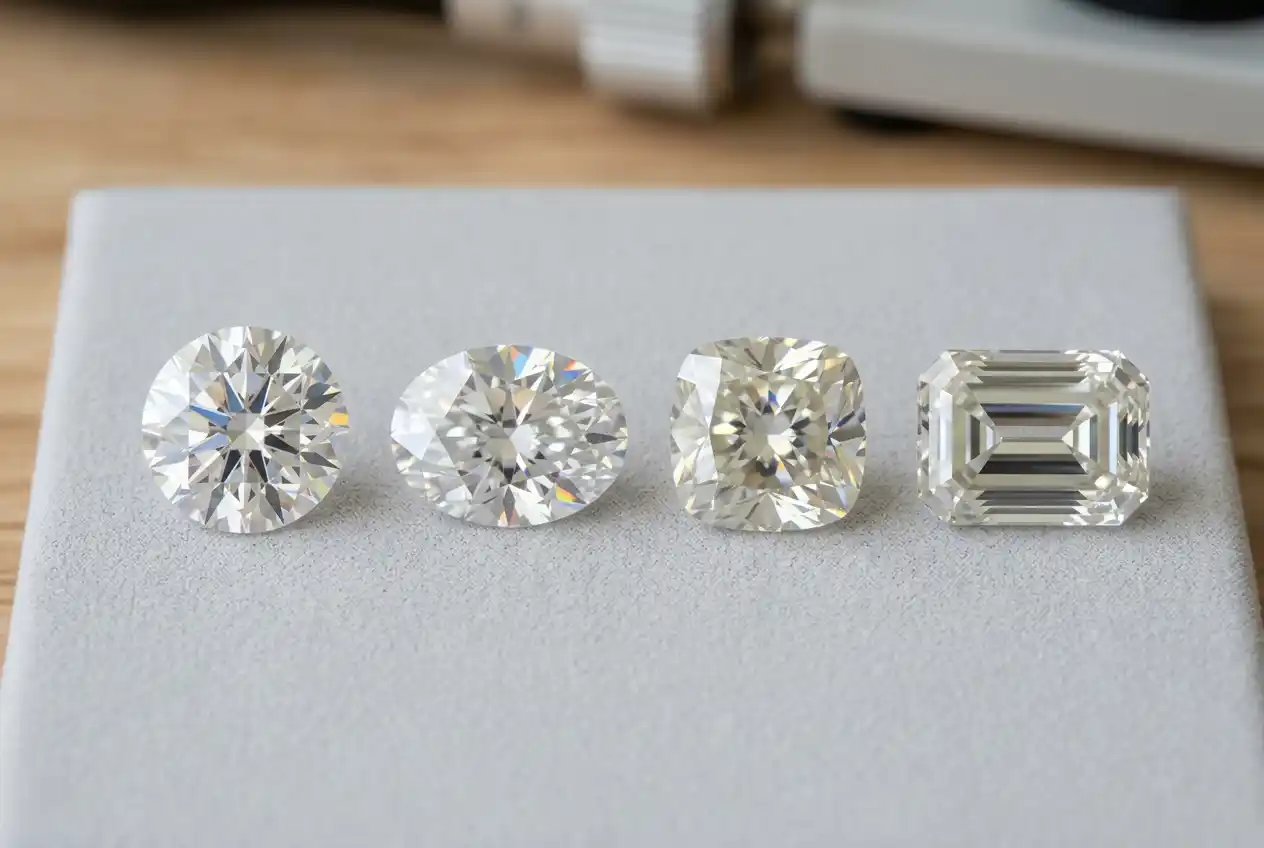
Moissanite Quality Grading: 9 Essential Standards for Fire & Clarity
Moissanite quality grading should focus on cut precision, light performance, color, clarity, symmetry, polish, proportions, crystal quality, and accurate disclosure. Unlike diamond, moissanite does not have one universally adopted grading system used consistently by every laboratory, manufacturer, and retailer. Sellers often borrow familiar terms such as D-F color, VVS clarity, excellent cut, or premium grade, but those labels may be based on different internal standards. Comparing the actual stone is therefore more reliable than assuming identical terminology means identical quality.
Almost all jewelry-quality moissanite is laboratory-grown silicon carbide. Natural moissanite is extraordinarily rare and is not the normal source of the faceted stones sold for rings, earrings, and other jewelry. Laboratory growth can produce remarkably clean crystals with tightly controlled color, so quality differences often depend more heavily on cutting and optical execution than on internal inclusions.
Moissanite is notable for its high refractive index and very strong dispersion, giving it intense brilliance and colorful fire. It also exhibits double refraction, which can make facet junctions appear doubled when viewed through certain directions in the stone. A high-quality cut manages these optical characteristics effectively so the gem looks crisp, bright, and balanced rather than blurry, dark, or excessively chaotic.
9 Essential Standards for Moissanite Fire & Clarity
- Cut precision: Facets should be accurately placed and proportioned to produce balanced brightness without persistent dead areas or obvious light leakage.
- Fire and dispersion: Color flashes should appear lively and well distributed rather than being concentrated into distracting zones caused by poor cutting.
- Brilliance: The stone should return abundant white light across the face instead of appearing watery, dull, or dark through large regions.
- Color quality: Near-colorless or colorless-looking stones generally receive stronger commercial grades than moissanite with obvious yellow, gray, green, or brown body color.
- Clarity: High-quality stones should appear eye-clean and free from inclusions that interfere with transparency, brilliance, or visual crispness.
- Symmetry: Matching facets, centered tables, even outlines, and properly aligned junctions contribute to both beauty and optical performance.
- Polish: Facet surfaces should be smooth and reflective without visible polishing lines, abrasions, burns, chips, or poorly finished edges.
- Crystal and optical quality: The gem should avoid distracting haze, excessive facet doubling, strain-related visual disturbance, or other features that reduce sharpness.
- Accurate grading disclosure: Color, clarity, dimensions, actual weight, carat-equivalent terminology, treatment, and laboratory-grown identity should be presented transparently.
Understanding Moissanite Quality Grades
Commercial moissanite is often sold with grading language adapted from the diamond market. A retailer may advertise D-F color, VVS clarity, excellent cut, or a combined grade such as premium or super premium. These descriptions can be useful within one seller’s inventory, but they should not automatically be treated as internationally standardized grades.
A practical comparison can instead use observable characteristics.
| Quality Level | Color and Clarity | Cutting and Optical Appearance | Typical Impression |
|---|---|---|---|
| Low commercial | Noticeable tint or visible quality variation | Uneven symmetry, weaker light return, possible haze or poor finish | Bright but less refined |
| Commercial | Near-colorless appearance, generally eye-clean | Competent cutting with acceptable brilliance | Suitable for everyday jewelry |
| Good | Consistent near-colorless appearance, clean to the eye | Strong brilliance, good symmetry and polish | Attractive quality for most buyers |
| Fine | Colorless to near-colorless, very clean appearance | Precise cutting with balanced brilliance and fire | Crisp and highly polished |
| Exceptional precision-cut | Excellent visual color and transparency | Highly controlled proportions, symmetry, polish, and optical balance | Distinctive high-end performance |
The highest commercial grade is not necessarily the best choice for every buyer. Some people prefer slightly warmer moissanite, softer antique-style cutting, or a less fiery step cut. Quality grading should separate technical execution from personal aesthetic preference.
Cut Quality Is the Most Important Standard
Cut has an unusually powerful effect on moissanite because the gemstone already possesses strong optical properties. High refractive index gives it exceptional capacity to bend light, while strong dispersion separates white light into spectral colors. If the facets are poorly proportioned, those properties can produce uneven brightness, distracting reflections, or visual confusion rather than beauty.
A high-quality round brilliant should display brightness throughout most of the face when moved under normal lighting. Some contrast is necessary because scintillation depends on alternating light and dark reflections, but large permanently dark zones generally indicate weaker light management.
Oval, pear, marquise, and elongated cuts require additional care because certain proportions can create a persistent dark bow-tie region across the center. A slight bow-tie effect can occur naturally in elongated brilliant designs, but a dominant black-looking band that remains obvious through ordinary movement may reduce quality.
Cushion and radiant cuts vary particularly widely because their pavilion facet arrangements can be designed for broad flashes, crushed-ice effects, or hybrid appearances. Two stones with the same measurements and nominal grade may therefore look entirely different.
Step cuts such as emerald and Asscher styles place less emphasis on rapid scintillation and more on broad flashes and geometric reflections. Because their large facets reveal the interior clearly, crystal quality, facet alignment, and polish become especially important.
How to Evaluate Moissanite Fire and Brilliance
Fire refers to the spectral colors produced when white light is dispersed, while brilliance describes the white light returned from the gemstone. Moissanite is famous for high dispersion, which can create stronger rainbow flashes than diamond. This optical property is natural to silicon carbide and should not be confused with an artificial coating or added visual effect.
The strongest fire usually appears under point-source lighting, such as jewelry-store spotlights or direct sunlight. Under diffuse daylight, the stone may show more white brightness and fewer concentrated rainbow flashes. This variation is normal and explains why moissanite can look different from one environment to another.
More fire is not automatically equivalent to higher quality. Some buyers love intense spectral flashes, while others prefer a calmer appearance. Cut quality should distribute brightness and dispersion attractively rather than simply maximizing every rainbow reflection.
Poorly cut stones may display intense color flashes in one region while remaining dark or lifeless elsewhere. A well-cut gem balances these effects so the face appears active during movement without losing structural definition.
Video is often more useful than a still photograph when evaluating fire because scintillation is dynamic. A single photograph may capture an unusually dramatic rainbow flash that is visible for only a fraction of a second, while continuous movement reveals the overall performance.
Moissanite Color Grading and Body Tint
Modern laboratory-grown moissanite can appear highly colorless, but subtle body color still varies. Commercial descriptions frequently use diamond-like ranges, with D-F representing colorless-looking stones and later letters indicating increasing warmth. Buyers should remember that these labels may not be assigned through one universal independent standard.
Older moissanite was more likely to display yellow, green, or gray undertones. Improvements in crystal growth have reduced these effects considerably in current high-quality production, although differences between manufacturers and batches remain possible.
Color can also become more noticeable as stone size increases because light travels through more crystal. A subtle warm tone that is difficult to see in a small gem may become easier to detect in a large oval or cushion.
Setting metal influences perception as well. Near-colorless stones can appear exceptionally white in platinum or white gold, while slight warmth may harmonize beautifully with yellow or rose gold. The highest theoretical color grade is therefore not automatically necessary for every design.
Lighting should be kept consistent when comparing color. Warm indoor bulbs can make any gemstone appear more yellow, while cool lighting may make it look whiter or slightly bluish. Neutral daylight or controlled white light gives a more meaningful comparison.
Clarity Standards in Laboratory-Grown Moissanite
Moissanite clarity describes the visibility and influence of internal or surface-reaching features. Laboratory production makes high clarity relatively common, so many jewelry-quality stones appear completely clean to the unaided eye.
Possible features can include small inclusions, needles, growth-related structures, pinpoint-like characteristics, cavities, or polish-related marks. Most are insignificant when they cannot be seen without magnification and do not interfere with durability or optical performance.
Because eye-clean clarity is common, paying a very large premium for a theoretical microscopic grade may provide little visible benefit. A buyer should concentrate on whether inclusions can be seen face-up under ordinary conditions and whether they interrupt brilliance.
Location matters as much as size. A small feature directly beneath the table can be more noticeable than a slightly larger inclusion near the girdle. Step cuts can also reveal internal features more easily because their broad facets provide clearer views into the gemstone.
Clarity terminology such as VVS or VS should be interpreted cautiously unless the grading standard is clearly explained. A VVS label from one moissanite seller may not be directly comparable with a VVS designation from another.
Double Refraction and Facet Crispness
One of moissanite’s distinguishing optical characteristics is double refraction. Light entering the crystal can divide into two rays under most viewing directions, potentially causing facets viewed through the stone to appear doubled.
This does not mean a genuine moissanite is defective. Double refraction is part of its optical nature. However, cutting orientation influences how noticeable the effect becomes, and skilled cutters can reduce distracting doubling in the face-up view.
A well-executed stone should therefore look crisp during ordinary observation even though magnification may reveal doubled facet junctions. If the entire interior appears persistently fuzzy or visually confused, the issue may involve cutting orientation, proportions, polish, or crystal quality rather than simply the fact that moissanite is doubly refractive.
Facet crispness becomes particularly important in step cuts and large stones because broad reflections make optical structure easier to observe. Buyers comparing premium stones should examine them through slow movement rather than relying solely on magnified still images.
Symmetry, Proportions, and Polish
Symmetry describes how accurately corresponding facets align around the gemstone. A round stone should have a centered table, even outline, consistent girdle, balanced facet junctions, and no obvious lopsidedness. Fancy shapes require similar precision adapted to their geometry.
Proportions determine how light travels through the stone. Excessive depth can make a gem look smaller than expected for its weight, while overly shallow cutting can produce weak light return. There is no single perfect proportion set for every moissanite shape because optical behavior varies with cutting design.
Polish concerns the condition of facet surfaces. A high-quality stone should have smooth, reflective facets without conspicuous scratches, abrasions, polishing lines, pits, burnt areas, or rough junctions. These finishing details can separate mass-produced stones from careful precision cutting.
Girdle quality should also be checked. A very thin girdle may be more vulnerable to chipping, while an unnecessarily thick girdle can hide weight without increasing face-up size. Evenness is generally preferable to abrupt thickness variation.
The culet, if present, should fit the intended cutting style. Modern brilliant cuts commonly have a pointed or extremely small culet, while antique-inspired stones may deliberately use a visible open culet as part of their historic aesthetic.
Shape-Specific Moissanite Quality Differences
Round brilliant moissanite offers relatively predictable optical performance because the shape is highly standardized and rotationally symmetrical. It is often the easiest form for buyers to compare because diameter, symmetry, and light return can be evaluated consistently.
Oval stones should be assessed for outline balance, bow-tie intensity, and whether the ends appear pleasantly rounded rather than too narrow or bulky. Length-to-width ratio is partly personal preference, but asymmetry between the two sides is a quality concern.
Pear shapes require careful evaluation of the point, shoulders, and rounded end. The point should align with the center of the stone, while both shoulders should appear balanced. Bow-tie effects can also occur in pears.
Cushions range from square to elongated and from chunky brilliant patterns to crushed-ice designs. A buyer should therefore judge whether the appearance matches the advertised cutting style rather than expecting all cushion moissanite to perform identically.
Emerald cuts benefit from exceptional clarity, precise step alignment, and good length-to-width proportions. Their broad facets can reduce the visual intensity of moissanite’s fire, making them attractive to buyers who prefer a more restrained optical appearance.
Moissanite Versus Diamond Grading
Moissanite and diamond should not be graded as though they are the same gemstone. Diamond is crystalline carbon, while moissanite is silicon carbide. Their hardness, density, refractive index, dispersion, optical character, and crystal structure differ.
Moissanite measures about 9.25 on the Mohs scale, making it extremely resistant to scratching and suitable for everyday jewelry. Diamond, at 10, remains harder. Hardness does not mean either gemstone is indestructible, since sharp impacts can still damage a faceted stone.
Moissanite has significantly stronger dispersion than diamond, which explains its more prominent rainbow fire. Some buyers consider this a major advantage, while others prefer the optical balance of diamond. That preference is aesthetic rather than a simple quality ranking.
The two gemstones also differ in density. A moissanite and diamond of identical dimensions will not necessarily have identical carat weights. This makes millimeter dimensions essential when comparing face-up size.
A moissanite seller who uses diamond-like color and clarity language should therefore make clear that the stone is moissanite and that the grades apply within the seller’s moissanite system rather than implying the gemstone has been graded as a diamond.
Accurate Disclosure Is Part of Quality
A high-quality stone should be accompanied by clear information about what it is. Jewelry moissanite should be represented as laboratory-grown silicon carbide rather than natural moissanite or diamond. Misleading terminology reduces buyer confidence regardless of how beautiful the stone itself may be.
Weight descriptions should also be explicit. If a seller uses diamond-equivalent weight or carat-equivalent size, that terminology should be distinguished from actual gemstone weight. Millimeter dimensions allow the buyer to confirm visual size independently.
Color and clarity grades deserve similar transparency. A seller using D-F, VVS, or other familiar labels should explain whether those grades come from an independent report, manufacturer specification, or internal assessment.
Treatment disclosure matters as well. Most ordinary moissanite does not require the types of clarity treatment associated with some natural gemstones, but coatings have historically been used on some products to alter apparent color. Any such enhancement should be disclosed rather than incorporated silently into a premium grade.
How to Compare Two Moissanite Stones
Start with dimensions and shape so the stones are genuinely comparable. Confirm whether both are approximately the same face-up size instead of trusting nominal carat-equivalent labels. Then examine them together under neutral lighting.
Move each stone slowly and observe white brightness, rainbow fire, contrast, and dark zones. A stronger stone should remain lively through different angles instead of producing one spectacular flash followed by persistent dullness.
Next judge color face-up and from the side. Subtle tint often becomes easier to detect through the pavilion or against a neutral white background. If both stones appear equally colorless in normal viewing, paying a large premium for a theoretical grade difference may offer little practical benefit.
Check clarity after optical performance rather than before it. If neither gemstone has visible inclusions without magnification, cut and color are likely to have a greater impact on beauty. Magnification can then be used to inspect facet junctions, polish, inclusions, and signs of sloppy finishing.
Finally, consider the quality of disclosure. Accurate dimensions, actual weight, grading terminology, laboratory-grown identity, return policies, and clear photography all contribute to a more trustworthy purchase.
Conclusion
Moissanite quality grading is most useful when it evaluates cut precision, fire, brilliance, color, clarity, symmetry, polish, crystal quality, and accurate disclosure together. Because commercial grading terminology is not universally standardized, a high letter or clarity label should never replace direct examination of the gemstone’s optical performance.
The finest moissanite looks crisp, balanced, bright, and well finished while displaying the degree of fire the buyer prefers. Technical quality and personal taste should work together, especially when comparing brilliant cuts with step cuts, antique designs, or intentionally crushed-ice styles.
FAQs About Moissanite Quality Grading
What is the highest grade of moissanite?
There is no single universally recognized highest moissanite grade used by every manufacturer and laboratory. Many sellers describe their best stones using terms such as D-F color, VVS clarity, premium, colorless, or excellent cut. These descriptions should be supported by strong cutting, eye-clean clarity, attractive color, good symmetry, smooth polish, and transparent grading information.
Is D color moissanite the best?
A colorless-looking moissanite may receive a premium, but D terminology is not necessarily standardized across all sellers. Some buyers cannot distinguish between a top color grade and a slightly warmer near-colorless stone once it is set. Cut quality and optical performance often have a greater visible effect than a small difference in stated color grade.
What clarity is best for moissanite?
An eye-clean stone is sufficient for most buyers because inclusions that require magnification rarely affect everyday beauty. VVS-type grades are commonly marketed, but an exceptionally high microscopic clarity grade does not automatically improve appearance if another eye-clean stone has superior cutting and light performance.
Why does moissanite show so much rainbow fire?
Moissanite has high dispersion, meaning it separates white light into spectral colors very effectively. This produces strong rainbow flashes, particularly under direct or point-source lighting. The effect is an inherent optical property of silicon carbide rather than an artificial treatment.
Is too much fire a sign of low-quality moissanite?
No. Strong fire is a natural characteristic of moissanite, although cutting style determines how it is distributed. A technically good stone can display intense fire, while some buyers simply prefer a more restrained look. Quality should be judged by balance, brightness, symmetry, and crispness rather than by reducing fire to one ideal amount.
Why do some moissanite facets look doubled?
Moissanite is doubly refractive, so light can split into two rays through much of the crystal. This can make facet junctions appear doubled, particularly under magnification or from certain directions. Skilled cutting and orientation can make the effect less distracting in ordinary face-up viewing.
Is moissanite harder than sapphire?
Moissanite is usually rated around 9.25 on the Mohs scale, while corundum, which includes sapphire and ruby, has a hardness of 9. Moissanite is therefore slightly harder in terms of scratch resistance. Both are highly suitable for jewelry, although hardness alone does not determine resistance to chipping or impact.
Is all jewelry moissanite laboratory-grown?
Virtually all faceted moissanite used in mainstream jewelry is laboratory-grown because natural moissanite is extraordinarily rare and generally occurs in crystals too small for commercial jewelry production. A large faceted stone claimed to be natural moissanite would require exceptional supporting evidence.
Should I choose cut or color first when buying moissanite?
Cut should usually receive the greater emphasis because it controls brilliance, fire distribution, symmetry, and overall visual crispness. Once a stone has strong cutting, buyers can select the color range that suits their setting and personal preference. A slightly warmer well-cut moissanite can look substantially better than a theoretically whiter stone with weak proportions.