Moonstone Quality Grading: 8 Ways to Evaluate Adularescence
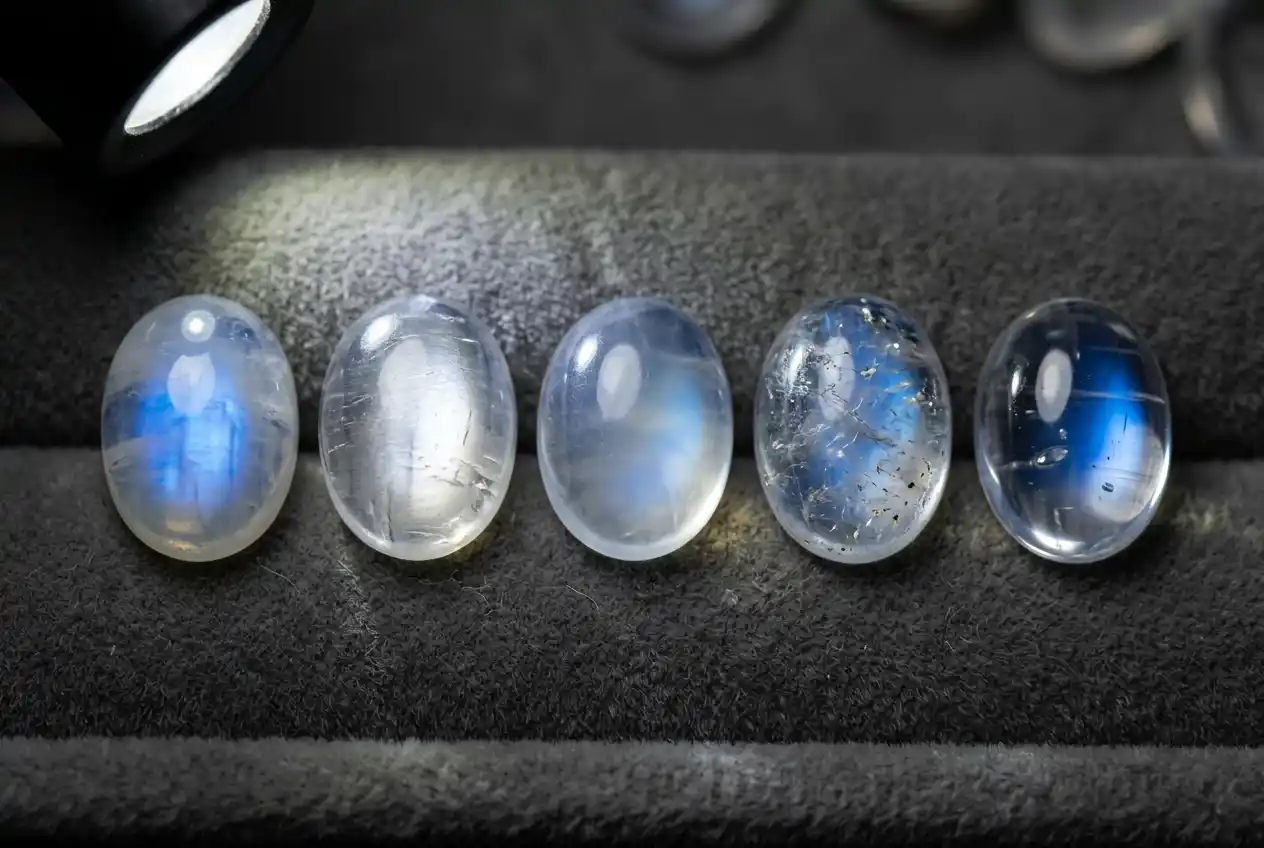
Moonstone quality grading depends primarily on the strength, color, movement, and placement of adularescence, followed by body transparency, color, clarity, structural condition, cutting, and accurate gemstone identification. Fine classic moonstone often combines a transparent to highly translucent near-colorless body with vivid blue sheen that appears to float beneath the surface and travel smoothly across the center as the stone moves. Commercial moonstone may still be attractive but commonly shows weaker white or silvery sheen, more cloudiness, visible fractures, or less precise optical orientation.
There is no single internationally standardized grading scale that makes every seller’s A, AA, AAA, or premium moonstone directly comparable. Commercial grades can therefore be useful within one seller’s inventory but unreliable between unrelated sellers. A stone described as AAA by one merchant may display weaker adularescence than another merchant’s ungraded stone, making direct visual assessment more important than the label.
Moonstone belongs to the feldspar family, and its characteristic adularescence develops because light interacts with very fine internal feldspar structures. In classic moonstone, these structures are commonly associated with intergrowths involving orthoclase and albite. So-called rainbow moonstone is generally transparent to translucent labradorite and is mineralogically different even though the trade name contains moonstone. Correct identification should therefore form part of any serious quality assessment.
8 Ways to Evaluate Moonstone Adularescence and Quality
- Judge adularescence strength: Look for a bright, distinct floating sheen rather than a weak, diffuse patch that appears only at one narrow angle.
- Evaluate sheen color: Blue adularescence is particularly prized in classic moonstone, while white and silvery effects can remain beautiful at different commercial levels.
- Check centering and movement: High-quality stones should show an optical effect that crosses a substantial part of the face and is well positioned within the cabochon.
- Assess transparency and body color: Fine stones often combine good transparency with a clean near-colorless body, although attractive colored moonstones can follow different preferences.
- Inspect inclusions, fractures, and cleavage-related features: Internal flaws should not overwhelm the optical effect or create unnecessary durability concerns.
- Evaluate cut orientation and proportions: The cabochon should be oriented to reveal maximum adularescence with a balanced dome and appropriate thickness.
- Examine polish and surface condition: Fine moonstone should have a smooth, clean polish without distracting scratches, abrasions, pits, or damaged edges.
- Confirm identity and treatment disclosure: Classic moonstone, rainbow moonstone, other feldspars, glass imitations, and coated products should be distinguished rather than graded as identical stones.
Practical Moonstone Quality Grades
Moonstone cannot be reliably graded through a letter alone because several characteristics interact. A strongly adularescent stone with moderate inclusions can be more appealing than a very clean feldspar cabochon whose optical effect is weak. A useful grading system therefore begins with phenomenon and then considers body quality and workmanship.
| Quality Level | Adularescence | Body Quality | Cut and Condition |
|---|---|---|---|
| Low commercial | Weak, narrow, diffuse, or poorly positioned | Cloudy, opaque, or visibly fractured | Basic polish and orientation |
| Commercial | Noticeable white or silvery sheen | Translucent with visible internal features | Acceptable cabochon cutting |
| Good | Stronger movable sheen, sometimes pale blue | Moderately clean and translucent | Good orientation and polish |
| Fine | Bright blue or strong silvery sheen centered over much of the face | Transparent to highly translucent with limited distraction | Excellent cabochon proportions |
| Exceptional | Vivid mobile blue adularescence with outstanding centering | Highly transparent, clean-looking body with sound structure | Precision orientation, smooth dome, superior polish |
These levels are descriptive rather than official laboratory grades. Colored moonstones such as peach or gray examples can also be high quality within their own type even when they do not resemble transparent blue-sheen stones. The grading criteria should match the variety being evaluated.
Adularescence Strength Is the First Quality Test
Adularescence should appear to float inside the stone rather than simply reflect from the polished surface. When a cabochon is tilted under directional light, the glow should move across the interior, sometimes resembling a luminous cloud or beam traveling beneath the dome.
Strong adularescence remains clearly visible through a useful range of angles. Weak stones may show only a faint milky patch or require an exact angle before any effect appears. Such stones can still be genuine moonstone, but their commercial quality is lower when the phenomenon is the main reason for purchase.
Intensity should be judged under realistic lighting. A powerful spotlight can exaggerate the effect in almost any phenomenal gemstone, while diffuse lighting may soften it. Comparing several stones under the same single-source illumination provides a much more meaningful assessment.
Brightness also needs to be separated from surface reflection. A polished cabochon can produce a white highlight from the lamp itself, but adularescence moves within the stone in a different way. Buyers unfamiliar with phenomenal gemstones should rotate the stone slowly and watch whether the internal sheen travels independently of the simple surface glare.
Why Blue Adularescence Is Especially Prized
Classic blue-sheen moonstone is among the most sought-after forms because the floating blue light can appear dramatically separated from a near-colorless body. The effect becomes particularly striking when the gemstone is transparent enough to show depth without becoming visually cloudy.
Blue intensity can range from very pale icy blue to a more vivid electric-looking blue under favorable lighting. The goal in high-quality grading is not artificial-looking saturation but a naturally strong, clean optical response that remains attractive as the stone moves.
White and silvery adularescence are more common and can also produce elegant jewelry. A fine white-sheen stone with excellent centering, translucency, and polish can be superior to a nominally blue stone whose effect is weak and confined to one corner.
Color therefore should be considered alongside strength and coverage. A slightly paler blue flash crossing the entire cabochon can be more desirable than an intense blue spot visible only near one edge.
Multicolored flashes require additional identification. Rainbow moonstone can display blue, green, yellow, orange, or violet optical colors, but the stone is usually labradorite rather than classic potassium feldspar moonstone. Its quality should be evaluated within that trade category rather than automatically ranked above classic moonstone because it shows more colors.
Centering and Movement Separate Fine Stones From Ordinary Ones
A high-quality moonstone should ideally display its adularescence prominently across the central face. As the stone is tilted, the sheen should travel smoothly rather than remain trapped at an edge or disappear almost immediately.
Centering depends heavily on how the rough was oriented before cutting. Moonstone’s internal feldspar structures must be positioned correctly relative to the dome. Even excellent rough can produce a mediocre cabochon when the cutter fails to align the optical plane.
A well-centered effect improves visual balance in jewelry because the glow remains visible when the stone is viewed normally from above. Off-center sheen can still be attractive in a freeform piece, but it usually receives a lower grade when the goal is a classic symmetrical cabochon.
Movement also matters. Fine adularescence appears dynamic, shifting visibly as the viewing angle changes. A static pale area that barely moves may indicate weaker internal structure for optical performance or poor orientation.
Coverage should be considered together with movement. An effect that crosses most of the stone creates a stronger impression than one occupying only a narrow strip. Large stones become especially valuable when the phenomenon stays strong throughout much of the face.
Transparency, Body Color, and Visual Depth
Transparency is one of the most important supporting quality characteristics. Fine moonstone can be surprisingly transparent, allowing the adularescence to appear suspended within the gem instead of hidden inside a cloudy body.
Highly translucent stones can also be excellent when the optical effect is strong. The key is whether the body allows enough light to create depth and whether internal cloudiness enhances or suppresses the visual phenomenon.
Near-colorless body color is widely preferred for classic blue moonstone because it allows the sheen to dominate. Yellowish or brownish body color may reduce top-grade status when it interferes with the clean blue-on-clear appearance buyers seek.
Moonstone also occurs commercially in peach, cream, gray, brownish, and other body colors. These stones should not be dismissed simply because they do not fit the colorless-blue ideal. A fine peach moonstone may be valued for warm body color, translucency, and silvery adularescence rather than blue sheen.
Body color grading should therefore begin by identifying which type of moonstone is being evaluated. Applying the exact same standard to every color variety can produce misleading results.
Clarity, Fractures, and Feldspar Cleavage
Clarity becomes increasingly important as transparency rises. In a highly transparent moonstone, internal fractures, large inclusions, cloudy zones, and cleavage-related features are easier to see and can interfere with the floating optical effect.
A perfectly inclusion-free stone is not necessary for high quality. Small internal features that remain unobtrusive can be acceptable, particularly when the adularescence is exceptional. The main concern is whether internal characteristics distract from beauty or weaken durability.
Feldspar cleavage deserves special attention. Moonstone can split along structural directions if struck sharply, even though its Mohs hardness of approximately 6 to 6.5 provides moderate scratch resistance. A large cleavage-related crack beneath the surface can therefore be more serious than a harmless microscopic inclusion.
When inspecting a loose stone, rotate it and examine the edges and back. Some fractures are difficult to see face-up because strong adularescence distracts the eye. Backlighting can reveal internal breaks that are invisible under ordinary reflected light.
Surface-reaching fractures can also collect dirt or become vulnerable during setting. Fine jewelry-grade stones generally benefit from compact structure with no obvious open breaks.
Cut Orientation Is Essential to Moonstone Quality
Cabochon cutting is the traditional choice for moonstone because the curved surface allows adularescence to move smoothly as the stone is tilted. Faceting is possible for some feldspar, but it usually does not display classic moonstone sheen as effectively as a carefully oriented cabochon.
The cutter must first determine the internal plane that produces the strongest phenomenon. The rough is then shaped so this optical structure lies in the correct relationship to the top of the cabochon. Poor orientation can reduce a potentially exceptional piece to a weakly glowing stone.
Dome height should support the optical effect without preserving unnecessary weight. An overly flat stone may display limited movement, while an excessively tall dome can look bulky and increase carat weight without improving beauty.
Symmetry also matters. Oval and round cabochons should have smooth outlines and balanced domes unless the design is intentionally freeform. The strongest glow should ideally correspond with the visual center of the finished shape.
Good cutting may require substantial sacrifice of rough. A cutter can remove cloudy or fractured areas and reduce size to center the blue sheen. The resulting stone may weigh less but receive a much higher quality grade because optical performance has been prioritized over maximum weight.
Surface Polish and Wear Condition
A clean polish is essential because scratches scatter light and can obscure the delicate internal effect. Moonstone is softer than sapphire, spinel, topaz, and quartz, making surface abrasion more likely during prolonged wear.
Fine stones should appear glossy and smooth under reflected light. Scratches, flat worn areas, chips around the girdle, or poorly finished backs lower quality, especially when the gem is being sold as new.
Older jewelry deserves a different interpretation because surface wear can be consistent with age. A historically interesting ring may retain value even when its moonstone requires repolishing, but the gemstone itself should still be assessed separately from antique craftsmanship.
Repolishing can restore surface clarity in some cases, although it removes a small amount of stone and can potentially alter the cabochon’s optical orientation if performed carelessly. Valuable phenomenal stones should therefore be handled by lapidaries experienced with feldspar.
Classic Moonstone and Rainbow Moonstone Need Separate Identification
Classic moonstone and rainbow moonstone are visually related trade products but not mineralogically identical. Classic moonstone is traditionally associated with potassium-rich feldspar and albite intergrowth structures, while rainbow moonstone is generally a transparent to translucent variety of labradorite within the plagioclase feldspar series.
Rainbow moonstone may display intense blue flash along with green, yellow, violet, orange, or multiple colors. These effects can be spectacular, but assigning a higher grade simply because more colors are present would be misleading.
The two stones also differ in internal appearance. Rainbow moonstone commonly contains characteristic internal features and can show a more vivid, directional flash, while classic moonstone often produces a softer floating adularescence.
Commercial naming should therefore be supplemented by mineralogical understanding. Buyers can legitimately prefer either gem, but the description should make clear whether the stone is classic moonstone or labradorite marketed as rainbow moonstone.
Treatments, Coatings, and Imitations in Quality Grading
Artificial surface coatings can be used to create blue or multicolored iridescence on otherwise ordinary stones or glass. Coated effects may appear highly uniform, unusually metallic, or concentrated on the surface rather than floating internally.
Glass imitations can also reproduce milky translucency, but their internal features and optical response differ from natural feldspar. Some manufactured stones may contain bubbles or swirls that reveal glass under magnification.
Correct gemstone identity becomes increasingly important as price rises. A low-cost fashion item may not justify extensive laboratory examination, but a high-priced transparent blue moonstone should be represented accurately because value depends heavily on natural feldspar structure and optical quality.
Treatment disclosure should be incorporated directly into grading. A naturally adularescent stone should not be compared at the same level with a coated product whose optical effect depends on an applied surface layer.
How to Grade Moonstone Before Buying
Begin with movement under directional light. Tilt the stone slowly and observe where the adularescence begins, how far it travels, how bright it becomes, and whether it crosses the center. This reveals more about quality than a single front-facing photograph.
Next examine the body without concentrating on the sheen. Look at transparency, body color, inclusions, fractures, and overall structural quality. A bright optical effect can distract from problems that become obvious only when the stone is viewed from the side or back.
Then judge the cut. Check whether the dome is symmetrical, whether the sheen has been centered successfully, and whether the back contains unnecessary weight. An excellent cut should make the phenomenon look effortless rather than forcing the viewer to search for the correct angle.
Inspect polish and edges last under reflected light. Surface scratches or chips can interfere with a fine stone’s appearance and may indicate rough handling.
Only after these observations should commercial grade labels be considered. If a seller calls a stone AAA but the glow is weak, off-center, cloudy, or poorly cut, the label does not transform it into exceptional moonstone.
Conclusion
Moonstone quality grading depends on eight interconnected features: adularescence strength, sheen color, centering, transparency, body quality, internal condition, cut orientation, polish, and accurate identity. The finest classic moonstones usually combine vivid blue floating light with a clean transparent body and precise cabochon cutting.
A grade label should never replace direct examination. Watching the optical effect move, checking transparency and fractures, evaluating the cut, and distinguishing classic moonstone from rainbow moonstone provide a much more reliable assessment of genuine quality.
FAQs About Moonstone Quality Grading
What does top-quality moonstone look like?
Top-quality classic moonstone generally has a transparent to highly translucent near-colorless body with vivid blue adularescence that moves prominently across the center. The stone should have few distracting inclusions or fractures, excellent orientation, a balanced cabochon dome, and a smooth polish. Large stones combining all of these features are particularly selective.
What is the best color of moonstone adularescence?
Blue is generally the most prized adularescence color in fine classic moonstone, especially when it appears vivid against a nearly colorless transparent body. White and silvery sheen can also be attractive, and colored moonstones have their own quality preferences. Strength, centering, and movement matter alongside color.
Does stronger adularescence always mean better moonstone?
Strong adularescence is a major quality factor, but it cannot compensate for every weakness. A stone with an intense flash may still receive a lower overall grade if it is heavily fractured, poorly polished, badly oriented, or excessively cloudy. Fine quality requires the optical phenomenon and the gemstone body to work together.
What does AAA moonstone mean?
AAA is usually a commercial seller grade rather than a globally standardized gemological designation. Its meaning can vary substantially between merchants. One seller may reserve AAA for transparent blue-sheen stones, while another may apply it to any attractive cabochon. Buyers should therefore evaluate the actual optical effect, clarity, cut, and treatment instead of relying solely on the letters.
How can I check moonstone adularescence?
Use a directional light and slowly tilt the stone through several angles. Genuine adularescence should appear to move within the gemstone as the angle changes. Observe brightness, color, coverage, and whether the sheen crosses the center rather than remaining confined to one small edge.
Is rainbow moonstone higher quality than regular moonstone?
Not necessarily, and the comparison is mineralogically imperfect. Rainbow moonstone is generally labradorite, while classic moonstone is associated with different feldspar structures. Rainbow moonstone can display spectacular multicolored flashes, but it should be graded according to its own color play, transparency, clarity, and cutting rather than automatically ranked above classic moonstone.
Are inclusions acceptable in high-quality moonstone?
Small unobtrusive inclusions can be acceptable, particularly when the adularescence is exceptional. Large fractures, cleavage-related breaks, or dense cloudy areas that interfere with transparency and optical performance are more serious. Their location and effect on durability matter more than simply counting inclusions.
Can a cloudy moonstone still be good quality?
Yes, especially within more translucent white, peach, or gray moonstone categories. However, the highest-priced classic blue-sheen stones generally benefit from greater transparency because it creates more visual depth around the adularescence. A cloudy stone needs a strong attractive optical effect and good structural condition to compete with cleaner examples.