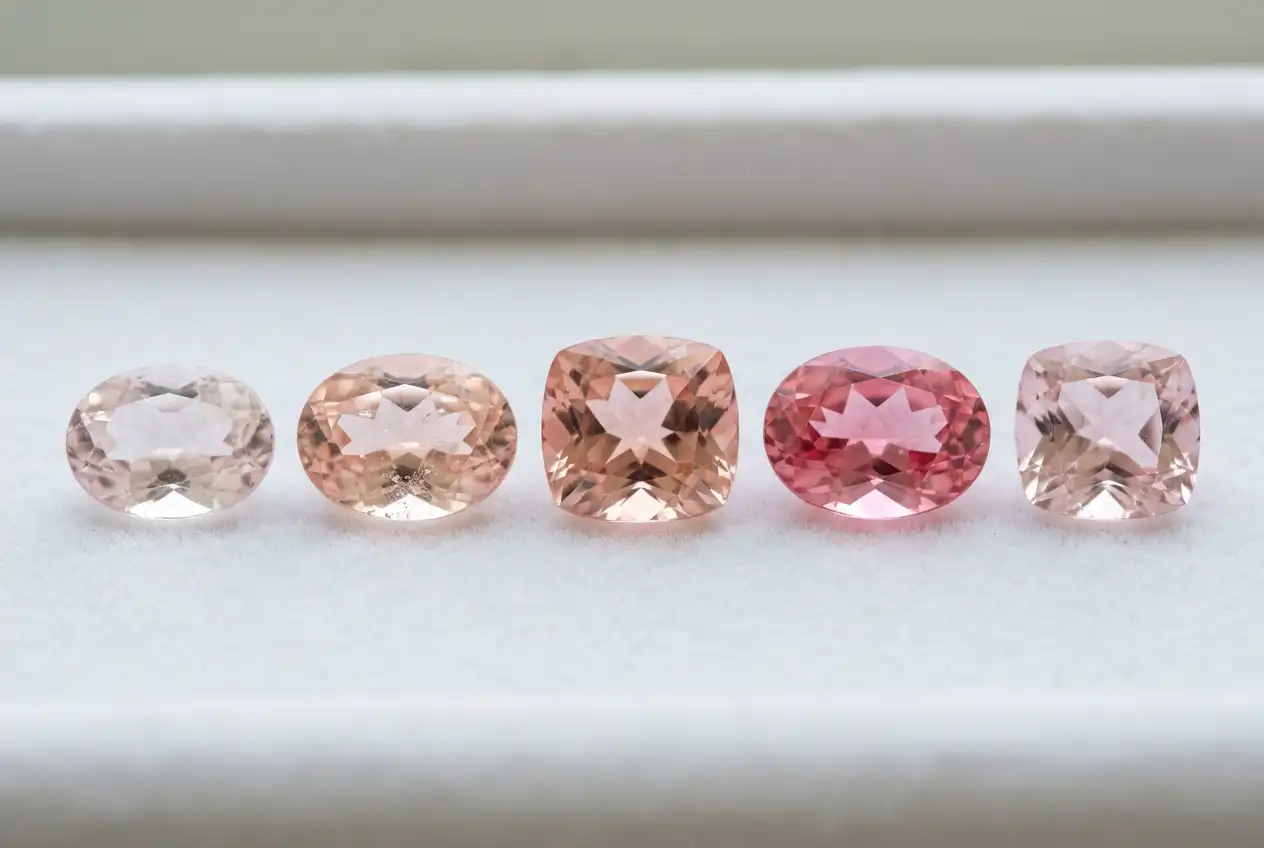
Morganite Quality Grading: 7 Essential Rules for Color Depth
Morganite quality grading should begin with color depth, hue, and brightness before moving to clarity, cut, size, treatment, and overall visual balance. Fine morganite usually displays a clearly recognizable pink, rose-pink, or attractive peach-pink body color rather than appearing nearly colorless. The stone should remain transparent and lively, with proportions that support its subtle color instead of allowing a large pale window through the center.
Morganite is the pink to peach variety of beryl, and its coloration is associated primarily with manganese. It belongs to the same mineral species as emerald and aquamarine but follows a different quality pattern. Morganite often occurs with high clarity, so an eye-clean stone is relatively common. Color is therefore usually a more important grading distinction than microscopic clarity, particularly when comparing stones that already look clean without magnification.
There is no universally adopted morganite grading system equivalent to a single international color-and-clarity scale used consistently by every seller. Terms such as AAA, premium, vivid pink, or investment grade can vary substantially between merchants. Reliable morganite quality grading should therefore describe observable characteristics rather than treating commercial letter grades as fixed scientific standards.
7 Essential Rules for Grading Morganite Color Depth
- Prioritize visible saturation: Fine morganite should show a recognizable pink, rose, peach-pink, or salmon color rather than appearing washed out or almost colorless.
- Evaluate hue modifiers: Attractive pink and peach combinations are desirable, while strong brownish or grayish modifiers usually reduce freshness and value.
- Judge tone with saturation: The stone should be light enough to remain bright but deep enough for the body color to stay visible in normal lighting.
- Assess clarity after color: Eye-clean transparency is preferred, but microscopic perfection usually matters less than rich color and strong cutting.
- Examine cut and color concentration: Good proportions should strengthen brilliance and help the gem display color evenly without a large central window.
- Consider size and color together: Larger morganite can show stronger apparent color, but high grade requires quality to remain consistent rather than relying on carat weight alone.
- Account for treatment and accurate identity: Heat-treated natural morganite, untreated morganite, laboratory-grown beryl, and simulants should be described separately rather than graded as equivalent products.
Practical Morganite Quality Grades
Morganite is commonly sold with letter grades, but those grades lack universal definitions. A practical system based on visible color, transparency, and cutting is more useful for comparing stones from different sellers.
| Quality Level | Color | Clarity and Transparency | Cut and Overall Appearance |
|---|---|---|---|
| Low commercial | Very pale, weak pink or peach, sometimes nearly colorless | May contain visible inclusions or cloudiness | Basic cutting, possible windowing |
| Commercial | Light pink or peach | Usually transparent and reasonably clean | Acceptable symmetry and brilliance |
| Good | Distinct pink, peach-pink, or salmon | Eye-clean to casual viewing | Good proportions and polish |
| Fine | Strong pink or rose-pink with attractive brightness | Excellent transparency with few distractions | Well-proportioned, lively cut |
| Exceptional | Unusually saturated, balanced pink with strong visual presence | Very clean appearance and high transparency | Superior cutting, color distribution, and finish |
These descriptions are not official laboratory grades. A peach-pink stone can be finer than a nominally rose-colored stone when its saturation, brightness, transparency, and cutting are substantially better. Morganite should therefore be judged as a complete gemstone rather than by one color word.
Color Saturation Is the Foundation of Morganite Quality
Morganite is naturally known for delicate colors, and much of the available rough produces pale stones. Fine quality begins when the hue is immediately recognizable without requiring favorable lighting or a colored background to make the gem look pink.
Saturation describes the strength or purity of the color. A strongly saturated stone looks clearly pink or peach rather than diluted with large amounts of gray or brown. Saturation should not be confused with darkness. A light stone can have attractive clean saturation, while a darker stone can look muddy if unwanted modifiers dominate.
Pink morganite is especially popular in fine jewelry, but peach and salmon tones are legitimate parts of the variety’s natural range. Preference varies by market and design. A warm peach-pink stone set in rose gold may appear particularly harmonious, while a cleaner pink gem can stand out against white metal.
Extremely pale stones deserve careful comparison because bright showroom lights can make them appear more colorful than they look in ordinary environments. Viewing several stones against a neutral background helps reveal whether the body color is genuinely distinct or mostly an effect of lighting and surrounding metal.
Hue, Tone, and Color Depth Must Be Judged Together
Hue describes the basic color impression, while tone describes how light or dark that color appears. Morganite grading becomes more accurate when these characteristics are considered together with saturation.
A medium-light pink stone can show excellent brightness while still carrying enough color to remain visibly morganite. A stone that is too light may lose its identity at normal viewing distance, while excessively dark or brownish examples can appear less lively.
Peach is not automatically a lower grade than pink. Some untreated or less modified morganite naturally has noticeable peach or orange-pink character and can be exceptionally attractive. The issue is whether the hue appears clean and intentional rather than dull, brown, or gray.
Lighting affects these judgments considerably. Warm incandescent light can emphasize peach and orange components, while cooler daylight may make a stone appear pinker. High-quality grading should therefore use neutral lighting and compare stones under more than one realistic environment.
Color zoning can also influence the grade. A gemstone whose face-up color is evenly distributed usually appears more refined than one with obvious pale and dark sections. Skilled orientation during cutting can reduce the visibility of zoning and improve the apparent consistency of the finished stone.
Clarity Matters, but Morganite Is Commonly Clean
Morganite often has good natural transparency, particularly compared with emerald. Many faceted stones are eye-clean, meaning inclusions are not readily visible without magnification. As a result, clarity differences above the eye-clean level may contribute less to quality than color and cutting.
This does not make inclusions irrelevant. Large fractures, cloudy zones, or prominent internal features can reduce transparency and interrupt brilliance. Surface-reaching fractures may also present durability concerns if they occur near vulnerable edges or corners.
Inclusions beneath the table are generally more noticeable than similar features close to the girdle. Step cuts such as emerald shapes can reveal internal features more clearly because their broad facets provide longer views through the interior, while brilliant-style cuts may disguise small inclusions among reflections.
For most buyers, an eye-clean morganite with rich color and excellent cutting will offer better visual quality than a microscopically cleaner stone that is pale or poorly proportioned. A grading system that places clarity ahead of color can therefore misrepresent what makes morganite desirable.
Cut Quality Controls Brilliance and Perceived Color
Morganite’s pale color means cutting errors can be particularly noticeable. A large central window allows the viewer to see through the gem and can make the body color appear weaker. Proper pavilion angles and depth help return light and can strengthen the overall impression of saturation.
A stone should also have reasonable face-up spread for its carat weight. Excessive depth can preserve weight but make the gem look smaller from above. High-grade cutting seeks a balance between visual size, light return, and color concentration rather than simply retaining as many carats as possible.
Symmetry is important across all shapes. Ovals should have balanced ends, pears should have properly aligned points and shoulders, cushions should not appear unintentionally lopsided, and emerald cuts should display straight, coordinated step facets.
Polish should be smooth and reflective without obvious facet scratches, abrasions, or poorly joined edges. Morganite has sufficient hardness to accept a fine polish, so weak surface finishing is usually a craftsmanship issue rather than an unavoidable natural feature.
Cutting style can also influence personality. Brilliant and modified brilliant cuts create greater scintillation, while step cuts emphasize transparency and broad flashes. Neither style is intrinsically superior, but the design should complement the rough and preserve visible color.
How Size Changes the Appearance of Morganite Color
Morganite can form sizeable crystals, making large faceted gems far more accessible than similarly clean stones in many rarer varieties. Larger size can also strengthen apparent color because light travels through a greater volume of the gemstone.
This effect explains why a ten-carat light-pink morganite may appear more colorful than a two-carat stone cut from rough with similar inherent saturation. Size can therefore assist color presentation, but it should not be mistaken for quality by itself.
A large stone with strong pink saturation is more selective because maintaining rich color, clean transparency, and excellent cutting across substantial dimensions is less common than finding a large pale crystal. High-grade large morganite should therefore combine size with quality rather than use weight as a substitute for it.
Buyers should also compare dimensions. A deeply cut stone can carry many carats below the setting while presenting a relatively small face-up area. High quality includes efficient use of weight as well as visible beauty.
Heat Treatment and How It Fits Into Morganite Grading
Heat treatment is widely used with morganite to modify color, particularly by reducing yellow or orange components and producing a cleaner pink appearance. Heating does not turn the stone into a synthetic gemstone. The gem remains natural beryl whose color has been modified through treatment.
A treated stone can still rank highly in commercial quality when it possesses strong color, excellent transparency, and fine cutting. Treatment should therefore be considered a disclosure category rather than an automatic sign of poor quality.
Some collectors prefer untreated stones because they value color as it occurred naturally before enhancement. A credible untreated designation can influence desirability for those buyers, particularly when the color is already strong. Such claims are more meaningful when supported by reliable gemological evidence rather than visual assumption.
The important distinction is between natural morganite that has been treated and products that are not natural morganite at all. Laboratory-grown beryl may be chemically and structurally similar but has an artificial growth origin, while glass and other simulants merely imitate appearance. These categories should not share one quality grade.
Morganite Durability and Surface Quality
Morganite has a Mohs hardness of approximately 7.5 to 8, providing useful resistance to everyday scratching. It is sufficiently durable for many jewelry applications, including rings, pendants, and earrings, when worn with reasonable care.
Hardness should not be interpreted as immunity from damage. Facet edges and pointed shapes can chip if struck against hard objects, while inclusions or fractures may create local weaknesses. Protective settings can be useful for large center stones intended for frequent wear.
Surface quality is part of grading because abrasions along facet junctions can make a transparent stone look dull. Fine morganite should display crisp facet edges and a clean polish. Secondhand stones may show wear that can sometimes be improved through professional repolishing, although recutting can reduce weight.
Cleaning also influences appearance. Morganite can accumulate oils and residue that reduce brilliance, especially when worn frequently in rings. A stone that appears dull may simply require appropriate cleaning rather than having poor inherent quality.
Morganite Versus Other Pink Beryl and Pink Gemstones
Morganite is defined as the pink to peach-colored variety of beryl. Emerald and aquamarine belong to the same mineral species but are different varieties distinguished principally by color and the trace elements associated with it.
A pale pink stone should not be called pink emerald simply to increase perceived prestige. Morganite is the established varietal name, and accurate nomenclature helps buyers compare quality realistically.
Pink sapphire, kunzite, pink tourmaline, rose quartz, and other pink gemstones should also be evaluated through their own mineralogical standards. A pink color match does not make them equivalent in hardness, refractive properties, durability, rarity, or price.
Morganite’s combination of beryl hardness, good clarity, large available sizes, and gentle color makes it distinctive. Its grading should therefore reflect what makes fine morganite exceptional rather than borrowing rarity assumptions from unrelated gemstones.
A Reliable Way to Compare Two Morganite Stones
Start with color against the same neutral background. Determine which stone looks more distinctly pink or peach without becoming brownish, grayish, or excessively pale. View both under consistent lighting because small changes in illumination can alter subtle morganite tones.
Next compare face-up dimensions and cutting. Look directly through the center for windowing and inspect the outline for symmetry. Tilt the stones to judge brilliance, extinction, and whether color remains evenly distributed as the viewing angle changes.
Clarity should then be examined without magnification before moving to a loupe. If both stones appear eye-clean, microscopic differences may have little practical impact. Large fractures or obvious inclusions should receive more attention than minor internal features visible only under magnification.
Finally, compare treatment disclosure, actual carat weight, dimensions, and price. If one stone costs substantially more, the premium should ideally correspond to stronger color, superior cutting, larger useful spread, credible untreated status, or another quality difference that is visible or meaningful to the buyer.
Conclusion
Morganite quality grading depends most strongly on color saturation, hue, tone, clarity, cut, size, treatment, and accurate identification. Fine morganite should display a clearly visible and attractive pink or peach-pink color while remaining transparent, lively, and well proportioned.
The highest commercial grade is not necessarily the largest or microscopically cleanest stone. A smaller morganite with richer color and superior cutting can outrank a much heavier gem whose appearance is pale or poorly balanced. Direct comparison of color depth and face-up performance provides a more reliable assessment than seller-created grade labels.
FAQs About Morganite Quality Grading
What does high-quality morganite look like?
High-quality morganite usually displays a clearly visible pink, rose-pink, or attractive peach-pink color with good saturation and brightness. The stone should be transparent, eye-clean, well cut, evenly polished, and free from large distracting fractures. Fine examples also use their carat weight efficiently, presenting good face-up dimensions rather than hiding excessive weight in depth.
What color morganite is considered best?
Strong clean pink and rose-pink are often especially prized, but attractive peach-pink and salmon tones can also be high quality. The best color should have good saturation without looking muddy, brownish, or gray. Personal preference matters because some buyers deliberately favor warmer peach morganite over cooler pink stones.
Is pale morganite considered low quality?
Very pale morganite generally receives a lower color grade when it appears nearly colorless, particularly if a stronger pink stone is available at similar clarity and cutting quality. Pale stones can still be beautiful and may look impressive in large sizes. Their lower saturation simply makes them less selective within traditional value grading.
What does AAA morganite mean?
AAA is usually a seller-defined commercial term rather than a standardized international morganite grade. Different merchants can use it for very different color, clarity, and cutting levels. Buyers should compare actual saturation, transparency, proportions, polish, treatment disclosure, and dimensions instead of assuming all AAA stones are equivalent.
Is clarity important in morganite?
Yes, but morganite is often naturally eye-clean, so extremely high microscopic clarity is not necessarily rare enough to justify a major premium. Visible fractures, cloudiness, and obvious inclusions can lower quality, while small internal features seen only under magnification may have little influence on appearance. Color and cut often create greater visual differences between fine stones.
Does heat-treated morganite count as natural morganite?
Yes. Heat-treated morganite is still natural beryl if the crystal itself formed naturally and was later heated to modify its color. Treatment should be disclosed when known, but it does not make the gem laboratory-grown. Natural origin and treatment status are separate characteristics.
Is darker morganite always higher grade?
No. Greater saturation is desirable, but a darker tone is useful only when the stone remains bright and attractive. Brownish or grayish darkness can lower quality, while a medium-light vivid pink may look substantially finer. Hue, tone, saturation, transparency, and cutting must be judged together.
Does large size make morganite higher quality?
Large size alone does not establish grade because sizable clean morganite crystals are commercially available. Size becomes more significant when a large stone also retains strong pink saturation, excellent transparency, and fine cutting. A smaller richly colored gem can therefore grade higher than a much larger pale stone.