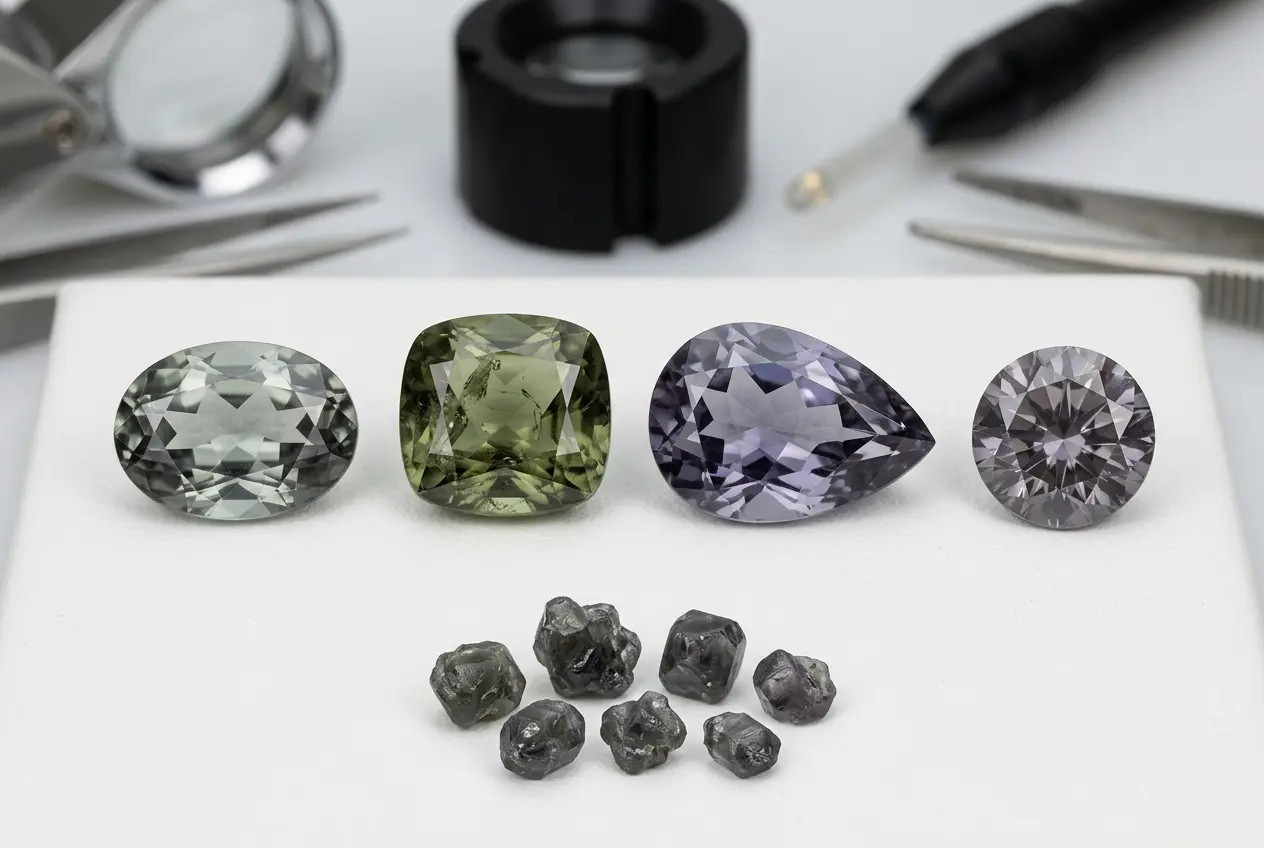
Musgravite Quality Grading: 8 Standards for Ultra-Rare Crystals
Musgravite quality grading begins with confirmed mineral identity because appearance alone cannot reliably establish that a rare transparent stone is musgravite. Once identity is secure, the main grading priorities are color, transparency, clarity, cut, carat weight, structural condition, and documentation. Fine examples are transparent, visually attractive, well cut, and sufficiently clean that inclusions do not dominate the face-up appearance, while exceptional stones combine those characteristics at a size rarely encountered in the market.
Musgravite is associated with the taaffeite mineral group and remains one of the rarest gemstones encountered in faceted form. Its familiar name comes from the Musgrave region of South Australia, where it was first recognized. Mineralogical nomenclature within this group has been refined over time, so professional reports may use more precise species terminology. In the gem trade, musgravite remains the best-known name for the ultra-rare gem buyers and collectors seek.
There is no universal commercial grading scale for musgravite comparable with widely applied diamond systems. Terms such as AAA, investment grade, museum grade, or exceptional quality are therefore seller descriptions rather than standardized international grades. Because available stones are so few, quality comparison must be based on measurable characteristics and direct observation instead of commercial labels.
8 Standards for Grading Ultra-Rare Musgravite Crystals
- Confirm mineral identity: The stone should be identified through appropriate gemological or laboratory testing rather than color or seller assertion alone.
- Evaluate color quality: Attractive gray-green, olive, violet-gray, purplish, greenish, and related tones should appear lively rather than muddy, excessively brown, or overly dark.
- Assess transparency: Fine faceted musgravite should transmit light well and avoid heavy cloudiness that suppresses brilliance.
- Grade clarity realistically: Eye-clean or nearly eye-clean stones are highly desirable, while visible inclusions should be judged by position, size, and effect on durability.
- Examine cutting quality: Proportions, symmetry, polish, and facet alignment should make efficient use of exceptionally scarce rough.
- Consider carat weight with quality: Larger stones deserve stronger grades only when attractive color, transparency, clarity, and cutting remain consistent.
- Inspect structural condition: Chips, open fractures, surface-reaching inclusions, abrasion, and durability concerns should be distinguished from harmless internal characteristics.
- Verify documentation and provenance: Laboratory reports, credible locality information, and traceable ownership history can materially strengthen confidence in an ultra-rare stone.
A Practical Musgravite Quality Framework
Because only a small number of confirmed faceted musgravites enter the market, quality categories must remain flexible. A collector may accept visible inclusions in a large stone because the size itself is exceptional, while another buyer may prefer a much smaller but cleaner specimen.
A practical framework can still describe how the main characteristics tend to interact.
| Quality Level | Color and Transparency | Clarity and Cut | Overall Assessment |
|---|---|---|---|
| Lower gem quality | Muted color, moderate transparency | Visible inclusions or basic cutting | Genuine but primarily rarity-driven |
| Good collector quality | Attractive gray-green, olive, violet-gray, or related hue | Reasonably clean with competent cutting | Strong specialist collector appeal |
| Fine | Pleasing color, high transparency and brightness | Limited distracting inclusions, excellent cut | Rare high-quality faceted gem |
| Exceptional | Strong visual balance, bright transparent body | Eye-clean appearance, precise symmetry and polish | Highly selective size-quality combination |
| Museum-level | Exceptional size, rarity, appearance, and documentation | Quality significant enough for institutional or major private collections | Individually assessed |
These descriptions should not be interpreted as official gemological grades. Musgravite rarity means that a stone falling short of conventional perfection can still be important because there may be very few confirmed alternatives in its size range.
Identity Is the First and Most Important Grading Standard
No meaningful musgravite grade can be assigned until the gemstone’s identity is credible. This is more important than with many common gemstones because visually similar stones can have dramatically different market values.
Taaffeite is the closest commercial comparison because it belongs to the same general mineralogical group and can overlap in color and appearance. Spinel and sapphire may also resemble certain musgravites, particularly in small faceted stones where subtle optical differences are difficult to recognize without instruments.
A basic visual examination can therefore suggest possibilities but should not be treated as definitive. Refractive properties, specific gravity, optical character, spectroscopy, chemical composition, and other advanced observations may be used by laboratories depending on what is necessary to separate related minerals.
For a valuable stone, identification should ideally be supported by a respected laboratory capable of dealing with rare mineral species. A seller-created certificate that merely repeats the commercial name adds much less confidence than an independent report based on measured properties.
Quality grading begins only after this step because a beautifully cut spinel is still not musgravite, regardless of how closely the color resembles one.
How to Judge Musgravite Color Quality
Musgravite does not have one universally accepted premium color. Natural stones have been reported in several subdued hues, including grayish green, olive, greenish, brownish, purplish, violet-gray, and related colors. Because faceted examples are so scarce, the market rewards visually attractive color rather than forcing every stone into one ideal hue.
The best color should appear clean enough to remain recognizable under neutral light. Heavy brown or gray modifiers can reduce brightness when they dominate the stone, while a balanced gray-green or violet-gray gem can appear sophisticated and lively.
Tone is equally important. A stone that is too dark may lose transparency and brilliance, particularly in deep cutting. A moderately light stone may show weaker saturation but return substantially more light, producing a better overall appearance.
Saturation should therefore be considered together with brightness. Musgravite is not typically valued for extremely vivid color, so expecting ruby-like or sapphire-like intensity would be unrealistic. Fine grading should respect the natural color range of the mineral.
Color distribution also matters. Obvious zoning or uneven dark areas can reduce visual balance, while well-oriented cutting may make subtle color appear more consistent across the face.
Transparency and Light Return in Fine Musgravite
Transparency is a major quality separator because many rare mineral crystals never produce attractive faceted gems. Fine musgravite should transmit light sufficiently well for the cut to create brilliance rather than appearing cloudy or opaque.
A transparent stone can still look weak if the proportions are poor. Windowing through the center allows light to pass straight through instead of returning to the viewer, while excessive depth may create dark extinction and reduce face-up spread.
Good transparency therefore needs good cutting. A fine stone should appear alive as it moves, with reflections distributed through the crown rather than concentrated around the edge.
Cloudy zones, dense inclusion concentrations, or numerous fractures can reduce transparency substantially. Their effect should be judged visually rather than by simply counting internal features.
The rarity of musgravite means collectors may accept moderate transparency in a historically important or unusually large specimen. For a gemstone graded primarily for faceted beauty, however, strong transparency remains one of the most desirable characteristics.
Clarity Standards Should Reflect Extreme Rarity
Eye-clean musgravite is exceptionally desirable, but clarity standards should be realistic. Applying the expectations used for abundant laboratory-grown gemstones would ignore how rarely facetable musgravite occurs.
Natural inclusions may include crystals, fractures, growth-related structures, or other features developed during crystal formation. These can provide evidence of natural origin, although inclusions alone do not establish mineral identity.
Location matters greatly. A small inclusion near the girdle may have little effect on beauty, while a similarly sized feature beneath the table can become obvious in face-up viewing. Surface-reaching fractures deserve additional attention because they may affect durability.
For very large musgravite, collectors may tolerate visible inclusions that would reduce the grade of a smaller stone. Size rarity can partially offset clarity limitations, particularly when transparency remains good.
The highest gem-quality grade should still be reserved for stones where inclusions do not distract significantly. Rarity can explain why an included stone remains valuable, but it does not make the inclusions disappear from a quality assessment.
Cut Quality Is Critical When Rough Is Nearly Irreplaceable
Cutters working with musgravite face a difficult compromise. Removing more rough can improve symmetry, brightness, or clarity, but every fraction of a carat lost may represent exceptionally scarce gemstone weight.
Poor cutting should not be excused completely because of rarity. A heavily windowed stone, crooked outline, or rough polish can reduce beauty substantially. High-quality cutting should retain reasonable weight while still producing a gemstone that looks intentional and lively.
Facet alignment is especially important in transparent stones because misaligned junctions can create uneven reflections. A centered table, consistent girdle, balanced pavilion, and clean polish all contribute to visual quality.
Custom cuts are understandable when the original rough has an unusual shape. Preserving a rare crystal may require an oval, cushion, mixed cut, or freeform design rather than a standardized calibrated shape. The quality question is whether the chosen design maximizes beauty and usable size.
Face-up dimensions should also be considered. A very deep stone may carry impressive carat weight but appear unexpectedly small when viewed from above. Fine cutting makes efficient use of rare mass rather than preserving hidden weight without visual benefit.
Why Size Changes Musgravite Quality Expectations
Carat weight has unusual importance in musgravite grading because larger faceted stones are extremely difficult to replace. A one-carat example may already be important, while a substantially larger fine stone can belong to a far more exclusive category.
Size should never operate independently from quality. A larger stone can have stronger collector importance despite moderate inclusions, but a cloudy, damaged, poorly cut example does not become exceptional merely because it is heavy.
The most important size premium occurs when several characteristics survive together. A large stone that remains transparent, attractively colored, reasonably clean, well cut, and documented is considerably rarer than a large stone possessing only weight.
This interaction makes grading less rigid than in high-volume commercial gems. A specialist collector may deliberately choose a larger slightly included stone over a smaller eye-clean gem because the larger example fills a rarer category. Neither choice is inherently incorrect.
Quality descriptions should therefore state both size and visual characteristics rather than hiding every trade-off behind one letter grade.
Structural Condition and Durability
Musgravite is a relatively hard gemstone, commonly placed around 8 to 8.5 on the Mohs scale. This provides good resistance to scratching compared with many jewelry stones, although hardness does not make a gemstone immune to chipping or fracture.
Open cracks, chipped corners, abraded facet junctions, and damage around the girdle reduce quality. Surface-reaching inclusions deserve close inspection before setting because stress from prongs can aggravate vulnerable areas.
A rare stone may have undergone several rounds of handling, examination, or recutting before reaching the market. Existing wear should therefore be distinguished from natural inclusions inside the gemstone.
Polish quality is also part of structural assessment. Fine facets should appear smooth under magnification rather than covered with scratches, pits, or incomplete polishing marks.
For valuable musgravite intended for jewelry, setting design matters. A protective mount that reduces direct impact can preserve both beauty and financial value, particularly when replacement would be extremely difficult.
Laboratory Reports, Provenance, and Naming Accuracy
Documentation is part of quality evaluation because the market value of musgravite depends strongly on confidence in what the stone actually is. A professional report should clearly identify the gemstone using terminology appropriate to the laboratory’s mineralogical standards.
Buyers may occasionally encounter differences between older trade names and current formal mineral names. Such differences do not necessarily indicate an error. Mineral classification evolves as analytical understanding improves, and rare members of the taaffeite group have received more precise nomenclature over time.
The important question is whether the laboratory’s identification supports the seller’s commercial description. When terminology differs, the seller should be able to explain the relationship rather than ignoring it.
Provenance can add another layer of confidence. Information about the source locality, previous owner, discovery history, or earlier reports can help establish a traceable chain for important stones.
For routine faceted gems, provenance remains secondary to confirmed identity and visual quality. For museum-level or historically significant examples, it can become an important part of the overall grade.
Musgravite Versus Taaffeite and Spinel
Musgravite, taaffeite, and spinel can overlap visually enough that unaided identification is unreliable. All may occur in muted colors, and a small faceted stone can appear deceptively similar under ordinary jewelry lighting.
Spinel is a separate mineral species and is far more widely available. Taaffeite is much rarer than spinel but still distinct from musgravite within the relevant mineralogical classification. Their different market rarity makes accurate separation financially significant.
A buyer should therefore be cautious when a stone is sold as musgravite based merely on color resemblance or an old verbal history. The rarer the claimed identity and the higher the price, the stronger the case for independent testing.
This caution does not diminish musgravite’s appeal. Instead, it protects the integrity of a gemstone whose rarity is genuine and whose market depends heavily on correct identification.
A Reliable Method for Comparing Two Musgravite Stones
Begin with the laboratory reports rather than the color. Confirm that both stones have comparable and credible identification. If one lacks independent documentation, the price comparison is already incomplete.
Next examine them under the same neutral lighting. Compare hue, tone, saturation, transparency, and brightness. Decide which stone looks more attractive rather than assuming the rarest or largest must automatically be superior.
Then inspect clarity face-up without magnification. Note any visible inclusions, fractures, or cloudy areas before using magnification to understand their exact position and character. A feature visible only under a loupe may have little effect on overall beauty.
Evaluate cut by examining face-up spread, windowing, extinction, symmetry, and polish. A smaller but well-proportioned stone may present far better than a heavier gem carrying unnecessary depth.
Finally, consider size, provenance, and replacement difficulty. If one stone is significantly larger while preserving similar quality, its rarity may justify a major premium. The final grade should explain that advantage directly rather than relying on an undefined word such as premium.
Conclusion
Musgravite quality grading requires eight core considerations: confirmed identity, color, transparency, clarity, cut, carat weight, structural condition, and documentation. The rarity of the gemstone changes how these factors are balanced, especially when a larger stone has minor inclusions that would receive less tolerance in a common gem.
The finest musgravite combines credible laboratory identification with attractive color, strong transparency, limited visible inclusions, excellent cutting, sound condition, and meaningful size. Commercial labels are far less useful than direct examination and professional documentation when evaluating a gemstone this rare.
FAQs About Musgravite Quality Grading
What does high-quality musgravite look like?
High-quality musgravite is transparent, well cut, attractively colored, and sufficiently clean that inclusions do not dominate the face-up appearance. Fine stones may show gray-green, olive, violet-gray, purplish, or related hues. Exceptional examples combine these visual qualities with unusual size and respected laboratory documentation.
Is there an official AAA grade for musgravite?
No universal AAA system is recognized across the musgravite market. AAA, premium, museum grade, and similar labels are commercial descriptions whose meanings can vary between sellers. Confirmed identity, color, transparency, clarity, cut, weight, condition, and documentation provide a more reliable quality assessment.
What color musgravite is considered best?
There is no single universally preferred hue because gem-quality musgravite is too scarce for the market to revolve around one narrow color standard. Attractive gray-green, olive, violet-gray, purplish, and related tones can all be desirable. Brightness, saturation, tone, and transparency matter more than matching one exact color name.
How important is clarity in musgravite?
Clarity is important, particularly when inclusions reduce transparency or appear prominently beneath the table. However, musgravite is so rare that collectors may accept visible inclusions in larger or otherwise exceptional stones. Eye-clean examples receive strong premiums because the combination of natural rarity and clean transparency is especially difficult to obtain.
Does larger musgravite automatically receive a higher grade?
No. Larger size substantially increases rarity, but quality still depends on color, transparency, clarity, cut, and condition. A smaller fine stone can be visually superior to a larger included or poorly cut gem. Size has its greatest grading impact when strong quality remains consistent as carat weight increases.
Why does musgravite need laboratory identification?
Musgravite can resemble taaffeite, spinel, sapphire, and other transparent gemstones, while its market value depends heavily on its rare mineral identity. Visual examination alone cannot reliably establish the distinction. Professional laboratory testing provides much stronger confidence for high-value purchases.
Is musgravite durable enough for jewelry?
Musgravite is relatively hard, generally around 8 to 8.5 on the Mohs scale, giving it good resistance to scratching. Like any faceted gemstone, it can still chip or fracture if struck sharply, particularly around thin girdle areas or existing fractures. Protective settings are sensible because replacing a rare stone can be difficult.
Can musgravite be confused with taaffeite?
Yes. Musgravite and taaffeite are closely related minerals and can overlap considerably in appearance. Correct separation may require detailed gemological or laboratory analysis. This is one of the main reasons independent documentation is particularly valuable when buying musgravite.