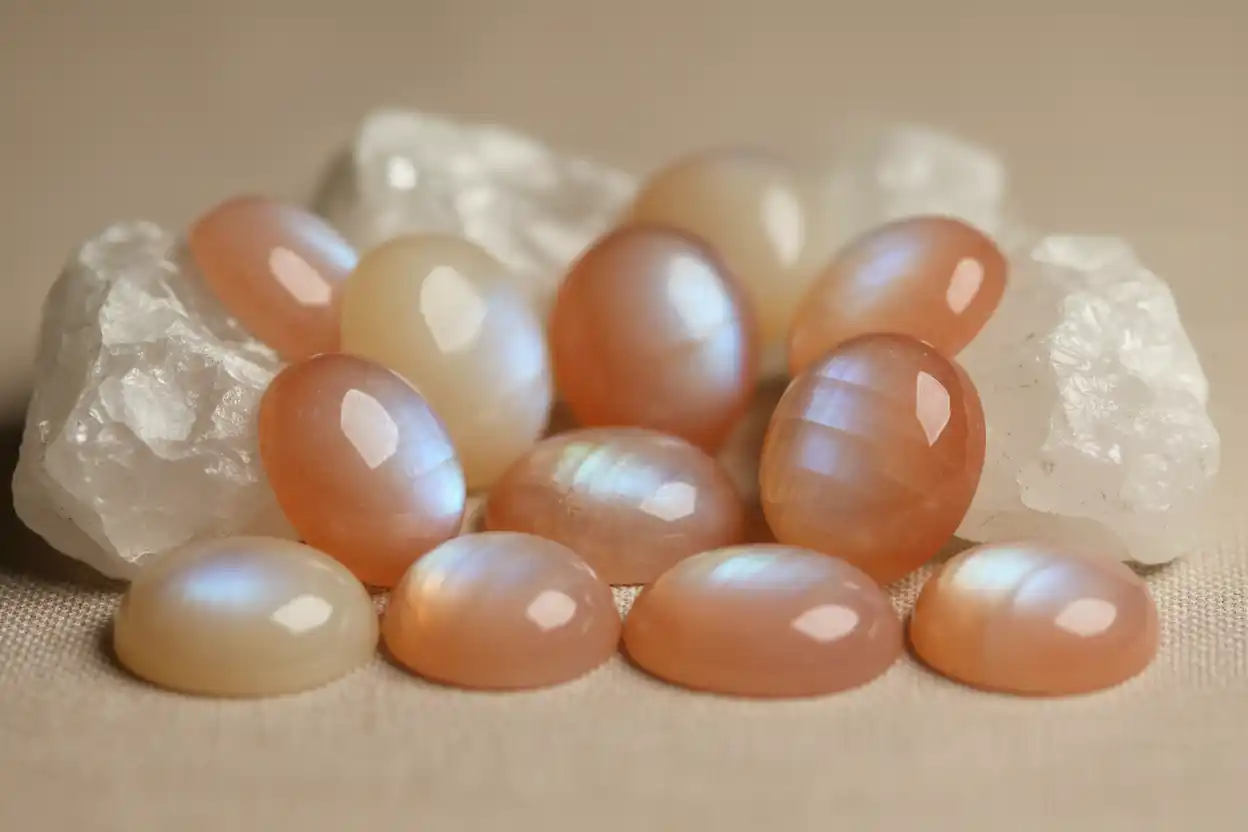
Peach Moonstone Meaning, Properties, Identification & Value
Peach Moonstone is a commercial name for peach, apricot, salmon, cream-orange, or pinkish-orange feldspar sold within the moonstone family. The best examples display adularescence: a soft glow that appears to float beneath the surface as the stone moves.
The name is used inconsistently. Some pieces are true adularescent potassium feldspar, while others may be different feldspar compositions, weakly phenomenal material, or ordinary peach-colored feldspar marketed through the moonstone name.
Peach Moonstone at a Glance
| Property | Peach Moonstone |
|---|---|
| Material type | Warm-colored feldspar trade variety |
| Typical mineral identity | Commonly alkali feldspar or moonstone-type feldspar; exact species can vary and should be tested |
| General composition | Variable feldspar aluminosilicate rather than one universal peach-moonstone formula |
| Common colors | Pale peach, apricot, cream-orange, pink-orange, salmon, tan, beige, and brownish peach |
| Optical effects | White, silver, cream, or occasionally blue adularescence; some pieces also contain glittering inclusions |
| Crystal system | Depends on feldspar species; commonly monoclinic or triclinic at the mineral level |
| Typical form | Massive rough, cleavable pieces, cabochons, beads, carvings, tumbles, and occasional faceted stones |
| Luster | Vitreous to pearly |
| Transparency | Transparent to opaque, commonly translucent |
| Mohs hardness | Approximately 6–6.5 |
| Cleavage | Two strong directions typical of feldspar |
| Tenacity | Brittle |
| Specific gravity | Commonly around 2.56–2.65, depending on composition |
| Common uses | Cabochons, beads, pendants, earrings, rings, bracelets, carvings, palm stones, and decorative objects |
| Main care concern | Cleavage chipping, weak or absent adularescence, mislabeling, dye or coating, and scratches from harder gems |
Peach Moonstone within the Feldspar Family
Peach Moonstone belongs to the feldspar family, whose members include potassium feldspars and the sodium-calcium plagioclase series.
Traditional moonstone descriptions focus on intimate intergrowths of potassium-rich orthoclase and sodium-rich albite. Light scatters between microscopic layers, producing adularescence.
However, moonstone-like iridescence also occurs in microcline, sanidine, albite-rich feldspar, oligoclase, and labradorite.
Consequently, the exact mineral species cannot be assumed from the words peach moonstone alone.
The parent moonstone guide owns the broader formation, history, symbolism, birthstone role, and optical phenomenon.
This page focuses on warm bodycolor, identification risks, commercial naming, inclusions, value, and care.
What Makes a Feldspar Moonstone?
Strict gemological use requires adularescence or a closely related moonstone optical effect.
The glow should appear beneath the surface rather than as a fixed external shine. It moves as the stone, light, or viewer changes position.
Commercial usage is looser. Many peach feldspar beads and carvings are sold as moonstone even when their adularescence is faint or absent.
A piece can be attractive peach feldspar without meeting a strict phenomenal-moonstone definition.
The distinction matters for value. A strongly adularescent cabochon should command more than an opaque feldspar bead whose principal feature is only color.
The wider visual categories are separated in types of moonstone.
How Adularescence Forms
Feldspar compositions mix more extensively at high temperatures than they do after cooling.
As a feldspar cools, sodium-rich and potassium-rich components can separate into extremely thin intergrowth layers.
Light entering the stone encounters boundaries between those layers. Scattering and interference create a soft glow that appears to billow or move.
Layer thickness influences color. Very fine structures can create blue adularescence, while thicker or less regular structures commonly produce white, silver, cream, or broader warm-toned effects.
Peach Moonstone usually displays white-to-cream glow over a peach body rather than the intense blue flash associated with fine colorless moonstone.
The cutter must orient the cabochon so the relevant layers lie beneath the dome at the correct angle. Poor orientation can reduce the glow dramatically.
What Causes the Peach Color?
Peach color in feldspar can arise from iron-bearing inclusions, iron-related impurities, microscopic hematite, goethite, altered mineral particles, and deposit-specific structural effects.
The precise cause is not identical in every commercial source.
Fine iron-oxide platelets may create a warm background without producing obvious sparkle. Larger oriented platelets can produce visible aventurescence, moving the material closer to a sunstone appearance.
Brown, tan, cream, and pink zones may also reflect alteration, exsolution, cracks, and varying inclusion concentrations.
Therefore, every peach stone should not be assigned one unsupported claim such as copper color or hematite color without analysis.
Dye and coatings can also produce stronger peach, pink, or orange shades. Treatment remains a separate possibility from natural iron-related color.
Peach Moonstone and Orthoclase
Orthoclase is a potassium feldspar with the ideal formula KAlSi₃O₈.
Traditional moonstone can consist mainly of orthoclase containing microscopic albite intergrowths.
Some Peach Moonstone falls within this model. However, other warm feldspars may be microcline, sanidine, albite-rich material, oligoclase, or mixed feldspar.
A seller who assigns the orthoclase formula automatically to every peach bead strand oversimplifies the market.
Laboratory testing can use refractive index, density, microscopy, Raman spectroscopy, X-ray diffraction, and chemical analysis to determine the feldspar species more accurately.
Peach Moonstone and Sunstone
Sunstone displays aventurescence from reflective platelets or inclusions, commonly copper, hematite, goethite, or related minerals.
The effect appears as individual glittering reflections. Adularescence instead looks like a smoother floating glow.
Some peach feldspar displays both effects. A stone may show soft white adularescence in one direction and tiny golden or reddish sparkles in another.
Retailers may call such material Peach Moonstone, peach sunstone, moonstone-sunstone, or peach aventurine feldspar.
No product name can replace observation. Buyers should ask whether the stone shows a broad moving glow, distinct glitter, both phenomena, or only bodycolor.
Peach Moonstone and Rainbow Moonstone
Rainbow Moonstone is usually transparent white labradorite rather than traditional orthoclase moonstone.
It commonly displays blue, green, yellow, orange, or multicolored labradorescence.
Peach Moonstone generally has a warm peach-to-orange bodycolor with white, silver, or cream adularescence.
A transparent stone with blue and orange flashes but no peach bodycolor may be rainbow moonstone rather than Peach Moonstone.
Conversely, an opaque peach feldspar with no moving light should not receive a rainbow label merely because it contains several color patches.
Peach and White Moonstone
White Moonstone has a white, cream, colorless, or light-gray body.
Peach material can contain white areas, particularly in banded beads or mixed rough. Those zones may reflect lower concentrations of iron-rich inclusions or another feldspar growth region.
A white glow over a peach body is normal and should not be confused with a white surface coating.
The value difference depends on effect and quality rather than a fixed rule that one color is superior.
Fine white moonstone with blue adularescence can command more than ordinary Peach Moonstone, while an unusually clean and strongly glowing peach cabochon may exceed low-grade white material.
Peach Moonstone and Labradorite
The visual distinction between moonstone and labradorite becomes difficult in translucent warm-colored material.
Traditional labradorite falls within a more calcium-rich plagioclase composition and commonly shows broad labradorescence.
Moonstone is associated with a softer adularescent glow and often a more sodium- or potassium-rich feldspar composition.
However, commercial rainbow moonstone is commonly labradorite, demonstrating that trade names do not always follow strict mineral boundaries.
The dedicated labradorite-versus-moonstone comparison owns the full optical and compositional separation.
Commercial Sources
India supplies much of the Peach Moonstone sold as beads, cabochons, carvings, and palm stones.
Indian material can range from pale cream-peach to reddish orange and may contain white glow, dark mineral inclusions, fractures, and aventurescent particles.
Madagascar supplies peach, cream, gray, and multicolored feldspars, including material marketed as moonstone and sunstone.
Sri Lanka has a long history of moonstone production and yields warm-toned feldspar among its wider gem gravels.
Tanzania and other East African regions also supply orange, pinkish, aventurescent, and adularescent feldspars.
A country of sale does not prove geological origin. India is also a major cutting and export center for rough mined elsewhere.
Fine locality claims require documentation because finished cabochons rarely preserve a diagnostic crystal shape or attached host rock.
How to Identify Peach Moonstone
Rotate the stone beneath a single concentrated light. Genuine adularescence should move below the surface rather than remain fixed.
A well-oriented cabochon commonly shows a broad white or cream glow traveling across the dome.
Magnification may reveal feldspar cleavage, intergrowth textures, iron-oxide platelets, mineral inclusions, healed fractures, polish lines, resin, dye, or coating.
Feldspar hardness lies around 6–6.5. Quartz can scratch it, while a steel point may or may not mark it depending on orientation and pressure.
Destructive scratch testing is inappropriate for a finished stone and cannot establish a specific feldspar species.
Specific gravity and refractive index help separate feldspar from glass, calcite, quartz, opal, and other materials.
Raman spectroscopy and X-ray diffraction can determine the mineral more accurately, although complex intergrowths may require careful interpretation.
The full sequence appears in how to identify crystals.
Common Imitations and Mislabeling
Opalescent glass can imitate a milky peach glow. Round bubbles, flow lines, uniform bodycolor, and a surface-like sheen may reveal it.
Resin and plastic can appear unusually light, warm, or easily scratched.
Dyed white feldspar, quartzite, chalcedony, calcite, and marble may be sold as Peach Moonstone.
Peach aventurine feldspar can be mislabeled when glitter is stronger than adularescence.
Opalite glass is another frequent source of confusion, although it commonly appears blue-white in reflected light and orange when backlit.
Synthetic spinel, coated glass, and assembled cabochons can imitate transparent phenomenal material.
Detailed warning signs belong on real versus fake moonstone rather than being repeated as a complete authentication manual here.
Durability and Jewelry Suitability
Peach Moonstone has a Mohs hardness around 6–6.5, providing moderate scratch resistance.
Its position appears on the gemstone hardness chart.
Two strong feldspar cleavage directions create the greater practical weakness. A sharp blow can split a cabochon or chip its girdle.
The distinction between hardness and structural toughness is explained in gemstone toughness versus hardness.
Pendants, earrings, brooches, and necklaces expose the stone to less impact than rings and bracelets.
A Peach Moonstone ring should have a low profile and a protective bezel or closely fitted halo. The general design considerations appear in the moonstone ring guide.
Bead holes should have enough surrounding material to resist cord pressure, especially where a cleavage line intersects the drill hole.
Treatments and Enhancements
Most Peach Moonstone is represented as untreated apart from cutting and polishing.
However, dye can strengthen peach, pink, orange, or brown coloration. Pigment may concentrate within fractures, pits, and drill holes.
Clear resin can fill cracks, improve apparent transparency, or strengthen heavily fractured material.
Surface coatings may create stronger iridescence, gloss, or color. Coatings often wear first at exposed edges.
Oil and wax can deepen color temporarily and conceal a dry or scratched surface.
Assembled stones may combine a thin feldspar slice with backing or a transparent cap.
Routine heat treatment is not considered necessary for most Peach Moonstone, but the wide commercial feldspar market makes treatment disclosure important.
The broader enhancement methods are covered in gemstone treatments explained.
Current Peach Moonstone Asking Prices
Peach Moonstone is generally affordable, although strong adularescence, transparency, size, and skilled cutting can raise value.
| Peach Moonstone product | Broad retail asking range |
|---|---|
| Small tumbled stone | About $2–$10 |
| Standard commercial cabochon | About $3–$25 |
| Strongly adularescent cabochon | About $20–$100 |
| Large designer or unusually translucent cabochon | About $60–$200 or more |
| Bead strand | About $10–$60 |
| Simple bracelet or pendant | About $20–$120 |
| Sterling-silver jewelry | About $40–$250 |
| Gold or custom jewelry | About $250–$1,500 or more |
| Sphere, carving, or large freeform | About $25–$200 |
These are broad July 2026 retail asking ranges rather than appraisals or likely resale values.
Mass-market grading terms such as AAA, high flash, rare peach, and top quality have no universal standard.
Detailed moonstone quality and price comparisons belong on the moonstone price guide.
What Gives Peach Moonstone Value?
Adularescence is the strongest factor when the material is sold as moonstone.
The glow should be bright, broad, mobile, and positioned near the center of the cabochon.
Bodycolor matters next. Even peach, apricot, salmon, or cream-orange generally commands more interest than gray-brown or muddy material.
Transparency can add depth, although attractive opaque material remains suitable for beads and carvings.
Cutting orientation determines whether the phenomenon appears. A poorly oriented stone can lose nearly all its glow.
Surface polish should remain smooth and free from flat spots, scratches, chipped edges, and polishing drag.
Inclusions can add or subtract value. Fine hematite sparkle may be attractive, while heavy black inclusions, open fractures, and cloudy resin reduce quality.
Treatment disclosure, exact mineral identification, documented source, and craftsmanship also influence confidence.
Buying Peach Moonstone
Ask whether the stone displays visible adularescence or is simply peach-colored feldspar.
Request a video under one moving light. Static photographs can conceal weak glow or replace it with reflected studio glare.
Inspect the surface and drill holes for dye, resin, coating, cracks, and chipped cleavage.
Determine whether glitter is present. Strong individual sparkles may indicate sunstone-like inclusions rather than classic moonstone alone.
Avoid assuming that every product from India was mined there. Cutting location and geological source are separate facts.
For a meaningful purchase, compare the stone with the general criteria in the moonstone buying guide.
Seller-specific checks for this variety belong on where to buy real Peach Moonstone.
Peach Moonstone appears in the crystals beginning with P directory and the gemstones beginning with P directory.
Cleaning and Storage
Clean Peach Moonstone with lukewarm water, mild soap, and a soft cloth or brush.
Avoid steam and ultrasonic cleaning. Cleavage, internal fractures, resin, dye, coatings, and glue make hand cleaning safer.
Do not place a cold stone directly into hot water or leave it near a jeweler’s torch. Sudden thermal change can extend fractures.
Remove rings and bracelets before exercise, housework, gardening, swimming, and activities involving hard surfaces.
Store moonstone separately from quartz, topaz, sapphire, ruby, and diamond.
A padded compartment prevents harder gems from scratching the dome and protects cabochon edges from impact.
Complete setting-specific instructions appear in how to clean moonstone jewelry.
Peach Moonstone Meaning and Symbolism
Modern crystal traditions associate Peach Moonstone with warmth, emotional openness, creative confidence, patience, and communicating with greater gentleness.
Its moving glow can represent an insight that becomes visible gradually rather than arriving all at once.
Peach and apricot bodycolors inspire associations with friendship, affection, optimism, and practical encouragement.
The stone’s cleavage provides a useful symbolic contrast: flexibility and softness do not eliminate the need for boundaries and careful handling.
Moonstone is also one of June’s recognized birthstones, as explained in the June birthstone guide.
These meanings remain spiritual, cultural, personal, or artistic interpretations. Scientific evidence does not show that Peach Moonstone alters hormones, increases fertility, treats illness, or guarantees emotional healing.
Frequently Asked Questions
Is Peach Moonstone a separate mineral?
No. It is a commercial name for peach-to-orange feldspar sold within the moonstone market.
Is Peach Moonstone always orthoclase?
No. Some material fits the traditional orthoclase-albite moonstone model, while other commercial stones may be microcline, sanidine, plagioclase, or mixed feldspar.
What makes a peach feldspar a moonstone?
In strict gemological usage, it should display adularescence—a soft glow moving beneath the surface. Retailers often use the name more broadly.
What causes Peach Moonstone’s color?
Iron-bearing impurities, microscopic hematite or goethite, alteration, and deposit-specific inclusions commonly contribute to the warm color.
What causes the moving white glow?
Light scatters and interferes at microscopic intergrowth layers inside the feldspar.
Is Peach Moonstone the same as sunstone?
No. Moonstone displays a broad floating glow, while sunstone usually shows separate glittering reflections. Some feldspars can display both effects.
Where does Peach Moonstone come from?
Much commercial material is associated with India and Madagascar, while warm-toned feldspars also occur in Sri Lanka, Tanzania, and other regions.
Is Peach Moonstone usually treated?
Many stones are untreated, but dye, resin filling, coating, oil, wax, and assembled construction can occur.
How can I distinguish Peach Moonstone from glass?
Natural feldspar may show cleavage, inclusions, uneven internal layers, and moving adularescence. Glass may contain bubbles, flow lines, and more uniform color.
Can Peach Moonstone be worn every day?
Pendants and earrings tolerate regular use more easily. Rings require a protective setting because feldspar scratches and cleaves.
Can Peach Moonstone go in water?
Brief gentle washing is normally suitable for intact untreated material. Avoid soaking fractured, filled, dyed, coated, glued, or strung pieces.
What makes Peach Moonstone valuable?
Strong centered adularescence, attractive bodycolor, transparency, cut orientation, polish, size, condition, treatment disclosure, and accurate feldspar identification determine value.
Peach Moonstone is most convincing when its moving glow is evaluated separately from its warm bodycolor. That distinction prevents ordinary peach feldspar, sunstone, coated glass, and true moonstone from being treated as identical products.