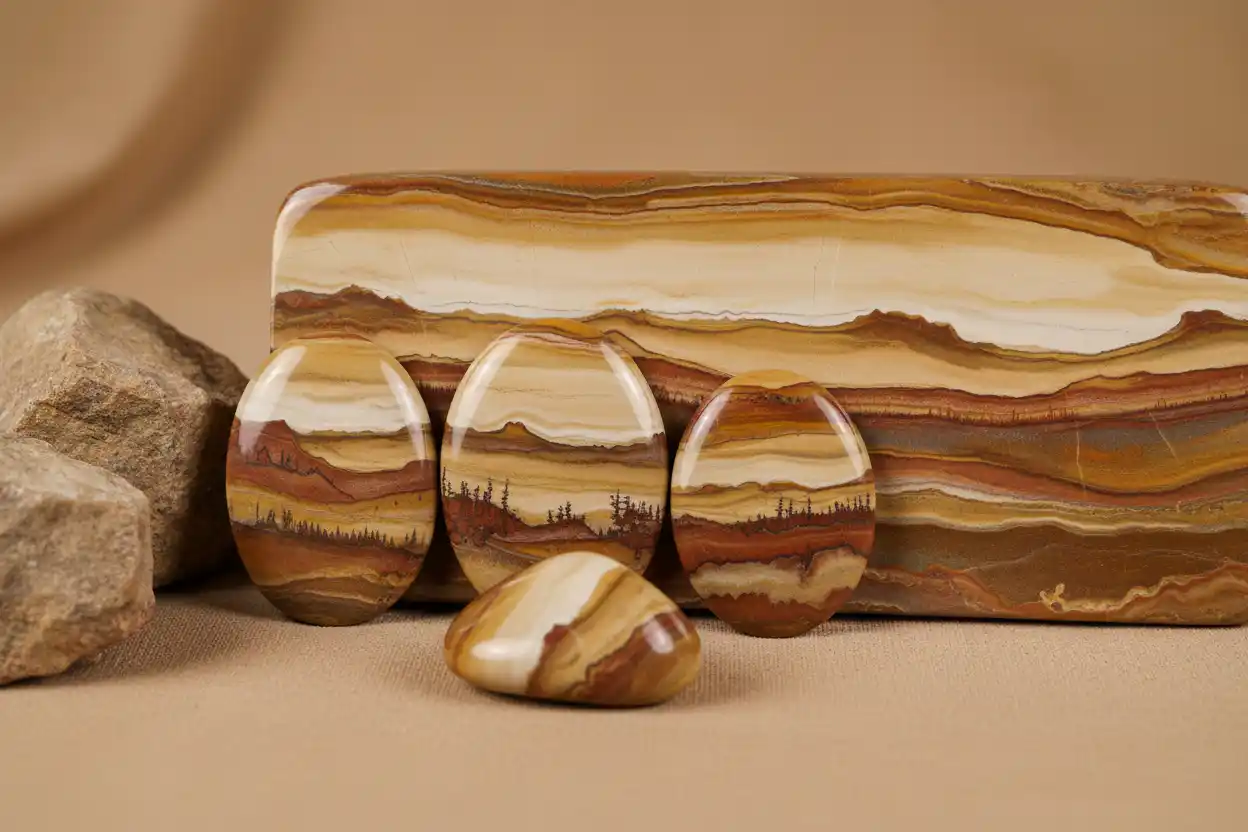
Picture Jasper: Meaning, Properties & Symbolism
Picture Jasper is a broad commercial name for opaque, polishable stones whose natural bands, stains, veins, dendrites, and color boundaries resemble landscapes, mountains, dunes, forests, rivers, clouds, or abstract scenes. Most material is silica rich and falls within the wider jasper or jasper-like lapidary category, although stones sold under the name do not necessarily share one locality or formation process.
Its familiar palette includes cream, beige, tan, brown, ochre, rust red, gray, black, and muted green. The apparent “picture” is not a fossilized photograph or intentionally formed image; it results from geological patterns that viewers interpret through visual association.
Picture Jasper at a Glance
| Property | Picture Jasper |
|---|---|
| Material type | Scenic-patterned jasper or jasper-like ornamental rock |
| Typical composition | Microcrystalline quartz and chalcedony with iron oxides, clay minerals, manganese compounds, and deposit-specific components |
| Common colors | Cream, beige, tan, yellow, brown, rust, red, gray, black, green, and blue-gray |
| Crystal system | No single external crystal system applies to the aggregate; quartz components are trigonal |
| Typical habit | Massive, banded, layered, nodular, veined, brecciated, and fine-grained |
| Luster | Dull to waxy when rough; waxy to vitreous after polishing |
| Transparency | Usually opaque, with locally translucent silica-rich edges or bands |
| Mohs hardness | Commonly about 6.5–7 in true silica-rich jasper; potentially variable in jasper-like rocks |
| Cleavage | None for quartz-rich material |
| Tenacity | Brittle |
| Fracture | Commonly conchoidal to uneven |
| Common uses | Cabochons, pendants, beads, bolo ties, belt buckles, spheres, carvings, slabs, inlay, and display stones |
| Main care concern | Edge chipping, natural fractures, misleading locality names, resin or dye, and silica-rich cutting dust |
Picture Jasper Is a Visual Category
Picture Jasper is not an approved mineral species. The name describes the way a cut surface appears rather than defining one precise composition.
The parent Jasper guide explains jasper as an opaque silica-rich ornamental material containing microgranular quartz, chalcedony, and variable impurities.
Chalcedony provides much of the microscopic silica structure in many jaspers. Nevertheless, some scenic stones sold as Picture Jasper include feldspar, volcanic material, altered ash, clay-rich remnants, or other components.
Mineralogists may distinguish true jasper, jasperoid, and jasper-like rock according to composition and geological origin. Commercial sellers often place all three beneath the simpler jasper label.
Therefore, a Picture Jasper cabochon should not automatically receive one universal formula or formation story. The exact deposit matters.
How the Landscape Patterns Form
Picture-like patterns can form through several geological processes.
Sedimentary layering creates horizontal bands that resemble distant horizons, dunes, or mountain ranges. Changes in grain size, mineral content, water chemistry, or oxidation can give each layer a different color.
Iron-bearing fluids produce red, yellow, orange, brown, and black staining. Hematite commonly contributes red and reddish brown, while goethite and related iron-weathering compounds produce yellow, ochre, and brown.
Manganese-rich minerals can create black dendrites, lines, or branching forms resembling trees and shrubs.
Fracturing introduces another set of pathways. Later mineral-bearing fluids fill cracks with contrasting silica, iron oxides, carbonates, or clay-rich material.
Brecciation can break earlier layers into angular fragments before later silica cements them together.
Volcanic ash and glass may alter into clay, silica, and iron-rich material before burial, heating, and hydrothermal activity produce fine scenic banding.
Because several mechanisms can operate in one deposit, a polished slab may preserve sedimentary layers, fluid staining, deformation, and fracture filling simultaneously.
The “Picture” Exists in the Viewer’s Interpretation
People naturally recognize familiar shapes in irregular patterns. A set of brown bands may resemble a desert canyon, while black dendrites suggest trees against a pale sky.
This visual effect is sometimes called pareidolia: the tendency to recognize meaningful images in random or naturally complex forms.
Two people may see different scenes in the same cabochon. Furthermore, rotating the stone can turn a mountain range into waves or a tree into branching lightning.
Cutters use this tendency deliberately. They examine rough and slabs from several directions before selecting the orientation that creates the strongest composition.
The geological structure is objective, but the scene is interpretive. That distinction gives Picture Jasper much of its appeal without requiring supernatural or artificial image formation.
Biggs Picture Jasper
Biggs Jasper is one of the best-known American Picture Jaspers. It comes from the Biggs Junction region of north-central Oregon.
Classic material displays thin beige, brown, gold, and dark-brown bands that can resemble desert mesas, hills, clouds, and distant horizons.
The deposit occurs within a volcanic landscape associated with Columbia River basalt flows. Geological accounts connect the jasper to altered volcanic ash, clay-rich sediment, silica, iron, burial, heat, and pressure between eruptive episodes.
Fine banding and strong polish give high-quality Biggs material an almost porcelain-like surface.
Older documented rough and cabochons can command premiums because the best-known deposits supplied limited quantities and collecting access has changed over time.
A seller should distinguish Biggs Jasper from generic brown scenic jasper. Pattern similarity alone does not prove Oregon provenance.
Bruneau Picture Jasper
Bruneau Jasper is associated with the Bruneau River Canyon region of southwestern Idaho.
Its classic appearance includes cream, tan, reddish brown, dark brown, and greenish layered patterns, often within rounded nodules or egg-like masses.
The material occurs in a volcanic setting associated with rhyolitic rocks. Its scenic banding differs from Biggs material, although finished cabochons can overlap visually.
Bruneau Jasper is especially valued when narrow concentric bands form clear hills, cliffs, or arch-like scenes.
Supply is limited and irregular, which encourages unsupported labeling. A cabochon offered as old-stock Bruneau should have credible provenance rather than merely matching the expected colors.
Biggs and Bruneau belong within the broader Picture Jasper market, but they are distinct locality materials rather than interchangeable grades.
Owyhee and Other Western Picture Jaspers
The Owyhee region spans parts of Oregon, Idaho, and Nevada and has supplied numerous scenic jaspers and related silica-rich lapidary stones.
Commercial names can refer to a specific claim, drainage, ranch, historical parcel, or a general regional appearance.
Owyhee Picture Jasper commonly shows cream, tan, brown, gold, red, and blue-gray layers. Some slabs appear to contain a pale “sky” over darker landscape bands.
Deschutes, Willow Creek, Wild Horse, Morrisonite, and other western trade materials can also be presented as scenic or picture stones. Their compositions and localities should remain distinct rather than being merged through appearance.
A dealer who knows the rough’s source should state the specific name. When provenance has been lost, “Picture Jasper” is more responsible than inventing a premium locality.
The complete commercial-variety framework belongs on types of jasper.
Picture Jasper and Noreena Jasper
Noreena Jasper is a silicified mudstone from Western Australia’s Pilbara region.
Its red, mustard, cream, gray, and burgundy patterns commonly form angular fracture networks and block-like mosaics.
Picture Jasper usually emphasizes scenic layers, flowing bands, dendrites, or horizon-like structures.
A Noreena slab can still look like an aerial landscape, but its locality, dominant fracture geometry, and geological identity remain separate.
Picture Jasper and Picasso Jasper
Picasso Jasper commonly refers to patterned Utah marble or altered carbonate rock rather than true silica jasper.
Its black, gray, brown, greenish, and cream lines often resemble abstract brushwork or leafless trees.
Picture Jasper is generally a silica-rich category and normally offers greater scratch resistance.
Because both stones can create landscape-like designs, online sellers sometimes use the names interchangeably. Hardness, acid sensitivity, source, and mineral composition provide more reliable distinctions than the perceived image.
Picture Jasper and Orbicular Jasper
Orbicular Jasper contains rounded spots, eyes, rings, flowers, or spherulitic structures.
Picture Jasper generally emphasizes scenes produced by lines, layers, stains, and dendrites rather than dominant circular orbs.
Overlap remains possible. A scenic cabochon may include several round structures that resemble a sun or moon within a landscape.
Meanwhile, Ocean Jasper is a specific Madagascar orbicular material and should not be applied to every multicolored Picture Jasper.
Color and Mineral Components
Cream and beige areas commonly contain relatively clean silica, pale clay remnants, or fewer visible iron compounds.
Yellow and golden bands often reflect goethite and related hydrated iron phases.
Red and rust tones commonly involve hematite.
Dark brown may represent concentrated iron minerals, organic remnants, manganese compounds, or mixtures of several phases.
Black dendrites and lines frequently involve manganese oxides, although exact identification requires analysis.
Muted green can result from chlorite, celadonite, epidote-related phases, altered volcanic minerals, or other inclusions.
Blue-gray areas may arise from fine silica, clay, light scattering, darker backing, or deposit-specific mineral mixtures.
The broader symbolic associations of these colors belong on the Jasper color guide, while geological color causes should remain separate from spiritual interpretation.
How to Identify Picture Jasper
Begin by examining whether the pattern continues through the stone.
Natural bands should remain visible around edges, on the reverse, and within drill holes when the cut intersects them. A printed, painted, or coated scene may stop at the surface.
Magnification can reveal fine silica texture, iron-rich particles, manganese dendrites, natural fractures, polishing marks, resin, and concentrated dye.
Quartz-rich Picture Jasper commonly resists scratching by ordinary steel and approaches Mohs 7. However, scratch testing can damage a finished piece and cannot confirm locality.
A conchoidal chip supports silica-rich composition but should never be created deliberately.
A laboratory can use Raman spectroscopy, X-ray diffraction, microscopy, and elemental analysis to distinguish microcrystalline quartz from carbonate, feldspar-rich rock, resin, glass, or ceramic.
The practical testing sequence in how to identify crystals helps buyers combine several observations instead of relying on color alone.
Common Imitations and Mislabeling
Ceramic and printed resin can reproduce scenic patterns. Mold seams, low weight, round bubbles, repeated identical images, and surface-only design provide warning signs.
Dyed pale stone may display unnaturally bright blue, purple, pink, green, or black colors.
Color concentrated inside cracks and drill holes suggests dye rather than natural internal distribution.
Reconstituted material can combine jasper fragments or powder with resin. Such products may contain genuine stone while no longer being one solid natural piece.
Ordinary rhyolite, marble, limestone, sandstone, agate, or other patterned rocks may receive a Picture Jasper label.
The issue is not that those rocks lack beauty. The problem arises when a commercial name creates false expectations about hardness, composition, locality, or value.
General signs of glass, plastic, composites, coatings, and misleading certificates appear in how to spot fake crystals.
Treatments
Good Picture Jasper may need only cutting and polishing.
Resin impregnation can stabilize fractures, seal porous zones, and improve the polish of weaker material.
Fracture filling may appear as clear glossy material inside cracks or pits. Small bubbles or a different surface luster can reveal the filler.
Dye intensifies weak colors and is particularly common in low-cost bright-blue, pink, green, or black products.
Wax and oil temporarily deepen contrast. Coatings can add gloss but may scratch or peel.
Backing may reinforce a thin scenic slab or provide contrast beneath a translucent layer.
These processes are not necessarily unacceptable when disclosed accurately. The wider enhancement framework appears in gemstone treatments explained.
Lapidary Cutting and Pattern Orientation
Picture Jasper is normally cut as a cabochon or polished slab rather than faceted.
A flat slab reveals the pattern first. The cutter then marks possible shapes while considering the position of horizons, dendrites, contrasting bands, and fractures.
Freeform outlines often preserve scenes better than standard ovals. A rigid template may cut away the feature that makes the stone distinctive.
The dome should remain low enough to keep the scene visible but high enough to create an attractive polish and durable edge.
A highly curved dome can distort fine horizontal bands. Conversely, an extremely flat face may appear dull and expose thin edges.
Matched pairs require adjacent slab sections or carefully selected pieces with compatible color and directional pattern.
Picture Jasper also suits carving, spheres, bolo stones, and belt buckles. Its use within non-faceted lapidary work is explored in the guide to gemstones for carving and cabochons.
Durability and Jewelry Suitability
True silica-rich Picture Jasper commonly measures around 6.5–7 on the Mohs scale.
Its scratch resistance is summarized in the gemstone hardness chart.
Nevertheless, it remains brittle. Natural fractures, brecciated zones, dendritic seams, and thin edges can chip after impact.
The difference between hardness and resistance to breakage appears in gemstone toughness versus hardness.
Pendants, earrings, brooches, bolo ties, bracelets, and protected rings are practical uses.
A bezel supports the edge of a cabochon more effectively than widely separated prongs.
Bracelet beads should have smooth drill holes and enough wall thickness to prevent cracking under cord tension.
A jasper-like stone containing softer carbonate or clay-rich zones may wear faster than true quartz-rich Picture Jasper.
Current Picture Jasper Asking Prices
Picture Jasper is generally affordable, but documented locality material and exceptional scenic cuts can command much more.
| Picture Jasper product | Broad July 2026 retail asking range |
|---|---|
| Small tumbled stone | About $2–$10 |
| Standard commercial cabochon | About $4–$25 |
| Strongly scenic hand-cut cabochon | About $20–$75 |
| Fine Biggs, Bruneau, or documented old-stock cabochon | About $50–$250 or more |
| Matched cabochon pair | About $20–$120 |
| Bead strand | About $10–$50 |
| Simple pendant, bolo component, or earrings | About $25–$150 |
| Small sphere or carving | About $25–$125 |
| Large sphere, slab, or display piece | About $100–$600 or more |
| Exceptional locality slab or lapidary artwork | Individually priced |
These are broad asking ranges rather than appraisals or guaranteed resale values.
Current mass-market cabochons commonly appear below $25, while carefully selected Oregon, Idaho, or Indonesian scenic stones may sell for several times that amount.
What Gives Picture Jasper Value?
A recognizable and balanced scene creates the strongest visual demand.
Contrast matters. Dark dendrites or mountain bands should remain visible against cream, tan, gold, or blue-gray areas.
Composition influences appeal. A stone that appears naturally framed within its cabochon outline is generally more desirable than one whose pattern runs awkwardly off the edge.
Cutting orientation can transform ordinary rough into a compelling landscape. It can also ruin valuable material when the cutter removes the central feature.
Polish should be even and free from scratches, flat spots, orange peel, resin pools, and undercut seams.
Structural stability matters more than size. A large scenic slab crossed by open fractures may be unsuitable for jewelry.
Documented Biggs, Bruneau, Owyhee, or another recognized locality can add collector confidence.
Treatments, repairs, backing, and uncertain provenance should be reflected in the price.
Buying Picture Jasper
Ask whether Picture Jasper is being used as a broad visual description or as a claim for a specific locality.
Request photographs of the front, back, sides, and drill holes.
View the piece in neutral lighting. Warm light and digital saturation can turn muted brown into vivid orange or create a false blue sky.
Inspect every dark line. A mineral-filled seam may be stable, while an open fracture can separate during setting or wear.
Ask about resin stabilization, dye, coating, wax, backing, and repair.
Terms such as AAA, gallery grade, museum landscape, and rare old stock have no universal grading standard.
Locality-specific purchasing and fraud checks belong on where to buy real Picture Jasper.
Picture Jasper appears in both the crystals beginning with P directory and the gemstones beginning with P directory.
Cleaning and Storage
Clean a sound quartz-rich piece with lukewarm water, mild soap, and a soft cloth or brush.
Rinse briefly and dry it thoroughly.
Avoid prolonged soaking when the stone contains fractures, resin, dye, glue, backing, or softer mixed-mineral zones.
Steam and ultrasonic cleaning are unnecessary, particularly for filled or brecciated material.
Do not use bleach, strong acids, abrasive powders, or household descalers.
Store Picture Jasper separately from diamond, sapphire, topaz, and other harder gems that can scratch its polish.
Large slabs should receive support across their full base rather than resting on one thin corner.
Picture Jasper Meaning and Symbolism
Modern crystal traditions associate Picture Jasper with perspective, observation, patience, and recognizing a larger pattern within several separate events.
Landscape-like stones inspire symbolism involving travel, place, memory, and connection with the physical environment.
Horizontal layers can represent experience accumulating gradually. Dendritic lines may symbolize branching choices or networks of relationships.
Because each perceived image depends partly on the viewer, Picture Jasper can also represent imagination and the way personal experience shapes interpretation.
Specific locality materials do not share one universal ancient spiritual tradition merely because modern sellers place them beneath the same trade name.
These meanings remain personal, artistic, cultural, or spiritual interpretations. Scientific evidence does not show that Picture Jasper treats illness, records ancient memories, or guarantees emotional stability.
Frequently Asked Questions
Is Picture Jasper a mineral?
No. It is a trade category for scenic-patterned jasper or jasper-like ornamental rock.
What creates the landscape pictures?
Layering, iron and manganese staining, fractures, dendrites, brecciation, volcanic alteration, and later mineral filling can create scene-like patterns.
Are the pictures fossils?
Usually not. Most scenes result from mineral patterns that resemble familiar landscapes through visual interpretation.
Is all Picture Jasper chemically identical?
No. Many pieces are quartz and chalcedony rich, while some commercial materials contain significant feldspar, clay, volcanic, or carbonate components.
What is Biggs Picture Jasper?
It is a renowned scenic jasper from the Biggs Junction area of Oregon, known for fine brown, beige, and gold landscape-like bands.
What is Bruneau Picture Jasper?
It is a locality material from southwestern Idaho, commonly showing concentric cream, brown, red, and greenish scenic patterns.
Is Picture Jasper the same as Picasso Jasper?
No. Classic Picasso Stone is generally patterned Utah marble or altered carbonate rock rather than quartz-rich jasper.
How hard is Picture Jasper?
True silica-rich material commonly measures about 6.5–7, although jasper-like stones sold under the name may vary.
Is Picture Jasper suitable for rings?
Sound material can be worn in a low protective setting. Stones with open fractures or soft mixed-mineral areas are better suited to pendants.
Is Picture Jasper commonly treated?
Many pieces are untreated apart from polishing, but resin stabilization, filling, dye, wax, coating, and backing can occur.
Can Picture Jasper go in water?
Brief washing is usually suitable for intact untreated quartz-rich material. Avoid soaking filled, dyed, backed, fractured, or mixed-mineral pieces.
What makes Picture Jasper valuable?
A strong scenic image, contrast, cutting orientation, locality, polish, structural condition, size, treatment disclosure, and craftsmanship determine value.
Picture Jasper’s strongest examples depend on the cutter recognizing a geological composition before removing it from the slab. That relationship between natural structure and human interpretation is what separates a compelling scenic cabochon from an ordinary brown stone.
Cutting, drilling, sanding, or grinding Picture Jasper can release respirable crystalline-silica dust. Use wet lapidary methods, effective local extraction, eye protection, and suitable respiratory protection rather than dry processing.