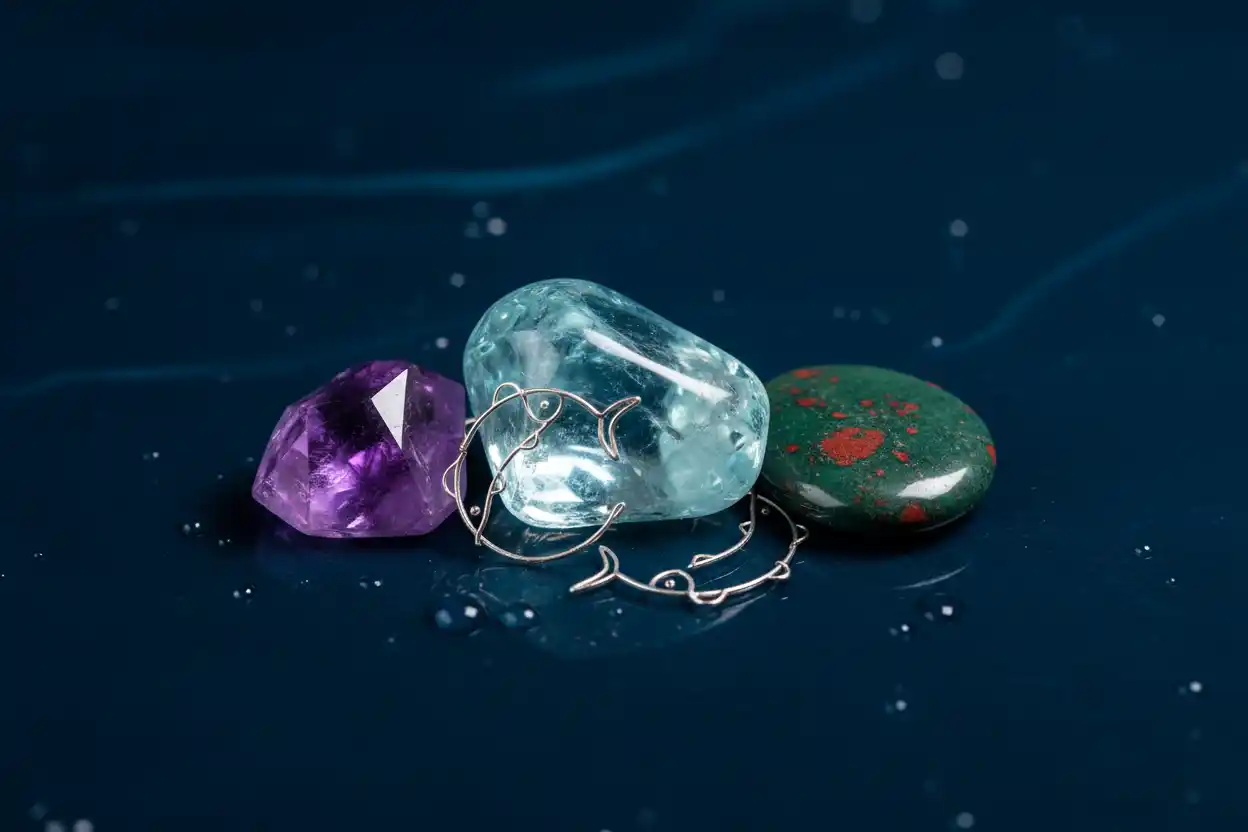
Pisces Birthstone: 21 Spiritual Symbols of Aquamarine & Amethyst
The Pisces birthstone tradition most naturally brings together aquamarine and amethyst because the Pisces zodiac period crosses February and March. Amethyst is the recognized modern birthstone for February, while aquamarine is one of the principal recognized birthstones for March. This gives both gems a clear calendar-based connection with people born under Pisces, although the idea of a single official gemstone assigned to the zodiac sign itself is not a standardized gemological classification.
Aquamarine and amethyst are also very different gemstones scientifically. Aquamarine is the blue to greenish-blue variety of beryl, the same mineral species that includes emerald. Amethyst is the violet variety of crystalline quartz. Their colors arise through different processes, they have different crystal structures and durability characteristics, and they require somewhat different buying considerations. Astrology and spiritual traditions often associate both stones with intuition, calmness, sensitivity, imagination, and reflective awareness, but such meanings are symbolic traditions rather than scientifically demonstrated effects of wearing a gemstone.
For a Pisces wearer, this makes the pair interesting for two separate reasons. Aquamarine connects strongly with March birthstone tradition and offers excellent jewelry durability, while amethyst connects with February and provides an accessible range of violet colors. Their symbolic associations can add personal meaning, but their actual quality should still be judged through color, clarity, cut, treatment disclosure, durability, and correct gemological identification.
21 Spiritual Symbols Associated With Pisces Birthstones
- Intuition
- Emotional awareness
- Calm reflection
- Compassion
- Imagination
- Inner clarity
- Peace
- Honest communication
- Spiritual reflection
- Sensitivity
- Adaptability
- Creative expression
- Self-awareness
- Patience
- Emotional balance
- Hope
- Personal renewal
- Thoughtful decision-making
- Trust
- Gentle confidence
- Meaningful connection
These 21 themes describe symbolic ideas commonly attached to Pisces, aquamarine, and amethyst in astrological and spiritual traditions. They should not be understood as physical properties of the gemstones or as predictions about every person born under Pisces. Birth date does not scientifically determine personality, and wearing either stone does not create measurable changes in emotional health, fortune, relationships, or future events.
Why Aquamarine and Amethyst Are Associated With Pisces
Pisces is generally placed from about February 19 to March 20 in Western tropical astrology, which means the sign overlaps two calendar months with well-established birthstone traditions. February is associated with amethyst, while March is associated with aquamarine. That overlap gives the two gems a more concrete connection with Pisces than many zodiac gemstone pairings that rely mainly on later astrological or metaphysical traditions.
The distinction matters because monthly birthstones and zodiac stones developed through different traditions. A person born on February 25, for example, may identify with Pisces astrologically while also having amethyst as the conventional birthstone for February. Someone born on March 10 may also identify as Pisces while having aquamarine as the recognized monthly birthstone. Neither relationship changes the mineral identity of the gem, and gemological laboratories do not classify aquamarine or amethyst according to zodiac signs.
Symbolically, aquamarine has long been associated with the sea, safe passage, composure, and clarity. Its name comes from Latin words referring to seawater, making the stone particularly easy to connect with Pisces, a water sign represented by two fish. Amethyst has a different historical tradition. It has been associated with restraint, clear thinking, spiritual devotion, and protection in several periods of European and Mediterranean history. Modern astrology often combines these older associations with Pisces themes such as sensitivity, intuition, imagination, and inward reflection.
Aquamarine and Amethyst Gemological Comparison
| Property | Aquamarine | Amethyst |
|---|---|---|
| Mineral species | Beryl | Quartz |
| Typical color | Pale blue to greenish blue | Light violet to deep purple |
| Chemical composition | Be₃Al₂Si₆O₁₈ | SiO₂ |
| Mohs hardness | 7.5 to 8 | 7 |
| Cleavage | Indistinct to poor | None |
| Typical transparency | Transparent to translucent | Transparent to translucent |
| Common treatment | Heat treatment | Heat treatment may alter color |
| Everyday jewelry suitability | Very good | Good |
| Recognized monthly birthstone | March | February |
Aquamarine belongs to the beryl mineral species. Its desirable blue and greenish-blue colors are associated principally with iron within the crystal structure. Fine aquamarine can be highly transparent and may occur as relatively large clean crystals. Pale stones are common, while strongly saturated blue colors are generally more sought after when other quality factors are comparable.
Amethyst belongs to quartz and receives its violet color through iron-related defects in the quartz structure combined with natural irradiation during geological formation. Its color can range from pale lilac through medium violet to strong reddish purple. Uneven color zoning is common in natural amethyst crystals, although skillful cutting can reduce its visual effect in a finished gem.
Their hardness values also differ. Aquamarine at 7.5 to 8 on the Mohs scale is harder than amethyst at 7, giving it somewhat greater resistance to scratching during normal jewelry use. Hardness is not the same as toughness, however. Aquamarine can still chip if struck sharply, particularly along thin facet edges. Amethyst lacks cleavage and is reasonably durable, but it should still be protected from hard impacts and abrasive contact with harder gems such as sapphire or diamond.
Aquamarine Meaning for Pisces and Its Actual Gemological Character
Aquamarine is often treated as the central Pisces birthstone because of its March connection and sea-like appearance. In symbolic traditions, its blue color may represent calm thought, emotional openness, communication, honesty, and the ability to move through change without losing direction. Someone who identifies with Pisces symbolism may therefore wear aquamarine as a visual representation of composure or clarity rather than expecting the stone to create those qualities physically.
The strongest aquamarine color can vary from blue to slightly greenish blue. Many commercial aquamarines are heat treated to reduce yellowish or greenish components and produce a purer blue appearance. This treatment is widely accepted within the gemstone trade, but treatment disclosure remains important because buyers should know whether a stone’s appearance has been altered.
Very clean aquamarine is common enough that heavily included transparent stones may be less desirable unless the inclusions create unusual character or the specimen is intended for collection rather than fine faceted jewelry. Certain aquamarines can contain hollow tubes, liquid inclusions, mineral crystals, or other internal features. Such inclusions are valuable to gemologists because they may help establish natural origin, although no single visible feature should be treated as automatic proof of authenticity.
Aquamarine is especially practical in pendants, earrings, bracelets, and rings. Its hardness makes it suitable for frequent wear, but rings still need sensible protection because repeated impacts can damage any faceted gem. A secure bezel, halo, or well-designed prong setting can protect exposed edges more effectively than a very high setting used during demanding daily activities.
Amethyst Meaning for Pisces and Its Mineralogical Identity
Amethyst brings a different visual and symbolic character to the Pisces birthstone pairing. Purple has often carried associations with contemplation, dignity, spiritual life, and inward awareness. For a Pisces wearer, amethyst may therefore symbolize reflective thinking, imagination, personal boundaries, or the effort to separate intuition from impulsive assumptions.
These are cultural and personal meanings. Amethyst does not scientifically alter thought patterns, cure anxiety, induce sleep, regulate the nervous system, or create a measurable spiritual field around the wearer. Its significance comes from how people interpret and use the gem within jewelry, ritual, family tradition, meditation, collecting, or personal symbolism.
Gemologically, amethyst is quartz. Quartz is abundant, but attractive transparent amethyst with desirable violet color remains one of the most familiar colored gemstones in jewelry. Value depends heavily on color quality. Rich violet with attractive saturation and relatively even distribution is usually preferred to very pale or strongly brownish stones, although personal taste remains important.
Heat can permanently change the color of some amethyst. Heating may turn suitable specimens yellow, orange, brown, green, or nearly colorless depending on their geological origin and internal chemistry. Some yellow quartz sold in jewelry was produced by heating amethyst. Because strong heat can alter color, amethyst jewelry should not be exposed unnecessarily to high temperatures during repair or cleaning.
Prolonged intense light may also affect the color stability of some amethyst. Ordinary indoor wear is generally uncomplicated, but collectors should avoid storing fine specimens for years in locations receiving intense direct sunlight.
Color, Clarity, Cut, and Quality Factors
For aquamarine, color is normally the first feature to judge. A stone that looks attractively blue under ordinary lighting will usually be more satisfying than one purchased merely because a seller uses an impressive color description. Pale aquamarine can still be beautiful, especially in larger gems where the longer light path allows color to appear more noticeable. Strongly saturated blue stones are less common and can command higher prices.
Cut is especially important because pale aquamarine can appear washed out if the proportions allow too much light to escape. A well-cut gem should display lively reflections and an appealing distribution of color rather than a large transparent window through the center. Facet symmetry, polish, outline, and weight retention all contribute to the finished appearance.
Amethyst should also be evaluated primarily through visible color rather than marketing terminology. Deep violet is attractive only when the stone remains lively enough to return light. A very dark amethyst that looks nearly black in normal indoor conditions may be less appealing than a slightly lighter gem with stronger brightness. Obvious color zoning can reduce visual uniformity, though zoning is also a natural feature of many amethyst crystals.
Clarity expectations differ slightly between the two. Fine faceted aquamarine is commonly eye-clean, while amethyst is also widely available with few inclusions visible without magnification. Buyers therefore do not need to accept severe fractures, large cavities, or distracting inclusions merely because a seller describes them as proof that a stone is natural.
Natural, Synthetic, and Imitation Pisces Birthstones
Natural aquamarine forms through geological processes involving beryl-bearing pegmatites and related mineral environments. Synthetic beryl can be grown in laboratories, although synthetic aquamarine is far less common in ordinary jewelry than many buyers assume. Blue glass, synthetic spinel, blue topaz, and other blue gems can sometimes be offered as aquamarine by careless or deceptive sellers, making reliable identification important for valuable purchases.
Amethyst presents a more significant synthetic-identification issue because synthetic quartz can be grown hydrothermally and may closely resemble natural amethyst. A synthetic amethyst is real crystalline quartz with essentially the same fundamental chemistry and many of the same physical properties as natural amethyst, but it was grown by people rather than formed geologically. It should therefore be disclosed as synthetic rather than sold as natural.
Glass can also imitate amethyst. Color alone cannot prove that a purple transparent stone is natural amethyst. For important purchases, trustworthy seller disclosure and independent gemological testing are more meaningful than claims involving energy, origin stories, or unverified visual tests.
Choosing Between Aquamarine and Amethyst for Pisces Jewelry
The best Pisces birthstone depends partly on birth month and partly on personal preference. A February-born Pisces may favor amethyst because it directly matches the recognized February birthstone tradition. A March-born Pisces may prefer aquamarine for the same reason. Someone choosing according to symbolism rather than month may simply select the color, appearance, historical associations, or jewelry durability that feels most meaningful.
Aquamarine is generally the stronger option when a wearer wants a light blue gem with very good hardness and a refined appearance that works well in everyday jewelry. It pairs particularly well with white metals, though yellow and rose gold can create attractive contrast. Large aquamarines are available, so buyers can often find substantial center stones without entering the extreme price levels associated with fine emerald or sapphire.
Amethyst offers a wider accessible range of sizes and violet shades. It is particularly attractive for pendants, earrings, cocktail rings, and decorative jewelry where strong purple color can become the visual center of the piece. Its hardness is adequate for many rings, but frequent-wear rings should still be removed during work that involves repeated impacts, abrasive surfaces, or heavy tools.
A buyer choosing a symbolic gift should also consider the recipient’s actual tastes. A beautiful gemstone that suits the person’s preferred color, jewelry style, and daily routine often carries more lasting meaning than a stone chosen solely because an astrology list assigns it to Pisces.
Cleaning and Caring for Pisces Birthstone Jewelry
Aquamarine and amethyst can usually be cleaned gently with lukewarm water, mild soap, and a soft brush when the jewelry setting permits. After cleaning, the piece should be rinsed carefully and dried with a soft cloth. This simple method avoids many of the risks created by aggressive chemicals, harsh abrasives, and unnecessary heat.
Steam and ultrasonic cleaning should not automatically be assumed safe for every stone simply because the mineral itself has reasonable durability. Fractures, inclusions, treatments, old settings, repaired jewelry, and fragile mounting components can change what is appropriate. When the condition of a valuable piece is uncertain, professional inspection is the safer choice.
Store aquamarine and amethyst separately from harder gemstones when possible. Diamond, corundum, and other harder gems can scratch them if loose jewelry repeatedly rubs together. Individual pouches or compartmented jewelry boxes reduce unnecessary contact and also help protect polished metal surfaces.
Amethyst deserves additional protection from prolonged strong sunlight and high heat because color can change under unfavorable conditions. Aquamarine is generally stable during ordinary wear, but high temperatures may still create risks for inclusions, settings, or previously repaired jewelry.
Historical Tradition and Symbolic Meaning Without Determinism
The appeal of Pisces birthstones is partly historical and partly modern. Aquamarine’s maritime associations are easy to trace through its name and its long connection with sailors, seawater, and safe travel traditions. Amethyst appears in ancient jewelry, religious objects, royal decoration, and later birthstone traditions, giving it an unusually rich cultural history for a relatively accessible quartz variety.
Modern astrology often maps these older ideas onto Pisces characteristics. Compassion, imagination, emotional sensitivity, intuition, creativity, and adaptability are frequently described as Pisces themes, while aquamarine and amethyst are assigned complementary symbolic roles. These associations can be meaningful within spiritual practice, but astrology does not scientifically establish that every Pisces person has these traits or that a gemstone changes them.
A more grounded way to use birthstone symbolism is to let a piece of jewelry represent an intention chosen by the wearer. Aquamarine might represent speaking calmly during difficult conversations, while amethyst might represent making time for reflection before acting. The meaning then comes from a conscious personal association rather than from a claim that the mineral itself controls behavior.
Conclusion
The Pisces birthstone tradition works especially well with aquamarine and amethyst because Pisces spans February and March, directly connecting the sign with two recognized monthly birthstones. Aquamarine is blue beryl with a hardness of 7.5 to 8, while amethyst is violet quartz with a hardness of 7. Both are attractive jewelry gems, although their color origins, treatments, durability, and buying considerations differ.
Their spiritual meanings are best understood as cultural and personal symbolism. Aquamarine can represent calmness, communication, and adaptation, while amethyst can represent reflection, awareness, and thoughtful restraint. Buyers should choose according to genuine gem quality, treatment disclosure, wearability, personal taste, and the form of symbolism that feels meaningful to them.
FAQs About Pisces Birthstone
What is the main Pisces birthstone?
There is no single universally standardized gemological birthstone assigned specifically to the Pisces zodiac sign. Aquamarine and amethyst are especially logical choices because Pisces overlaps February and March. Amethyst is the recognized February birthstone, while aquamarine is a principal March birthstone, giving both stones a direct calendar connection with Pisces birthdays.
Is aquamarine or amethyst better for Pisces?
Neither gemstone is objectively better for everyone born under Pisces. A February-born Pisces may prefer amethyst, while a March-born Pisces may favor aquamarine because of the monthly birthstone tradition. Aquamarine is slightly harder and often chosen for frequent-wear jewelry, while amethyst offers rich violet color and is usually available in attractive sizes at accessible prices.
Is aquamarine durable enough for a Pisces birthstone ring?
Aquamarine has a Mohs hardness of 7.5 to 8 and is generally a very good jewelry gemstone. It can work well in rings, including regularly worn pieces, although it should still be protected from sharp impacts. Secure settings and sensible removal during heavy manual work can substantially reduce the risk of chipping.
Can amethyst be worn every day?
Amethyst has a Mohs hardness of 7 and no cleavage, making it suitable for many forms of everyday jewelry. Rings receive more abrasion and impact than pendants or earrings, so an amethyst ring benefits from a protective setting and reasonable care. Prolonged intense sunlight and high heat should also be avoided because some amethyst can experience color changes.
Are Pisces birthstone meanings scientifically proven?
No. Ideas connecting aquamarine and amethyst with intuition, emotional balance, spiritual awareness, protection, or Pisces personality traits belong to cultural, astrological, and spiritual traditions. Gemology can establish properties such as chemistry, hardness, optical behavior, treatment, and natural or synthetic origin, but it does not demonstrate that gemstones control emotions, personality, relationships, or future events.
How can I tell if a Pisces birthstone is natural?
Visual inspection alone is not always enough. Natural aquamarine can be confused with other blue gems or glass, while synthetic amethyst can resemble natural amethyst closely because both are crystalline quartz. Seller transparency, accurate treatment disclosure, and professional gemological testing are the most reliable approaches when natural origin significantly affects value.
Which Pisces birthstone is easier to maintain?
Both are relatively practical. Aquamarine’s higher hardness gives it an advantage against scratching, while amethyst has no cleavage and performs well when handled sensibly. Gentle soap-and-water cleaning, protection from hard impacts, and separate storage are appropriate for both. Amethyst deserves extra protection from prolonged strong light and excessive heat.
Can someone born under Pisces wear both aquamarine and amethyst?
Yes. There is no gemological rule limiting a person to one birthstone. Since Pisces spans February and March, wearing both stones can represent the complete calendar range of the sign. Combining pale blue aquamarine with violet amethyst can also create an attractive jewelry design even for someone who treats the zodiac association purely as personal symbolism.