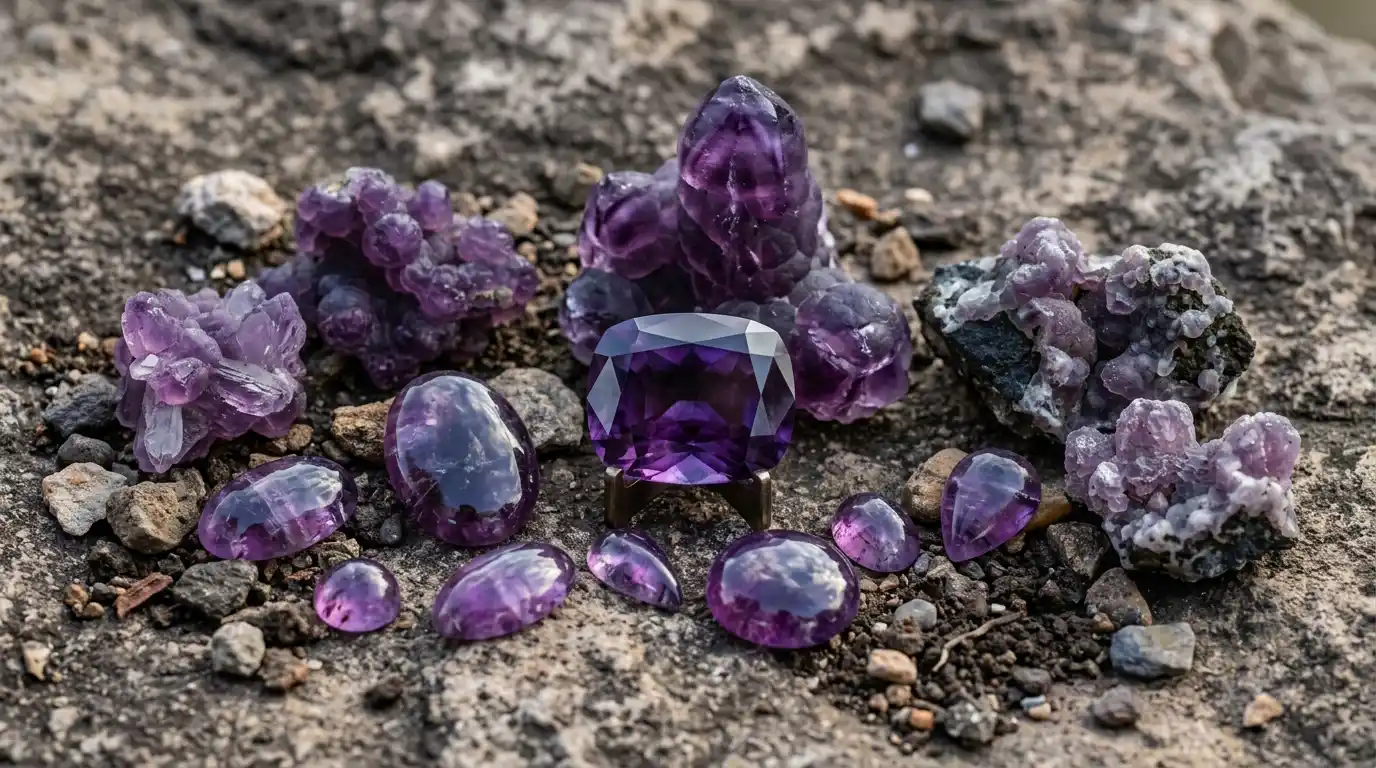
Purple Fluorite Benefits: 7 Real Uses, Third Eye Connection & Water Safety
Purple fluorite benefits begin with the real properties of fluorite itself. Fluorite is calcium fluoride, CaF2, an isometric mineral famous for cubic crystals, perfect cleavage, striking color zoning, and an exceptionally wide range of natural colors. Purple is among its most familiar varieties, ranging from delicate lilac and violet to deep purple, sometimes within the same crystal.
For collectors, students, lapidaries, and jewelry enthusiasts, purple fluorite benefits include impressive crystal forms, educational value, optical interest, decorative use, lapidary potential, and access to specimens from many important mineral localities. Its major limitation is durability. Fluorite defines hardness 4 on the Mohs scale and has perfect octahedral cleavage, which means a beautiful crystal or cut stone can scratch, chip, or split more easily than harder jewelry gems.
The third eye connection often included among purple fluorite benefits belongs to modern spiritual practice. Purple stones are commonly linked with intuition, concentration, meditation, and the third eye chakra in contemporary crystal traditions. People can use that symbolism for reflection or personal ritual, but there is no scientific evidence that purple fluorite activates an anatomical structure, changes brain function, or treats a mental or physical condition.
7 Purple Fluorite Benefits at a Glance
- Natural purple coloration and zoning make fluorite visually distinctive for specimens, carvings, and decorative gems.
- Cubic crystals and perfect octahedral cleavage provide excellent examples for learning crystallography and mineral identification.
- Transparent to translucent crystals can display attractive optical effects, internal zoning, and occasional fluorescence.
- Purple fluorite can be faceted, carved, polished, or cut into cabochons when its softness and cleavage are respected.
- Mineral specimens from documented localities offer strong collector and geological interest.
- Modern third eye traditions use purple fluorite as a symbolic focus for meditation, concentration, and reflective practice.
- Understanding its Mohs hardness of 4, perfect cleavage, chemical limits, and careful cleaning needs allows safer ownership and handling.
Purple Fluorite Benefits Begin With Its Crystal Structure
The physical character of fluorite explains many practical purple fluorite benefits. Fluorite crystallizes in the isometric system and commonly develops cubes, octahedra, combinations of crystal forms, massive deposits, and intergrown specimens. Well-formed cubes can be so geometrically precise that they make excellent examples for teaching basic crystallography without requiring advanced equipment.
Fluorite also possesses perfect cleavage along octahedral directions. A cube can therefore break along planes that produce triangular faces and ultimately octahedral forms. For mineral students, this relationship between external crystal habit and internal cleavage is particularly instructive. For jewelry owners, the same property becomes a warning because a forceful impact can separate the crystal along those planes.
Hardness is another defining characteristic. Fluorite is the reference mineral for Mohs hardness 4, placing it below apatite, feldspar, quartz, topaz, corundum, and diamond. This makes controlled scratch-hardness comparisons educational on rough reference specimens, but scratch testing should not be performed on finished jewelry or valuable collector pieces.
Many general fluorite benefits therefore come from the mineral’s combination of distinctive structure, educational importance, diverse colors, collectability, and industrial history rather than from any single purple-specific property.
Purple Fluorite Benefits for Collectors and Lapidary Use
One of the strongest purple fluorite benefits is collector appeal. Natural crystals may combine violet, lavender, colorless, green, blue, or other zones within a single specimen. The patterns can record changes in the chemistry and physical conditions of crystal growth, making the specimen visually attractive while also preserving geological information.
Knowing where purple fluorite is found adds another layer of value because locality can influence crystal habit, associations, color zoning, fluorescence, size, and overall specimen character. Fluorite occurs in hydrothermal veins, carbonate rocks, granitic environments, pegmatites, and several types of mineral deposits, frequently alongside calcite, quartz, barite, sulfides, and other minerals.
Lapidaries also work with purple fluorite, although the stone demands patience. Transparent rough can produce attractive faceted gems, while translucent pieces may be cut into cabochons, beads, carvings, spheres, decorative objects, or polished freeforms. A successful fluorite cut can display vivid color and attractive transparency, but the cutter must constantly account for cleavage.
These purple fluorite benefits make the mineral better suited to protected or occasional jewelry than to pieces exposed to constant wear. Pendants, earrings, and carefully worn brooches usually place less mechanical stress on the stone than an unprotected ring. Even a well-cut fluorite ring should be treated as delicate jewelry rather than as an everyday hard-wearing gem.
Purple Color, Zoning, and Optical Interest
Purple color is among the most obvious purple fluorite benefits for collectors. Pure calcium fluoride would not necessarily display the many colors seen in natural fluorite. Color can develop through structural defects, irradiation-related color centers, trace impurities, and interactions among these factors. The mechanism can differ among deposits and even among zones within a single crystal.
This complexity is valuable for mineral education because it discourages the assumption that every gemstone color has one simple chemical cause. A purple band inside a crystal may reflect a different growth episode or defect environment from a neighboring colorless or green zone. Color zoning can therefore be both decorative and scientifically interesting.
Some fluorite also fluoresces under ultraviolet light, although strength and color vary considerably and not every purple specimen produces a dramatic response. The word fluorescence itself was derived from fluorite because certain specimens famously emit visible light when exposed to ultraviolet radiation. Fluorescence should therefore be treated as a variable identifying or collecting feature rather than something guaranteed by purple color.
Fluorite is also optically distinctive because the cubic crystal structure makes it singly refractive under normal gemological conditions. Combined with its relatively low refractive index and characteristic cleavage, these properties give trained gemologists several clues when separating fluorite from purple quartz, glass, amethyst, and other lookalikes.
Third Eye Connection and Symbolic Purple Fluorite Benefits
Third eye symbolism is one of the most familiar spiritual purple fluorite benefits. Contemporary chakra systems often associate violet and indigo stones with intuition, inner awareness, contemplation, imagination, and the third eye chakra. Purple fluorite’s color therefore makes it a natural candidate for meditation layouts, personal rituals, or symbolic objects intended to represent mental organization and thoughtful reflection.
The purple fluorite chakra connection should be understood within that spiritual framework. Chakras are not anatomical organs, and the third eye chakra should not be confused with the pineal gland, brain tissue, vision, or another measurable body structure. Placing a crystal near the forehead has not been shown to activate neurological processes or improve cognition.
A person can still use the stone in a meaningful way. For example, keeping purple fluorite on a desk might become a visual reminder to slow down before making a decision, while holding it during meditation may create a consistent personal ritual. In these examples, the practical mechanism involves attention, habit, symbolism, and personal intention rather than a demonstrated energy emitted by the mineral.
Claims surrounding purple fluorite healing properties may include concentration, emotional calm, sleep, anxiety, detoxification, neurological health, or other wellness outcomes. Scientific evidence does not establish purple fluorite as a treatment for these conditions. Medical or psychological concerns require appropriate professional care rather than substitution with a gemstone.
Water Safety and the Limits of Purple Fluorite
Water safety deserves special attention because purple fluorite benefits can easily be overshadowed by careless cleaning. Calcium fluoride has relatively low solubility in ordinary water, so brief contact with clean water is not the same as rapidly dissolving the stone. The larger practical concern is fluorite’s softness, perfect cleavage, fractures, inclusions, surface condition, and vulnerability to rough handling.
Whether purple fluorite is safe in water also depends on what someone means by “safe.” A brief gentle cleaning is very different from leaving a specimen submerged for hours, repeatedly soaking it as part of a ritual, exposing it to hot water, or placing fluorite jewelry containing adhesives and metal components into liquid.
For routine cleaning, a soft dry or slightly damp cloth is often sufficient. When more cleaning is necessary, use mild conditions, minimal handling, and no abrasive brush. Avoid ultrasonic systems, steam, sudden temperature changes, and harsh chemicals. A fractured or heavily included specimen should receive especially conservative care because vibrations or impacts can exploit existing weaknesses.
Strong acids are inappropriate around fluorite. Calcium fluoride can react under sufficiently acidic conditions, so chemical experimentation with a collector specimen is unnecessary and potentially hazardous. Fluorite should never be powdered, intentionally dissolved, swallowed, or placed in drinking water to create an ingestible crystal elixir.
Purple Fluorite as an Educational Mineral
Educational value is one of the most substantial purple fluorite benefits because a single mineral can illustrate several major geological and gemological concepts. Fluorite demonstrates cubic crystallography, perfect octahedral cleavage, Mohs hardness, color centers, zoning, fluorescence, hydrothermal mineralization, lapidary limitations, and the distinction between hardness and toughness.
Its industrial history is equally important. Fluorite, also known commercially as fluorspar, has long been used as a flux in metallurgical processes and is a major commercial source of fluorine used in chemical manufacturing. This history connects attractive mineral specimens with large-scale geology, mining, chemistry, and industry.
Collectors should nevertheless distinguish industrial fluorite from specimen-grade or gem-quality purple fluorite. A beautiful crystal cluster may be valuable because of form, transparency, zoning, locality, mineral associations, condition, and aesthetics, while industrial fluorite is evaluated for entirely different purposes. The fact that both belong to the same mineral species is part of what makes fluorite so educational.
Evaluating Purple Fluorite for Jewelry and Collections
The best purple fluorite benefits become easier to appreciate when the specimen is selected for its intended use. A collector crystal should be examined for crystal form, natural contacts, cleavage damage, chips, repairs, coatings, associated minerals, locality information, and overall aesthetics. Perfectly sharp crystals are desirable, but natural contact points should not automatically be mistaken for recent damage.
For polished gems, color saturation, transparency, zoning, cut quality, polish, fractures, and setting design matter. Deep purple color can be striking, but extremely dark stones may lose transparency. Lighter violet fluorite may show zoning more clearly. There is no single best color because collectors often value unusual growth patterns or provenance as much as uniform saturation.
Purple fluorite benefits are strongest when expectations remain realistic. It is an excellent collector mineral, a fascinating study stone, an attractive lapidary gem, and a meaningful symbolic object for people who enjoy contemporary crystal traditions. It is not a high-durability everyday gemstone and does not need unsupported medical claims to be interesting.
Conclusion
Purple fluorite benefits include exceptional crystal forms, vivid color, zoning, fluorescence in some specimens, educational value, lapidary potential, geological interest, and strong collector appeal. Its Mohs hardness of 4 and perfect cleavage require careful handling, while third eye associations belong to modern spiritual symbolism rather than medical science.
FAQs
What are the most important purple fluorite benefits?
The strongest purple fluorite benefits are its collector appeal, cubic crystal forms, striking purple color and zoning, usefulness for mineral education, potential for faceting and carving, occasional fluorescence, and geological interest. Modern spiritual practices also associate the stone with meditation and third eye symbolism, but these beliefs are separate from scientifically established properties.
Is purple fluorite suitable for everyday jewelry?
Purple fluorite is generally better for occasional or protected jewelry than for constant everyday wear. Its Mohs hardness is only 4, meaning many common substances can scratch it, and its perfect cleavage increases the chance of chipping or splitting after impact. Pendants and earrings are usually lower-risk choices than exposed rings or bracelets.
What causes purple fluorite to be purple?
Purple fluorite coloration can result from structural defects, irradiation-related color centers, trace impurities, and interactions among these factors. The exact mechanism may vary among deposits and growth zones. Natural fluorite can consequently contain purple bands next to green, blue, colorless, or other zones within one crystal.
Is the third eye connection one of the proven purple fluorite benefits?
No. The third eye association belongs to modern spiritual and chakra traditions. People may use purple fluorite during meditation, journaling, prayer, or reflection as a symbolic focus, but scientific evidence does not show that the mineral activates the brain, pineal gland, intuition, or another physical structure.
Can purple fluorite be washed with water?
Brief, careful contact with clean water is different from prolonged soaking. Because fluorite is soft, brittle, and perfectly cleavable, conservative cleaning is preferable. Use a soft cloth and minimal moisture when practical, and avoid extended immersion, steam, ultrasonic cleaning, abrupt temperature changes, acids, and aggressive detergents.
Does purple fluorite always fluoresce under ultraviolet light?
No. Fluorescence varies among fluorite specimens according to impurities, activators, defects, and locality. Some specimens show strong fluorescence, while others show weak or little visible response. Purple color by itself does not guarantee a particular ultraviolet reaction.
Can purple fluorite improve concentration or mental health?
Purple fluorite has not been clinically proven to improve concentration or treat anxiety, depression, neurological conditions, sleep disorders, or other medical concerns. Someone may use the stone as a visual reminder during study or meditation, but any perceived benefit from that practice should not be interpreted as medical action by the mineral.
Evidence-safe note: Spiritual, chakra, emotional, and energetic descriptions of purple fluorite reflect belief systems and personal practices. Purple fluorite is not a medical treatment and should not replace professional healthcare.