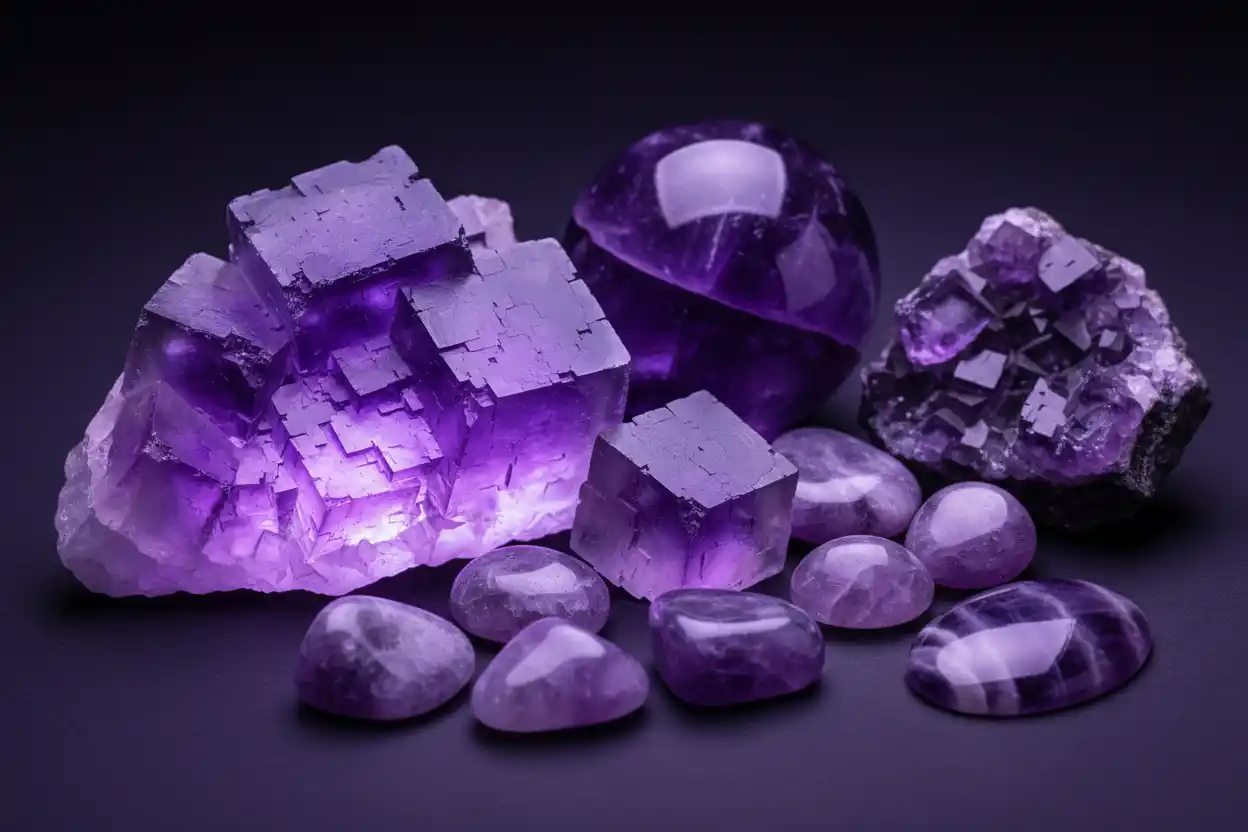
Purple Fluorite: Meaning, Properties & Symbolism
Purple Fluorite is the violet, lavender, lilac, plum, grape, or purple-black color variety of fluorite, the calcium-fluoride mineral CaF₂. It commonly forms cubic and octahedral crystals, color-zoned masses, cleavage fragments, polished bands, and occasional transparent faceted collector gems.
The purple color does not define a separate mineral species. It develops through structural defects, radiation-related color centers, trace elements, and interactions among impurities and vacancies within fluorite’s cubic lattice.
Purple Fluorite at a Glance
| Property | Purple Fluorite |
|---|---|
| Material type | Purple color variety of fluorite |
| Composition | Calcium fluoride, CaF₂ |
| Mineral class | Halide |
| Common colors | Pale lilac, lavender, violet, grape purple, blue-purple, red-purple, smoky purple, and nearly black |
| Crystal system | Cubic |
| Typical habit | Cubes, octahedrons, dodecahedral modifications, interpenetrant twins, stepped crystals, massive bands, and cleavage fragments |
| Luster | Vitreous |
| Transparency | Transparent to opaque |
| Mohs hardness | 4 |
| Cleavage | Perfect octahedral cleavage in four directions |
| Tenacity | Brittle |
| Fracture | Subconchoidal to uneven outside cleavage |
| Specific gravity | Approximately 3.18 |
| Optical character | Isotropic |
| Common uses | Mineral specimens, carvings, spheres, towers, cabochons, beads, faceted collector gems, and protected jewelry |
| Main care concern | Cleavage, scratches, color instability in some specimens, coatings, thermal shock, and water entering fractures |
Purple Fluorite within the Fluorite Family
Purple Fluorite remains chemically and structurally ordinary fluorite.
The parent Fluorite guide owns the mineral’s broad formation, industrial importance, general symbolism, and full physical-property framework.
The guide to types of Fluorite distinguishes purple material from green, yellow, blue, color-change, rainbow, yttrium-bearing, massive, and locality-based products.
Purple is among fluorite’s most familiar colors, yet the cause is not identical in every deposit.
A purple cube from Illinois, a lavender octahedron from Mexico, and a zoned Chinese crystal may contain different defects, impurities, radiation histories, and growth structures.
Consequently, no single trace element should be presented as the universal cause of every purple fluorite.
What Creates the Purple Color?
Pure calcium fluoride is colorless.
Fluorite’s lattice can contain missing fluorine ions, displaced electrons, trace rare-earth elements, and substitutions for calcium.
Natural radiation from surrounding rocks can create or modify defects known as color centers.
An electron trapped at a fluorine vacancy can absorb selected wavelengths of visible light, leaving purple, blue, green, yellow, or mixed color visible.
Rare-earth elements such as yttrium, cerium, europium, samarium, and others can influence color, fluorescence, and defect stability.
Heating, daylight, ultraviolet radiation, X-rays, electron beams, and other energy sources may change certain color centers.
Therefore, purple coloration can be intrinsic to one stable natural defect system, produced by geological irradiation, modified by later exposure, or created artificially through treatment.
The wider relationship between fluorite hue and modern symbolism appears in Fluorite color meaning.
Purple Zoning and Phantoms
Fluorite frequently shows color zoning.
A single cube may contain a dark-purple core beneath a paler outer layer. Other specimens have purple edges, stepped purple bands, alternating purple and colorless growth, or geometric internal phantoms.
Each zone records a change in fluid chemistry, impurity supply, radiation exposure, defect concentration, or crystal-growth conditions.
Cubic geometry creates square or rectangular zones when viewed through a face. Octahedral growth can produce triangular or diamond-shaped internal patterns.
A purple core beneath clear or blue outer fluorite can appear suspended inside the crystal.
These patterns are natural growth records rather than separate stones trapped together.
Cutters often orient cabochons and faceted gems to preserve the most attractive zoning. Poor orientation can mix colors into gray or remove the darkest band completely.
Purple Fluorite and Rainbow Fluorite
Rainbow Fluorite contains two or more visible color bands, commonly purple with green, blue, yellow, or colorless zones.
A stone can therefore be both purple fluorite and rainbow fluorite.
The purple name emphasizes the dominant bodycolor. Rainbow describes multicolored zoning.
Massive rainbow material is commonly carved into towers, spheres, palm stones, bowls, and decorative objects.
Transparent purple cubes belong more strongly to mineral collecting, whereas banded rainbow products dominate the polished crystal market.
Neither term guarantees origin, treatment, fluorescence, or durability.
Purple Fluorite and Green Fluorite
Green Fluorite ranges from pale mint to deep emerald or blue-green.
Green and purple zones often occur within the same crystal or deposit.
In some light-sensitive specimens, sunlight can reduce green color and leave a pale purple or pink-purple appearance. That change is locality and defect dependent rather than universal.
A stable purple crystal should not be treated as faded green fluorite without evidence.
Similarly, a green outer layer surrounding a purple core may represent separate natural growth stages rather than ongoing alteration.
Purple Fluorite and Yellow Fluorite
Yellow Fluorite includes pale lemon, golden, honey, amber, and brown-yellow material.
Purple-yellow zoning is especially attractive because the complementary colors create strong contrast.
Illinois, Spain, China, France, and other localities have produced yellow fluorite with purple edges, cores, or phantoms.
The two colors may respond differently to heat and light. A treatment that weakens one band may leave another visible.
Accordingly, a multicolored specimen should not receive aggressive cleaning, heating, or prolonged sunlight to “improve” its color.
Purple Fluorite and Yttrian Fluorite
Yttrian Fluorite contains significant yttrium substituting for calcium within the fluorite structure.
It can appear purple, blue, lavender, green, colorless, or brownish.
Purple color alone does not establish yttrium enrichment.
Chemical analysis is needed because ordinary fluorite can contain small rare-earth concentrations without qualifying as a distinct yttrian variety.
Retailers sometimes use Yttrian Fluorite as a rarity label for any lavender massive fluorite. The name should be supported by compositional data.
Fluorescence
Fluorite gave its name to the phenomenon of fluorescence, but not every specimen fluoresces.
Some purple fluorite emits blue, violet, white, green, yellow, or another color under long-wave or short-wave ultraviolet radiation.
Other pieces remain weak or inert.
Activating elements, lattice defects, impurities, and quenching components control the response.
The daylight bodycolor does not predict fluorescence reliably. A deep-purple crystal may be inert, while a colorless or pale-yellow specimen glows strongly.
Phosphorescence is different. A phosphorescent fluorite continues glowing briefly after the ultraviolet source is removed.
Repeated ultraviolet testing can affect light-sensitive material. Valuable specimens should not be exposed continuously merely to demonstrate fluorescence.
Does Purple Fluorite Fade in Sunlight?
Some fluorite colors are light sensitive, but the behavior varies greatly.
Blue, green, pink, purple, and color-change material from particular deposits can fade, shift hue, or become more purple after sunlight exposure.
Other purple fluorite remains stable for decades under conservative indoor display.
The safest assumption is that locality-specific stability is unknown until documented.
Direct sunlight should therefore be avoided. Sun through a window still contains visible and ultraviolet energy capable of modifying color centers.
Ultraviolet display lamps should be used briefly rather than continuously.
Heat can also alter fluorite color, sometimes bleaching, darkening, or changing a specimen unpredictably.
A color change caused by damage should not be marketed as an enhancement or cleansing result.
How Purple Fluorite Forms
Fluorite forms in hydrothermal veins, carbonate-replacement deposits, granite-related systems, pegmatites, greisens, sedimentary environments, and some metamorphic rocks.
Calcium- and fluorine-bearing fluids circulate through fractures or porous host rock.
As temperature, pressure, pH, and chemistry change, calcium fluoride precipitates.
Purple fluorite commonly grows with calcite, barite, quartz, galena, sphalerite, pyrite, chalcopyrite, dolomite, and other vein minerals.
In carbonate-hosted districts, fluids can replace limestone or dolostone while depositing fluorite and metallic sulfides.
Granite-related deposits may produce fluorite with quartz, muscovite, topaz, tourmaline, cassiterite, or wolframite.
Several growth episodes create color zoning, etched surfaces, overgrowths, and complex interpenetrant twins.
Important Purple Fluorite Localities
The Illinois-Kentucky Fluorspar District produced classic purple, yellow, blue, and multicolored fluorite. Hardin County mines are especially known for large cubes, color zoning, calcite, barite, sphalerite, and historic American mining associations.
Weardale in County Durham, England, has yielded purple, green, color-changing, twinned, and fluorescent crystals from numerous mines.
China is a major modern source. Hunan, Jiangxi, Fujian, Inner Mongolia, Yunnan, and other provinces produce purple cubes, octahedrons, phantoms, etched crystals, and large matrix specimens.
Spain is known for gemmy purple cubes from Asturias and other northern districts, commonly associated with quartz or calcite.
Mexico produces purple, pink-purple, green-purple, and octahedral material from Durango, Coahuila, Chihuahua, and other mining regions.
Morocco, Pakistan, Namibia, France, Germany, Peru, South Africa, Mongolia, and New Mexico also provide attractive purple specimens.
A photograph cannot prove locality. Cubic habit, color, matrix, associated minerals, and surface texture may suggest a source but rarely establish it conclusively.
Purple Fluorite versus Amethyst
Purple Fluorite and Amethyst overlap in lavender-to-deep-purple color.
Amethyst is quartz with a hardness of 7. Purple Fluorite has a hardness of 4 and scratches much more easily.
Fluorite has perfect octahedral cleavage, whereas quartz has no cleavage and breaks conchoidally.
Fluorite is isotropic, while Amethyst is doubly refractive and uniaxial.
Natural fluorite commonly forms cubes and octahedrons. Amethyst typically forms six-sided prisms with pointed terminations.
Specific gravity and refractive index also differ significantly.
The complete non-destructive comparison belongs on Fluorite versus Amethyst.
How to Identify Purple Fluorite
Cubic or octahedral crystal form provides a strong preliminary clue.
Perfect octahedral cleavage can create triangular faces and eight-sided fragments, although deliberate cleavage testing destroys the specimen.
Fluorite’s hardness of 4 means a steel point can scratch it, but destructive testing is inappropriate for a finished object.
Specific gravity near 3.18 makes it heavier than quartz of similar size.
A refractive index around 1.43–1.45 and isotropic optical behavior distinguish transparent fluorite from Amethyst, glass, calcite, and many purple gems.
Magnification may reveal color zoning, cleavage cracks, fluid inclusions, mineral crystals, healed fractures, coating, resin, and dye.
Raman spectroscopy or X-ray diffraction provides reliable species identification.
The sequence in how to identify crystals helps buyers move from visual clues to defensible testing.
Treatments, Synthetic Fluorite, and Imitations
Irradiation can create or modify purple color centers in fluorite.
Heating may bleach, shift, or destabilize color. The result depends on the specimen’s defects and impurities.
Surface coatings can add stronger purple, iridescence, phosphorescence, or gloss.
GIA has documented fluorite objects coated with phosphorescent powder and clear plastic, demonstrating that an unusual glow may come from a surface layer rather than the mineral.
Dye can enter fractures in massive pale fluorite. Pigment commonly concentrates around cracks, pits, and drill holes.
Resin impregnation stabilizes fractured carving material and may improve apparent transparency.
Synthetic calcium fluoride is produced for optical and technical applications. Laboratory-grown fluorite can be transparent and colored, although it is not the main risk in inexpensive crystal carvings.
Glass, dyed calcite, Amethyst, resin, and coated manufactured products may imitate purple fluorite.
The treatment framework appears in gemstone treatments explained, while general fraud indicators appear in how to spot fake crystals.
Durability and Jewelry Suitability
Fluorite defines hardness 4 on the Mohs scale.
The gemstone hardness chart shows that ordinary dust containing quartz can scratch it.
Perfect cleavage creates an even larger risk. A small impact can split a stone along one of four octahedral directions.
The relationship between hardness, toughness, and cleavage is explained in gemstone toughness versus hardness.
Pendants, earrings, brooches, and collector jewelry are safer than rings or bracelets.
A low bezel can support a cabochon, but setting pressure must remain gentle.
Faceted fluorite is best treated as a display gem. Thin girdles, pointed corners, and large open facets chip easily.
Purple Fluorite is generally a poor choice for an engagement ring. More durable options are compared in purple gemstones for engagement rings.
Current Purple Fluorite Asking Prices
Purple Fluorite spans inexpensive carvings and museum-quality mineral specimens.
| Purple Fluorite product | Broad July 2026 retail asking range |
|---|---|
| Small tumbled stone | About $2–$10 |
| Palm stone or small tower | About $8–$40 |
| Standard cabochon | About $5–$30 |
| Fine zoned or transparent cabochon | About $25–$100 |
| Commercial faceted gem | About $5–$30 per carat |
| Fine precision-cut transparent gem | About $30–$100 per carat |
| Small crystal specimen | About $15–$100 |
| Attractive locality or phantom specimen | About $100–$500 |
| Fine cabinet specimen | About $500–$2,000 |
| Exceptional classic or one-find specimen | Several thousand dollars or more |
These are broad asking ranges rather than formal appraisals or expected resale values.
Recent dealer listings include small gemmy purple specimens around $100–$250, fine Chinese cabinet pieces near $900–$1,500, and exceptional locality specimens priced far higher.
What Gives Purple Fluorite Value?
Color should be attractive and visible under ordinary lighting. A specimen that appears purple only when intensely backlit may be less satisfying in normal display.
Transparency increases value when the crystal remains well formed and minimally cleaved.
Zoning, phantoms, colored edges, and contrasting cores can create a premium.
Crystal form matters strongly. Sharp cubes, octahedrons, complex twins, stepped surfaces, and undamaged terminations attract collectors.
Matrix and associated minerals add context and visual contrast.
Locality can outweigh size. A small pristine crystal from a classic closed mine may command more than a large generic carving.
Fluorescence or phosphorescence can add interest when natural and documented, but it should not replace daylight quality.
Color stability, treatment status, repairs, chips, cleavage, and provenance complete the valuation.
Buying Purple Fluorite
View the stone under daylight-equivalent and warm indoor lighting.
Purple Fluorite can shift from blue-violet to red-violet, gray-purple, or nearly colorless depending on the light source.
Request a video showing the exact specimen from several angles.
Inspect cube corners, octahedral points, and internal cleavage planes for damage.
Ask whether the color is natural, irradiated, heated, dyed, coated, or unknown.
For fluorescent material, confirm whether the glow comes from the fluorite rather than a coating or associated mineral.
A locality claim should include the mine or district whenever possible.
Detailed seller checks belong on where to buy real Purple Fluorite.
Purple Fluorite appears in the purple-crystal directory and the purple-gemstone directory.
It is also indexed under P in the crystals directory and gemstones directory.
Cleaning and Storage
Remove loose dust with a hand-operated air bulb or very soft brush.
For a stable polished stone, use lukewarm water, mild soap, and minimal pressure. Rinse briefly and dry thoroughly.
Do not soak fluorite. Water can enter cleavage fractures, weaken glue, carry dye, or leave residue inside porous matrix.
The broader limitations appear in which crystals can and cannot go in water.
Avoid ultrasonic and steam cleaning. Vibration and heat can extend cleavage cracks.
Do not use acids, bleach, abrasive powder, toothpaste, or commercial silver cleaner.
Keep the specimen away from direct sunlight, strong ultraviolet lamps, hot display cases, and abrupt temperature changes.
Store it separately from quartz, Amethyst, topaz, sapphire, ruby, and diamond.
Purple Fluorite Meaning and Symbolism
Modern crystal traditions associate Purple Fluorite with concentration, mental organization, discernment, imagination, and separating useful information from distraction.
Its geometric cubic structure inspires symbolism involving order, systems, boundaries, and building a stable framework.
Color zoning can represent several stages or influences remaining visible within one developing structure.
Lavender material receives associations with reflection and subtle creativity, while deep purple is linked with confidence in intellectual or spiritual inquiry.
Fluorescence can provide a metaphor for qualities that become visible only under particular conditions.
These meanings remain personal, artistic, cultural, or spiritual interpretations. Scientific evidence does not show that Purple Fluorite treats neurological illness, improves intelligence, protects against radiation, or guarantees mental clarity.
Frequently Asked Questions
Is Purple Fluorite a separate mineral?
No. It is the purple color variety of fluorite, CaF₂.
What causes Purple Fluorite’s color?
Radiation-related color centers, lattice vacancies, trapped electrons, rare-earth elements, and other impurities can contribute. The exact mechanism varies among deposits.
Is all Purple Fluorite naturally irradiated?
Natural geological radiation can create color centers, but not every purple specimen has the same radiation history. Commercial irradiation can also modify color.
Does Purple Fluorite always fluoresce?
No. Some specimens fluoresce strongly, others weakly, and many remain inert.
What color does Purple Fluorite fluoresce?
Possible responses include blue, violet, white, green, or other colors, depending on activators and defects.
Can Purple Fluorite fade in sunlight?
Yes, some specimens can fade or change color. Others remain stable, so conservative dark or low-light storage is safest.
How does Purple Fluorite differ from Amethyst?
Fluorite is softer, isotropic, denser, and has perfect octahedral cleavage. Amethyst is quartz with hardness 7 and no cleavage.
Is Purple Fluorite the same as Rainbow Fluorite?
Not always. Rainbow Fluorite contains several colors, while Purple Fluorite may be uniformly purple or show only purple and colorless zoning.
Can Purple Fluorite be worn in a ring?
It can be used in a highly protected occasional-wear ring, but pendants and earrings are more practical because fluorite scratches and cleaves easily.
Is Purple Fluorite commonly treated?
Irradiation, heating, dye, resin stabilization, coatings, and artificial phosphorescent layers can occur.
Can Purple Fluorite go in water?
Brief gentle washing may suit intact untreated material, but soaking is not recommended because cleavage, dye, glue, coatings, and matrix can create problems.
What makes Purple Fluorite valuable?
Color, transparency, zoning, crystal form, fluorescence, condition, locality, matrix aesthetics, treatment status, and provenance determine value.
Purple Fluorite is best evaluated as a soft, cleavable mineral specimen whose color can record both crystal growth and defect chemistry. Collectors comparing it with multicolored material can next examine how purple bands interact with green, blue, and yellow zones in the full Fluorite-variety framework.
Fluorite must not be ingested, licked, powdered, heated, burned, or used in drinking-water preparations. Finished intact pieces are generally suitable for external handling, but cutting and grinding create calcium-fluoride and associated-mineral dust that requires wet methods, effective extraction, eye protection, and suitable respiratory controls.