Ruby vs Garnet vs Spinel: Differences and Identification Tests
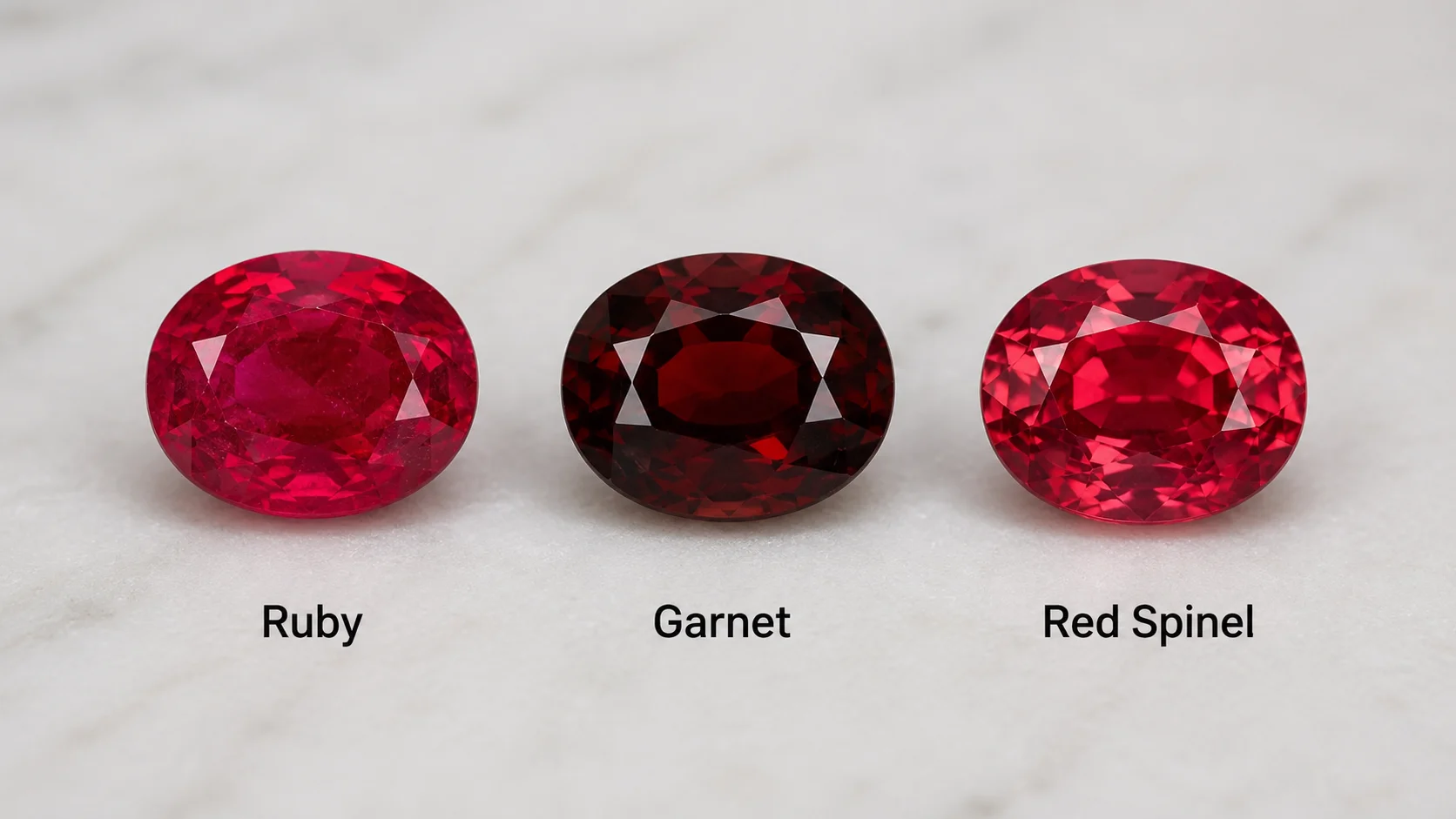
Ruby, red garnet and red spinel can all show vivid crimson, purplish-red, pinkish-red or dark wine-red color. Before modern gemology, even important collectors and royal treasuries confused them.
Today, these stones are separated through mineral structure and optical properties rather than red color alone. Ruby is red corundum, spinel is a cubic magnesium aluminum oxide, and garnet is a group of related silicate minerals with several red members.
A quick visual inspection can suggest an identity, but it cannot establish natural origin, treatment or exact garnet species. Refractive index, density, polarized-light behavior, spectroscopy and microscopy provide the reliable distinction.
Ruby vs Garnet vs Spinel at a Glance
| Feature | Ruby | Red garnet | Red spinel |
|---|---|---|---|
| Mineral identity | Red corundum | Group of silicate minerals | Spinel mineral |
| Simplified chemistry | Al₂O₃ with chromium | Varies by species; common red stones are pyrope–almandine mixtures | MgAl₂O₄, commonly chromium-colored |
| Crystal system | Trigonal | Cubic | Cubic |
| Typical red range | Pinkish red, vivid red, purplish red, orangish red | Brownish red, dark red, purple-red, raspberry and orange-red | Scarlet, vivid red, pink-red and orangish red |
| Mohs hardness | 9 | Approximately 6.5–7.5 | 8 |
| Cleavage | None; parting may occur | None | None |
| Refraction | Doubly refractive | Singly refractive | Singly refractive |
| Pleochroism | Usually visible | None | None |
| Refractive index | Approximately 1.762–1.770 | Varies widely by species, commonly around the low 1.70s to low 1.80s for red varieties | Commonly near 1.718 |
| Specific gravity | About 4.00 | Varies by species, commonly roughly 3.6–4.3 | About 3.60 |
| Fluorescence | Often red, especially in low-iron ruby | Common iron-rich red garnets are usually weak or inert | Red spinel can fluoresce strongly |
| Common inclusions | Rutile silk, crystals, healed fissures and zoning | Crystals, needles and growth features depending on species | Crystals, octahedral inclusions and fingerprints |
| Routine treatment | Heating is common; diffusion and glass filling occur | Most red garnet is untreated; rare filling may occur | Most red spinel is untreated; synthetics are important |
| Laboratory-grown counterpart | Common | True natural-species equivalents are uncommon in ordinary jewelry | Common |
The Mineral Difference
Ruby is chromium-colored corundum.
Garnet is not one mineral species. It is a group whose members share a cubic structure while differing in chemistry.
Spinel is a separate cubic oxide mineral.
These differences affect hardness, density, refraction, pleochroism, spectroscopy and treatment patterns.
A red stone does not become ruby because its color looks expensive, and a genuine garnet or spinel is not fake merely because a seller or owner expected ruby.
Which Garnets Resemble Ruby?
Several red garnet varieties can overlap visually with ruby.
Almandine garnet commonly appears deep red, brownish red or purplish red. Thick or deeply cut stones may look nearly black.
Pyrope garnet can show a cleaner dark red with less brown.
Rhodolite garnet is a brighter purple-red or raspberry pyrope–almandine variety and may resemble pinkish or purplish ruby.
Spessartine-rich mixtures can become orange-red, though their appearance usually moves away from classic ruby.
The complete family relationship appears in Types of Garnet.
Color Differences
Ruby’s most prized color is vivid red to slightly purplish red.
Fine spinel can match or rival that vividness and may show scarlet, pink-red or orangish-red color.
Red garnets commonly show more brown, purple or dark tone, although fine rhodolite and selected pyrope-rich stones can be bright.
Color alone is unreliable because all three groups overlap.
A stone that appears red in a spotlight may become dark or brown under ordinary room light. Always compare it under daylight-equivalent and warm illumination.
Brightness and Extinction
Fine ruby combines saturation with strong internal brightness.
Spinel is singly refractive and can show excellent clean brilliance when cut well.
Many red garnets absorb substantial light. A deep stone may display black areas or dark reflections, especially around the center.
Nevertheless, cut quality can reverse these tendencies. A poorly cut ruby may look darker than a fine spinel or rhodolite.
Extinction is therefore a quality clue, not a mineral test.
Pleochroism
Ruby is pleochroic because it is doubly refractive.
Viewed through a dichroscope, a ruby commonly shows two related colors, such as red and purplish red or red and orange-red.
Spinel and garnet crystallize in the cubic system and normally show no true pleochroism.
This makes dichroscope testing a useful separation between ruby and the other two.
However, strain, inclusions and aggregate material can complicate the observation. A dichroscope result should be combined with refractive index and other properties.
Single and Double Refraction
Ruby is anisotropic and doubly refractive.
Spinel and garnet are normally isotropic and singly refractive.
In a polariscope, a faceted ruby typically changes between light and dark as it rotates.
A spinel or garnet normally remains dark through a full rotation when viewed between crossed polarizers.
Some garnets and spinels can show anomalous double-refraction effects caused by strain or growth structure. Therefore, a flashing reaction does not prove ruby without supporting tests.
Refractive Index
Ruby’s refractive index falls around 1.762–1.770.
Spinel commonly measures near 1.718.
Garnet varies by species. Pyrope-rich stones can overlap spinel’s range, while almandine-rich stones may approach or exceed ruby’s refractive index.
This means refractive index separates ruby from spinel readily in many cases but must be interpreted more carefully with garnet.
A professional refractometer can also reveal ruby’s birefringence, while cubic spinel and garnet provide one principal reading.
Specific Gravity
Ruby has a specific gravity near 4.00.
Spinel is lighter at about 3.60.
Garnet spans a broad range. Pyrope and rhodolite can overlap spinel, while iron-rich almandine may be as dense as or denser than ruby.
Hand heft cannot provide a dependable conclusion.
Hydrostatic measurement is useful on loose, unmounted stones when combined with dimensions and refractive index.
Settings, cavities and composites make density readings unreliable.
Hardness
Ruby is the hardest of the three at Mohs 9.
Spinel follows at Mohs 8.
Garnet generally ranges from about 6.5 to 7.5.
This difference affects long-term surface wear, but deliberate scratch testing should never be used on a finished gem.
A steel point, quartz fragment or knife can damage polish without proving natural origin.
The broader comparison appears in the gemstone hardness chart.
Hardness also does not measure resistance to breaking, as explained in Gemstone Toughness vs Hardness.
Cleavage and Breakage
Ruby, garnet and spinel lack perfect cleavage.
That makes all three comparatively practical for jewelry.
Ruby can show parting, while each material remains brittle enough to chip under a sharp impact.
A thin girdle, pointed cut or surface-reaching fracture increases risk regardless of species.
The gemstone cleavage guide explains why fracture and cleavage should not be treated as the same property.
Fluorescence
Ruby often fluoresces red under ultraviolet light because chromium produces both its color and glow.
Low-iron ruby may fluoresce strongly, while iron-rich ruby can respond weakly.
Red spinel can also fluoresce bright red.
Common iron-rich red garnets are often inert or weak, giving fluorescence some screening value.
However, synthetic ruby and synthetic spinel may fluoresce strongly as well. UV light cannot establish natural origin or separate ruby from spinel by itself.
Magnetism
Many red garnets contain substantial iron or manganese and may show attraction to a strong neodymium magnet.
Ruby and red spinel are generally much less responsive.
A magnet can therefore support a garnet identification in some cases.
However, the response varies with garnet composition, stone size and setting metal.
Magnetic attraction is not a pass-or-fail test and should never replace gemological measurements.
Inclusions in Ruby
Natural ruby may contain rutile silk, mineral crystals, healed fissures, growth zoning and twinning-related features.
Rutile silk can soften color or create a star when the stone is cut as a cabochon.
Heat treatment can alter or dissolve silk.
Glass-filled ruby may show bubbles, blue or orange flash effects and luster differences across filled fractures.
The detailed treatment workflow appears in How to Spot Treated or Synthetic Ruby.
Inclusions in Garnet
Red garnet inclusions depend on species and locality.
Almandine and pyrope may contain crystals, needles, rounded inclusions and growth features.
Red garnets are often eye-clean, especially in modest sizes.
A clean appearance therefore does not prove spinel or synthetic origin.
Garnet identification frequently depends more on refractive index, density, magnetic response and chemistry than on one diagnostic inclusion.
Inclusions in Spinel
Natural spinel may contain octahedral crystals, aligned inclusions, fingerprints, healed fissures and other mineral inclusions.
Fine red spinel is often highly transparent.
Synthetic flame-fusion spinel may show curved growth, gas bubbles or anomalous optical behavior.
Other growth methods produce subtler evidence.
A clean spinel must not be assumed synthetic, and an included stone must not be assumed natural.
Natural and Laboratory-Grown Ruby
Laboratory-grown ruby is manufactured corundum.
It shares the hardness, density and refractive properties of natural ruby.
Growth structures, trace chemistry, inclusions and spectroscopy separate the origins.
Flame-fusion ruby can be inexpensive, while flux- or hydrothermal-grown material may appear more natural internally.
The Real vs Fake Ruby guide covers these distinctions in detail.
Natural and Synthetic Spinel
Synthetic spinel has been produced for more than a century.
It may imitate red spinel, ruby, sapphire, aquamarine and other colored stones.
Flame-fusion synthetic spinel can show curved growth or gas bubbles, although appearances vary.
Natural spinel is commonly untreated and carries a different rarity and value structure.
A seller should state natural or synthetic origin explicitly.
Synthetic Garnet Materials
Industrial and jewelry products such as yttrium aluminum garnet and gadolinium gallium garnet have garnet-like crystal structures but are not ordinary natural red garnet species.
They have been used as diamond and colored-stone simulants.
True laboratory counterparts of common natural gem garnets are not encountered as routinely as synthetic ruby and spinel in ordinary red jewelry.
A report should identify the precise material rather than using lab garnet as a vague retail phrase.
Ruby Treatments
Most natural ruby has been heated.
Diffusion can add color near the surface, while glass filling can make heavily fractured material appear clearer.
A conventionally heated ruby remains natural corundum and is generally durable.
A heavily glass-filled ruby is more vulnerable to heat, acid, repair and aggressive cleaning.
Treatment affects care and value as well as appearance.
Garnet Treatments
Most red garnet is sold without routine color enhancement.
Rare fracture filling or coating can occur.
Because treatment is uncommon, sellers sometimes use untreated as a marketing claim without providing evidence.
Imitations and misidentification may be more relevant concerns than enhancement in ordinary red garnet jewelry.
The Real vs Fake Garnet guide covers glass, synthetics and other substitutes.
Spinel Treatments
Natural red spinel is commonly untreated.
Heating and filling have been reported, but they are not routine across most of the market.
Synthetic spinel remains an important concern, especially in older jewelry and inexpensive red stones.
An untreated claim does not establish natural origin.
Laboratory analysis should address both origin and treatment separately.
Jewelry Durability
Ruby offers the strongest resistance to surface wear.
Spinel is also excellent for rings, earrings, bracelets and necklaces.
Garnet works well in most jewelry but will abrade sooner under harsh daily ring wear.
All three stones should be removed before heavy manual work.
Prongs, metal thickness and fracture condition can matter more than a one-point difference in hardness.
For specific ring construction, compare the Garnet Rings and Spinel Rings guides with the ruby ring requirements.
Price and Rarity
Fine natural ruby generally carries the highest price, especially when it combines vivid color, transparency, substantial size and little or no treatment.
Fine red spinel can also be rare and expensive, although it often costs less than a comparable ruby.
Red garnet covers the broadest accessible range. Common almandine is inexpensive, while fine rhodolite, unusual pyrope and exceptional collector garnets can command substantial prices.
Current market factors belong in the Ruby Price Guide, Garnet Price Guide and Spinel Price Guide.
Buying Ruby, Garnet or Spinel
Begin by asking for the exact material name.
A listing should state natural ruby, laboratory-grown ruby, natural spinel, synthetic spinel or a specific garnet variety where known.
Use the Ruby Buying Guide, Garnet Buying Guide and Spinel Buying Guide for species-specific selection.
Treatment, origin and dimensions should appear on the invoice.
Unsupported labels such as pigeon’s-blood style, ruby red or AAA red do not identify the mineral.
Safe Home Inspection
Inspect color under neutral and warm lighting.
Use a loupe to look for bubbles, curved growth, silk, crystals, filled fractures and surface coatings.
A dichroscope can reveal ruby’s pleochroism.
A strong magnet may support an iron-rich garnet identification.
Do not scratch, heat, burn, acid-test or solvent-soak the stone.
The general How to Identify Crystals guide provides a non-destructive sequence for unknown materials.
Laboratory Identification
A basic gemological separation can use refractive index, polariscope reaction, dichroscope response, density and fluorescence.
Raman spectroscopy identifies the mineral species directly.
Microscopy and spectroscopy help separate natural and laboratory-grown ruby or spinel.
Chemical analysis can classify garnet composition and detect glass filler or diffusion-related elements.
A significant purchase may justify an independent report. The Gemstone Certification guide explains laboratory options, while How to Read a Gem Lab Report helps interpret identity, treatment and origin language.
For remote purchases, follow How to Buy Gemstones Online.
Frequently Asked Questions
1. Which is hardest: ruby, garnet or spinel?
Ruby is hardest at Mohs 9, followed by spinel at 8 and garnet at approximately 6.5–7.5.
2. Can garnet look exactly like ruby?
Fine pyrope, almandine and rhodolite can overlap ruby’s red range, although their optical properties differ.
3. Can spinel look exactly like ruby?
Yes. Fine red spinel can resemble ruby closely and was historically confused with it.
4. Which stone is doubly refractive?
Ruby is doubly refractive. Garnet and spinel are normally singly refractive.
5. Does strong red fluorescence prove a stone is ruby?
No. Red spinel and synthetic ruby or spinel can also fluoresce strongly.
6. Is garnet always darker than ruby?
No. Many red garnets are dark, but fine rhodolite and pyrope-rich stones can be bright.
7. Is red spinel a fake ruby?
No. Natural red spinel is a distinct and valuable gemstone.
8. Are all clear red stones laboratory-grown?
No. Natural ruby, garnet and spinel can all be eye-clean.
9. Which stone is most valuable?
Fine natural ruby is generally most expensive, although exceptional spinel and rare garnet can also be valuable.
10. Can a magnet identify garnet?
Many iron-rich garnets respond to a strong magnet, but the test is supportive rather than definitive.
11. Which test separates ruby from spinel most easily?
A combination of refractive index, pleochroism and polariscope response separates them efficiently.
12. Do ruby, garnet and spinel need different care?
Yes. Ruby is hardest, spinel is slightly softer and garnet varies by species. Treatments and settings can create additional care requirements.
Ruby, garnet and spinel demonstrate why red color is not a mineral identity. Ruby’s double refraction and hardness, spinel’s cubic brilliance and garnet’s variable group chemistry provide the reliable distinctions. Visual appearance starts the comparison, but instrument testing completes it.
All three belong in Red Gemstones, while ruby appears in Crystals That Start With R and Gemstones That Start With R.