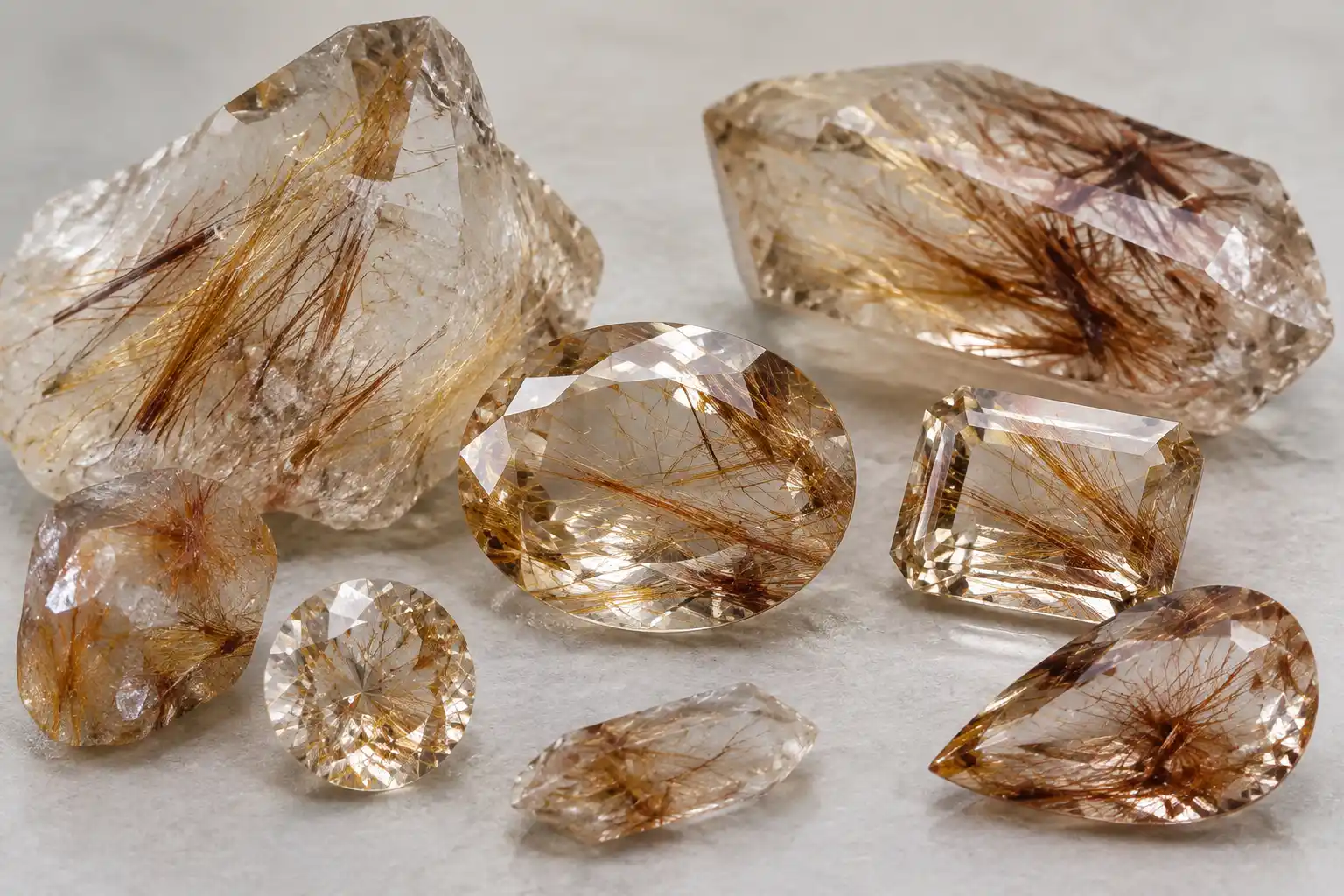
11 Rutilated Quartz Benefits for Spiritual Clarity
Rutilated quartz benefits begin with an unusual combination of two real minerals: quartz and rutile. The transparent to translucent host is quartz, SiO2, while the internal needles are usually rutile, TiO2, a titanium dioxide mineral that may appear golden, reddish brown, coppery, silvery gray, or other natural shades depending on the specimen and its trace chemistry.
The most useful rutilated quartz benefits come from its Mohs 7 hardness, lack of true cleavage, unusual inclusion patterns, lapidary versatility, geological interest, and the individuality created by every group of rutile needles. Some specimens contain only a few slender crystals, while others display dense networks, radiating stars, crossed needles, or dramatic geometric formations that become the main visual feature of the gem.
Modern crystal traditions add spiritual clarity, focus, manifestation, energetic cleansing, and chakra symbolism to rutilated quartz benefits. These ideas can provide a personal focus during meditation or journaling, but quartz containing rutile has not been shown to improve cognition, treat psychological conditions, remove invisible energy, or alter the body’s physiology.
11 Rutilated Quartz Benefits at a Glance
- Natural rutile needles make every rutilated quartz specimen visually individual.
- Mohs hardness 7 gives the quartz host useful resistance to everyday scratching.
- Quartz has no true cleavage, which supports practical use in many types of jewelry.
- Transparent quartz can display golden, red, brown, copper, or silvery rutile with exceptional clarity.
- Rutile inclusions provide valuable information about mineral growth and the geological history of the host crystal.
- Radiating or intersecting rutile needles can create rare star-like and geometric inclusion patterns.
- Skilled cutting can emphasize the orientation, density, color, and arrangement of the internal rutile.
- Rutilated quartz is useful for studying inclusions, crystallography, mineral associations, and gemstone identification.
- Modern spiritual clarity practices use the stone symbolically for focus, reflection, and intentional decision-making.
- Jewelry and polished specimens are generally easy to maintain when fractures and thermal shock are respected.
- Safe lapidary practice keeps silica-bearing cutting dust separate from the ordinary handling of intact polished stones.
Rutilated Quartz Benefits Begin With Two Distinct Minerals
Understanding rutilated quartz benefits requires distinguishing the quartz host from the inclusions inside it. Quartz is crystalline silicon dioxide with Mohs hardness 7, while rutile is crystalline titanium dioxide and normally forms in the tetragonal crystal system.
The rutile commonly develops as acicular, or needle-like, crystals. These needles may cross, radiate, cluster, or extend through large areas of transparent quartz, producing patterns that look dramatically different from one stone to another.
The inclusions are not cracks painted gold or metallic threads inserted into the quartz. In natural rutilated quartz, the rutile is part of the gemstone’s geological growth history and can be examined with magnification or gemological instruments.
This two-mineral relationship is one of the most useful rutilated quartz benefits for gemology students. It shows how a transparent host crystal can preserve another mineral while still remaining identifiable as quartz.
Rutile Needles Create One-of-a-Kind Appearance
Visual individuality is among the strongest rutilated quartz benefits. Traditional transparent gemstones are often valued for minimizing inclusions, but rutilated quartz reverses that expectation because the inclusions themselves create the stone’s appeal.
Golden needles are especially familiar, although rutile can also appear reddish, coppery, brown, gray, or nearly black under some lighting. Color can be influenced by trace elements, alteration, thickness, optical reflection, and the characteristics of individual rutile crystals.
Some rutile crystals occur as isolated straight needles, while others intersect in dense networks. Particularly striking specimens may contain radiating groups associated with hematite or ilmenite-related cores, creating star-like structures visible through transparent quartz.
These internal arrangements make rutilated quartz benefits especially valuable for collectors who prefer natural variation. Two cut stones from the same deposit can still have completely different internal landscapes.
Mohs 7 Hardness Supports Jewelry Use
Rutilated quartz benefits jewelry wearers because the quartz host has Mohs hardness 7. It resists scratching better than feldspar, apatite, fluorite, calcite, and many common ornamental stones.
Quartz also lacks true cleavage, reducing the risk of the gem splitting along fixed crystallographic planes. Strong impacts can still cause conchoidal fracture, chips, or breaks, particularly where large inclusions intersect existing fractures.
Rutilated quartz works well in pendants, earrings, beads, bracelets, cabochons, and rings. A protective setting is particularly useful when a stone contains prominent surface-reaching fractures or a complicated internal inclusion network.
Hardness should not be mistaken for indestructibility. Diamond, corundum, topaz, and other harder gemstones can scratch quartz, so individual storage remains sensible for polished jewelry.
Cutting Can Transform Rutile Into the Main Visual Feature
Lapidary design is another important source of rutilated quartz benefits. The cutter does not simply choose a shape and remove unwanted inclusions. In high-quality pieces, the orientation of the rutile may determine the entire design.
A dense golden cluster may look best beneath a broad polished surface, while a radiating rutile formation may require careful orientation so its geometry appears face-up. Transparent rough with scattered needles can also work well in faceted designs that combine internal inclusions with reflections from polished facets.
Freeform cutting is especially effective because the cutter can adapt to the natural distribution of rutile rather than sacrificing an unusual formation to fit a standard outline. Large rutilated quartz crystals also give artists enough space to create sculptural cuts and polished objects.
These rutilated quartz benefits explain why inclusions do not automatically reduce value. In this gem, a visually exceptional inclusion pattern can be the principal reason the stone is desirable.
Geological Formation Adds Scientific Value
Knowing where rutilated quartz is found adds geological meaning to the internal needles. Important rutilated quartz has come from Brazil, Madagascar, Pakistan, India, the United States, and other quartz-producing regions.
Rutile and quartz can form across several geological environments, including hydrothermal veins, metamorphic rocks, and pegmatitic systems. The exact relationship between host quartz and rutile can differ from one specimen to another.
Some rutile crystals existed before the surrounding quartz fully enclosed them, while others developed during related stages of crystal growth. Later fluids can also enter fractures and create secondary features around preexisting inclusions.
These relationships are useful because inclusions can preserve evidence about more than appearance. They may reveal mineral growth sequences, later fluid movement, deformation, and changing geological conditions.
Rutile Stars and Unusual Inclusion Patterns
Rare inclusion arrangements add another group of rutilated quartz benefits. Intersecting or radiating needles can create star-like structures inside transparent quartz, particularly when rutile grows around another mineral such as hematite.
This internal “star” is different from the surface asterism seen in star sapphire or star ruby. In many rutilated quartz gems, the observer is looking directly at the geometric arrangement of rutile crystals inside the transparent host.
Cutting orientation remains critical. A spectacular star embedded in rough can lose much of its impact if the stone is cut so the formation faces sideways or disappears beneath an unsuitable facet arrangement.
These specimens are valuable for teaching the difference between an inclusion scene and a conventional optical phenomenon. Both can look star-like, but their gemological causes are not identical.
Rutilated Quartz Benefits for Gem Identification
Rutilated quartz benefits gemology because it teaches why an inclusion must be identified rather than guessed from shape alone. Needle-like inclusions occur in numerous gemstones, and not every golden, black, or reddish needle inside quartz is automatically rutile.
Rutile has characteristic crystal structure, luster, chemistry, and Raman spectral features that allow a laboratory to distinguish it from tourmaline, hematite, goethite, amphiboles, or other needle-forming minerals.
This matters commercially because trade names can sometimes be applied too loosely. A transparent quartz containing black tourmaline needles, for example, belongs more appropriately with tourmalinated quartz rather than rutilated quartz.
Gemological testing protects the scientific identity of the gemstone while also making the inclusion scene more interesting. Knowing exactly which mineral forms the needles gives the stone a more precise geological story.
Spiritual Clarity as Personal Symbolism
Spiritual clarity is one of the most common modern themes attached to rutilated quartz benefits. The transparent quartz surrounding distinct internal needles can serve as an intuitive visual metaphor for separating important thoughts from mental distraction.
A person might keep a polished stone near a journal and associate it with identifying one priority before starting work. Another may use it during meditation as a tactile object while considering a difficult decision.
The gemstone itself does not improve intelligence, memory, attention span, neurological function, or decision-making ability. Quartz and rutile do not generate a clinically established signal that changes the brain.
Used symbolically, however, the stone can become part of an intentional routine. The clarity comes from reflection, attention, and subsequent choices rather than from a medical effect of the crystal.
Chakra Traditions and Rutilated Quartz
Modern rutilated quartz chakra practices vary according to rutile color and spiritual system. Golden rutilated quartz may be associated with solar plexus or crown themes, while some practitioners connect transparent quartz with several chakras.
Chakras are spiritual concepts rather than anatomical structures. Holding rutilated quartz near the forehead, chest, or abdomen does not establish a physiological interaction with the brain, heart, endocrine glands, digestive system, or nervous system.
A chakra practice may still function as structured reflection. Someone might connect golden needles with confidence or transparent quartz with mental openness while meditating on those ideas.
The symbolism remains personal. There is no gemological reason to describe one rutile needle as carrying a different measurable energy merely because of its color.
Healing Claims Need Clear Limits
Claims described as rutilated quartz healing properties can include anxiety relief, detoxification, immunity, hormonal balance, pain reduction, emotional healing, or improved circulation. Scientific evidence does not establish rutilated quartz as a treatment for these conditions.
The titanium inside rutile does not enter the body beneficially through ordinary skin contact. Likewise, silicon and oxygen within quartz do not provide a nutritional or therapeutic dose simply because someone wears the stone.
Meditation, journaling, breathing exercises, prayer, or quiet reflection may be valuable personal practices. The presence of a gemstone can give those routines consistency without making the mineral a medicine.
This distinction allows rutilated quartz benefits to include meaningful symbolism while keeping health decisions grounded in appropriate evidence.
Personal Meaning Can Come From the Inclusions Themselves
Personal rutilated quartz meaning can develop naturally from the stone’s internal patterns. A dense web of needles might represent complexity to one owner, while another sees a radiating cluster as a symbol of direction or creativity.
A particular stone can also represent an anniversary, journey, achievement, relationship, gift, or collecting milestone. Its unique inclusion pattern can make that association especially personal because another specimen is unlikely to look exactly the same.
Collectors may attach meaning to locality or geological formation instead of spirituality. A crystal from a favorite mining region can carry significance through provenance and mineral associations.
None of these interpretations changes the mineral chemistry. They simply show how a natural object can acquire human meaning through experience.
Silica Dust and Responsible Lapidary Work
Ordinary handling of an intact polished stone is very different from cutting or grinding quartz. Lapidary work can create fine silica-bearing dust, and repeated inhalation of respirable crystalline silica is a serious occupational concern.
Rutilated quartz should therefore be worked with appropriate wet cutting, ventilation, extraction, and respiratory controls suited to the operation. Dry grinding without dust control is unnecessary and unsafe.
The rutile inclusions do not create a reason to fear intact jewelry. The practical safety issue appears when quartz is mechanically disturbed enough to generate airborne particles.
This distinction keeps rutilated quartz benefits realistic. A finished pendant can be worn normally, while cutting rough calls for professional mineral-dust precautions.
Cleaning and Long-Term Care
Rutilated quartz is generally straightforward to care for. Warm water, mild soap, and a soft cloth or brush are appropriate for many intact stones.
Large rutile inclusions can be surrounded by stress fractures or liquid-filled cavities, so aggressive ultrasonic cleaning is not ideal when a stone is heavily fractured. Steam and sudden temperature changes can also place unnecessary stress on existing internal weaknesses.
After cleaning, dry the jewelry thoroughly and store it away from harder gems. Separate storage helps preserve facet edges and polished surfaces.
Rutilated quartz benefits from simple care rather than elaborate cleansing treatments. Salt, boiling water, chemical baths, and prolonged soaking are unnecessary for ordinary jewelry maintenance.
Conclusion
Rutilated quartz benefits include Mohs 7 hardness, distinctive rutile inclusions, jewelry versatility, unusual star-like formations, geological information, and strong gemological educational value. Spiritual clarity and chakra practices can provide personal symbolism, but the real physical identity of the gemstone comes from quartz hosting natural rutile crystals.
FAQs
What are the main rutilated quartz benefits?
Rutilated quartz benefits include useful quartz durability, distinctive natural rutile inclusions, jewelry and collector appeal, geological interest, and excellent educational value for studying mineral inclusions. Modern spiritual traditions also connect it with clarity, focus, and intention.
What are the needles inside rutilated quartz?
The characteristic needles are rutile, a titanium dioxide mineral with the chemical formula TiO2. Natural rutile may appear golden, reddish brown, coppery, gray, or other shades depending on the specimen.
Is rutilated quartz real quartz?
Yes. The host gemstone is quartz, SiO2, containing natural mineral inclusions. The presence of rutile does not stop the surrounding crystal from being quartz.
Is rutilated quartz durable enough for jewelry?
Generally, yes. Quartz has Mohs hardness 7 and no true cleavage, making rutilated quartz suitable for many jewelry styles. Large fractures around inclusions can create local weaknesses, so individual stones still need sensible care.
Does rutilated quartz improve mental clarity?
There is no scientific evidence that rutilated quartz directly improves memory, concentration, intelligence, or neurological function. It can serve as a personal reminder during meditation, planning, or reflection.
Does every needle in quartz mean the stone is rutilated quartz?
No. Quartz can contain tourmaline, hematite, amphiboles, goethite, and other elongated minerals. Proper identification of the inclusions is necessary before calling a specimen rutilated quartz.
Is rutilated quartz safe to wear?
Yes, intact polished rutilated quartz can be handled and worn normally. Cutting, drilling, or grinding quartz requires appropriate silica-dust controls because those activities can create respirable crystalline particles.
Can rutilated quartz have personal meaning?
Yes. Rutilated quartz can represent clarity, creativity, a relationship, achievement, journey, mineral locality, or private memory. Personal symbolism does not require a universal metaphysical explanation.
Disclaimer: Spiritual clarity, chakra, manifestation, emotional, cleansing, and energetic descriptions of rutilated quartz reflect spiritual beliefs and personal practices. Rutilated quartz is not a medical or psychological treatment and should not replace professional healthcare.