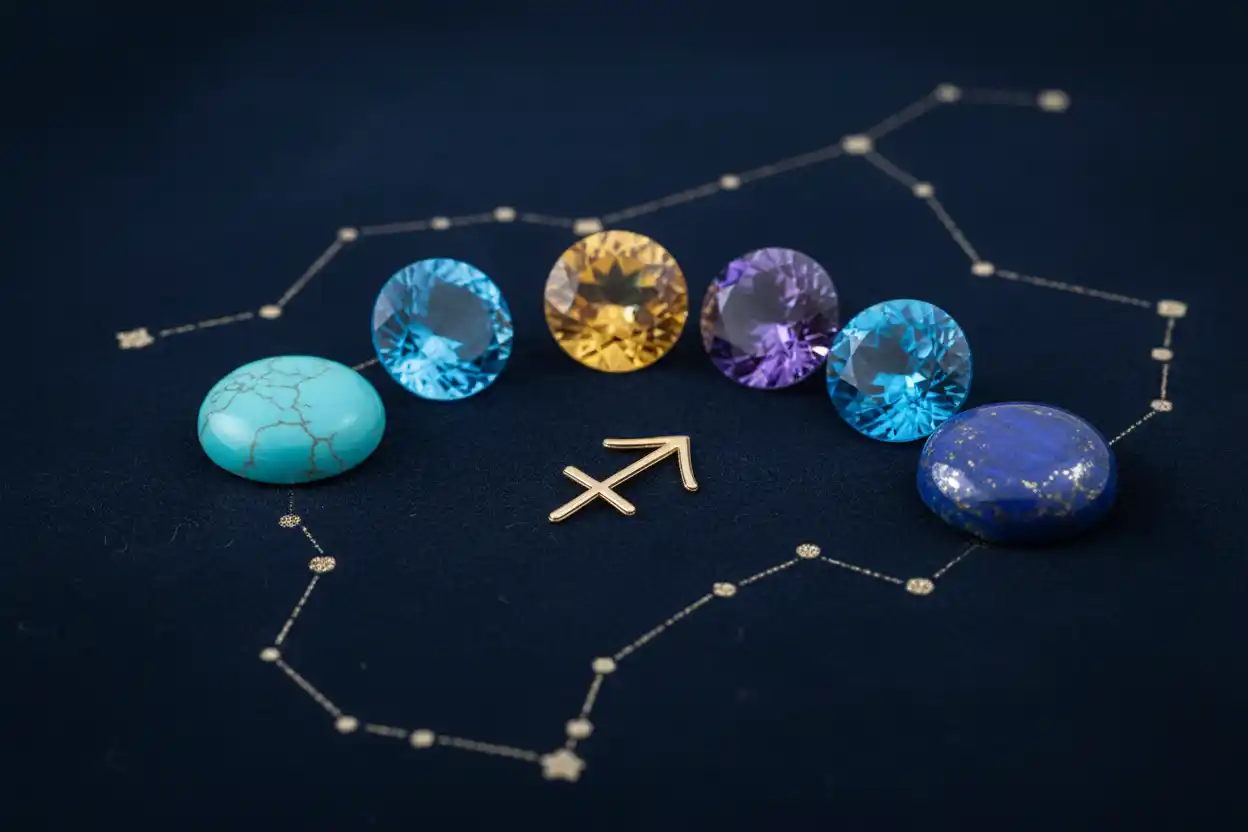
Sagittarius Birthstone: 17 Sacred Meanings of Turquoise & Topaz
The Sagittarius birthstone tradition commonly connects the sign with turquoise and topaz because Sagittarius extends across late November and most of December. Topaz is a recognized November birthstone, while turquoise is one of the principal traditional December birthstones. Their connection with Sagittarius therefore comes partly from recognized monthly birthstone customs and partly from later zodiac symbolism rather than from any scientific system that assigns minerals to astrological signs.
Gemologically, the two stones could hardly be more different. Topaz is a transparent crystalline mineral that can occur in several colors and reaches 8 on the Mohs hardness scale. Turquoise is an opaque to occasionally semitranslucent hydrated copper aluminum phosphate, usually blue, blue-green, or greenish, with a Mohs hardness generally around 5 to 6. Topaz is commonly faceted, while turquoise is usually fashioned as cabochons, beads, carvings, or polished inlay.
Spiritual traditions often connect Sagittarius with freedom, exploration, optimism, honesty, philosophy, and purposeful movement. Turquoise and topaz have accumulated symbolic associations that fit many of those themes, but gemstones do not scientifically determine personality, attract guaranteed good fortune, create physical protection, or control future outcomes. Their spiritual value is better understood through history, personal meaning, cultural traditions, and the intentions a wearer chooses to associate with them.
17 Sacred Meanings Associated With Sagittarius Birthstones
- Truth
- Courage
- Exploration
- Optimism
- Wisdom
- Freedom
- Honest communication
- Purpose
- Confidence
- Friendship
- Personal growth
- Clear judgment
- Generosity
- Resilience
- Curiosity
- Hope
- Meaningful direction
These themes reflect traditional and modern symbolic associations rather than measurable powers produced by turquoise or topaz. A Sagittarius wearer may find personal significance in one or several of these ideas, but birth date does not scientifically determine temperament, and the presence of a gemstone does not guarantee courage, luck, success, protection, or emotional transformation.
Why Turquoise and Topaz Are Linked With Sagittarius
Sagittarius is generally placed from about November 22 to December 21 in Western tropical astrology. That date range crosses two months with established birthstone traditions. November is strongly associated with topaz, often alongside citrine in modern lists, while December is associated with turquoise and, in many modern traditions, zircon and tanzanite.
This creates a practical distinction between a monthly birthstone and a zodiac-associated gemstone. A Sagittarius born in late November can choose topaz through the recognized November tradition. A person born during December can choose turquoise through the December birthstone tradition. Astrology may combine both under Sagittarius, but gemological classification itself has nothing to do with zodiac signs.
Their symbolism also developed separately. Turquoise has a long history across parts of the Middle East, Central Asia, the Americas, and other regions, where it has appeared in jewelry, ceremonial objects, personal adornment, and protective traditions. Topaz has its own history in jewelry and lore, though older references to “topaz” do not always correspond to the mineral now identified scientifically as topaz. Historical gemstone names were often based more on appearance than modern mineralogical classification.
For a present-day Sagittarius wearer, turquoise may symbolize travel, friendship, truth, and protective intention, while topaz may represent confidence, clarity, generosity, purpose, or optimism. These ideas can enrich the personal significance of jewelry without changing what the stones physically are.
Turquoise and Topaz Gemological Comparison
| Property | Turquoise | Topaz |
|---|---|---|
| Mineral identity | Hydrated copper aluminum phosphate | Topaz mineral species |
| Chemical composition | CuAl₆(PO₄)₄(OH)₈·4H₂O | Al₂SiO₄(F,OH)₂ |
| Typical color | Blue, blue-green, greenish blue | Colorless, blue, yellow, orange, pink, brown and others |
| Transparency | Usually opaque | Usually transparent |
| Mohs hardness | About 5 to 6 | 8 |
| Cleavage | Generally indistinct | Perfect basal cleavage |
| Common cutting style | Cabochon, bead, carving, inlay | Faceted |
| Important treatments | Stabilization, impregnation, dyeing | Irradiation and heat common in blue topaz |
| Monthly birthstone tradition | December | November |
| Everyday ring suitability | Requires extra care | Good with impact protection |
Turquoise owes its blue coloration principally to copper. Iron can contribute greener tones, while differences in structure, porosity, host rock, and other geological features influence appearance. Natural turquoise may contain dark or brown matrix patterns from surrounding rock, though the presence or absence of matrix does not by itself establish quality or geographic origin.
Topaz is an aluminum silicate mineral containing fluorine and hydroxyl. Natural topaz occurs in a wider range of colors than many jewelry buyers realize. Colorless topaz is abundant, while natural yellow, golden, orange, pinkish, reddish, brown, and blue examples can occur. Much of the vivid blue topaz seen in commercial jewelry began as pale or colorless topaz and was treated through irradiation followed by heat.
This difference in treatment history makes proper disclosure important. A treated blue topaz is still topaz, but its color may have been produced or significantly changed through human intervention. Turquoise treatment can be even more important to value because stabilization, polymer impregnation, dyeing, reconstruction, and surface enhancement can substantially alter durability, appearance, and commercial category.
Turquoise Meaning for Sagittarius and Its Real Gemological Nature
Turquoise has one of the longest symbolic histories among opaque jewelry gems. Its blue and blue-green colors have been associated with sky, water, travel, friendship, good fortune, and protection in different cultures. For Sagittarius, a sign traditionally linked with travel and exploration, turquoise can naturally symbolize confidence while moving into unfamiliar places or the importance of remaining connected to one’s values during change.
Such symbolism should not be confused with physical protection. Turquoise jewelry cannot scientifically prevent accidents, repel harmful forces, predict danger, or guarantee safe travel. A wearer can nevertheless use it as a meaningful reminder of caution, courage, friendship, or responsible decision-making.
Natural turquoise forms through secondary geological processes in dry or semi-arid regions where copper-bearing waters interact with aluminum- and phosphorus-bearing rocks. It commonly occurs as veins, nodules, or fillings rather than large transparent crystals. Because good natural turquoise can be relatively porous, its surface may respond to oils, cosmetics, chemicals, heat, and prolonged wear.
Color has an important influence on turquoise desirability. Strong blue has historically attracted considerable demand, but attractive blue-green and greenish examples also have established markets. Matrix can either increase or decrease appeal depending on pattern, provenance, craftsmanship, and buyer preference. A visually balanced spiderweb pattern, for example, may be prized in certain turquoise varieties even though other buyers prefer clean, matrix-free blue.
Topaz Meaning for Sagittarius and Its Mineralogical Character
Topaz is often associated symbolically with clarity, generosity, confidence, purposeful action, and positive direction. Those ideas align naturally with common Sagittarius themes involving exploration, knowledge, optimism, and personal freedom. A topaz ring or pendant can therefore represent a chosen value such as honest communication or disciplined pursuit of a long-term goal.
Topaz itself does not create optimism, guarantee success, increase intelligence, or attract wealth. Its beauty comes from measurable mineral properties, while any personal or spiritual meaning is supplied through cultural tradition and individual interpretation.
With a Mohs hardness of 8, topaz resists scratching better than many common jewelry gems. However, hardness alone can create a misleading impression of indestructibility. Topaz has perfect basal cleavage, which means a sufficiently sharp blow in an unfavorable direction can split or damage the crystal. Jewelers must take this into account during cutting, setting, repair, and daily wear.
For rings, this means topaz can be a good choice, but a wearer should avoid heavy impacts. Protective settings can be especially valuable for large stones whose exposed edges may receive accidental knocks. Pendants and earrings generally place less mechanical stress on the gem.
Understanding Blue, Imperial, Golden, and Colorless Topaz
Blue topaz dominates much of the modern commercial jewelry market, but intense blue is not the most common untreated natural color. Irradiation followed by controlled heating is widely used to produce stable blue shades from suitable pale or colorless topaz. Commercial descriptions such as light sky blue, stronger Swiss blue, and deep London blue are trade terms describing appearance rather than separate mineral varieties.
The existence of treatment does not make blue topaz fake. A treated stone remains natural topaz if the original crystal formed in nature. What matters is truthful disclosure because treatment history affects how a buyer understands rarity and value.
Imperial topaz occupies a more prestigious part of the market, typically referring to valuable yellow-orange, orange, pinkish-orange, pink, or reddish topaz within trade traditions. Precise use of the term can vary, so buyers should judge actual color and obtain appropriate documentation for expensive stones rather than relying entirely on a commercial label.
Colorless topaz can also be attractive and is sometimes used as a diamond alternative in inexpensive jewelry, although its optical properties differ from diamond. It has lower brilliance and dispersion, and the presence of perfect cleavage makes its durability behavior different despite respectable hardness.
Turquoise Treatments, Imitations, and Buying Risks
Turquoise deserves careful treatment disclosure because lower-quality rough can be improved in several ways. Stabilization commonly involves introducing resin or polymer into porous turquoise to strengthen it and improve durability. Stabilized turquoise can be perfectly suitable for jewelry when accurately represented, and it is often more resistant to ordinary handling than very porous untreated stone.
Dyeing can deepen or alter color, while impregnation may change surface appearance. Reconstituted or reconstructed turquoise may be produced by binding turquoise fragments or powder together. Completely different substances, including dyed howlite, magnesite, glass, plastic, and ceramic products, may also imitate turquoise.
Visual appearance alone is therefore an unreliable way to judge whether expensive turquoise is natural and untreated. Uniform bright color, dramatic matrix, or a seller’s geographic claim should not replace proper disclosure. Geographic names can carry substantial value in the turquoise market, but provenance should be supported rather than assumed from appearance.
Buyers should also be cautious with destructive home tests. Scratching, burning, applying solvents, or exposing a stone to chemicals can permanently damage turquoise and still fail to provide reliable identification.
Topaz Treatments, Synthetics, and Imitation Risks
Natural topaz is widely available, and synthetic topaz is uncommon in mainstream jewelry compared with synthetic corundum, synthetic spinel, or synthetic quartz. The more frequent issue is treatment, especially in blue topaz, or confusion with other transparent gems.
Glass, quartz, synthetic spinel, and other stones may resemble some topaz colors to an untrained eye. Accurate identification relies on gemological properties such as refractive index, specific gravity, optical character, inclusions, and other laboratory observations rather than on color alone.
Topaz color can also create misleading value assumptions. Blue topaz may appear intensely colored yet remain relatively affordable because treatment allows substantial quantities to enter the market. A rare natural pink, red, or fine imperial-colored topaz can occupy a very different price level. Two stones of similar size may therefore have dramatically different value even though both are genuinely topaz.
Choosing a Sagittarius Birthstone for Jewelry
Turquoise and topaz suit different styles of jewelry. Turquoise offers opaque color, visible geological character, and a distinctive appearance that works particularly well in silver, yellow gold, beads, cabochons, signet designs, and handcrafted settings. Matrix patterns can make each piece visually individual, especially when the cutter works with the natural structure of the rough rather than trying to create perfectly uniform stones.
Topaz offers transparency and faceted brilliance. Blue topaz works well in contemporary white-metal jewelry, while warm yellow, orange, and imperial colors can pair beautifully with yellow or rose gold. Because transparent topaz can occur in large crystals, substantial faceted gems are widely available.
For frequent ring wear, topaz usually offers better scratch resistance than turquoise, but the decision is not based on hardness alone. A topaz ring still needs protection from sharp blows because of cleavage. Turquoise is softer and may also absorb oils or react to cosmetics, so everyday turquoise rings require greater care and benefit from protective settings.
A Sagittarius born in November may choose topaz to match the recognized monthly birthstone tradition. A December-born Sagittarius may favor turquoise. Someone choosing according to aesthetics or symbolism can select either one without treating astrology as a scientific rule.
Caring for Turquoise and Topaz Safely
Turquoise should be handled with particular care. Because some stones are porous and treatments vary, prolonged exposure to cosmetics, perfume, skin oils, household chemicals, acidic cleaners, and high heat should be avoided. Jewelry is best put on after lotions, fragrances, and cosmetics have dried. After wear, the surface can be gently wiped with a clean soft cloth.
A brief gentle cleaning with a slightly damp cloth may be suitable for many turquoise pieces, but soaking is not ideal when treatment status or jewelry construction is uncertain. Steam and ultrasonic cleaning are poor default choices for turquoise because heat, vibration, treatments, and porosity can create unnecessary risks.
Topaz is less chemically sensitive during ordinary wear but requires protection from impact. Warm water, mild soap, and a soft brush are generally suitable for uncomplicated topaz jewelry. Sudden temperature changes and harsh mechanical cleaning should still be avoided when the stone contains fractures or the setting is delicate.
Storage should also reflect their different hardness. Topaz at Mohs 8 can scratch turquoise and several other gems if loose pieces rub together. Separate pouches or divided compartments protect both the stones and polished jewelry surfaces.
Historical Symbolism Without Treating Astrology as Science
Turquoise has carried symbolic importance for thousands of years and appears in archaeological jewelry and ornament from multiple civilizations. Different cultures developed their own interpretations, so it is inaccurate to reduce turquoise to one universal spiritual meaning. Protection, status, sky symbolism, water associations, friendship, and good fortune all appear in different traditions, but they do not form a single standardized belief system.
Topaz also accumulated changing meanings over time. Historical references can be difficult to interpret because ancient and medieval gemstone names did not always match present mineral species. A yellow stone called topaz in an old source may not necessarily have been what a modern gemologist would classify as topaz. Modern mineralogy depends on chemistry, crystal structure, optical properties, and other diagnostic characteristics rather than inherited color names.
Sagittarius symbolism can still give these gems personal relevance. Turquoise may represent the wish to travel with awareness and integrity, while topaz may represent purposeful ambition or honest expression. Used in this way, birthstone jewelry becomes a personal symbol without requiring claims that minerals control personality or destiny.
Conclusion
Turquoise and topaz make a meaningful Sagittarius birthstone pairing because Sagittarius spans November and December, connecting the sign with recognized monthly birthstone traditions from both months. Topaz is a hard transparent mineral that is usually faceted, while turquoise is a softer opaque copper-bearing phosphate valued for its distinctive blue to green colors and natural patterns.
The two stones also require very different buying and care decisions. Topaz buyers should understand color treatment and cleavage, while turquoise buyers should pay close attention to stabilization, dyeing, reconstruction, imitation risks, and provenance claims. Their sacred or spiritual meanings remain symbolic rather than scientifically established, allowing a wearer to appreciate tradition without confusing it with gemological fact.
FAQs About Sagittarius Birthstone
What is the main Sagittarius birthstone?
There is no single universally standardized gemological birthstone assigned to Sagittarius itself. Topaz and turquoise are especially logical choices because Sagittarius crosses November and December. Topaz is a recognized November birthstone, while turquoise has a longstanding place among December birthstones.
Is turquoise or topaz better for Sagittarius?
The better choice depends on birth month, jewelry use, color preference, and personal symbolism. Topaz is harder and better suited to many frequent-wear jewelry designs, although its perfect cleavage requires impact protection. Turquoise has a distinctive opaque blue or blue-green appearance but is softer, often more porous, and needs more careful handling.
Is blue topaz naturally blue?
Natural blue topaz exists, but strongly colored blue topaz in commercial jewelry is commonly produced by treating pale or colorless natural topaz with irradiation followed by heat. The resulting gem is still topaz, but treatment should be disclosed because intense blue color does not necessarily indicate natural rarity.
Is stabilized turquoise real turquoise?
Stabilized turquoise can be genuine natural turquoise that has been impregnated with a polymer or resin to improve strength and durability. Stabilization does not make the stone an imitation, but it changes its treatment status and should be disclosed. Reconstituted turquoise, dyed substitutes, and imitation stones belong to different categories.
Can turquoise be worn every day?
Turquoise can be worn regularly, but it requires more care than harder transparent gems. Its hardness is usually around 5 to 6, and some specimens are porous. Rings experience particularly heavy wear, so turquoise rings should be protected from abrasion, cosmetics, household chemicals, water exposure, and sharp impacts.
Is topaz safe for an everyday ring?
Topaz has a Mohs hardness of 8, giving it strong resistance to scratching, but it also has perfect cleavage. A hard strike in an unfavorable direction can damage or split the stone. A well-designed protective setting and sensible removal during heavy work make topaz more suitable for regular ring wear.
Does turquoise protect Sagittarius travelers?
Turquoise has historically been associated with protection and travel in several traditions, which can make it a meaningful symbolic stone for a Sagittarius wearer. There is no scientific evidence that turquoise physically prevents accidents, blocks harmful forces, or guarantees safe travel. Practical precautions remain responsible for actual safety.
Does topaz bring luck or wealth to Sagittarius?
Topaz has been associated with prosperity, confidence, generosity, and good fortune in different traditions, but wearing it does not scientifically guarantee money, professional success, or favorable events. It can instead serve as a chosen symbol of ambition, discipline, optimism, or purposeful action.
How can I tell whether turquoise is natural and untreated?
Appearance alone is unreliable because natural turquoise, stabilized turquoise, dyed stone, reconstructed products, and imitations can overlap visually. For valuable pieces, accurate seller disclosure and professional gemological testing are much more dependable than home tests or assumptions based on color and matrix.
Why are both turquoise and topaz called Sagittarius birthstones?
Sagittarius spans parts of November and December. Topaz belongs to recognized November birthstone traditions, while turquoise is traditionally associated with December. Astrology sources often combine both into Sagittarius gemstone symbolism, but this zodiac grouping is separate from scientific gem classification.