Snowflake Obsidian Healing Properties: 11 Wellness Themes, Cristobalite Snowflakes & Safe Use
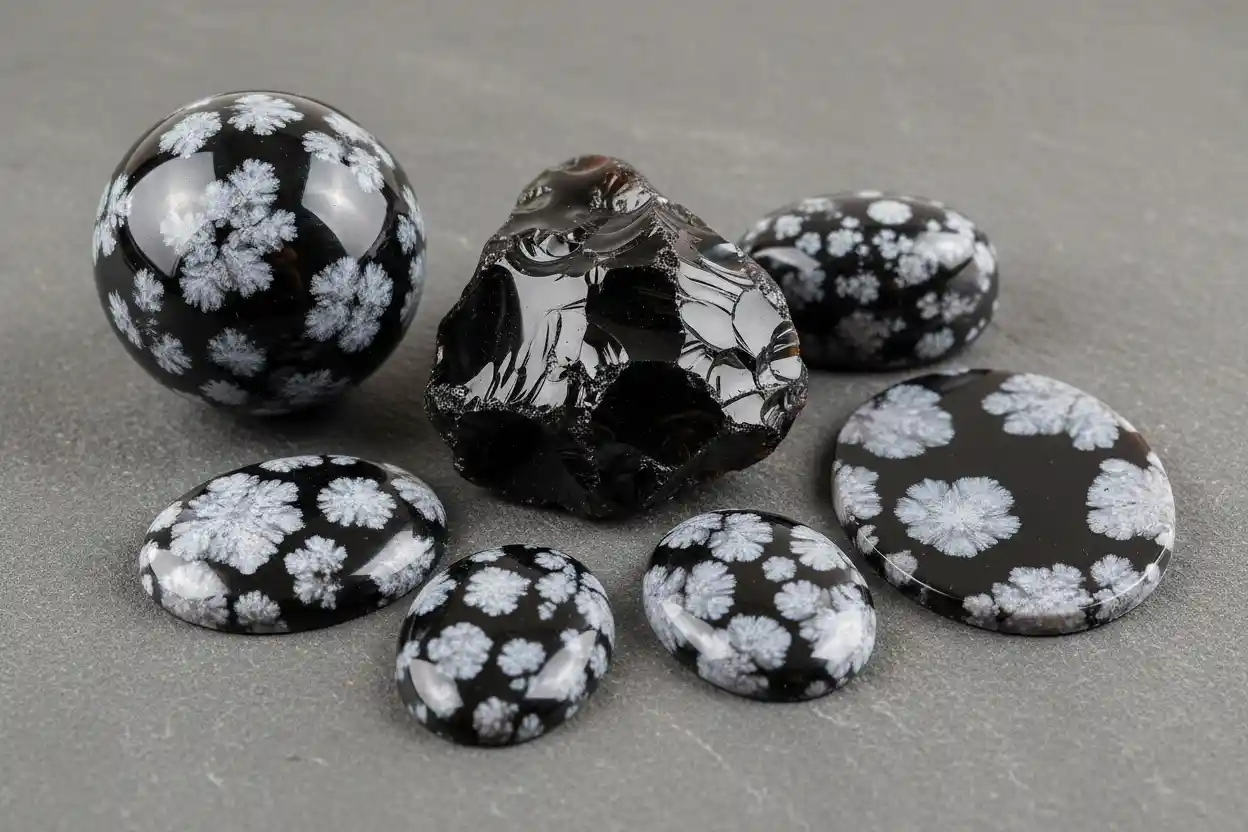
Snowflake obsidian healing properties are commonly associated with grounding, emotional balance, self-reflection, resilience, patience, boundaries, concentration, adaptability, confidence, meditation, and spiritual renewal. The black volcanic-glass background scattered with white or gray flower-like spots creates a strong visual contrast that naturally suggests balance between difficulty and calm, darkness and clarity, or disruption and renewal. Those interpretations do not establish a therapeutic mechanism. Snowflake obsidian healing properties have not been scientifically demonstrated to treat anxiety, depression, trauma, pain, inflammation, digestive disorders, neurological illness, hormonal conditions, or another medical problem. Scientifically, Snowflake Obsidian is a variety of natural volcanic glass containing pale cristobalite spherulites produced during partial crystallization, or devitrification, of the glass. Mindat classifies it as silicic volcanic glass containing white “snowflake” patterns of cristobalite rather than as a separate mineral species.
11 Snowflake Obsidian Healing Properties Themes
- Grounding and present-moment awareness
- Emotional balance during stressful periods
- Self-reflection and recognition of patterns
- Resilience after setbacks
- Patience with gradual progress
- Stronger personal boundaries
- Concentration and practical focus
- Adaptability when conditions change
- Confidence through purposeful action
- Meditation and sustained awareness
- Spiritual renewal after difficult transitions
These eleven snowflake obsidian healing properties become more useful when they are translated into deliberate practices rather than treated as automatic effects of volcanic glass. Grounding can mean noticing immediate sensory information, resilience can mean rebuilding after disruption, and boundaries can mean deciding what behavior is acceptable. The separate Snowflake Obsidian benefits page can address everyday uses, while this article keeps snowflake obsidian healing properties focused on modern wellness themes, volcanic geology, evidence limits, and safe care.
Snowflake Obsidian Is Volcanic Glass With Crystals
Understanding snowflake obsidian healing properties begins with the unusual fact that Snowflake Obsidian is mostly glass but contains visible crystals.
Ordinary obsidian forms when silica-rich volcanic melt cools so rapidly that extensive crystal growth cannot occur. Mindat classifies obsidian as a silica-rich natural volcanic glass with vitreous luster and characteristic conchoidal fracture.
Snowflake Obsidian develops when parts of that glass later begin to crystallize. Cristobalite, a SiO₂ polymorph, forms rounded radiating aggregates called spherulites. Against the dark glass, these pale structures look like snowflakes, flowers, stars, or small bursts.
Mindat specifically describes Snowflake Obsidian as black volcanic glass containing white cristobalite crystal patterns formed through partial crystallization of the glass.
Snowflake obsidian healing properties do not arise because the white spots contain a different healing substance. They are geological products of devitrification inside volcanic glass.
What Are the White Snowflakes?
The visual feature behind snowflake obsidian healing properties is usually cristobalite, a silica mineral with the same chemical formula, SiO₂, as quartz but a different crystal structure.
Cristobalite can form spherulites in obsidian and other silica-rich volcanic rocks. Mindat records this behavior directly and notes that cristobalite commonly forms within silicic volcanic environments.
A spherulite consists of many tiny crystals growing outward from a central region. When cut across during polishing, the radiating structure produces circular, star-shaped, or snowflake-like patterns.
The pattern does not preserve literal snow, fossils, flowers, or frozen water. Snowflake obsidian healing properties related to purity, balance, or renewal are symbolic responses to the visual contrast.
In some specimens, other minerals or microscopic phases may accompany the cristobalite, so every pale spot should not be assumed to have perfectly identical composition without analysis.
Snowflake Obsidian Records Devitrification
Snowflake obsidian healing properties are often associated with transformation, and the stone’s actual geology provides an unusually fitting metaphor.
Fresh volcanic glass is amorphous, meaning its atoms do not possess the regular long-range arrangement found in a normal crystal. Over time and under suitable thermal or chemical conditions, parts of the glass can begin reorganizing into crystalline phases.
This process is called devitrification. Cristobalite spherulites develop within the dark glass and gradually interrupt the once more-uniform glassy structure.
That geological transformation is measurable. It does not mean the stone stores emotional lessons or consciously transforms negative energy.
Snowflake obsidian healing properties involving change or growth can still use devitrification as symbolism as long as geology and spirituality remain separate.
Obsidian Has Genuine Ancient Human History
Snowflake obsidian healing properties as a specific modern system should not automatically be described as ancient, but obsidian itself has an extensive human history.
The glass breaks with exceptionally sharp conchoidal edges, which made it useful for prehistoric cutting tools, blades, projectile points, and later polished decorative and ritual objects. Mindat notes that obsidian is brittle, around Mohs 5 to 5.5, and capable of producing sharp edges when fractured.
Ancient cultures in Mesoamerica, the Mediterranean, Anatolia, the Near East, and other volcanic regions traded and worked obsidian extensively.
That history belongs to obsidian generally. It does not demonstrate that ancient communities identified Snowflake Obsidian as today’s separate crystal-healing category with a standardized list of emotional or chakra effects.
The related Obsidian healing properties page addresses the wider volcanic-glass category, while snowflake obsidian healing properties focus specifically on the patterned variety.
Grounding, Balance, and Self-Reflection
Grounding Through Immediate Sensory Information
Grounding is one of the most repeated snowflake obsidian healing properties. Volcanic glass does not electrically connect the nervous system to Earth through ordinary contact.
A practical exercise is to notice the stone’s weight, temperature, glossy surface, pale spots, breathing rhythm, and surrounding sounds. Bringing attention back to present sensory information can interrupt mental wandering.
Emotional Balance Without Suppression
Balance is especially common among snowflake obsidian healing properties because the stone combines stark black and white.
The glass cannot regulate cortisol, serotonin, or emotional states biologically. A more grounded practice is to acknowledge a difficult emotion without treating it as the only relevant information. Ask what happened, what you feel, what evidence is available, and what action is actually necessary.
Self-Reflection Through Repeated Patterns
Snowflake obsidian healing properties often include self-awareness or recognition of recurring habits.
The stone cannot expose hidden subconscious content automatically. Keeping it near a journal can create a consistent cue to record situations, emotional reactions, interpretations, and consequences until recurring patterns become visible.
Resilience, Patience, and Boundaries
Resilience After Disruption
The cristobalite snowflakes formed as volcanic glass partially crystallized, making change a natural metaphor for snowflake obsidian healing properties.
The stone cannot transfer psychological resilience. After a setback, identify what failed, what remains usable, and what change makes the next attempt more realistic.
Patience With Gradual Change
Patience also fits snowflake obsidian healing properties because geological devitrification does not occur as an instant transformation.
A practical use is to judge long-term goals on an appropriate timescale. Learning, saving, training, writing, or changing habits often makes more sense when progress is reviewed over weeks or months rather than one day.
Boundaries as Practical Protection
Protection is often included among snowflake obsidian healing properties because obsidian generally has a strong modern protective reputation.
There is no evidence that the stone blocks psychic attack or absorbs another person’s negative energy. A practical interpretation uses boundaries: define unacceptable behavior, communicate the limit, and decide what action follows if it continues.
Focus, Adaptability, and Confidence
Concentration With a Defined Task
Focus appears frequently within snowflake obsidian healing properties. Volcanic glass and cristobalite have not been demonstrated to increase memory or attention span through contact.
Use the stone as a work cue: choose one task, remove unrelated notifications, define an endpoint, and avoid unnecessary switching.
Adaptability When Conditions Change
Snowflake obsidian healing properties often include adaptability because the stone itself records a change from glass toward partial crystallization.
A gemstone cannot make someone cognitively flexible. When circumstances change, separate the underlying goal from the method being used to reach it. An ineffective method can be changed without abandoning the goal.
Confidence Through Action
Confidence is another modern part of snowflake obsidian healing properties. The stone cannot biologically raise self-esteem.
Before a difficult task, identify what has already been prepared, what remains uncertain, and what first action is under your control. Confidence becomes stronger when experience confirms capability.
Meditation and Snowflake Obsidian Healing Properties
Meditation is one of the easiest snowflake obsidian healing properties to translate into a real attentional practice because the black-and-white pattern gives the eyes distinct features to follow.
Choose one cristobalite snowflake and examine its radiating branches. Notice how its edges disappear into the glass and how nearby spherulites differ in shape or size.
When attention wanders, return to the same pattern or to the breath. This genuinely practices sustained attention.
Snowflake obsidian healing properties do not need to be explained through claims that the stone changes brain waves or clears an aura. The meditation process itself is enough.
Spiritual Renewal After Difficult Transitions
The eleventh of the snowflake obsidian healing properties concerns renewal, integration, or beginning again after a difficult period.
The visual contrast makes this symbolism understandable. Pale crystalline structures emerged within dark volcanic glass as its internal state changed.
A person can use that image during reflection on a job change, relationship ending, relocation, recovery from disappointment, or another transition.
A grounded renewal practice identifies what has ended, what lesson deserves to remain, and what concrete behavior will define the next stage.
Snowflake obsidian healing properties remain personal symbolism rather than evidence that the rock physically transforms emotions.
Snowflake Obsidian Chakra Associations
Snowflake obsidian healing properties are most commonly associated with the root chakra because of the stone’s black volcanic-glass background and grounding reputation.
Some practitioners also connect the white cristobalite patterns with the crown chakra, creating a symbolic contrast between grounding and spiritual reflection.
Chakras are spiritual frameworks rather than anatomical structures. Snowflake obsidian healing properties have not been demonstrated to affect the spine, adrenal glands, brain, nervous system, endocrine system, or another physiological structure through chakra placement.
Snowflake Obsidian Care and Durability
Snowflake obsidian healing properties do not change the physical behavior of natural volcanic glass. Obsidian is commonly around Mohs 5 to 5.5 and is brittle, with a characteristic conchoidal fracture that can create extremely sharp edges when broken.
Store polished stones separately from quartz, topaz, sapphire, ruby, and other harder gemstones that can scratch the surface.
Warm water, mild soap, and a soft cloth are suitable for routine cleaning of intact polished Snowflake Obsidian. Avoid sudden temperature changes and hard impacts.
Steam and ultrasonic cleaning are unnecessary, particularly for pieces containing fractures, drilled holes, glued settings, or thin carved areas.
If a piece chips or breaks, handle the fragments carefully because glassy fracture edges can be extremely sharp.
Cristobalite Dust and Cutting Safety
Finished polished Snowflake Obsidian is appropriate for ordinary handling, but cutting and grinding deserve more caution than many crystal guides mention.
The white spherulites contain cristobalite, a crystalline form of silica. Cutting or grinding can generate fine dust containing crystalline silica as well as particles from the surrounding volcanic glass.
Professional lapidary work should use wet methods where appropriate, effective extraction, eye protection, appropriate respiratory controls, and careful cleanup.
Snowflake obsidian healing properties never justify intentionally grinding the stone into powder, inhaling dust, or adding crushed pieces to drinks.
The relevant hazard comes from processing dust and sharp fragments, not from normal contact with an intact polished stone.
Safe Ritual Cleansing
Snowflake obsidian healing properties do not require saltwater, flame, aggressive heat, acids, or abrasive cleansing.
Sound, intentional breathing, quiet reflection, dry placement, or gentle washing with mild soap and water are lower-risk practices.
A balance-focused ritual can involve identifying one area where you have become too rigid and another where a firmer boundary is needed.
Avoid rough burial, extreme temperature changes, and any cleansing method that could chip the glass or create sharp edges.
Conclusion
Snowflake obsidian healing properties are contemporary wellness and spiritual themes inspired by a distinctive geological process. Snowflake Obsidian is natural volcanic glass containing pale cristobalite spherulites formed during partial crystallization, giving the rock its characteristic black-and-white pattern. Grounding, balance, resilience, patience, boundaries, adaptability, meditation, and renewal can all become useful reflective practices when the stone remains symbolic rather than medical.
FAQs
What are snowflake obsidian healing properties?
Snowflake obsidian healing properties commonly refer to beliefs involving grounding, emotional balance, self-reflection, resilience, patience, boundaries, concentration, adaptability, confidence, meditation, and spiritual renewal.
What is Snowflake Obsidian made of?
Snowflake Obsidian is silica-rich volcanic glass containing white or gray cristobalite spherulites.
What causes the white snowflakes?
The pale patterns are radiating cristobalite crystal aggregates formed as parts of the volcanic glass devitrified or partially crystallized.
Is Snowflake Obsidian a crystal?
Not as a whole. Obsidian is natural volcanic glass, although Snowflake Obsidian contains crystalline cristobalite spherulites.
How hard is Snowflake Obsidian?
Obsidian is typically around Mohs 5 to 5.5 and remains brittle despite its moderate scratch resistance.
Are snowflake obsidian healing properties ancient?
Obsidian has extensive ancient practical and cultural history, but snowflake obsidian healing properties as a distinct standardized system are mainly modern.
Which chakra is associated with Snowflake Obsidian?
Modern crystal practice most commonly links it with the root chakra, sometimes adding crown symbolism because of the white snowflake patterns.
Can Snowflake Obsidian go in water?
Yes. Brief cleaning with lukewarm water and mild soap is generally suitable for an intact polished stone.
Is broken Snowflake Obsidian sharp?
Yes. Like other volcanic glass, it can develop very sharp conchoidal fracture edges when broken.
Are snowflake obsidian healing properties medically proven?
No. Snowflake obsidian healing properties are contemporary spiritual or personal wellness beliefs rather than scientifically established therapeutic effects.
Snowflake obsidian healing properties are modern spiritual or personal beliefs and should not replace qualified medical or mental health care.