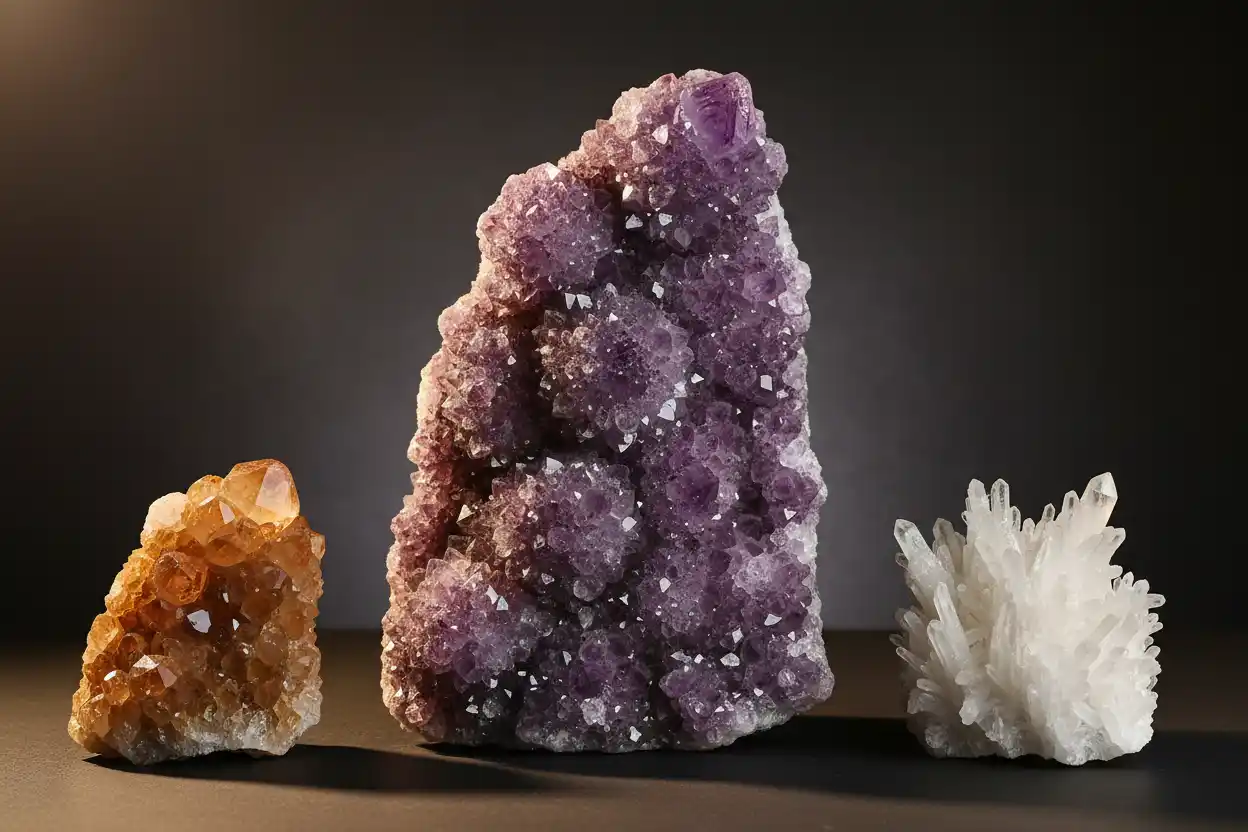
Spirit Quartz: Meaning, Properties & Symbolism
Spirit Quartz is a South African quartz formation in which a larger central crystal becomes coated along its prism faces by a second generation of tiny sparkling quartz crystals. Also called Cactus Quartz, the material most commonly appears as pale-to-deep amethyst, although white, grey, yellow, brown, mauve, and reddish-purple examples also occur.
Its identity depends on growth structure and locality rather than color alone. A generic druzy-coated quartz from another region may look similar, but the established Spirit Quartz trade name refers primarily to cactus-like specimens from Boekenhouthoek in Mpumalanga, South Africa.
Spirit Quartz at a Glance
| Property | Spirit Quartz |
|---|---|
| Composition | Silicon dioxide, SiO₂ |
| Group or type | Cactus Quartz; a distinctive second-generation growth form of macrocrystalline quartz |
| Color | Colorless, white, grey, lilac, purple, reddish purple, yellow, brown, smoky, iron-stained |
| Crystal system or texture | Trigonal quartz with drusy second-generation overgrowth |
| Habit | One or more larger quartz crystals coated on prism faces by many small quartz points |
| Luster | Vitreous; strongly sparkling across the small crystal coating |
| Transparency | Transparent to opaque, commonly translucent |
| Mohs hardness | 7 |
| Cleavage | None |
| Tenacity | Brittle; fine secondary crystal tips are especially fragile |
| Common uses | Mineral specimens, display clusters, wire-wrapped pendants, collector pieces |
| Primary care concern | Broken drusy tips, fractures, fading of amethyst color, coatings, glue repairs, and silica dust |
What Is Spirit Quartz?
Spirit Quartz is a trade and collector name rather than an independent mineral species. Mineralogically, it is quartz with a distinctive two-stage or multi-stage growth habit.
The first generation forms the main crystal or group of larger crystals. Later, many smaller quartz crystals grow across the prism faces, producing a prickly, cactus-like coating.
The larger terminal face often remains partly exposed. This contrast between one dominant termination and hundreds of smaller side crystals distinguishes good cactus quartz from a random cluster of equally sized points.
Common alternate names include Cactus Quartz, Pineapple Quartz, Porcupine Quartz, and Spirit Amethyst. Cactus Quartz is the clearest descriptive synonym.
Spirit Quartz belongs in the crystals that start with S and gemstones that start with S directories. It also occupies a narrow child-page intent within the broader quartz family rather than replacing the parent mineral guide.
How the Cactus-Like Coating Forms
Spirit Quartz records at least two recognizable crystal-growth stages.
During the first stage, silica-rich hydrothermal fluids deposit the main quartz crystal. Changes in temperature, pressure, fluid chemistry, available space, or silica saturation later interrupt or slow that growth.
A subsequent fluid episode deposits many new quartz crystals across the existing prism faces. Each smaller point is crystallographically attached to the older central crystal or to neighboring secondary crystals.
Growth may continue until the sides are almost completely covered. The main termination can remain smooth and relatively large because the conditions on that face differ from those along the prism.
Iron-bearing fluids may introduce goethite, hematite, limonite, or related coatings and inclusions. These phases can produce yellow, brown, orange, and reddish colors.
The resulting texture is natural druzy growth, but not every druzy quartz is Spirit Quartz. Ordinary druzy may coat a cavity wall or matrix without the characteristic larger crystal underneath.
South African Locality
The best-known Spirit Quartz comes from Boekenhouthoek, near Mkobola in Mpumalanga Province, South Africa. The occurrence lies northeast of Pretoria and has become internationally recognized among quartz collectors.
Amethyst is the most widespread color variety from the area. White, grey, mauve, reddish-purple, brown, yellow, and mixed-color specimens are also documented.
Collectors sometimes use the broader geographic label Magaliesberg or Magaliesburg. Boekenhouthoek in Mpumalanga provides a more precise locality for the well-known cactus quartz deposits.
The material reached collector markets before its major commercial popularity in the early twenty-first century. Older South African collections contain specimens acquired during the 1980s.
Mining often involves local, small-scale recovery rather than a uniform industrial operation. Consequently, supply, color distribution, specimen size, and market availability can change substantially.
A seller claiming an origin premium should provide more than “African quartz.” Country, province, district, and deposit-level information improve the value of the label.
Spirit Quartz Colors
Purple Spirit Quartz belongs to the amethyst variety of quartz. Iron-related color centers produce shades ranging from pale lilac to dark violet.
White or colorless material may have clear, cloudy, or frosted points. Iron-stained surfaces can shift white quartz toward cream, yellow, orange, or brown.
Yellow Spirit Quartz requires careful naming. Some pieces contain natural goethite or iron-oxide inclusions and coatings rather than the structural color centers that define true citrine.
Retailers may use “citrine Spirit Quartz” for any yellow specimen. That description should be supported by gemological evidence rather than color alone.
Smoky grey and brown material can occur where irradiation-related color centers or iron-rich coatings affect the quartz. Mixed purple-yellow specimens may combine amethyst growth with iron staining or later alteration.
Red or orange Spirit Quartz commonly owes its appearance to hematite, goethite, or iron-oxide coatings and inclusions rather than red quartz body color.
Crystal Forms and Associated Minerals
Spirit Quartz may occur as one dominant point, a cluster of several main crystals, radiating groups, or irregular matrix specimens.
The secondary coating can be extremely fine and sugar-like or consist of larger, easily visible points. Dense, evenly distributed crystals generally produce the strongest sparkle.
Some specimens contain cavities where small crystals grew inward. Others show broken main terminations that later received partial rehealing or secondary growth.
Goethite is a notable associated mineral and may occur as yellow, brown, orange, or black inclusions and coatings. Hematite can contribute red-brown tones or metallic areas.
Quartz may also grow over earlier mineral surfaces or weathered host rock. Matrix can remain attached beneath the cluster and may be softer or more porous than the quartz.
A specimen’s exact appearance therefore reflects the original crystal shape, later overgrowth, mineral inclusions, weathering, and mining damage.
Spirit Quartz Versus Candle Quartz
Candle Quartz also features a larger central quartz crystal surrounded by smaller growths. However, its texture commonly resembles melted candle wax, scales, or overlapping layers.
Spirit Quartz generally carries sharper, more numerous, individually terminated points over the prism faces. Its surface looks prickly or sparkling rather than wax-dripped.
Candle Quartz may come from Madagascar and other localities, while established Spirit Quartz comes from South Africa.
The two trade names can overlap in poorly documented listings. Locality, surface texture, and growth structure provide more useful distinctions than metaphysical marketing language.
Spirit Quartz Versus Amethyst Clusters
An ordinary amethyst cluster usually consists of many crystals growing together from one matrix. The points may be similar in size and remain separate from base to termination.
Spirit Amethyst has one or more larger parent crystals whose sides are encrusted by a later generation of much smaller quartz points.
An amethyst geode surface also contains densely packed crystals, but they grow inward from a cavity wall rather than coating the prism of a larger standing crystal.
The distinction can be seen most clearly from the side. Genuine cactus structure should reveal a recognizable central prism beneath the smaller coating.
How to Identify Spirit Quartz
Begin with the growth pattern. A genuine example should show larger quartz crystals whose prism faces carry a secondary coating of much smaller terminated quartz points.
The mineral should have quartz properties: hardness 7, vitreous luster, no cleavage, conchoidal fracture, specific gravity near 2.65, and standard quartz refractive behavior.
Testing hardness on the specimen is unnecessary and may break tiny points. A loupe provides more useful information about terminations, coatings, dye, glue, and repairs.
Natural secondary crystals vary in size, angle, and perfection. They should not look like identical molded spikes or glitter glued onto the surface.
Amethyst color may show natural zoning, pale areas, darker tips, or uneven distribution. Dye often collects in cracks, porous matrix, or around the bases of small points.
The how to identify crystals guide explains how habit, locality, hardness, magnification, and analytical testing work together.
Treatments, Coatings, and Repairs
Most natural Spirit Quartz reaches the market without a treatment intended to create its original purple, white, brown, or iron-stained appearance.
Heat can alter amethyst color. Depending on temperature and material, purple quartz may turn yellow, orange-brown, greenish, pale, or nearly colorless.
The treated amethyst guide owns detailed heat-treatment and synthetic-amethyst identification. Yellow Spirit Quartz should not automatically be assumed to be natural citrine.
Artificial aura coatings deposit metals over the quartz surface, producing vivid rainbow, blue, pink, gold, or metallic colors. The coating often covers both the small points and damaged areas uniformly.
Dye can enter fractures, matrix, and porous coatings. Strong blue, hot pink, neon green, and evenly saturated purple deserve scrutiny.
Broken clusters may be glued back together or reattached to matrix. Adhesive can collect beneath a crystal, along a fracture, or inside a gap.
Clear resin may stabilize fragile matrix or coat the surface. Such treatments change luster and cleaning requirements.
General disclosure terminology is covered in gemstone treatments explained and treated clear quartz.
Synthetic Quartz and Imitations
Quartz can be grown hydrothermally in laboratories, especially for electronics and gem applications. However, commercial synthetic Spirit Quartz with a convincing cactus habit is uncommon.
Manufactured glass can imitate purple or yellow color but rarely reproduces the natural two-stage crystal architecture.
Resin casts may show repeated points, mold seams, trapped bubbles, flexible projections, or a plastic surface.
Some products attach crushed quartz, glitter, or small crystals to a larger core with resin. Glue accumulation and unnatural uniformity may reveal construction.
Ordinary druzy clusters from unrelated localities may be renamed Spirit Quartz. They can still be natural quartz, but the locality-linked trade description becomes inaccurate.
The distinctions among natural quartz, synthetic material, glass, composites, and imitations are discussed in lab-grown vs natural gemstones.
Cutting and Jewelry Use
Most Spirit Quartz should remain uncut because its secondary crystal coating creates the material’s identity and collector value.
Sawing or polishing removes the cactus texture and converts the piece into ordinary quartz. Even a small cut can destroy the relationship between the main crystal and its overgrowth.
Wire-wrapped pendants sometimes use intact small points. The wrapping should hold the base or matrix rather than press directly against delicate secondary crystals.
Drilling is risky because vibration can break points, open fractures, and create silica dust. Glue-on bails avoid drilling but should be disclosed and checked periodically.
Rings and bracelets are impractical. Tiny tips catch on fabric, scratch adjacent surfaces, and break under routine impact.
Display specimens, shelf pieces, protected pendants, and collector boxes offer better uses than conventional high-contact jewelry.
Durability and Care Concerns
Quartz itself has hardness 7 and no cleavage. Spirit Quartz remains much more fragile than a polished quartz cabochon because hundreds of exposed crystal tips can snap.
The main crystal may also contain fractures beneath the secondary coating. A cluster that looks solid can break at its base if lifted by the termination.
Amethyst can fade after prolonged exposure to strong sunlight or heat. The crystals that fade in sunlight guide explains why purple quartz should not remain in a bright window indefinitely.
Matrix and associated iron minerals may react differently from quartz. Rust staining can spread when a damp specimen contains unstable iron-bearing material.
Protect the cluster from vibration, pets, unstable shelving, and repeated handling. A clear display case reduces the need for cleaning.
Spirit Quartz Value and July 2026 Asking Prices
Spirit Quartz is normally valued by the specimen rather than by carat or gram alone. Size, color, crystal completeness, coating density, main termination quality, symmetry, damage, locality, and repairs determine value.
As of July 2026, small individual points and modest clusters commonly carry asking prices around $5–$30.
Attractive hand-sized amethyst specimens with dense secondary growth often appear around $30–$100. Larger pieces, richer purple color, multiple strong terminations, and unusual goethite or multicolor patterns may ask $100–$300.
Major display specimens, well-balanced clusters, older documented material, and exceptionally aesthetic pieces can exceed $300, with selected large examples reaching $500–$1,000 or more.
A large specimen with many broken tips may be less desirable than a smaller piece with intact terminations. Weight is secondary to structure and condition.
Detailed seller evaluation and product selection belong on the dedicated where to buy Spirit Quartz guide.
Buying Spirit Quartz
Request the exact locality. Boekenhouthoek, Mkobola, Mpumalanga, South Africa, provides stronger documentation than the vague label “African Spirit Quartz.”
Inspect photographs from several angles. A single front view can hide broken main terminations, missing side crystals, glue repairs, and unstable matrix.
Ask whether the color is natural, heated, dyed, coated, irradiated, or iron-stained. Yellow material deserves particular scrutiny because not every specimen sold as citrine has citrine body color.
Look closely at the smaller points. Intact terminations should outnumber obvious fresh breaks in a premium specimen.
Check the base for glue, resin, saw marks, unstable host rock, and reattached crystals. Repair does not necessarily eliminate collector value, but the price should reflect it.
The real vs fake amethyst and real vs fake clear quartz guides provide additional checks for glass, dye, coatings, and synthetic quartz.
General online transaction safeguards appear in how to buy gemstones online.
Cleaning and Storage
Remove loose dust with a rubber air blower or a very soft artist’s brush. Direct the brush outward from the crystal rather than pushing against the tips.
A stable specimen can receive a brief rinse in room-temperature water, but soaking is unnecessary. Matrix, glue, resin, iron minerals, and hidden fractures may react differently from quartz.
The crystals you can put in water guide distinguishes short cleaning contact from prolonged immersion.
Do not use ultrasonic cleaning. Vibration can snap small crystals, loosen repairs, or open existing fractures. The broader risks are explained in gemstones in ultrasonic cleaners.
Avoid steam, boiling water, bleach, acids, abrasive powder, and sudden temperature changes.
Store the specimen in a fitted box or stable enclosed display. Support the matrix, leaving clearance around every exposed point.
Spirit Quartz Meaning and Symbolism
Spirit Quartz has a modern symbolic tradition connected closely with its many small crystals growing together over one larger form.
Contemporary crystal practices commonly interpret the structure as a symbol of cooperation, community, shared purpose, and individual contributions supporting a larger whole.
The central crystal may represent personal identity, while the surrounding points can symbolize relationships, teams, families, or interconnected experiences.
Purple material is often associated with reflection, imagination, spiritual inquiry, and calm. White examples may represent openness or clarity, while yellow and brown specimens can symbolize practical optimism and steadiness.
Its multi-stage formation also offers a natural metaphor for growth that does not erase an earlier self. New structures develop over the original crystal while its central form remains visible.
These meanings belong to personal and spiritual belief systems. Scientific evidence does not show that Spirit Quartz heals disease, synchronizes groups, changes brain function, or guarantees spiritual experiences.
Frequently Asked Questions
1. Is Spirit Quartz a separate mineral?
No. It is quartz with a distinctive second-generation cactus-like crystal overgrowth.
2. Is Cactus Quartz the same as Spirit Quartz?
Yes. Cactus Quartz is the most widely accepted descriptive synonym for Spirit Quartz.
3. Where does authentic Spirit Quartz come from?
The established trade material comes primarily from Boekenhouthoek near Mkobola in Mpumalanga, South Africa.
4. Is every druzy-covered quartz Spirit Quartz?
No. Genuine cactus structure requires smaller crystals coating the prism faces of a larger underlying quartz crystal.
5. Is purple Spirit Quartz amethyst?
Yes. Purple examples are amethyst because their quartz body contains amethyst color centers.
6. Is yellow Spirit Quartz always citrine?
No. Yellow color may come from goethite, iron oxides, surface staining, or heat treatment rather than true citrine body color.
7. Why does the main termination remain larger?
The secondary crystals preferentially coat the prism faces, while the terminal face may remain less completely covered.
8. Can Spirit Quartz be polished?
It can be cut, but polishing removes the small crystals that define its cactus appearance and usually reduces collector interest.
9. Does Spirit Quartz fade in sunlight?
Amethyst-colored material can fade after prolonged strong light or heat exposure.
10. Can Spirit Quartz be washed in water?
A brief gentle rinse may suit a stable untreated specimen, but soaking is discouraged because of matrix, iron minerals, repairs, and fractures.
11. How can aura-coated Spirit Quartz be recognized?
Metallic rainbow color concentrated on the surface, coating wear, unusual uniformity, and color across broken areas can indicate treatment.
12. What most affects Spirit Quartz value?
Authentic locality, dense secondary growth, intact tips, main-crystal form, color, symmetry, size, condition, and repair disclosure determine value.
Spirit Quartz is best judged as a natural growth architecture rather than a purple quartz commodity. The most desirable specimen preserves a clear central crystal, a dense later overgrowth, and enough intact points to show how the two stages developed together.
Spirit Quartz is crystalline silica. Cutting, drilling, grinding, or dry brushing damaged material can create respirable silica dust capable of causing serious lung disease. Preserve natural specimens intact and use wet methods, effective local exhaust ventilation, eye protection, and suitable respiratory protection for any necessary lapidary work.