Strawberry Quartz: Meaning, Properties & Symbolism
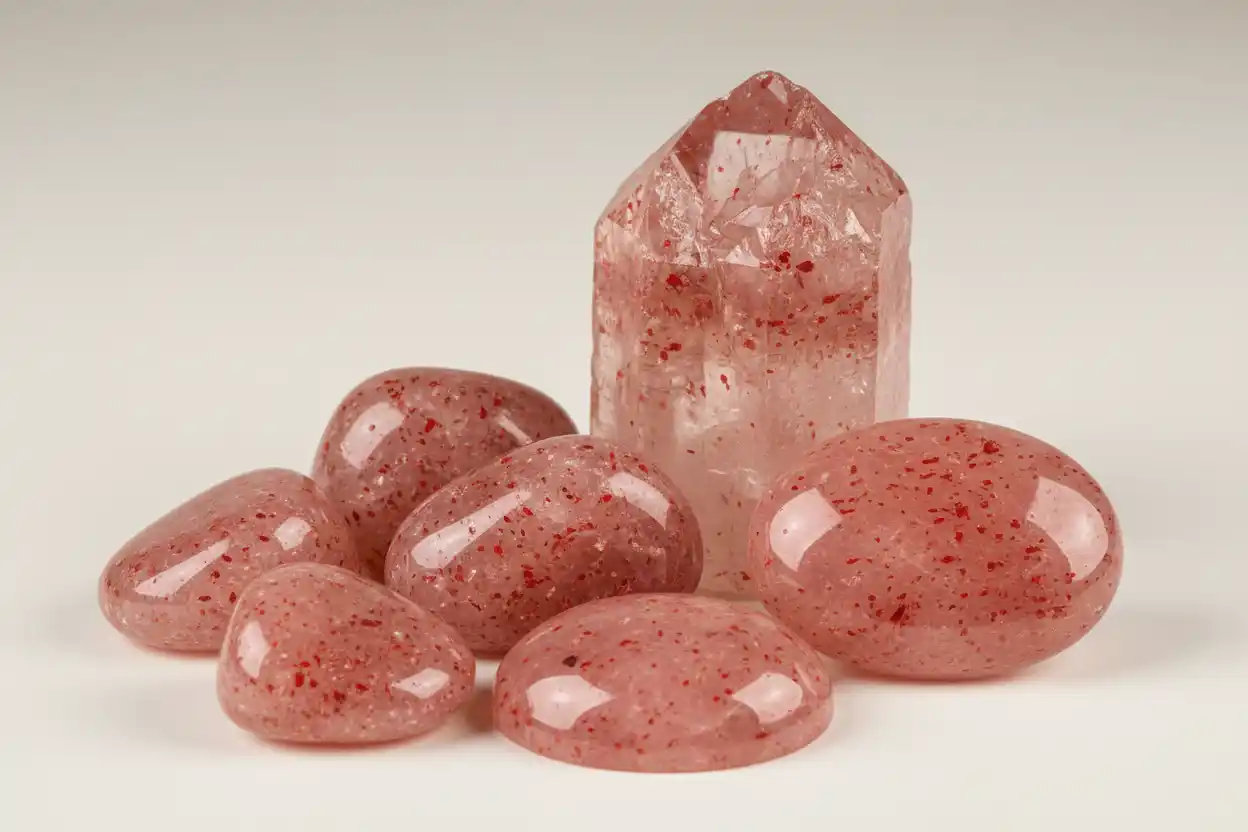
Strawberry Quartz is a trade name for transparent-to-translucent quartz containing enough pink, red, orange-red, or reddish-brown inclusions to create a strawberry-like appearance. Classic material commonly contains fine hematite plates, needles, flakes, or clouds, although the loosely defined name is also applied to quartz containing other red minerals and even to pink aventurine aggregates.
It is not a separate mineral species. The host remains crystalline quartz, while the inclusion type, distribution, and authenticity determine whether a particular stone deserves the commercial name.
Strawberry Quartz at a Glance
| Property | Strawberry Quartz |
|---|---|
| Composition | Silicon dioxide, SiO₂, with visible pink-to-red mineral inclusions |
| Group or type | Included macrocrystalline quartz; loosely defined trade variety |
| Color | Colorless to pale pink host with red, pink, orange, brown-red, or metallic inclusions |
| Crystal system or texture | Trigonal quartz; single crystal or, in some trade material, polycrystalline aggregate |
| Habit | Prismatic quartz crystals, massive rough, pebbles, inclusion-rich cut stones |
| Luster | Vitreous; aventurescent or softly sparkling in some inclusion-rich material |
| Transparency | Transparent to opaque, most commonly transparent to translucent |
| Mohs hardness | 7 |
| Cleavage | None |
| Tenacity | Brittle |
| Common uses | Cabochons, faceted stones, beads, pendants, carvings, spheres, collector specimens |
| Primary care concern | Internal fractures, dye, crackle treatment, coatings, glass imitations, and silica dust |
What Is Strawberry Quartz?
Strawberry Quartz belongs to the broader quartz family. Its essential host material has the same SiO₂ composition, trigonal crystal structure, hardness, and conchoidal fracture as ordinary rock crystal.
The strawberry description comes from its internal pattern. Fine red flakes and dots can resemble seeds suspended through clear fruit, while dense inclusion clouds create an overall pink or reddish appearance.
Unlike formally recognized mineral names, Strawberry Quartz has no universally enforced gemological definition. Sellers apply it to several visually related materials, including single-crystal quartz with hematite, quartz with red iron-bearing mica, pink aventurine quartz, and occasionally heavily included or artificially colored quartz.
For that reason, the trade name should follow the material description rather than replace it. A precise listing might identify “natural quartz with hematite inclusions, sold as Strawberry Quartz” instead of treating Strawberry Quartz as a mineral species.
The material occupies a specific included-quartz intent within the wider guide to types of gemstones. It also appears in both the crystals that start with S and gemstones that start with S directories.
What Causes the Strawberry Color?
Red and pink coloration usually comes from tiny mineral inclusions rather than a uniform color center throughout the quartz lattice.
Hematite is one of the most important inclusions. Thin plates, irregular flakes, needles, and microscopic particles can appear bright red, dark crimson, rusty brown, or metallic when viewed under magnification.
Some material contains goethite or related iron oxyhydroxides. The dedicated goethite guide covers that mineral independently, while Strawberry Quartz focuses on its appearance as an inclusion within quartz.
Retail descriptions frequently mention lepidocrocite, but the identification should not be accepted from color alone. Red blades historically described as lepidocrocite may prove to be hematite, goethite, or another iron-bearing phase when examined with Raman spectroscopy.
Iron-bearing mica can also create pink or reddish flakes. Gemological research has documented polycrystalline quartz containing alurgite, a reddish variety of muscovite, sold under the Strawberry Quartz name.
Other possible coloring inclusions include piemontite, rutile-associated iron oxides, lepidolite-like mica, and mixed iron-rich particles. The exact mineral must be tested rather than inferred from a seller’s photograph.
The hematite page owns the broader mineral history and properties of the most common red inclusion species.
Strawberry Quartz Versus Rose Quartz
Rose Quartz usually has a soft, comparatively uniform pink body color. Its coloring mechanisms can involve microscopic fibrous inclusions or irradiation-related centers, depending on the material.
Strawberry Quartz instead shows visible red, pink, or brown-red particles inside a clearer quartz host. Individual dots, flakes, needles, clouds, or reflective plates should remain recognizable under magnification.
Rose Quartz is generally massive and cloudy. Strawberry Quartz more often appears transparent enough for inclusions to be seen through the host, although opaque trade material also exists.
Some stones sit between the two appearances. A pale pink quartz containing visible red inclusions may be marketed under either name, which makes microscopic description more useful than a trade label.
A seller should not charge a Strawberry Quartz premium for ordinary Rose Quartz merely because the piece contains a few reddish stains or surface deposits.
Strawberry Quartz Versus Fire Quartz
The Strawberry Quartz and Fire Quartz names overlap substantially in the marketplace.
Fire Quartz is usually applied more broadly to quartz containing vivid red, orange, or brown iron-oxide clouds, layers, phantoms, or surface coatings. Some pieces are also called Hematoid Quartz.
Strawberry Quartz generally suggests finer, more evenly distributed red inclusions within transparent quartz. The pattern often looks seed-like, glittery, or speckled rather than dominated by broad iron-rich zones.
Nevertheless, no internationally enforced boundary separates the terms. A seller may call the same specimen Strawberry Quartz, Fire Quartz, Harlequin Quartz, or Hematoid Quartz according to its strongest visual feature.
The Harlequin Quartz page owns material characterized by visually dramatic mixed red inclusions, flashes, and patterned effects rather than the narrower strawberry-like appearance.
Natural Crystal Habits and Internal Patterns
Strawberry Quartz can occur as complete prismatic crystals, broken crystal sections, massive rough, alluvial pebbles, or inclusion-rich zones within otherwise clearer quartz.
The red material may form:
- Fine seed-like dots
- Flat hexagonal or irregular plates
- Needles and short rods
- Wispy clouds
- Radiating sprays
- Parallel layers
- Phantoms marking earlier growth stages
- Metallic reflective flakes
- Dense aventurescent masses
In a single quartz crystal, inclusion concentration may change from base to tip. One zone can appear almost colorless while another becomes opaque red.
Growth phantoms form when inclusions coat an earlier crystal surface before later quartz encloses it. These internal outlines preserve stages in the crystal’s development.
Fractures can also collect iron oxides after the quartz has formed. Such material may look red internally but differs from inclusions trapped during primary crystal growth.
How Strawberry Quartz Forms
Quartz forms when silica-rich fluids or melts cool and deposit silicon dioxide. Hydrothermal veins, volcanic cavities, pegmatites, metamorphic fractures, and related settings can all produce inclusion-bearing quartz.
During growth, iron-bearing minerals may crystallize before, during, or after the quartz. If quartz continues growing around them, the red particles become enclosed.
Changes in temperature, pressure, oxygen availability, pH, and fluid chemistry influence whether iron forms hematite, goethite, another oxide, or an iron-bearing silicate.
Inclusions can also enter along healed fractures. A crack opens, iron-rich fluid moves through it, and later quartz seals part of the opening.
Some Strawberry Quartz is single-crystal rock crystal containing discrete inclusions. Other material is polycrystalline or aventurine-like, with many small quartz grains and reflective mica flakes.
That difference affects appearance, optical behavior, and nomenclature. The single-crystal variety typically shows clearer windows and isolated internal inclusions, whereas polycrystalline material may display a more uniform shimmer.
Important Sources and Locality Claims
Material sold as Strawberry Quartz has been attributed to Kazakhstan, Russia, Mexico, Brazil, Namibia, Madagascar, Tanzania, and other quartz-producing regions.
Kazakhstan is historically associated with transparent quartz containing abundant red hematite inclusions. Fine crystals can show seed-like particles distributed through a colorless host.
Russian material is commonly offered as cabochons and massive polished pieces. However, the commercial label can cover more than one inclusion type and deposit.
Mexico has produced quartz with red plates, phantoms, and iron-rich patterns. Some Mexican pieces also display trapiche-like or sectoral arrangements.
Brazil supplies a wide range of included quartz, including hematite-, goethite-, and rutile-bearing crystals. Sellers sometimes use overlapping names such as Fire Quartz, Red Quartz, Strawberry Quartz, or Harlequin Quartz.
Namibian quartz may contain sharply formed hematite blades and needles. East African material also enters the cabochon and bead market under several pink or red included-quartz names.
Origin should not be inferred from appearance. For higher-value specimens, a mine or district label carries more meaning than a country-level claim.
Inclusions and Aventurescence
Some Strawberry Quartz displays aventurescence, a sparkling effect created when flat reflective inclusions return light from numerous small surfaces.
Hematite plates can produce bright red, silver-red, or metallic flashes. Iron-bearing mica may create a softer pink, orange, or coppery sparkle.
Aventurescent material may be polycrystalline quartz rather than a single quartz crystal. The distinction can often be observed with a polariscope, microscope, or examination of grain boundaries.
Fine sparkle should move with the stone rather than appear as a fixed glitter coating on the surface. However, natural inclusions may reflect only from certain directions.
Dense aventurescence can reduce transparency. A stone with strong sparkle is not necessarily higher quality than one with delicate inclusions and better clarity; the preferred balance depends on the intended design.
How to Identify Strawberry Quartz
Identification begins by confirming the host is quartz. Quartz has hardness 7, specific gravity near 2.65, no cleavage, and refractive indices around 1.544–1.553.
A loupe or microscope should reveal inclusions beneath the surface. Genuine red flakes may be irregular, angular, hexagonal, fibrous, or layered rather than perfectly identical.
Natural quartz commonly contains fluid inclusions, healed fractures, negative crystals, growth zones, and mineral grains alongside the red particles.
Glass imitations may show rounded gas bubbles, curved flow lines, mold seams, swirl marks, or metallic glitter suspended too uniformly throughout the material.
Dye can concentrate in open fractures, drill holes, pits, or near the surface. Crackle-treated quartz may show a dense network of sharp artificial fractures filled with bright color.
Because the Strawberry Quartz name covers several inclusion types, reliable analysis may require Raman spectroscopy, X-ray diffraction, or chemical testing. These methods can separate hematite from goethite, mica, rutile, and other visually similar phases.
The wider how to identify crystals guide explains why mineral identity, treatment, and trade name should be evaluated separately.
Common Imitations and Mislabels
Manufactured glass is one of the most common Strawberry Quartz imitations. Red glitter, metallic particles, bubbles, and pigments can be suspended in a pink or colorless glass body.
A popular bead material sometimes called Strawberry Quartz is actually manufactured glass containing copper-colored or red reflective particles. It may be attractive, but it is not natural quartz.
Dyed crackle quartz is another frequent substitute. Heat or mechanical shock creates fractures, which are later filled with red or pink dye.
Ordinary clear quartz may be coated with a pink film. Surface wear at facet edges, scratches, or drill holes can reveal the colorless material beneath.
Pink aventurine quartz can be genuine natural stone but should not automatically be described as classic hematite-included Strawberry Quartz. Its aggregate texture and mica-based sparkle create a different material identity.
Ordinary Clear Quartz containing a few red particles can also be overgraded. Inclusion abundance, distribution, appearance, and natural origin determine whether the Strawberry Quartz label adds useful information.
The real vs fake Clear Quartz guide provides broader tests for separating natural quartz from glass, resin, and composites.
Treatments and Enhancement
Most fine natural inclusion patterns do not require treatment. However, treatment and misrepresentation are common enough to justify careful disclosure.
Dyeing can turn pale fractures bright red or pink. The color often appears strongest around cracks and drill holes rather than inside solid quartz.
Crackle treatment deliberately creates a dense fracture network. It is frequently combined with dye to imitate richly included material.
Surface coatings can produce pink, red, rainbow, or metallic effects. A coating remains concentrated at the surface and may wear away along exposed edges.
Resin can fill fractures or stabilize heavily included rough. Filling may improve transparency and reduce the appearance of cracks, but it changes durability and repair requirements.
Heat treatment may alter iron-bearing inclusions, oxidize surface coatings, or change the color of associated amethyst or smoky zones. It is not the standard method for producing classic Strawberry Quartz.
The dedicated treated Clear Quartz guide owns detailed treatment and synthetic-quartz identification, while lab-grown vs natural gemstones explains the difference between synthetic quartz and glass imitation.
Cutting and Polishing Behavior
Strawberry Quartz is cut to display inclusion placement rather than maximum brilliance alone.
Cabochons work well when the inclusions form clouds, flakes, phantoms, or aventurescent patterns. A broad dome creates depth and allows the viewer to look through several inclusion layers.
Faceting suits transparent rough with evenly distributed red particles. Brilliant and checkerboard cuts can reflect the inclusions repeatedly, though excessive faceting may make a busy stone look chaotic.
Rose cuts and flat tablets preserve weight and emphasize broad inclusion scenes. Beads are common because every rotation shows a different internal pattern.
The cutter must work around fractures. A red line that looks attractive in rough may mark a structurally weak opening that expands during sawing.
Fine iron-bearing plates can also tear out when they reach the surface. Polishing compound may collect inside cavities and appear as white residue.
Quartz itself polishes well, but even excellent cutting cannot compensate for artificial color, unstable fractures, or poorly distributed inclusions.
Durability and Jewelry Suitability
Quartz has hardness 7 and no cleavage, giving Strawberry Quartz good basic resistance to scratching.
Its practical toughness depends on the inclusion scene. A stone with many surface-reaching fractures or large mineral plates can be weaker than clean Clear Quartz.
Pendants, earrings, necklaces, beads, brooches, and occasional-wear rings are suitable when the material is stable.
A protective bezel reduces the risk of chipping around a cabochon’s edge. Sharp pointed cuts are more vulnerable than rounded ovals and cushions.
The gemstone hardness chart provides scratch-resistance context, although inclusions and fractures remain more important than the quartz hardness alone.
Dyed, coated, filled, and crackle-treated stones require gentler use. Solvents, heat, and repeated soaking can damage treatment or expose previously hidden fractures.
Strawberry Quartz Value and July 2026 Asking Prices
Strawberry Quartz has no standardized per-carat market because the name covers several inclusion types and qualities.
As of July 2026, small tumbled stones and bead pieces commonly carry asking prices around $3–$15. Commercial cabochons frequently appear around $10–$30, with current individual listings near $12–$15.
Better transparent cabochons, inclusion-rich faceted stones, and larger polished pieces commonly ask approximately $25–$100 per stone.
Fine natural crystals with attractive hematite patterns, strong transparency, unusual phantoms, or documented locality may reach $100–$300 or more.
Large collector specimens and exceptionally aesthetic included quartz can exceed these ranges, particularly when the locality and inclusion mineral have been analytically documented.
A high price should reflect more than vivid pink color. Natural quartz identity, genuine inclusions, transparency, cutting, condition, provenance, and treatment disclosure determine value.
Detailed seller selection and authentication belong on the dedicated where to buy Strawberry Quartz guide.
Buying Strawberry Quartz
Ask the seller to identify both the host and inclusions. “Natural Strawberry Quartz” is incomplete when the inclusion mineral remains unknown.
Request photographs in neutral transmitted and reflected light. Transmitted light shows whether inclusions sit inside transparent quartz, while reflected light reveals metallic plates and surface coatings.
Magnified photographs should show the red particles, fractures, drill holes, and surface condition. Perfectly round glitter throughout the stone suggests manufactured glass.
Ask specifically about dye, crackle treatment, coating, resin filling, backing, synthetic quartz, and glass construction.
Origin claims should be reasonably precise. A mine or district label carries more evidentiary weight than “Russian” or “Brazilian” alone.
For costly material, a laboratory report can identify the quartz and, where practical, analyze the inclusions. The general how to buy gemstones online framework helps assess seller descriptions, returns, scale, and independent testing.
Cleaning and Storage
Clean untreated Strawberry Quartz with lukewarm water, mild soap, and a soft brush or cloth. Rinse briefly and dry it thoroughly.
Avoid sudden temperature changes, particularly when the stone contains visible fractures.
Steam and ultrasonic cleaning should not be used on crackle-treated, filled, coated, dyed, or heavily fractured material.
Strong acids, bleach, abrasive powders, and household jewelry dips can affect inclusions, treatments, glue, and metal settings.
Store the stone separately from harder gemstones such as sapphire, topaz, and diamond. Although quartz is fairly hard, its polished surface can still be scratched by those materials.
Strawberry Quartz Meaning and Symbolism
Strawberry Quartz has little separate ancient symbolism because the commercial name developed relatively recently. Its modern meanings draw from its pink-red color, visible inclusions, and connection with the broader quartz family.
Contemporary crystal traditions commonly associate it with affection, enjoyment, gratitude, emotional openness, friendship, and appreciating everyday experiences.
The red inclusions may symbolize individuality within a shared structure. Each particle remains visually distinct while becoming part of one crystal.
Its transparent host can also serve as a metaphor for recognizing emotions clearly rather than hiding or simplifying them.
Some people use Strawberry Quartz as a reminder to approach relationships with patience, honesty, and realistic expectations.
These interpretations belong to personal and spiritual belief systems. Scientific evidence does not show that Strawberry Quartz treats disease, changes hormones, improves fertility, or produces guaranteed emotional effects.
Frequently Asked Questions
1. Is Strawberry Quartz a separate mineral?
No. It is a trade name for quartz containing visible pink-to-red inclusions.
2. What mineral creates the red color?
Hematite is common, but goethite, iron-bearing mica, piemontite, rutile-associated oxides, and other minerals can also occur.
3. Does all Strawberry Quartz contain lepidocrocite?
No. Lepidocrocite is often claimed without testing, and many red inclusions prove to be hematite, goethite, or mica.
4. How does Strawberry Quartz differ from Rose Quartz?
Strawberry Quartz normally shows visible red inclusions in a clearer host, while Rose Quartz has a softer, more uniform pink body color.
5. Is Strawberry Quartz the same as Fire Quartz?
The trade names overlap, but Fire Quartz usually emphasizes broader red or orange iron-oxide zones, while Strawberry Quartz suggests finer seed-like inclusions.
6. Can Strawberry Quartz be aventurescent?
Yes. Flat hematite or mica inclusions can create a sparkling aventurescent effect.
7. Is pink aventurine sold as Strawberry Quartz?
Yes. Some polycrystalline quartz with red iron-bearing mica is marketed under the same loosely defined name.
8. Is Strawberry Quartz glass common?
Yes. Manufactured glass containing red glitter or metallic particles is frequently sold under the name.
9. Can Strawberry Quartz be dyed?
Yes. Dye can be introduced into fractures, especially in crackle-treated quartz.
10. Is Strawberry Quartz suitable for a ring?
Stable natural material can tolerate moderate wear, but heavily fractured, filled, or crackle-treated stones require protection.
11. What should a laboratory test examine?
Testing should confirm the quartz host, identify major inclusions where possible, and detect glass, dye, coating, filling, or synthetic material.
12. What makes Strawberry Quartz valuable?
Natural inclusion pattern, transparency, color contrast, cutting, size, condition, locality, and reliable treatment disclosure determine value.
Strawberry Quartz is best purchased as an included quartz, not as a mystical mineral formula. A convincing stone should reveal a natural internal landscape whose host, inclusions, and treatments can all be described honestly.
Cutting, drilling, grinding, or dry-polishing Strawberry Quartz can release respirable crystalline silica dust capable of causing serious lung disease. Use wet methods, effective local exhaust ventilation, sealed eye protection, suitable respiratory protection, and controlled cleanup during lapidary work.