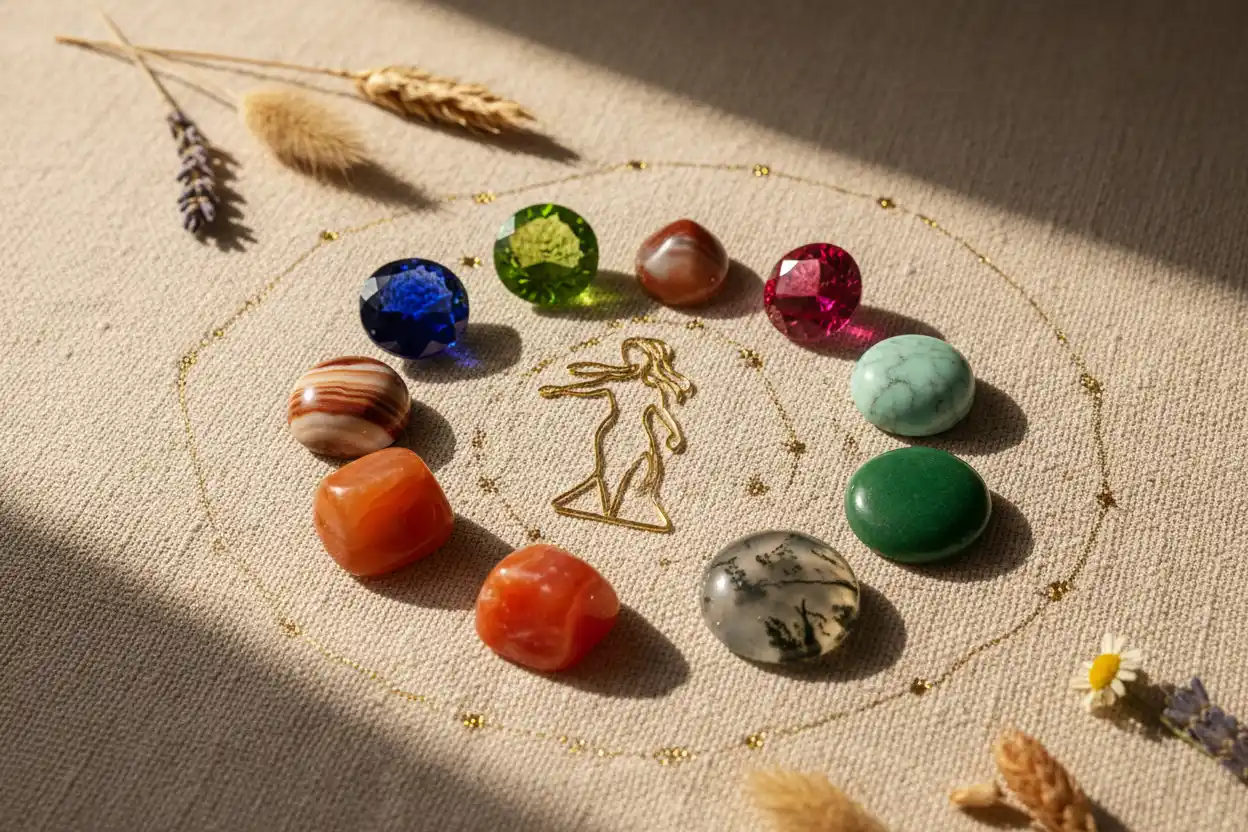
Virgo Birthstone: 20 Spiritual Symbols of Sapphire & Carnelian
The Virgo birthstone tradition commonly brings sapphire and carnelian together, although the two stones are connected with Virgo for different reasons. Virgo generally extends from late August through most of September. Sapphire is the recognized birthstone for September, giving it a direct monthly connection with most Virgo birthdays. Carnelian is not a standardized September birthstone, but it has become a popular Virgo-associated stone in astrological and spiritual traditions because its warm orange-red color is linked symbolically with motivation, practical action, creativity, and confidence.
Gemologically, sapphire and carnelian are very different. Sapphire is corundum, an aluminum oxide mineral with a Mohs hardness of 9, making it one of the hardest natural gemstones used in jewelry. Carnelian is a red, orange, or brownish-orange variety of chalcedony, the microcrystalline form of quartz, and reaches about 6.5 to 7 on the Mohs scale. Sapphire is normally transparent to translucent and often faceted, while carnelian is usually translucent and fashioned into cabochons, beads, carvings, or polished forms.
The spiritual meanings associated with these stones are best understood symbolically. Sapphire may represent discipline, wisdom, loyalty, thoughtful judgment, and integrity, while carnelian can symbolize initiative, confidence, creativity, and determined action. Neither gemstone scientifically determines Virgo personality traits, changes mental health, guarantees success, or creates measurable astrological effects. Their significance comes from history, personal interpretation, birthstone tradition, and the meaning a wearer chooses to give them.
20 Spiritual Symbols Associated With Virgo Birthstones
- Wisdom
- Discipline
- Clear judgment
- Integrity
- Practical action
- Patience
- Focus
- Confidence
- Loyalty
- Creativity
- Self-awareness
- Persistence
- Responsibility
- Purpose
- Thoughtful communication
- Courage
- Organization
- Personal growth
- Emotional steadiness
- Meaningful progress
These 20 themes reflect traditional and modern symbolic associations rather than measurable powers within sapphire or carnelian. Someone born under Virgo may use either stone to represent qualities they value, but birth date does not scientifically determine personality, and gemstones do not automatically create discipline, confidence, intelligence, or emotional balance.
Why Sapphire and Carnelian Are Associated With Virgo
Virgo is generally placed from about August 23 to September 22 in Western tropical astrology. This means the sign crosses August and September, which have different recognized monthly birthstones. Peridot is strongly associated with August, while sapphire is the traditional and modern birthstone for September. Since most of the Virgo period falls in September, sapphire has the clearest recognized birthstone relationship with the sign.
Carnelian comes from a different tradition. It has appeared in jewelry, seals, amulets, beads, and carved objects for thousands of years and has accumulated associations with courage, activity, creativity, and personal resolve. Contemporary astrology often pairs those ideas with Virgo themes involving practical work, discipline, organization, and purposeful improvement.
These astrological descriptions are symbolic themes rather than scientific personality categories. Not every Virgo is methodical or reserved, just as wearing carnelian does not create motivation and wearing sapphire does not make someone more analytical. Birthstone jewelry can still carry personal value when the symbolism is treated as an expression of intention rather than a prediction of behavior.
The pairing is also visually distinctive. Sapphire offers rich blue, although the mineral occurs in many other colors, while carnelian produces warm orange to reddish tones. Together they create a strong cool-and-warm contrast that can work especially well in jewelry intended to represent balance between careful thought and decisive action.
Sapphire and Carnelian Gemological Comparison
| Property | Sapphire | Carnelian |
|---|---|---|
| Mineral identity | Corundum | Chalcedony quartz |
| Chemical composition | Al₂O₃ | SiO₂ |
| Typical color | Blue, plus many fancy colors | Orange, reddish orange, brownish orange |
| Mohs hardness | 9 | About 6.5 to 7 |
| Cleavage | None | None |
| Typical transparency | Transparent to translucent | Translucent to nearly opaque |
| Common cutting style | Faceted, cabochon | Cabochon, bead, carving |
| Important treatments | Heat, diffusion and other treatments | Heat treatment and dyeing may occur |
| Ring suitability | Excellent | Good with sensible protection |
| Recognized monthly birthstone | September | No standardized Virgo assignment |
Sapphire’s hardness of 9 gives it outstanding resistance to scratching and makes it one of the strongest choices for rings worn regularly. Diamond is harder, but sapphire remains far more resistant to everyday abrasion than quartz, feldspar, opal, or many ornamental stones. Sapphire also lacks cleavage, which contributes to its practical durability.
Carnelian is durable enough for many jewelry uses but sits lower on the hardness scale. It can be scratched by harder gemstones such as sapphire, ruby, topaz, and diamond, so separate storage is sensible. Its microcrystalline structure generally gives it useful toughness, making well-cut carnelian suitable for rings, pendants, earrings, beads, and carved jewelry.
Sapphire Meaning for Virgo and Its Actual Mineral Identity
Sapphire has long accumulated associations with wisdom, loyalty, truth, sincerity, authority, and thoughtful judgment. Within Virgo symbolism, these themes are often connected with careful decision-making, responsibility, discipline, and a preference for purposeful action rather than impulsive behavior.
A sapphire ring can therefore represent commitment to a long-term goal, intellectual honesty, or loyalty within a relationship. The meaning may be deeply personal, but the stone does not scientifically increase intelligence, improve concentration, regulate emotions, or determine whether someone behaves responsibly.
Sapphire is the non-red gem variety of corundum. Red corundum is classified as ruby, while blue and other non-red colors generally fall within the sapphire family. Blue sapphire commonly owes its color to interactions involving iron and titanium within the crystal structure. Other trace elements can produce yellow, green, pink, orange, violet, and other colors.
Fine blue sapphire is usually judged strongly by color. Attractive stones combine desirable hue, saturation, and tone without becoming excessively dark or noticeably gray. Color distribution also matters because natural sapphire can display zoning, with stronger and weaker areas of color within the same crystal.
Clarity standards differ from those applied to diamond. Natural sapphire commonly contains mineral crystals, healed fractures, growth structures, color zoning, and other internal features. Some inclusions can help gemologists understand whether a sapphire is natural and may provide clues about geological formation or treatment history.
Heat Treatment, Diffusion, and Synthetic Sapphire
Heat treatment is common in the sapphire trade. Controlled heating can improve color and sometimes clarity by altering features within the stone. Properly performed heat treatment can produce stable changes and is widely accepted, but disclosure remains important because an unheated sapphire of comparable quality may command a considerable premium.
Some sapphire treatments are more extensive. Diffusion processes can introduce color-producing elements into or near the surface of a gemstone. Different diffusion techniques penetrate to different depths, so accurate identification can require laboratory testing. Fracture filling may also occur in lower-quality corundum.
Synthetic sapphire creates another important distinction. Laboratory-grown corundum has essentially the same fundamental chemical composition and crystal structure as natural sapphire, but its origin is artificial. Flame-fusion, flux, hydrothermal, and other growth techniques have produced synthetic corundum for jewelry and industrial applications.
A synthetic sapphire can be beautiful and durable, but it should never be represented as a natural sapphire. When a valuable stone is being purchased, reliable disclosure and professional gemological examination are much more dependable than claims based solely on color, apparent perfection, or seller terminology.
Carnelian Meaning for Virgo and Its Quartz Structure
Carnelian has traditionally been associated with courage, vitality, creativity, initiative, and personal resolve. In a Virgo birthstone interpretation, these ideas can provide a symbolic counterpoint to sapphire. Sapphire may represent careful judgment, while carnelian can represent the decision to move from analysis into action.
The stone does not physically generate motivation, increase energy levels, cure fatigue, or alter the body’s systems. Someone may nevertheless wear a carnelian bracelet or pendant as a visual reminder to begin a delayed project, speak confidently, or continue working toward a chosen goal.
Carnelian belongs to chalcedony, a microcrystalline variety of quartz formed from extremely fine intergrowths of silica. Its familiar colors range from pale orange through deep reddish orange and brownish red. Iron-related compounds are responsible for much of this coloration.
Because chalcedony consists of microscopic quartz structures rather than large transparent crystals, carnelian normally has a soft translucent appearance. Light may penetrate the stone and create a warm internal glow, especially around thinner edges, but high transparency is not required for quality.
Historically, carnelian has been especially suitable for seals and engraved objects because it can take a good polish and provide sufficient durability for carving. Ancient examples survive from several civilizations, demonstrating that its appeal long predates modern crystal symbolism.
Natural Color, Heat Treatment, and Carnelian Imitations
Carnelian color can be natural, enhanced by heating, or influenced through treatment of related chalcedony. Heating iron-bearing chalcedony can deepen or modify orange and reddish colors. Such treatment has a long history and can be difficult to establish from appearance alone.
Some products may also involve dyed chalcedony. Dye can create stronger or more uniform color than naturally present, and porous areas may accept colorants differently. Treatment does not necessarily make a gemstone unsuitable for jewelry, but accurate representation remains important.
Glass and other colored products may imitate carnelian, although genuine chalcedony itself is relatively abundant. Buyers should be cautious when inexpensive polished objects are accompanied by extraordinary claims of rarity or geographic origin without supporting evidence.
Quality carnelian should be evaluated through color, translucency, polish, craftsmanship, structural condition, and overall appearance. Extremely dark pieces that lose their warm transmitted color may appeal to some buyers, while others prefer lively orange-red examples that seem to glow around their edges.
Virgo Birthstone Jewelry and Everyday Durability
Sapphire is one of the strongest colored-gem choices for an everyday ring. Its Mohs hardness of 9 means ordinary household dust, many metals, and softer gemstones are unlikely to scratch it easily. This durability is one reason sapphire has a long history in engagement rings and heirloom jewelry.
Durability does not mean immunity from damage. Strong blows can still chip facet edges, especially around pointed shapes or stones mounted high above the finger. Existing fractures, treatment, and setting design also influence how safely an individual sapphire can be worn.
Carnelian performs differently. Its hardness of approximately 6.5 to 7 makes it suitable for jewelry, but rings will gradually show wear more readily than sapphire. Smooth cabochons are practical because they eliminate sharp facet junctions and display the stone’s translucent color effectively.
A Virgo wearer who wants a birthstone for daily ring use may therefore favor sapphire. Someone seeking a pendant, bracelet, bead strand, or larger symbolic piece may find carnelian especially attractive. The two can also be combined when the design protects softer carnelian from repeated contact with harder sapphire edges.
Choosing Sapphire or Carnelian by Quality Rather Than Symbolism Alone
For sapphire, the first major consideration is usually color. A beautiful blue should remain attractive across normal lighting conditions rather than appearing vivid only under intense showroom illumination. Cut quality is also crucial because a poorly proportioned sapphire may appear dark, windowed, or uneven even when the rough had promising color.
Clarity should be judged according to the type of stone rather than by demanding complete internal perfection. An inclusion that is barely visible without magnification may have little practical effect, while a large surface-reaching fracture can influence both appearance and durability.
For carnelian, buyers should pay attention to color distribution, translucency, polish, and craftsmanship. A well-made cabochon should have a smooth surface, attractive outline, and sufficient thickness to show rich color without appearing unnecessarily bulky.
Treatment disclosure should be considered for both stones. Heat-treated sapphire can be a legitimate and beautiful choice, while heat-enhanced carnelian can also be attractive. The important issue is whether the buyer receives an accurate description and pays a price appropriate to the stone’s actual identity and treatment history.
Caring for Sapphire and Carnelian
Most uncomplicated sapphire jewelry can be cleaned with lukewarm water, mild soap, and a soft brush. Untreated and conventionally heat-treated sapphires are generally stable under ordinary jewelry conditions, although unusual treatments, significant fractures, or fragile settings may require more cautious cleaning.
Carnelian is also easily maintained with mild soap and water. Abrasive powders and harsh chemicals are unnecessary and may dull polished surfaces or damage the jewelry setting. Strong thermal shock should be avoided even when the gemstone itself appears sound.
Ultrasonic and steam cleaning should not be treated as automatic choices simply because sapphire is hard. A stone with fractures, fillings, unusual treatment, or a weakened mounting may respond differently from a clean untreated gem. When treatment status is uncertain, gentle cleaning is the safer routine.
Storage matters because sapphire can scratch carnelian and many other gemstones. Keeping pieces in separate pouches or compartments prevents unnecessary contact and protects both gemstone surfaces and precious-metal settings.
Virgo Symbolism Without Fixed Personality Claims
Astrology often describes Virgo through themes such as analysis, organization, reliability, practicality, careful communication, and attention to detail. These descriptions can explain why sapphire and carnelian are appealing symbolic choices, but they should not be treated as scientifically determined characteristics shared by everyone born within the Virgo period.
Sapphire can represent the value of thinking carefully before making an important decision. Carnelian can represent the opposite but complementary need to act after enough information has been gathered. In that sense, wearing the two together may symbolize balance between judgment and initiative.
Such meaning comes from the wearer rather than from an invisible force in the gemstone. A sapphire inherited from a grandparent may symbolize reliability because of the person who wore it. A carnelian pendant purchased after completing an important project may represent persistence because of the memory attached to it.
This personal form of symbolism allows birthstone jewelry to remain meaningful while keeping gemological facts and spiritual interpretation clearly separated.
Conclusion
Sapphire and carnelian offer two distinct approaches to the Virgo birthstone tradition. Sapphire has the strongest recognized connection because it is September’s birthstone and provides exceptional hardness, excellent jewelry durability, and a wide range of natural colors. Carnelian is orange to reddish chalcedony with a long history in jewelry and carving, offering warm color, useful durability, and a more accessible price range.
Their Virgo meanings are symbolic rather than scientifically proven. Sapphire can represent discipline, wisdom, integrity, and loyalty, while carnelian can represent initiative, courage, creativity, and purposeful action. The best choice depends on birth month, gemstone quality, treatment disclosure, intended jewelry use, and the meaning the wearer personally values.
FAQs About Virgo Birthstone
What is the main Virgo birthstone?
There is no single standardized gemological birthstone for the entire Virgo zodiac period because Virgo crosses August and September. Sapphire is the recognized September birthstone and therefore has the clearest monthly connection with most Virgo birthdays. Carnelian is primarily a popular astrological and symbolic Virgo stone rather than an official monthly assignment.
Why is sapphire associated with Virgo?
Most of the Virgo period falls during September, and sapphire is the recognized September birthstone. Modern astrology also associates sapphire with themes such as wisdom, responsibility, loyalty, and thoughtful judgment, although those personality connections are symbolic rather than scientifically established.
Is carnelian an official Virgo birthstone?
Carnelian is not a standardized monthly birthstone for Virgo. Its connection comes mainly from historical symbolism and modern astrology, where it is associated with courage, motivation, creativity, and action. It can still be meaningful as Virgo jewelry without being treated as an official gemological classification.
Is sapphire suitable for an everyday Virgo birthstone ring?
Yes. Sapphire has a Mohs hardness of 9 and no cleavage, making it one of the best colored gemstones for rings worn frequently. It can still chip under severe impact, so sensible protection remains important, especially around pointed corners and exposed facet edges.
Can carnelian be worn every day?
Carnelian is durable enough for many forms of regular jewelry because its hardness is approximately 6.5 to 7 and its microcrystalline structure provides useful toughness. Rings may develop surface wear more quickly than sapphire, while pendants, earrings, and beads usually experience less abrasion.
Are most blue sapphires treated?
Heat treatment is common in the sapphire trade and is widely accepted when disclosed. Some sapphires remain unheated, and fine examples with documented natural color may carry a premium. More extensive treatments such as diffusion or fracture filling should also be represented accurately because they can influence value.
Is synthetic sapphire real sapphire?
Synthetic sapphire is laboratory-grown corundum with the essential chemistry and crystal structure of sapphire, so it is not simply imitation glass. Its origin is artificial rather than geological, however, and it must be clearly disclosed as synthetic or laboratory-grown rather than sold as natural sapphire.
What gives carnelian its orange-red color?
Carnelian’s warm coloration is primarily associated with iron-bearing compounds within chalcedony. Natural geological processes can produce orange, red, and brownish tones, while heat treatment may intensify or modify color in some stones.
Does carnelian increase Virgo energy or motivation?
There is no scientific evidence that carnelian physically increases energy, motivation, creativity, or productivity. Its long symbolic connection with courage and action may make it useful as a personal reminder of a goal, but the effect comes from the meaning assigned by the wearer rather than a proven force emitted by the stone.
Can Virgo wear sapphire and carnelian together?
Yes. There is no gemological restriction against combining them. Deep blue sapphire and orange-red carnelian can create a strong visual contrast, while their symbolic themes can represent a balance between thoughtful judgment and purposeful action.