Bronzite Benefits: 9 Real Uses, Meaningful Symbolism & Hidden Facts, Responsible Use
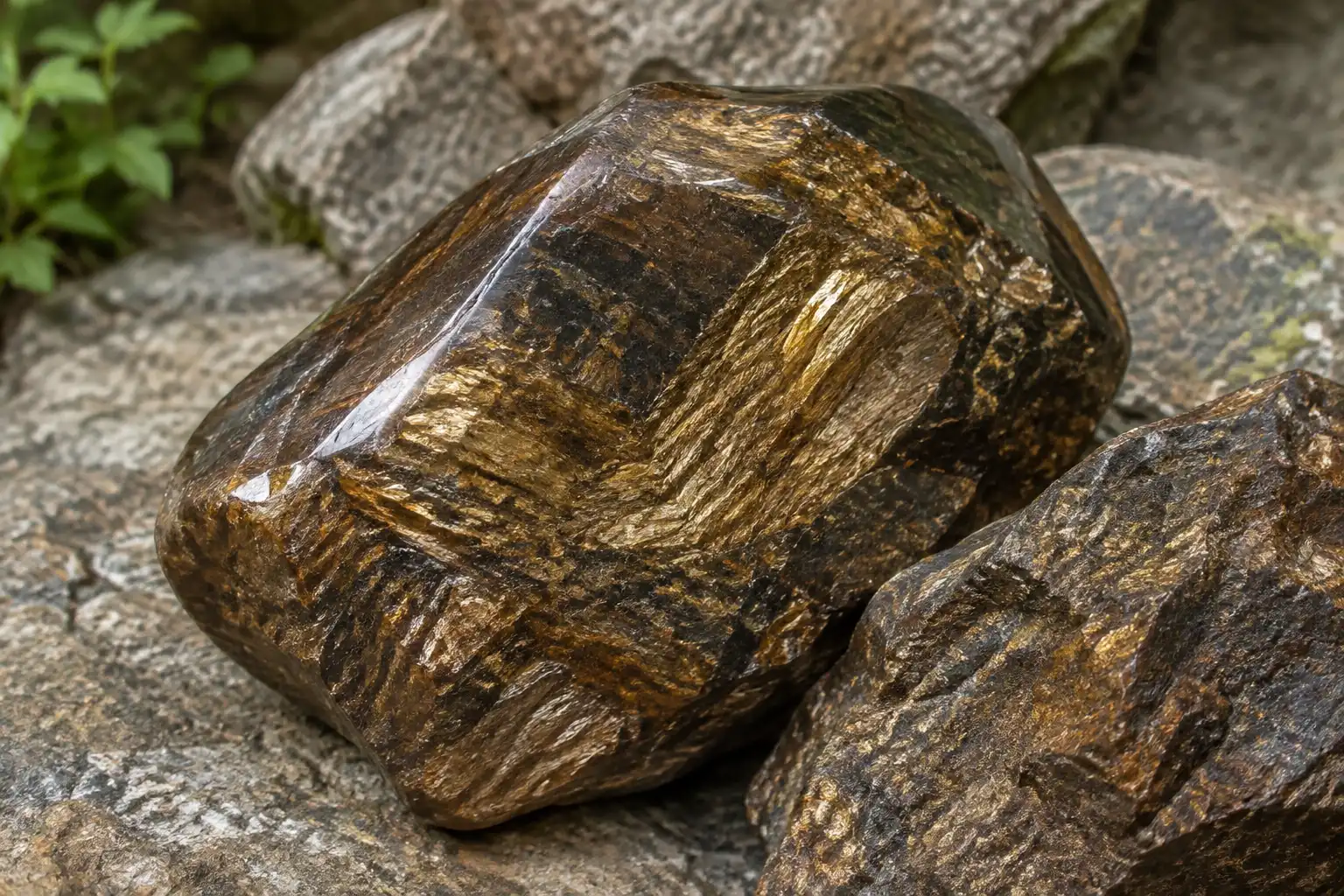
Bronzite benefits begin with an unusual visual effect rather than a health claim. Bronzite is an iron-bearing variety of enstatite in the pyroxene mineral group, generally appearing brown, dark brown, greenish brown, or nearly black with metallic bronze-colored flashes. These reflective areas can create a warm sheen that becomes especially attractive after polishing, giving cabochons, beads, palm stones, and carvings a distinctive appearance.
Its geological identity makes bronzite useful far beyond decoration. The mineral can help students understand pyroxene chemistry, iron substitution, rock-forming minerals, cleavage, luster, alteration, and the way internal structures influence surface appearance. It also occurs in igneous and metamorphic settings where pyroxenes form an important part of the rock, adding genuine educational and collecting value.
Modern crystal traditions often describe bronzite benefits in terms of grounding, confidence, protection, decisiveness, emotional stability, or courage. These ideas can function as personal symbolism, but they are not established medical or psychological effects. Bronzite does not treat anxiety disorders, improve circulation, balance hormones, remove toxins, or create a measurable protective field around the body.
9 Bronzite Benefits at a Glance
- Bronze-colored schiller gives polished bronzite a distinctive reflective appearance.
- Pyroxene mineralogy provides useful insight into rock-forming minerals and iron-rich silicates.
- Dense brown coloration makes bronzite practical for understated jewelry and decorative objects.
- Cabochon cutting and polishing can reveal reflective structures hidden in ordinary-looking rough.
- Collectors can compare bronzite with enstatite, hypersthene, and other pyroxene varieties.
- Jewelry designers gain a neutral brown gemstone that pairs easily with many metals and colors.
- Identification practice encourages attention to luster, cleavage, hardness, color, and internal reflection.
- Modern symbolism can represent steadiness, confidence, or deliberate action without medical claims.
- Sensible care allows polished bronzite to remain attractive for long-term ownership.
Bronze Schiller Is One of the Most Distinctive Bronzite Benefits
The reflective bronze sheen that gives bronzite its name is central to the stone’s appeal. A rough piece can look relatively plain until light reaches the polished surface at the right angle, when bronze, coppery, or golden reflections become visible.
This effect is often called schiller and results from internal structural features that reflect light differently from the surrounding mineral. In bronzite, fine lamellae and alteration-related structures can contribute to the characteristic metallic-looking sheen. The visual result differs from the glitter of aventurine or the moving cat’s-eye band of tiger’s eye. Bronzite tends to produce broader bronze flashes or silky reflective patches across a darker brown background.
This creates one of the most immediately observable bronzite benefits. The stone can appear subdued in ordinary light and then become much more dynamic when turned. Jewelry and polished objects therefore reward movement rather than relying on intense body color alone.
Cutting quality matters. A poorly oriented surface may show little reflection, while a carefully polished cabochon can reveal much more of the internal sheen. The stone’s value as an ornamental gem is closely connected with how effectively that bronze effect is displayed.
Pyroxene Mineralogy Gives Bronzite Scientific Value
Bronzite belongs to the orthopyroxene side of the pyroxene family and is closely associated with enstatite containing appreciable iron. Its chemistry is dominated by magnesium, iron, silicon, and oxygen, while exact composition can vary according to the specimen and geological environment.
This makes mineralogy one of the strongest educational bronzite benefits. Pyroxenes are major rock-forming minerals in many igneous and metamorphic rocks, so a bronzite specimen can introduce concepts involving silicate structure, solid solution, iron substitution, metamorphism, and mineral assemblages.
Bronzite may occur in mafic and ultramafic rocks as well as in metamorphic settings. It can appear alongside olivine, other pyroxenes, feldspar, or related minerals depending on the host rock and formation conditions.
Collectors who understand these relationships gain more from a specimen than someone who sees bronzite only as a polished brown crystal. A piece can represent a specific mineral family, geological environment, and chemical variation within pyroxene.
The stone’s real geological identity therefore provides more substance than exaggerated claims about hidden energies.
Polishing Reveals Beauty That Rough Bronzite Can Hide
Lapidary work is another practical source of bronzite benefits. Rough pieces may look dull, uneven, or almost ordinary until grinding and polishing expose a surface capable of reflecting light from internal structures.
Cabochons are especially effective because their smooth curved faces can reveal bronze flashes across a relatively wide area. Beads also work well because movement continually changes the angle between light and the polished surface. Larger pieces can become freeforms, palm stones, spheres, small carvings, or decorative objects.
The cutter needs to evaluate fractures, cleavage, grain direction, and the location of reflective zones before deciding how to orient the finished piece. Maximum size is not always the best goal. A somewhat smaller cabochon showing stronger schiller can be more visually successful than a larger stone with a dull face.
This relationship between rough appearance and polished result is one of the hidden bronzite benefits. It demonstrates how craftsmanship can reveal optical features that natural surfaces do not show clearly.
Brown and Bronze Tones Make Bronzite Versatile in Jewelry
Bronzite’s color palette gives it considerable design flexibility. Brown, bronze, copper, gold, and dark neutral tones can work with silver, yellow gold, rose gold, brass, copper, leather, wood, and many other jewelry components.
The stone generally suits designs that emphasize texture and warmth rather than brilliant transparent color. A polished bronzite cabochon can provide a strong focal point in a pendant or ring, while beads create a more understated effect in necklaces and bracelets.
Warm metals tend to reinforce the bronze reflections, while silver-colored metals create stronger contrast with the brown body. Bronzite also pairs naturally with black stones, clear quartz, smoky quartz, tiger’s eye, and lighter neutral gems.
Jewelry use is therefore one of the most practical bronzite benefits. The stone does not require extreme saturation or transparency to be attractive. Its appeal comes from a combination of polish, metallic-looking reflection, body color, and movement.
Because bronzite is not among the hardest jewelry gems, exposed rings deserve more caution than pendants or earrings. Thoughtful setting design can protect edges while preserving the surface area needed to show schiller.
Bronzite Helps Collectors Compare Pyroxene Varieties
Collecting becomes more interesting when bronzite is viewed alongside other pyroxene-group minerals. Enstatite, iron-bearing orthopyroxene varieties, and stones marketed under related names can overlap in appearance, making composition and terminology worth understanding.
This is one of the less obvious bronzite benefits because it encourages collectors to look beyond trade names. Brown color alone does not establish mineral identity. Crystal structure, cleavage, hardness, luster, optical behavior, chemical composition, and geological association all contribute to proper identification.
Some commercial stones called bronzite are sold primarily in polished form, which can hide natural crystal features. Rough specimens or pieces retaining host-rock associations may provide more geological information.
Collectors can also compare how the bronze sheen changes between specimens. Some show strong metallic flashes across much of the surface, while others display only small reflective areas. Variation in color and texture makes individual pieces useful for side-by-side study.
Someone deciding where to buy bronzite should therefore consider identification, surface quality, treatment disclosure, seller accuracy, and whether locality information is genuinely known.
Identification Builds Better Gemstone-Buying Skills
Bronzite may be confused with hypersthene, dark enstatite, tiger’s eye, brown feldspar, metallic-looking glass, or other dark stones when viewed only through photographs.
Identification requires attention to several features. Bronzite generally has a brown to dark brown body color with bronze-colored internal reflections. Its hardness is moderate rather than extremely high, and its pyroxene structure gives it cleavage that should be considered when examining rough pieces.
Tiger’s eye produces a more directional cat’s-eye-style band, while bronzite usually shows broader metallic-looking flashes. Hypersthene can also display schiller and may overlap closely in trade usage, which is one reason exact labeling deserves caution.
These distinctions create a useful bronzite benefit for gemstone buyers: the stone encourages observation rather than relying on color alone.
Marketing language such as powerful, ancient, protective, or rare does not establish identity. Buyers gain more reliable information from clear photographs, honest mineral names, dimensions, condition, locality when known, and professional testing when a high-value claim requires confirmation.
Modern Symbolism Can Represent Steadiness and Deliberate Action
Contemporary crystal culture frequently associates bronzite benefits with grounding, courage, protection, decisiveness, confidence, and emotional steadiness. The stone’s dark brown color and bronze reflections make these themes visually understandable, but they remain symbolic interpretations.
Steadiness can be translated into ordinary behavior. Someone might keep bronzite near a workspace as a reminder to finish one important task before starting several others. Another person may associate a bracelet with maintaining a boundary or making decisions after reviewing the available facts.
Decisiveness does not mean acting impulsively. A useful symbolic interpretation of bronzite is deciding once adequate information has been gathered rather than delaying indefinitely because perfect certainty is impossible.
Modern discussions of bronzite healing properties may extend these themes into claims involving anxiety relief, nervous-system balance, digestion, circulation, or physical healing. Those ideas belong to spiritual traditions and are not established medical effects of pyroxene.
Bronzite benefits remain meaningful when symbolism encourages deliberate behavior while leaving medical care to evidence-based practice.
Moderate Hardness Creates Useful but Limited Durability
Bronzite can be worn successfully in jewelry, but it is not as scratch-resistant as quartz, topaz, sapphire, or diamond. It generally falls around the middle of the Mohs scale, so abrasion from harder objects can gradually affect polish.
This makes care an important part of bronzite benefits. Pendants, earrings, beads, and protected cabochons are often easier to maintain than highly exposed rings. Large polished pieces should also be protected from drops because fractures or cleavage can lead to chips.
Routine cleaning should remain gentle. Lukewarm water, mild soap, and a soft cloth are usually appropriate for stable polished pieces. Harsh chemicals, steam, aggressive ultrasonic cleaning, and abrupt temperature changes provide little advantage.
Storage matters as well. Keeping bronzite separate from harder stones reduces scratching and helps preserve the reflective surface responsible for much of its visual appeal.
A gemstone does not need exceptional hardness to be practical. It simply needs care that matches its real physical properties.
Decorative and Educational Uses Extend Beyond Jewelry
Bronzite benefits are not limited to wearable objects. Larger pieces may become desk stones, carvings, spheres, bookends, inlay, or polished decorative forms. These objects provide enough surface area for the bronze reflections to become especially visible.
Rough specimens can serve a different purpose by preserving more geological information. Students can examine grain, association with host rock, natural fracture, and surface appearance before polishing changes the way light interacts with the stone.
This contrast between rough and polished bronzite can make a useful educational set. The rough piece demonstrates natural occurrence, while the finished piece shows how lapidary work reveals the stone’s optical potential.
The mineral therefore works across several interests: geology, collecting, jewelry design, lapidary craft, and personal symbolism. These real bronzite benefits are more substantial than reducing the stone to a list of wellness promises.
Responsible Use Means Separating Mineral Chemistry from Health Claims
Bronzite contains iron-bearing silicate minerals, but that chemistry does not make the stone a source of medicinal iron. Wearing or holding bronzite does not provide nutritional supplementation, improve blood chemistry, or correct iron deficiency.
The same evidence boundary applies to detoxification, emotional healing, pain relief, digestive function, nervous-system regulation, and electromagnetic protection. These claims require medical evidence that the gemstone does not provide.
Someone may still find a familiar stone comforting or useful as a reminder during reflection. Personal ritual, symbolism, and aesthetics can have meaning without establishing a physiological mechanism.
This distinction strengthens rather than weakens bronzite benefits. The stone already offers mineralogical interest, bronze schiller, jewelry versatility, lapidary value, collecting possibilities, identification practice, and individual symbolism.
Conclusion
Bronzite benefits include bronze-colored schiller, pyroxene mineralogy, lapidary potential, jewelry versatility, collecting value, identification practice, moderate durability, decorative use, and meaningful modern symbolism. Its dark brown body and reflective bronze flashes create an appearance that becomes especially effective after skilled polishing.
Modern ideas about grounding, confidence, steadiness, or protection can remain part of personal practice when they are treated as symbols rather than medical effects. The most dependable bronzite benefits come from understanding the stone’s real mineral identity, appreciating the craftsmanship needed to reveal its sheen, and caring for it according to its physical limitations.
FAQs
What are the main bronzite benefits?
The most verifiable bronzite benefits include jewelry use, metallic-looking schiller, mineral collecting, pyroxene education, lapidary work, identification practice, decorative use, and personal symbolism.
What is bronzite made of?
Bronzite is an iron-bearing variety of enstatite in the orthopyroxene mineral group, composed mainly of magnesium, iron, silicon, and oxygen.
Why does bronzite look metallic?
Fine internal structures can reflect light and produce bronze-colored schiller across polished surfaces, creating the metallic-looking sheen associated with the stone.
Is bronzite durable enough for jewelry?
Yes, with reasonable care. It is less scratch-resistant than quartz and has cleavage, so protected settings and avoidance of hard impacts are sensible.
Is bronzite the same as tiger’s eye?
No. Both may show reflective optical effects, but tiger’s eye displays directional chatoyancy from aligned fibrous structures, while bronzite typically shows broader bronze schiller.
Is bronzite good for collecting?
Yes. Bronzite offers mineralogical interest as an iron-bearing orthopyroxene and can be collected as rough specimens, polished pieces, cabochons, or carvings.
What does bronzite symbolize?
Modern symbolism commonly connects bronzite with steadiness, confidence, decision-making, protection, grounding, and resilience. These are personal or spiritual interpretations.
Does bronzite provide iron to the body?
No. Iron contained within a solid silicate mineral is not equivalent to dietary iron or medically prescribed supplementation.
Does bronzite have healing benefits?
There is no established clinical evidence that bronzite treats anxiety, pain, circulation problems, digestive conditions, iron deficiency, neurological issues, or other medical concerns.
Bronzite benefits described as healing, grounding, protective, or energetic effects belong to spiritual and personal belief and should not replace qualified medical or mental-health care.