Where to Buy Real Bronzite and Avoid Glass or Resin Fakes
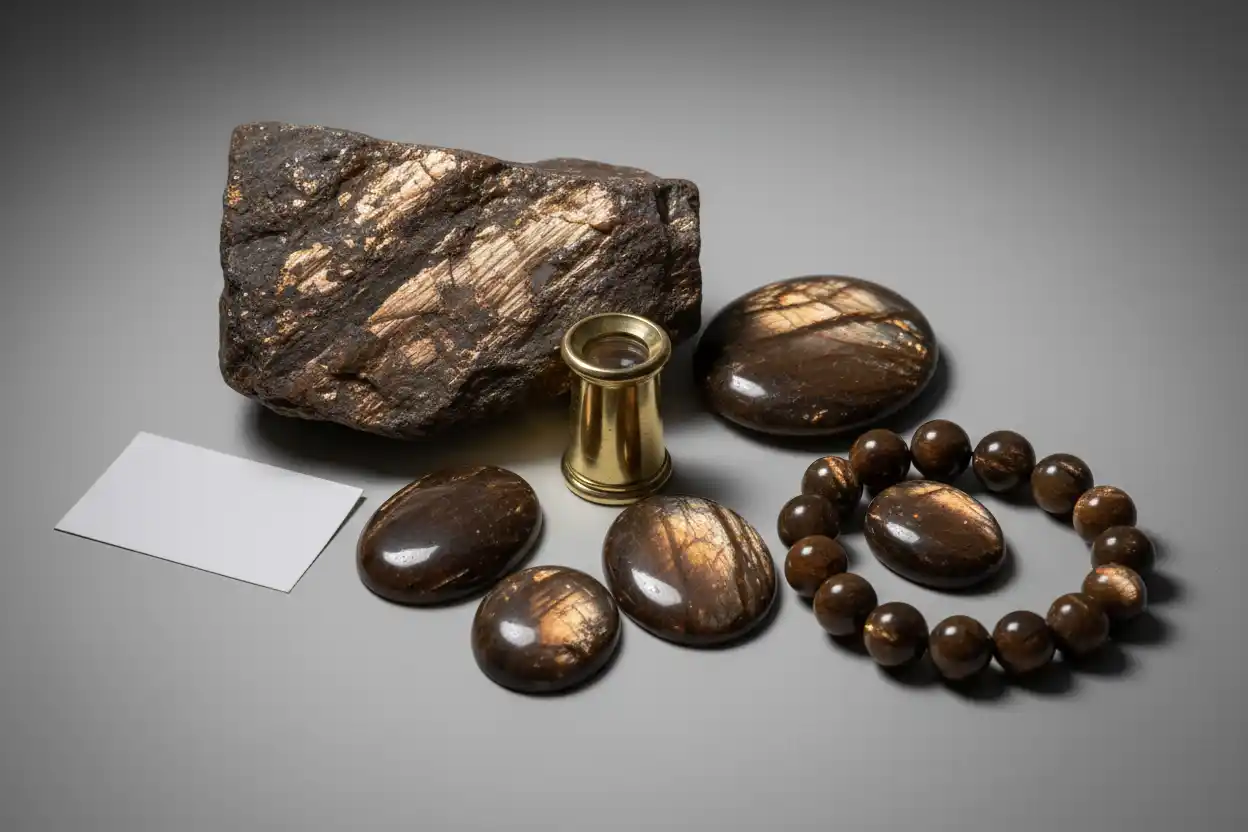
Real bronzite is a brown to bronze-colored pyroxene material valued for its metallic-looking schiller. When a polished piece moves beneath directional light, fine internal features can produce golden, coppery or bronze reflections against a dark brown, greenish-brown or nearly black body.
The name requires some mineralogical context. Bronzite is traditionally treated as a variety of enstatite rather than a separate approved mineral species. Consequently, a careful seller may describe an item as bronzite, enstatite variety bronzite, or bronzy enstatite. That wording is more accurate than claims that bronzite is an entirely separate crystal species.
Most retail problems involve weak identification, gold-painted stone, resin, glass, mica-rich rock, hypersthene, tiger’s eye or other bronzy materials—not a sophisticated synthetic bronzite.
The bronzite meaning and properties guide covers its identity and traditional symbolism. This page focuses on finding knowledgeable sellers, judging schiller, checking treatments and choosing sound rough, cabochons, beads, carvings and jewelry.
Understand the Bronzite Name
Bronzite belongs within the orthopyroxene group and is historically associated with iron-bearing enstatite that shows a bronze-like sheen. Modern mineral classification places greater emphasis on measured composition than on older appearance-based variety names.
That distinction matters most for collector specimens. A decorative cabochon can reasonably be sold under the established bronzite trade name, whereas a scientifically important crystal may require chemical analysis before the exact pyroxene composition is known.
The enstatite guide covers the mineral parent. The hypersthene guide addresses another historically used pyroxene name that can overlap visually and nomenclaturally with bronzy orthopyroxenes.
A seller who acknowledges this complexity is generally more reliable than one who invents a unique chemical formula for bronzite.
Choose the Product Form First
| Product | Best source | Main concern |
|---|---|---|
| Natural rough | Mineral or lapidary supplier | Correct pyroxene identification, fractures and temporary oil enhancement |
| Slab | Lapidary dealer | Schiller orientation, cutting yield and resin filling |
| Cabochon | Gem dealer or independent cutter | Optical strength, backing, coating and polish |
| Tumbled stone | Established crystal retailer | Generic brown stone or glass substitution |
| Bead strand | Reputable bead supplier | Resin, dyed material and inconsistent drill holes |
| Sphere or tower | Lapidary retailer | Hidden fractures, filler and low bronzite content |
| Carving | Skilled stone carver | Weak projections and surface coating |
| Jewelry | Jeweler familiar with cleavable silicates | Edge chips, glue and unrealistic durability claims |
| Collector specimen | Mineral dealer with analytical or locality context | Incorrect species-level naming |
A lapidary buyer needs well-oriented schiller and usable solid material. A collector needs stronger identity and locality evidence.
Where to Buy Genuine Bronzite
Specialist mineral dealers
A mineral dealer is the strongest source when the purchase depends on pyroxene identity, crystal form or locality.
Ask whether the material was identified as enstatite variety bronzite, orthopyroxene or simply a commercial bronzite rock. The answer should match the evidence available.
Crystal specimens should include dimensions, matrix description and condition. Many commercial pieces are massive lapidary material rather than individual well-formed crystals, and the listing should make that distinction clear.
Lapidary suppliers
Lapidary suppliers are often the best source for rough and slabs. Good sellers show how the bronze reflection behaves under one directional light and explain which cutting orientation produces the strongest effect.
Request dry photographs. Oil or water can deepen the body color and make weak schiller appear more dramatic.
Ask whether the supplier has cut cabochons from the same batch. Their polish and optical performance reveal whether the rough contains coherent bronzite or a mixed rock with only scattered reflective grains.
Gem and mineral shows
Shows allow you to compare bronzite with hypersthene, tiger’s eye, astrophyllite, mica-rich rock and goldstone.
Rotate each piece beneath a small focused light. Natural bronzite usually shows irregular bronze flashes associated with grains, cleavage or internal lamellae rather than one perfectly straight cat’s-eye band.
Use a loupe to inspect cracks, coatings, resin and the relationship between reflective areas and the stone’s body.
Established online gemstone shops
Online listings should include a moving-light video. A still photograph can capture one bright reflection and make ordinary dark stone look highly chatoyant.
The online gemstone buying guide explains seller identity, protected payment and return terms.
For bronzite, request front, back, edge and dry-surface images. Ensure the seller is shipping the exact piece or clearly describes batch variation.
Independent lapidaries and jewelry makers
A cutter who works directly with the rough can explain orientation, treatment and construction. Ask whether the cabochon has been backed and whether resin was used to stabilize cracks.
A jewelry maker should also explain whether the stone is solid bronzite, bronzite-bearing rock or a composite.
What Real Bronzite Usually Looks Like
Bronzite commonly has a dark brown, bronze-brown, greenish-brown or nearly black body. Polished surfaces can display copper, gold or bronze reflections that shift as the stone moves.
The reflective effect is usually granular, streaked or patchy. It may follow individual pyroxene grains or appear as elongated flashes within a massive stone.
Natural material can contain black areas, pale silicate grains, fractures and changes in grain size. A completely uniform metallic surface is not required.
Under magnification, reflective features should lie within the stone rather than forming a layer of glitter or paint on top. Small cleavage steps and internal lamellae may catch the light.
Some rough looks unimpressive until correctly oriented and polished. Conversely, a wet rough surface can exaggerate performance that does not survive cutting.
Bronzite Versus Hypersthene
Bronzite and hypersthene are both historical names associated with iron-bearing orthopyroxenes. Their traditional distinction relied partly on composition and appearance, but modern nomenclature has reduced the importance of those older varietal boundaries.
Commercial hypersthene often shows silver, bronze or reddish sheen in a dark gray to brown body. Bronzite tends to be marketed for warmer bronze-gold reflection.
Appearance alone cannot determine exact chemistry. A seller should not claim a rare pyroxene species solely because the flash looks silver rather than gold.
For ordinary jewelry, transparent trade naming may be sufficient. For collector or research material, Raman spectroscopy, X-ray diffraction and compositional analysis are more appropriate.
Bronzite Versus Tiger’s Eye
Tiger’s eye is chatoyant quartz with aligned fibrous texture. It commonly produces a distinct moving silky band.
Bronzite’s reflection is more often patchy, grain-based or lamellar rather than a continuous cat’s-eye line. Nevertheless, lower-quality tiger’s eye and strongly oriented bronzite can look similar in one photograph.
The types of tiger’s eye guide covers the quartz family’s color varieties. The completed guide to buying blue tiger’s eye explains Hawk’s Eye and fiber-optic glass, which should not be confused with bronzite’s pyroxene schiller.
Bronzite Versus Astrophyllite
Astrophyllite typically occurs as bronze to golden blades or starburst-like aggregates within a contrasting matrix.
Bronzite usually displays its reflection across pyroxene grains in a more uniform rock or crystal body. It does not normally form the dramatic isolated golden sprays associated with astrophyllite.
The completed guide to buying astrophyllite addresses painted blades, mica-rich substitutes and mixed host rocks.
Bronzite Versus Mica-Rich Rock
Mica can create abundant platy bronze, gold or silver sparkle. Mica flakes may separate into very thin sheets and can dominate the appearance of a schist or decorative rock.
Bronzite should show pyroxene-based reflection rather than easily peeling mica books. However, a multi-mineral rock may contain both pyroxene and mica.
A seller should identify whether the object is solid bronzite, bronzite-bearing rock or an attractive mixed lapidary material.
Bronzite Versus Goldstone
Goldstone is manufactured glass containing reflective crystals. Brown goldstone commonly shows dense, evenly distributed copper-colored glitter.
Natural bronzite tends to have less uniform reflection and a more mineral-grain texture. Goldstone may show round bubbles, glassy flow lines and remarkably consistent glitter from one bead to another.
Goldstone is a legitimate decorative material when labeled honestly. It is not a natural bronzite variety.
Other Imitations and Mislabels
Painted or bronzed stone
Ordinary dark rock can receive metallic paint or powder. Pigment may bridge cracks, collect in recesses or rub from damaged edges.
Resin with metallic particles
Resin can be molded with bronze pigment, stone chips or glitter. Bubbles, mold seams, repeated shapes and soft scratches may reveal manufacture.
Bronzy glass
Colored glass can mimic polished bronzite. Round bubbles, flow lines and uniform internal appearance support a glass identification.
Labradorite or feldspar
Some brown feldspar materials display schiller or flash. Their optical effect, cleavage and mineral properties differ from bronzite, but polished stones may require testing.
Generic pyroxenite or mixed rock
A decorative rock may contain bronzite alongside other minerals. It can still be natural and attractive, but the seller should not describe the entire object as one pure bronzite crystal.
The fake-crystal buyer’s guide provides a broader framework for evaluating glass, resin, coatings and misleading mineral names.
Treatments and Enhancement
Bronzite may be waxed, oiled, resin-impregnated, fracture-filled, coated or backed. Color dye is less central than it is for porous chalcedony, but surface enhancement can still make dark material appear richer.
Oil and wax deepen brown tones and make bronze reflections stand out. Resin may stabilize fractured rough or fill pits before polishing.
A clear coating can produce a glossy finish that hides uneven polish. Metallic coatings can also exaggerate schiller.
The gemstone treatments guide explains why a natural-origin stone can still require treatment disclosure.
How to Evaluate Rough
Request dry photographs from several directions. Schiller is orientation-dependent, so the seller should show how the reflection changes rather than selecting one flattering angle.
Look for coherent material between fractures. A large block can contain weak seams that reduce the number of usable cabochons.
Ask whether the rough is a single pyroxene-rich mass or a multi-mineral rock. Mixed material can create attractive patterns but may polish unevenly.
A sawn face reveals grain size and potential optical performance better than a weathered rind.
How to Evaluate Slabs
A useful slab should show reflective areas distributed across enough surface for cutting. One bright patch in a large plain slab offers limited yield.
Inspect both faces and the edges for open fractures, resin and color changes. A treated fracture may have a different gloss or trapped bubbles.
Check slab thickness. Thin slabs may require backing, while thick material can support higher domes that reveal stronger schiller.
How to Judge Cabochons
The strongest cabochons place bronze reflection across the face rather than hiding it around the girdle.
Rotate the stone beneath one small light. The flash should shift naturally through internal grains and planes. It should not behave like surface glitter.
The dome needs an even polish without ripples, deep pits or a thick coating. Mixed pyroxene rock can undercut where minerals of different hardness meet, so minor texture may occur.
Inspect the back for resin, dark backing or matrix. A backed cabochon can be wearable, but the construction should be disclosed.
Buying Tumbles, Spheres and Towers
A good tumble should have a smooth surface and visible bronze reflection from at least one normal viewing direction.
Spheres should be shown through a full rotation. One face may display excellent schiller while the opposite side appears plain or heavily fractured.
Towers require stable bases and sound points. Internal cleavage or grain boundaries can cause the tip to break after a minor impact.
Large polished pieces may contain more filler than small cabochons because maintaining one solid object requires substantial rough. Ask about repairs and stabilization.
Buying Beads and Bracelets
Natural bead strands should show variation in grain pattern and reflection. Each bead may flash from a different angle because the rough was drilled and rounded in varying orientations.
Perfectly identical glitter suggests glass or resin. However, skilled sorting can produce a well-matched natural strand, so uniformity is only one clue.
Inspect drill holes for chips and radial fractures. Rough hole edges can cut elastic or cord.
Avoid overtight stringing. Continuous bead-to-bead impact may dull the polish or extend existing cracks.
Buying Bronzite Jewelry
Bronzite is better suited to pendants, earrings, brooches and protected cabochon rings than to exposed rough-crystal jewelry.
The gemstone hardness chart helps compare its moderate scratch resistance with quartz and harder gems. The gemstone toughness-versus-hardness guide explains why cleavage and grain boundaries remain relevant.
A bezel supports cabochon edges better than high prongs. Large domes should not sit far above the setting where they receive frequent impacts.
Ask whether the stone is glued. Adhesive construction can be practical in low-cost jewelry, but it affects cleaning and repair.
Locality and Provenance
Bronzite-bearing rocks and enstatite occur in many geological environments, including ultramafic and mafic rocks, pyroxenites, norites and some meteorites.
Commercial lapidary material may be associated with Brazil, India, South Africa and other countries. Nevertheless, appearance alone cannot establish origin.
A precise mine or meteorite claim requires documentation. Be particularly cautious when ordinary decorative bronzite receives a meteorite story without laboratory evidence and legal provenance.
Price and Value
Bronzite is generally an affordable lapidary material. Price rises with strong bronze schiller, attractive grain pattern, usable size, structural stability, polish and craftsmanship.
A large plain stone should not receive a premium merely because it is heavy. In contrast, a smaller cabochon with vivid directional reflection may justify a higher price.
Spheres and carvings include cutting labor and material loss. Jewelry prices may depend more on metal and design than on the bronzite itself.
The gemstone pricing guide explains how optical quality, treatment, yield and workmanship influence retail cost.
Questions to Ask the Seller
Ask whether the material is identified as bronzite, enstatite variety bronzite or a bronzite-bearing rock.
Determine whether that identification comes from locality, supplier records or laboratory testing. Request disclosure of wax, oil, resin, filler, coating, backing and repair.
For rough, ask for dry moving-light videos. For cabochons, request front, back, edge and rotating views. For beads, request drill-hole close-ups.
Finally, confirm whether the exact item will ship and whether the return policy covers differences in schiller or color.
Professional Identification
A mineral laboratory can use Raman spectroscopy, X-ray diffraction and chemical analysis to establish orthopyroxene identity and composition.
Standard gemological observations may include refractive properties, specific gravity, pleochroism and microscopy. Mixed rocks complicate testing because one reading may come from an associated mineral rather than bronzite.
Professional analysis is most useful for collector specimens, disputed species claims, alleged meteorite material and wholesale batches with uncertain identification.
Responsible Buying and Care
The ethical crystal sourcing guide provides practical questions about origin, labor and supply-chain claims. Sellers should distinguish verified locality from wholesaler tradition.
Clean sound untreated bronzite with lukewarm water, mild soap and a soft cloth. Rinse briefly and dry completely.
Avoid steam and ultrasonic cleaning when a piece is fractured, filled, backed or glued. Do not use abrasives that can dull the schiller-bearing polish.
Store bronzite away from harder stones and protect large carvings from impacts along visible fractures.
Frequently Asked Questions
1. Is bronzite a separate mineral species?
Bronzite is traditionally treated as a variety of enstatite or iron-bearing orthopyroxene rather than a separate approved species.
2. What creates bronzite’s metallic-looking sheen?
Fine internal structures, lamellae and alteration-related features can reflect light and produce bronze schiller.
3. Is bronzite the same as hypersthene?
Not exactly, although both are historical names associated with iron-bearing orthopyroxenes and can overlap in appearance and older nomenclature.
4. How is bronzite different from tiger’s eye?
Tiger’s eye usually shows a coherent moving chatoyant band. Bronzite more often displays patchy or grain-based bronze reflection.
5. Is bronzite commonly dyed?
Dye is not the main treatment concern. Wax, oil, resin, coating, filler and incorrect identification are more relevant.
6. Can bronzite be made from glass?
Glass can imitate its brown color and metallic effect. Bubbles, flow lines and uniform glitter may support a glass identification.
7. Does strong sparkle prove that a stone is bronzite?
No. Mica, goldstone, astrophyllite, feldspar and resin composites can also show bronze or gold reflection.
8. Is bronzite suitable for daily rings?
A sound protected cabochon can be worn with care, but exposed stones may chip along fractures or grain boundaries.
9. Can bronzite cabochons be backed?
Yes. Backing can support thin or fractured material. It should be disclosed because it changes construction and care.
10. Is Brazilian bronzite always better?
No. Quality depends on schiller, structure, cut and treatment rather than country alone.
11. Do ordinary bronzite beads need certificates?
Usually not. Accurate seller disclosure, close photographs and return rights are more practical for inexpensive strands.
12. What is the biggest warning sign in a listing?
Be cautious when a perfectly glittering “rare bronzite crystal” has no moving-light video, no material description and no information about resin or coating.
Buy the Schiller, Not an Invented Species Story
Bronzite is most rewarding when the bronze reflection emerges naturally from a well-cut pyroxene-rich stone. Its appeal does not depend on presenting an old variety name as a rare modern species.
The B crystal directory, B gemstone directory and visual gemstone guide provide broader context. Choose the stone whose internal reflection, composition and treatment remain credible after close inspection.