Chevron Amethyst Benefits: 9 Real Uses, Meaningful Symbolism, Evidence, Safe Use & Clear Limits
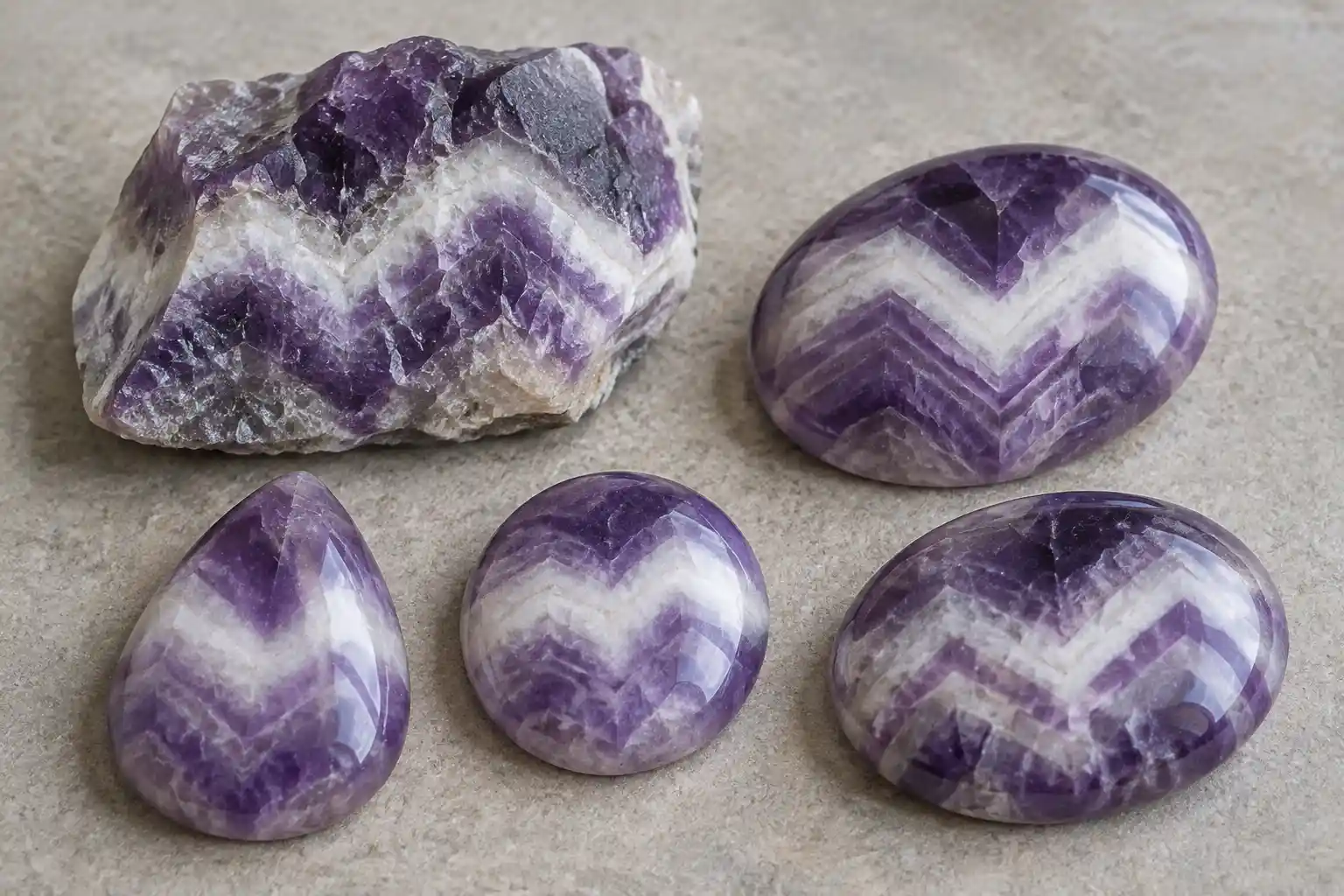
Chevron amethyst benefits begin with a striking geological pattern created by alternating purple amethyst and pale or milky quartz zones. The stone is still quartz, SiO₂, but repeated changes during crystal growth can produce angular bands, zigzags, layered points, or V-shaped patterns that distinguish it visually from more uniformly colored amethyst. Because those markings come from the internal growth of quartz rather than a painted surface design, every well-patterned piece develops an individual combination of purple color, white zones, transparency, inclusions, and band direction.
That structure gives chevron amethyst benefits in jewelry, lapidary work, collecting, mineral education, decorative carving, and gemstone identification. Quartz has a Mohs hardness of 7 and generally good toughness, so polished pieces are substantially more practical for regular handling than soft collector minerals such as calcite or celestite. The visible zoning also creates an opportunity to study how one mineral species can record changing conditions during growth without requiring a completely different chemical identity for every band.
Modern crystal traditions add chevron amethyst benefits involving focus, calmness, intuition, clarity, meditation, or emotional balance. These associations can serve as personal symbolism, but they should remain distinct from health claims. Chevron amethyst does not treat anxiety disorders, insomnia, headaches, neurological conditions, addiction, hormonal problems, or other illnesses merely because its bands are visually distinctive or because it belongs to the amethyst family.
9 Chevron Amethyst Benefits at a Glance
- Natural purple-and-white zoning gives each chevron amethyst a distinctive internal pattern.
- Quartz hardness provides useful scratch resistance for many jewelry and decorative applications.
- Alternating growth zones make the stone valuable for learning about quartz crystallization and color zoning.
- Cabochon cutting and polishing can emphasize V-shaped bands, zigzags, layered points, and contrasting quartz zones.
- Collectors can compare patterned chevron amethyst with uniformly colored amethyst and other zoned quartz.
- Jewelry designers gain a patterned purple stone that creates visual interest without relying on faceting alone.
- Identification practice teaches buyers to distinguish natural growth zoning from dye, composites, or misleading trade descriptions.
- Amethyst’s long cultural and ornamental history gives the stone historical context even though chevron-specific spiritual meanings are largely modern.
- Contemporary symbolism can represent focus, integration, or perspective when kept separate from medical claims.
Natural Purple and White Banding Creates the Most Distinctive Chevron Amethyst Benefits
Pattern is the defining feature behind many chevron amethyst benefits. Instead of displaying an evenly distributed purple body color, chevron material typically shows alternating amethyst and lighter quartz zones arranged in repeated points, bands, wedges, or zigzag structures. Some stones contain crisp white V-shaped layers against deep purple, while others show softer transitions through lavender, grayish white, clear quartz, and cloudy areas. The pattern can become especially dramatic after cutting because a polished surface reveals internal growth zones that may be difficult to appreciate on weathered rough.
These bands are not separate gemstones glued together. They are part of a quartz growth history in which color intensity, inclusions, fluid conditions, and crystal development varied through successive stages. That makes chevron amethyst benefits especially interesting for people who enjoy geological pattern rather than uniform color. A stone with strong zoning may be less desirable for traditional transparent faceted amethyst, where even color is often preferred, yet the same zoning becomes the central attraction in ornamental chevron amethyst.
The difference illustrates an important gemstone principle: a feature considered undesirable in one cutting style can become desirable in another. Chevron material succeeds precisely because the cutter preserves and emphasizes variation instead of trying to eliminate it.
Quartz Hardness Makes Chevron Amethyst Practical for Many Jewelry Styles
Durability is one of the most dependable chevron amethyst benefits because the stone shares the fundamental physical properties of quartz. With a Mohs hardness of 7 and generally good toughness, it resists ordinary scratching better than many softer ornamental stones and can be used in pendants, earrings, bracelets, beads, brooches, cabochons, and rings with sensible care.
The patterned nature of chevron amethyst also means a small surface scratch may be less visually dominant than it would be on a completely transparent faceted gem, although this is not a reason to treat the stone carelessly. Diamond, sapphire, topaz, and other harder gems can still scratch quartz, while sharp impact can chip exposed edges or damage thin carvings.
Rings deserve the most attention because hands encounter hard surfaces frequently. Protective bezels and lower-profile settings reduce risk, while pendants and earrings usually experience less mechanical stress. Separate storage also prevents harder jewelry from rubbing against polished quartz.
The general amethyst benefits associated with quartz durability, jewelry versatility, color, collecting, and lapidary use apply to chevron material as well, but the patterned variety adds a visual character that makes smooth polished surfaces particularly effective.
Chevron Amethyst Reveals How Quartz Records Changing Growth Conditions
One of the more educational chevron amethyst benefits comes from its visible zoning. Quartz crystals can record changes that occurred while they grew, and amethyst color can become stronger or weaker according to variations in iron incorporation, irradiation-related color centers, growth conditions, and later geological history.
Chevron patterns make those changes easy to see because purple and paler zones alternate instead of blending into one uniform body color. Milky areas may contain abundant microscopic inclusions or structural features that scatter light, while purple zones contain the color-producing conditions associated with amethyst.
This does not mean every white band and every purple layer formed through one identical process in every specimen. Geological environments vary, and the exact history of a piece can be more complicated than its polished surface suggests. The important lesson is that crystals can preserve changing conditions during growth.
For students and collectors, these chevron amethyst benefits make the stone useful as more than decoration. A polished slab can become a visible record of mineral growth, zoning, and the relationship between chemistry, defects, inclusions, and color.
Lapidary Cutting Can Turn Internal Zoning into the Entire Design
Chevron amethyst often rewards cabochon cutting, freeform polishing, carving, beads, spheres, and decorative objects because these shapes provide enough surface area for the internal banding to remain visible. Faceting is possible, but intricate zoning may become visually fragmented when a stone is divided into many small reflective facets.
A lapidary therefore studies the rough before cutting. Slicing perpendicular to one direction may reveal repeated V-shaped chevrons, while another orientation can produce stripes, arcs, triangles, or abstract purple-and-white patterns. A few millimeters of difference in cutting position can dramatically change the final appearance.
This makes lapidary interpretation one of the strongest chevron amethyst benefits. The geology creates the zones, but human cutting determines which part of the growth structure becomes the focal design. A cutter may sacrifice some weight to center a symmetrical chevron or preserve an irregular freeform outline because it captures a stronger pattern.
Large decorative pieces can be particularly effective because they allow several growth zones to remain visible simultaneously. A sphere or polished freeform may show patterns changing around its entire surface, creating a different effect from a flat cabochon.
Collecting Chevron Amethyst Encourages Comparison Rather Than Uniformity
Collectors can appreciate chevron amethyst benefits through variation in pattern, color saturation, transparency, crystal shape, locality, and associated minerals. Some specimens contain sharply defined white and purple layers, while others show smoky undertones, clear quartz zones, iron staining, or more diffuse lavender banding.
Rough specimens preserve natural surfaces and crystal relationships that polished pieces remove. Slabs reveal cross-sections through the zoning, while cabochons emphasize aesthetics. Keeping examples in several forms can show how the same type of quartz changes visually through cutting.
Comparison with ordinary amethyst is particularly useful. Uniformly colored transparent rough is often preferred for faceting, whereas strongly zoned chevron rough is valued precisely because the color is not uniform. The two stones share the same basic amethyst identity but satisfy different collecting and lapidary preferences.
Reliable locality information can add another dimension. Patterned amethyst occurs in more than one geological region, so a familiar chevron appearance should not automatically be treated as proof of a particular mine or country. Provenance is strongest when it comes with credible documentation rather than visual guesswork.
Chevron Amethyst Jewelry Uses Pattern Instead of Brilliance Alone
Jewelry design brings out chevron amethyst benefits in a way that differs from traditional faceted amethyst. A transparent faceted stone is usually cut to maximize color, light return, and symmetry, while chevron amethyst can succeed through pattern even when it is translucent rather than transparent.
Large oval or freeform cabochons give the bands room to remain visible. Beads create repeated flashes of purple and white as they turn, and carved pendants can use the zoning as part of the design rather than treating it as an imperfection.
White metals often reinforce the cool purple and milky tones, while yellow or rose gold creates warmer contrast. Blackened silver can make pale bands appear brighter and deeper purple zones more dramatic. The choice depends on the specific piece because chevron amethyst varies considerably in saturation.
Matching stones for earrings can be challenging. Two cabochons may have nearly identical size and color yet completely different band direction. Designers can either search for closely related patterns or intentionally use complementary rather than identical stones.
These chevron amethyst benefits make one-of-a-kind jewelry especially natural because the internal pattern already gives each piece its own composition.
Identification Matters Because Patterned Purple Quartz Can Be Misrepresented
Purple and white banding is a strong clue, but it should not replace careful identification. Dyed quartz, composite stones, glass, altered photographs, and other purple ornamental products can be marketed under attractive names.
Natural chevron amethyst should still display physical properties consistent with quartz. When value or treatment status matters, gemological examination provides stronger evidence than color alone. Photographs should also show the actual stone under several angles and lighting conditions rather than relying on oversaturated images.
Treatment deserves attention because amethyst can be heated or otherwise processed to alter color. Heat may lighten very dark amethyst or shift suitable material toward yellow or brownish colors associated with citrine-type products. Some quartz may also be dyed, especially when natural color is weak.
A person deciding where to buy chevron amethyst should therefore prioritize accurate descriptions, realistic photographs, treatment disclosure, dimensions, workmanship, and provenance when supplied. Claims about extraordinary energy, rare vibration, or supernatural power do not establish authenticity.
Historical Amethyst Traditions Do Not Automatically Become Chevron Traditions
Amethyst has a long and genuine history in jewelry, religious objects, engraved gems, royal ornament, and symbolic use, but chevron amethyst benefits should not be built by assigning every historical amethyst belief directly to patterned material.
Ancient societies certainly encountered amethyst, yet modern trade categories such as chevron amethyst or dream amethyst do not necessarily correspond with distinct ancient traditions. A historical account referring to amethyst does not prove that the writer meant purple-and-white chevron quartz specifically.
This distinction allows real cultural history to remain intact. Amethyst has accumulated associations with sobriety, status, devotion, protection, spirituality, and ornament across different periods, but those meanings varied according to place and context.
Chevron amethyst can inherit general amethyst heritage in a descriptive sense while still having modern symbolism of its own. Historical honesty creates a more substantial story than simply attaching the word ancient to every contemporary crystal interpretation.
Modern Symbolism Often Uses the Pattern as a Metaphor for Focus and Integration
Contemporary crystal traditions frequently describe chevron amethyst benefits in terms of focus, intuition, meditation, clarity, emotional balance, and integration. The repeated meeting of purple and white zones makes integration a particularly understandable modern metaphor.
Someone might associate the bands with bringing separate priorities into one workable plan or keeping several responsibilities organized around a central goal. Another person may use the alternating colors as a reminder that complex situations rarely contain only one perspective.
Focus can also be interpreted behaviorally. A chevron amethyst on a desk might symbolize finishing a defined task before switching attention elsewhere. The stone does not alter concentration biologically, but objects can serve as deliberate reminders when people assign them a specific purpose.
Beliefs surrounding chevron amethyst healing properties sometimes extend these themes into sleep, anxiety, headaches, addiction, neurological function, or energetic cleansing. Those interpretations belong to spiritual practice rather than established medical evidence.
Safe Care Preserves Both Color and Pattern
Chevron amethyst is durable enough for many uses, but proper care helps preserve its surface and purple coloration. Warm water, mild soap, and a soft brush or cloth are suitable for many stable untreated pieces. Steam cleaning is best avoided, and severe thermal shock can fracture quartz.
Prolonged exposure to intense heat can alter amethyst color, while some specimens may fade with extended exposure to very strong light. Normal wear is generally not a problem, but repeatedly leaving jewelry in intense direct sunlight for long periods is unnecessary.
Abrasive storage creates a more ordinary risk. Harder gemstones can scratch quartz, while metal components from other jewelry can damage polished edges over time. Individual pouches or lined compartments reduce that contact.
Lapidary work requires effective silica-dust control. Cutting, grinding, and drilling quartz should use wet methods, proper ventilation, eye protection, and suitable workshop precautions because respirable crystalline silica dust should not be inhaled.
These limitations do not reduce chevron amethyst benefits. They simply define how a durable quartz gemstone should be handled responsibly.
Conclusion
Chevron amethyst benefits include distinctive natural banding, quartz durability, geological education, lapidary versatility, collecting interest, jewelry potential, identification practice, genuine amethyst heritage, and meaningful modern symbolism. Its purple-and-white growth zones turn variation into the central feature rather than something a cutter must hide.
The strongest chevron amethyst benefits remain connected with what the stone demonstrably offers: quartz structure, individual pattern, craftsmanship, wearability, geological information, and visual appeal. Modern themes of focus, integration, calmness, or perspective can add personal significance when they remain symbolic rather than being presented as medical effects.
FAQs
What are the main chevron amethyst benefits?
The most verifiable chevron amethyst benefits include quartz durability, natural purple-and-white patterning, jewelry use, carving, collecting, mineral education, gemstone identification, and personal symbolism.
What is chevron amethyst?
Chevron amethyst is patterned amethyst and quartz showing alternating purple and pale or milky growth zones that can form V-shaped, zigzag, striped, or layered patterns.
Is chevron amethyst real amethyst?
Yes. The purple areas are amethyst, which is purple quartz, while the lighter zones are quartz with less visible purple coloration or more pronounced milky appearance.
How hard is chevron amethyst?
Like other quartz, chevron amethyst has a Mohs hardness of 7 and generally good toughness, making it suitable for many jewelry applications.
Is chevron amethyst good for everyday jewelry?
Many pieces can be worn regularly with reasonable care. Rings experience more impact than pendants or earrings, so protected settings are preferable for frequent wear.
Is chevron amethyst the same as dream amethyst?
Dream amethyst is a common trade name used for purple-and-white patterned or chevron amethyst. Trade terminology can vary between sellers.
Can chevron amethyst be treated?
Amethyst can be heat treated or otherwise altered commercially. Treatment disclosure matters when natural color or processing is important to the buyer.
What does chevron amethyst symbolize?
Modern symbolism often connects chevron amethyst with focus, perspective, integration, clarity, meditation, and personal reflection.
Does chevron amethyst improve sleep or anxiety?
There is no established clinical evidence that chevron amethyst treats insomnia, anxiety disorders, neurological conditions, headaches, or other medical concerns.
Chevron amethyst benefits described as healing, emotional, chakra, intuitive, sleep-related, or energetic effects remain spiritual and personal beliefs and should not replace qualified medical or mental-health care.