Where to Buy Real Chevron Amethyst and Avoid Dyed Fakes
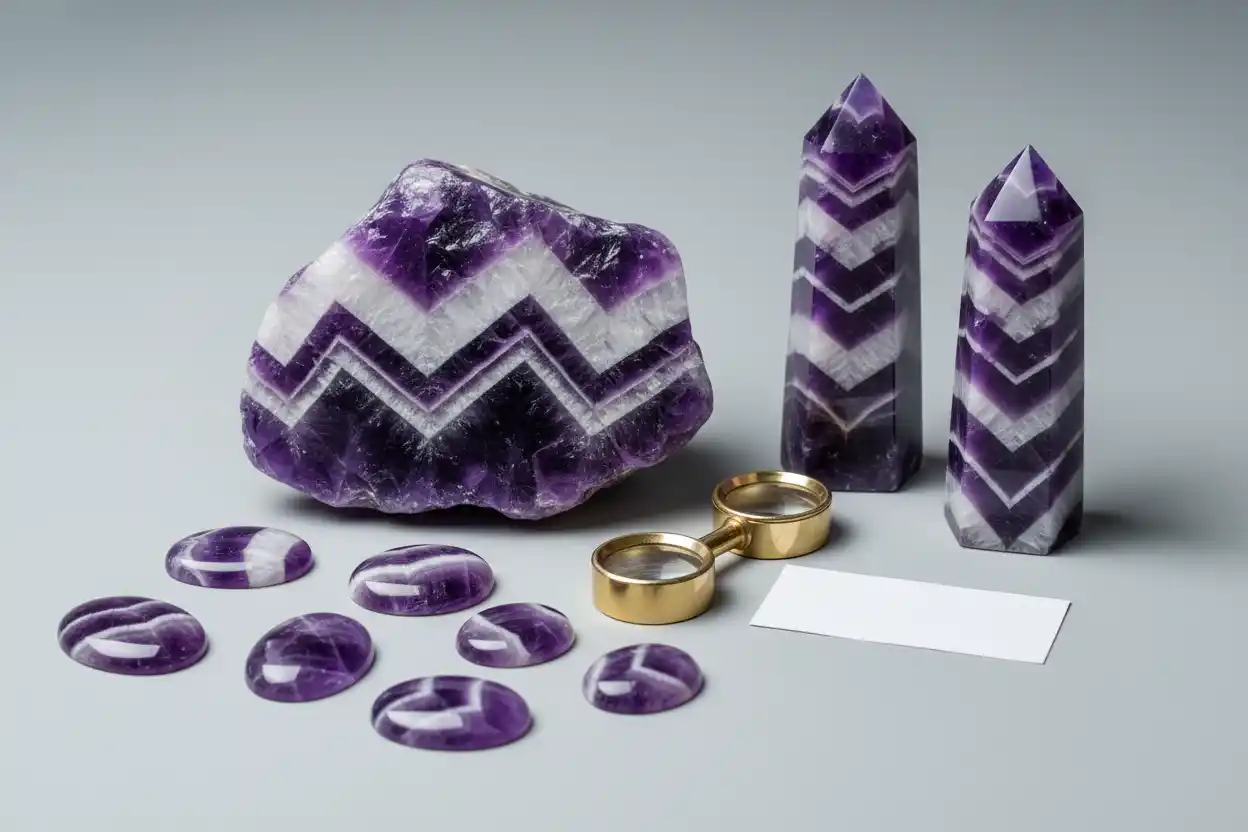
Real chevron amethyst is amethystine quartz with angular, V-shaped, zigzag, phantom-like or layered purple-and-white growth patterns. It is also sold as Dream Amethyst, a trade-name synonym that should route to the same material rather than a separate gemstone category.
The strongest examples show bands that belong to the quartz growth structure. Purple amethyst zones alternate with milky, colorless or pale quartz, creating nested points, arrowheads, chevrons or irregular geometric layers.
The material is widely available as rough, slabs, towers, spheres, carvings, cabochons, beads and jewelry. Most buying problems involve dye, glass, resin, reconstructed pieces, artificial coatings, inaccurate “Dream Amethyst” claims or ordinary purple-and-white stone that lacks a credible quartz structure.
The chevron amethyst meaning and properties guide covers the variety’s identity and traditional symbolism. This page remains focused on sellers, pattern quality, treatments, imitation risks and choosing a piece whose bands continue naturally through the material.
Dream Amethyst Is a Trade-Name Synonym
The workbook’s canonical boundary treats Dream Amethyst as an alternate commercial name for Chevron Amethyst. It does not need a competing meaning or buying page.
Some sellers use Dream Amethyst for polished towers with especially bold white zigzags, while others apply the name to nearly any banded amethyst. That usage is commercial rather than mineralogical.
A listing should therefore identify the product as Chevron Amethyst or banded amethyst and mention Dream Amethyst as an alternate name. It should not imply that Dream Amethyst has a different chemical composition or scientifically proven energetic strength.
The parent amethyst guide covers the purple quartz variety, while the quartz family guide provides the broader mineral context.
How Chevron Amethyst Differs from Ordinary Amethyst
Ordinary gem-quality amethyst is often evaluated for even face-up purple color, transparency, clarity and cutting. Visible color zoning can reduce the value of a conventional faceted gem.
Chevron Amethyst uses zoning and alternating quartz growth as its defining decorative feature. White bands, pale phantom layers and angular purple changes are not defects when they create the intended pattern.
The material is generally opaque to translucent and is more often carved or polished than faceted for brilliance. A faceted transparent amethyst and a Chevron Amethyst tower therefore belong to different quality markets.
The types of amethyst guide explains how Chevron Amethyst fits among color, locality and growth-pattern varieties.
Choose the Product Form Before Shopping
| Product form | Best buying source | Main buying concern |
|---|---|---|
| Natural rough | Mineral dealer or lapidary supplier | Pattern depth, fractures, dye and misleading wet photographs |
| Slab | Lapidary supplier | Band continuity, cutting yield and resin stabilization |
| Tower or point | Experienced crystal retailer | Carved versus natural termination, repaired tips and weak reverse pattern |
| Sphere | Lapidary retailer | Hidden plain areas, filled fractures and surface coating |
| Cabochon | Gem dealer or independent lapidary | Pattern placement, backing and polish |
| Beads | Established bead supplier | Dyed quartz, glass and drill-hole fractures |
| Carving | Skilled stone seller | Resin, assembled sections and fragile projections |
| Jewelry | Jeweler with treatment disclosure | Glue, backing and band visibility |
| Natural crystal specimen | Mineral dealer | Genuine growth form, repairs and locality |
| Decorative cluster | Mineral dealer or specialist retailer | Glued points and artificial assembly |
A carved Chevron Amethyst point can be completely genuine material. The seller simply needs to state that the shape was cut rather than naturally terminated.
Where to Buy Genuine Chevron Amethyst
Specialist mineral dealers
A mineral dealer is the strongest source for natural crystal specimens, vein material and locality-labeled rough.
Listings should distinguish a naturally terminated amethyst crystal with internal chevrons from a polished tower cut from massive banded material. Both products can be authentic, but their value factors differ.
Ask whether any crystal was reattached, whether matrix was repaired and whether the locality comes from an original label or wholesaler assumption.
Lapidary suppliers
Lapidary sellers are the best source for rough and slabs. Good sellers show dry sawn faces, edges and sample cabochons from the same parcel.
Ask whether the chevron pattern continues deeply enough to survive cutting. A striking pattern confined to one thin face may disappear after reshaping.
Water or oil can deepen the purple and conceal fine scratches. Request a dry comparison before purchasing.
Gem and mineral shows
Shows let you compare natural banded quartz with dyed crackle quartz, purple fluorite, glass and resin.
Hold the piece over white paper and rotate it under one focused light. Genuine bands should remain within the quartz and continue around edges where the growth structure is exposed.
Use a loupe to inspect fractures, dye concentrations, polishing pits and adhesive. Do not scratch the stone or use solvents.
Established online stores
An online seller should show the exact tower, sphere, cabochon or carving. Chevron patterns vary too widely for one exceptional stock image to represent a random item.
The online gemstone buying guide explains seller identity, payment protection and return terms.
Request a full rotation under neutral light. Many towers show a dramatic front face but largely white or weakly patterned sides.
Independent makers
A jewelry maker or lapidary who cut the stone can explain how the pattern was oriented and whether resin or backing was used.
For a custom pendant, ask to see the loose cabochon before setting. A closed back may deepen purple color or hide fractures.
What Real Chevron Amethyst Looks Like
Genuine material can range from pale lavender and white to deep purple, gray-purple and milky quartz. The pattern may form sharp Vs, broad zigzags, nested triangular phantoms, irregular wedges or alternating clouds.
Not every piece has perfect repeated chevrons. Natural growth can produce broken, offset or asymmetrical bands.
The white component should appear as quartz growth, not as paint sitting on the surface. Bands commonly continue around the sides and into the interior.
Translucency varies. Thin purple zones may transmit light, while milky bands scatter it strongly. Dark pieces can look nearly opaque until backlit.
Under magnification, natural quartz may show veils, small mineral inclusions, healed fractures and growth zoning. Uniform craft glitter, round bubbles and mold seams point toward manufactured material.
Chevron Amethyst Versus Regular Amethyst
The general amethyst buying guide focuses on conventional amethyst color, clarity, cut and market quality.
Chevron Amethyst should not be judged by a requirement for perfectly even purple color. Its white and pale growth zones are the primary decorative feature.
However, purple saturation still matters. A stone with strong but natural contrast can be more visually desirable than material dominated by chalky white quartz.
The amethyst price guide provides wider value context. Chevron material should be priced according to pattern, size, cutting and condition rather than applying fine faceted-amethyst per-carat logic.
Chevron Amethyst Versus Clear or Milky Quartz
Chevron Amethyst includes amethyst and paler quartz growth, but a mostly white quartz object with one faint purple stain should not receive a strong Chevron Amethyst premium.
The clear quartz guide explains colorless quartz, while the types of clear quartz guide covers growth forms and commercial varieties.
The future guide to buying real clear quartz will address glass, synthetic quartz and treated colorless material without duplicating the chevron-pattern market.
Chevron Amethyst Versus Purple Fluorite
Purple fluorite can show angular color zoning, white layers or banded polished patterns. Its cubic crystal system and cleavage differ from quartz, but those distinctions may be hidden in a carving.
The planned fluorite-versus-amethyst guide owns the detailed comparison.
Fluorite is softer and more cleavable than amethyst. Nevertheless, do not perform a scratch test. A gemologist can use refractive index, specific gravity and spectroscopy.
Chevron Amethyst Versus Charoite
Charoite is a fibrous purple silicate material, not quartz. It commonly shows flowing swirls, feathers and silky movement rather than geometric purple-and-white quartz growth.
The planned amethyst-versus-charoite guide keeps that identification intent separate.
A Chevron Amethyst tower should show quartz-like polish and internal bands. A charoite carving may contain black aegirine and fibrous purple texture instead.
Dyed Quartz
Pale quartz, milky quartz and crackled quartz can be dyed purple. Color may concentrate in fractures, pits, drill holes and more porous zones.
Dyed crackle quartz often displays an intense spiderweb of purple lines. Natural Chevron Amethyst has growth-related bands rather than a random network of color-filled fractures.
Lower-quality pale amethyst and colorless quartz can also receive purple dye. Therefore, natural quartz identity does not prove natural amethyst color.
The real-versus-fake amethyst guide owns the wider identification process, while the treated-amethyst guide covers dye, heat and synthetic material.
Heat Treatment
Heating can lighten very dark amethyst, reduce some brownish components or transform certain amethyst into yellow to orange quartz marketed as citrine.
For Chevron Amethyst, excessive heat could alter the purple zones and reduce the intended contrast. Most buyers therefore expect the purple-and-white pattern to remain in its amethyst form.
A seller should disclose heat treatment when known. However, laboratory confirmation of every heat history may not be possible, particularly for inexpensive carvings.
Synthetic Amethyst and Synthetic Quartz
Laboratory-grown quartz can be produced with amethyst color. Synthetic material is more relevant to transparent faceted amethyst than to inexpensive massive Chevron Amethyst, but it remains technically possible to create patterned or assembled products using synthetic quartz.
Natural and synthetic amethyst can be difficult to separate with basic home observations. Microscopic growth features and high-resolution infrared spectroscopy may be needed.
The lab-grown-versus-natural gemstone guide explains why laboratory-grown material is not the same as an imitation. It becomes deceptive only when sold as natural.
Glass and Resin Imitations
Purple-and-white glass can be swirled, layered or molded to imitate banded quartz. Round bubbles, flow lines, mold seams and an excessively glassy uniform body may provide clues.
Resin can reproduce chevrons using colored layers or printed inserts. Bubbles, soft scratches, casting marks and repeated patterns support manufactured construction.
Some decorative objects contain real quartz fragments embedded in resin. They should be sold as composites rather than solid Chevron Amethyst.
Glued and Reconstructed Products
Broken towers and carvings may be repaired with adhesive. Clear resin can also fill open fractures and stabilize points.
A natural crystal cluster can be assembled from separate quartz points. The individual crystals may be genuine, but the cluster did not grow in its current arrangement.
Inspect bases, tip repairs and abrupt pattern discontinuities. A band that fails to cross a glossy join may reveal reconstruction.
Repairs are acceptable when fully disclosed and reflected in the price.
How to Evaluate Rough
Ask for a sawn face that shows the interior pattern. A weathered rind may conceal attractive chevrons, while a selectively polished window may exaggerate the quality of the whole block.
Inspect the edges to determine whether purple and white layers continue through the rough.
Fractures can either follow the quartz growth or cut across it. Large open cracks reduce usable yield and may require resin.
Ask whether the seller has cut towers or cabochons from the same parcel. Their pattern and polish offer practical evidence about the rough.
How to Evaluate Slabs
A good slab displays chevrons across enough surface to support intentional cutting. One small V-shaped zone in a largely plain slab offers limited value.
Compare both faces. A pattern that changes gradually through the slab is more plausible than a design visible only on one coated surface.
Backlighting can reveal translucency and hidden fractures, but the slab should also look attractive under ordinary reflected light.
Ask about impregnation or filling before purchase.
How to Judge Towers and Points
Most retail Chevron Amethyst towers are carved. A natural crystal point should preserve quartz prism faces and a natural termination rather than machine-flat facets.
A carved tower should have a level base, sound tip and pattern that remains attractive across several sides. The point should not cross a major fracture.
Check for glue around the tip or base. A polished join can be difficult to see in photographs, so request a rotating close-up.
A large white area is not automatically a defect, but the amount of visible amethyst should match the product description.
Buying Spheres
A sphere requires a complete rotation video. The pattern may be concentrated on one hemisphere.
Look for flat spots, deep scratches, filled fractures and a thick coating. Quartz accepts a strong polish, so extensive waviness usually reflects poor cutting or mixed filler.
A centered nested chevron can be especially attractive, although asymmetrical patterns may create more natural visual movement.
Buying Cabochons
A skilled cutter should position the strongest V-shaped or phantom pattern face-up. The girdle needs a clean, stable edge for setting.
Inspect the back for dye, resin or dark backing. A white backing can brighten pale purple zones, while a dark backing can deepen contrast.
Cabochons with thin white fractures may remain wearable when stable, but open cracks reaching the surface should affect value.
Buying Beads and Bracelets
Round beads rarely show perfect chevrons because the original pattern is divided and rotated during cutting. Expect stripes, wedges, patches and partial Vs.
Natural strands should show coordinated purple-and-white material without identical patterns. Perfect repetition can suggest glass or resin.
Inspect drill holes for dye concentration and radial fractures. The amethyst bracelet guide covers strand sizing and wear without replacing this authenticity discussion.
Buying Pendants, Necklaces and Earrings
Chevron patterns often work well in pendants because a broad cabochon or polished slice can show the full geometry. The amethyst necklace guide covers chain length and setting proportions.
For earrings, match overall purple tone and pattern density rather than demanding identical chevrons. The amethyst earrings guide addresses style and pair balance.
Closed settings should be disclosed. Ask whether glue or backing affects the face-up color.
Buying Rings
Quartz has good everyday durability, but existing fractures and pointed corners remain vulnerable.
The amethyst ring guide covers setting design. A low bezel around a cabochon is generally safer than a tall exposed point.
The gemstone hardness chart places amethyst at Mohs 7. The gemstone toughness-versus-hardness guide explains why a fractured quartz carving can still break despite its scratch resistance.
Locality and Provenance
Chevron-patterned amethyst has been reported from several quartz-producing regions, and commercial material is often associated with countries such as Zambia, Brazil and others.
However, pattern alone cannot establish geographic origin. One locality may produce several appearances, while similar growth structures can occur in different regions.
A premium country or mine claim should come from labels, supplier records or direct sourcing. Be cautious when a retailer invents spiritual quality tiers based on locality without mineralogical evidence.
Price and Value
Chevron Amethyst is generally valued as a decorative quartz variety rather than as fine transparent faceting material.
Important value factors include:
- Purple saturation
- Contrast between purple and pale quartz
- Sharpness and continuity of chevrons
- Pattern placement
- Size and usable yield
- Structural condition
- Cut and polish
- Natural crystal form, when present
- Treatment and repair
- Locality documentation
- Carving skill
A large tower is not automatically better. A smaller piece with a centered, continuous chevron can be more desirable than a heavy object dominated by white quartz.
The seller should not apply fine faceted-amethyst grading language mechanically to opaque patterned material.
Questions to Ask the Seller
Ask whether the product is natural Chevron Amethyst, dyed quartz, synthetic quartz, glass or composite material.
Determine whether Dream Amethyst is being used as an alternate name or presented as a separate species. Request treatment disclosure covering heat, dye, coating, resin, backing and repair.
For rough, ask for dry sawn-face and edge photographs. For towers and spheres, request a complete rotation. For beads, request drill-hole close-ups.
If the shape resembles a crystal point, ask whether it is naturally terminated or carved. Finally, obtain a return policy that allows inspection under neutral light.
Professional Identification
A gemologist can confirm quartz using refractive index, specific gravity, optic character and Raman spectroscopy.
Microscopy can reveal dye-filled fractures, glass bubbles, resin, coating and natural or synthetic growth features. High-resolution infrared spectroscopy can assist in separating natural from synthetic amethyst when ordinary inclusions are inconclusive.
Testing one white area may confirm quartz without proving that the purple color is natural. Treatment assessment must examine the relevant colored zones.
Care and Storage
Sound untreated Chevron Amethyst can generally be cleaned with warm water, mild soap and a soft cloth. The completed guide to cleaning amethyst jewelry provides setting-specific instructions.
Avoid steam, abrupt temperature change and high heat. Some amethyst can fade after prolonged exposure to intense light, so do not place a prized piece indefinitely in a hot, sunlit display window.
The planned sunlight-fading guide provides broader display guidance. For traditional practices, the completed amethyst cleansing and charging guide offers non-destructive options.
Store polished pieces away from diamonds, sapphires and other harder gems. Protect tower tips and sphere surfaces from impact.
The February birthstone guide provides broader cultural context, while the C crystal directory, C gemstone directory and visual gemstone guide support wider comparison.
Frequently Asked Questions
1. Is Dream Amethyst the same as Chevron Amethyst?
Yes. Dream Amethyst is a commercial synonym for Chevron Amethyst rather than a separate mineral species.
2. What creates the white chevrons?
They are pale, milky or colorless quartz growth zones alternating with purple amethyst zones.
3. Does every genuine piece have perfect V-shaped bands?
No. Natural patterns can be offset, incomplete, broad, irregular or phantom-like.
4. Are Chevron Amethyst towers naturally pointed?
Most retail towers are carved and polished from massive material. Natural crystal points should retain genuine quartz growth faces and terminations.
5. Can Chevron Amethyst be dyed?
Yes. Pale quartz or crackled quartz can be dyed purple. Color concentrated in fractures and drill holes is a warning sign.
6. Is Chevron Amethyst commonly heat-treated?
Heat treatment is possible in amethyst, although the intended purple pattern could be lightened or changed. Sellers should disclose known treatment.
7. Can synthetic quartz imitate Chevron Amethyst?
Yes, in principle. Synthetic amethyst and assembled quartz products exist, although dyed natural quartz, glass and resin are more common concerns in inexpensive patterned objects.
8. Is Chevron Amethyst the same as purple fluorite?
No. Chevron Amethyst is quartz, while fluorite is a softer mineral with different crystal structure and cleavage.
9. Is strong white banding a defect?
No. White quartz bands define the variety. Value depends on how attractively they contrast with the purple zones.
10. Is Chevron Amethyst suitable for everyday jewelry?
Sound quartz is reasonably durable. Fractures, carved points and high settings need more care than solid cabochons.
11. Do ordinary towers need laboratory certificates?
Usually not. Exact photographs, treatment disclosure and return rights are more practical for ordinary decorative pieces.
12. What is the biggest warning sign in a listing?
Be cautious when a perfectly patterned electric-purple tower has no side views, no treatment information and a seller who presents Dream Amethyst as a scientifically separate crystal.
Buy a Pattern That Continues Through the Quartz
A genuine Chevron Amethyst piece should remain coherent when viewed from its front, sides, edges and back. Its purple-and-white geometry should belong to the stone rather than to dye, print or resin.
Choose a seller who distinguishes natural growth from carved shape, explains treatment and shows the exact object under neutral light. The strongest purchase is not the most symmetrical chevron; it is the one whose pattern and construction remain believable from every direction.
Safety note: Chevron Amethyst is quartz and can generate hazardous respirable crystalline-silica dust during cutting, drilling, sanding or grinding. Do not dry-work the material. Lapidary processing requires wet methods, effective local extraction and suitable respiratory and eye protection.