9 Real Dalmatian Jasper Benefits: Deep Uses, Verified Facts & Safe Limits
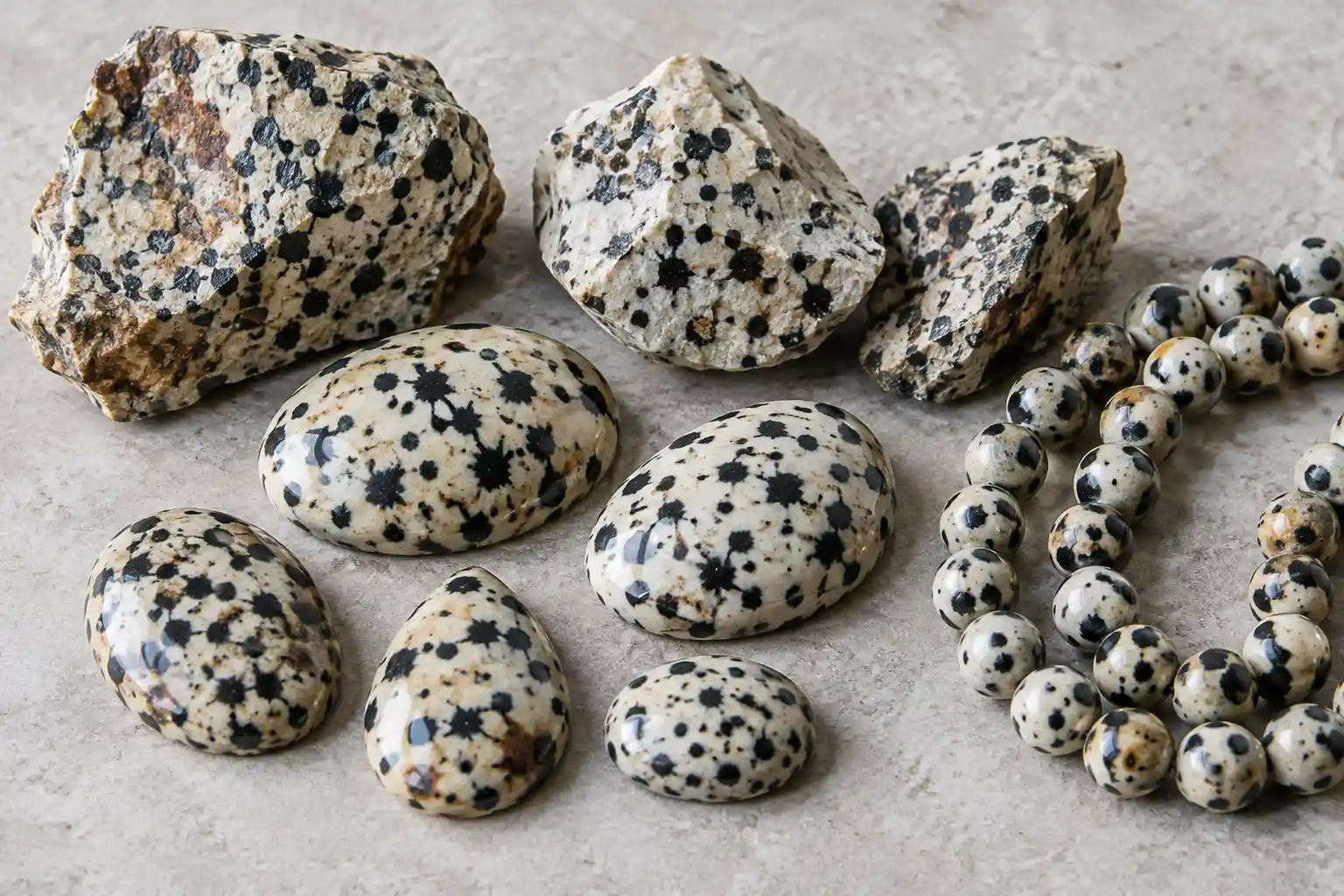
Dalmatian Jasper benefits begin with its instantly recognizable spotted appearance, good polish, usefulness in beads and cabochons, geological interest, and ability to create jewelry that looks very different from uniformly colored gemstones. Despite the familiar trade name, Dalmatian Jasper is not a classic jasper in the strict mineralogical sense. Commercial Dalmatian stone is generally a pale feldspar- and silica-rich rock containing contrasting dark mineral spots, so its composition and texture differ from the dense microcrystalline quartz normally associated with true jasper.
That distinction makes accurate identification one of the most important Dalmatian Jasper benefits. The pale background commonly ranges from cream and beige to light gray or tan, while the dark spots may appear black, brown, or nearly charcoal. The contrasting pattern resembles the coat of a Dalmatian dog, which explains the commercial name. Mineral composition can vary within the rock, and dark spots should not automatically be described as black tourmaline without analytical evidence. Some material contains dark amphibole- or pyroxene-group components rather than tourmaline, illustrating why trade descriptions and mineral identification should remain separate.
Modern crystal traditions add Dalmatian Jasper benefits involving playfulness, grounding, loyalty, protection, emotional balance, and companionship. Those themes can work as personal symbolism, but they are not established medical effects. Dalmatian Jasper does not treat anxiety disorders, depression, pain, neurological problems, blood conditions, or other illnesses through ordinary wearing or handling.
9 Dalmatian Jasper Benefits at a Glance
- Cream-and-black spotting gives Dalmatian Jasper an immediately recognizable decorative appearance.
- Dense workable rough can be polished into beads, cabochons, carvings, palm stones, and ornamental objects.
- Random spot distribution makes individual polished pieces naturally different from one another.
- The misleading jasper trade name provides a useful lesson in the difference between commercial terminology and mineral classification.
- Collectors can study the relationship between pale host rock and contrasting dark mineral inclusions.
- Jewelry designers gain a neutral patterned stone that works with many metals, colors, and casual styles.
- Identification practice encourages buyers to question unsupported claims about black tourmaline and exact composition.
- Lapidary cutting can emphasize different spot densities and pattern arrangements within the same rough.
- Modern symbolism can represent individuality, companionship, or adaptability when kept separate from health claims.
Spotted Patterning Creates the Most Distinctive Dalmatian Jasper Benefit
Visual identity is one of the strongest Dalmatian Jasper benefits because the stone does not need transparency, faceting, or intense color to stand out. Its appeal comes from contrast. Dark spots are scattered irregularly through a pale cream, beige, grayish, or light brown background, creating an appearance that can range from densely speckled to relatively open and minimalist.
The irregularity is important. A polished cabochon may contain one large dark inclusion surrounded by open pale areas, while another cut from nearby rough may contain dozens of smaller spots. Beads can alternate between heavily spotted and almost plain surfaces as they rotate, creating movement without relying on optical phenomena such as chatoyancy or labradorescence.
These Dalmatian Jasper benefits make the stone especially effective in jewelry where pattern is more important than brilliance. A simple polished oval can already have enough visual complexity to function as the central design, and even inexpensive beads can look distinctive because no two surfaces are arranged exactly alike.
The natural variation also means buyers should evaluate the actual piece rather than expecting every Dalmatian Jasper stone to reproduce one ideal commercial photograph.
Lapidary Work Turns Ordinary-Looking Rough into Distinctive Jewelry
Polishing often transforms Dalmatian stone dramatically. Rough surfaces may look dry, pale, and relatively plain, but grinding and polishing can sharpen the contrast between the background and dark inclusions while producing a smoother, more saturated appearance. This makes lapidary use one of the most practical Dalmatian Jasper benefits.
Cabochons allow cutters to select an interesting balance between pale background and darker inclusions. Freeforms are equally useful when the most attractive pattern does not fit within a calibrated oval or rectangle. Beads, spheres, worry stones, carvings, and decorative pieces can make good use of the random spotting because repetition never becomes perfectly uniform.
The mixed composition also means cutters should pay attention to differences between the pale host and darker inclusions. Separate mineral components can respond slightly differently to grinding and polishing, particularly when grain size or hardness varies across the stone. Careful finishing therefore matters more than the trade name suggests.
Good lapidary work reveals the stone rather than disguising it. The pattern already exists naturally, while orientation and shaping determine which part of that pattern becomes the finished design.
Dalmatian Jasper Is Useful for Learning Why Trade Names Can Be Misleading
One of the most educational Dalmatian Jasper benefits comes from its name. Jasper normally refers to an opaque, microcrystalline silica-rich gemstone within the chalcedony family. Dalmatian stone, however, is generally described as a feldspar-rich igneous or altered rock containing several mineral components rather than conventional jasper.
This difference provides an excellent introduction to commercial gemstone terminology. Trade names are often created because they are memorable, visually descriptive, or easy to market, not because they represent precise mineralogical classification.
Understanding that principle helps buyers across the gemstone market. A product name may describe appearance, locality, pattern, tradition, or commercial convention without identifying one scientifically defined mineral species.
Dalmatian Jasper therefore remains a perfectly usable trade name as long as it is not treated as proof that the stone has the same composition as every geological jasper. Clear terminology adds value because it allows the decorative identity and the geological identity to coexist without confusing them.
Dark Spots Make Mineral Identification More Interesting Than the Name Suggests
The black spotting is often explained online as black tourmaline, but that statement should not be repeated automatically. Dalmatian stone can contain several dark mineral components, and the exact identity of a spot cannot be determined reliably merely because it looks black.
This uncertainty creates useful Dalmatian Jasper benefits for collectors interested in mineral identification. Color alone is rarely sufficient. Grain shape, luster, hardness, cleavage, optical properties, chemical composition, and analytical testing may all matter when the mineral identity of individual inclusions becomes important.
The pale portion deserves the same caution. Commercial descriptions sometimes reduce the rock to a single mineral even though the host can contain feldspar and silica-rich components in varying proportions.
These complexities make Dalmatian stone an interesting example of why a rock can be more difficult to describe than a single crystal species. A quartz point may be primarily one mineral, while a spotted ornamental rock can combine several minerals whose proportions and textures vary.
For anyone learning gemology or geology, that complexity is a genuine benefit rather than a problem.
Collecting Dalmatian Jasper Rewards Pattern Rather Than Rarity Alone
Dalmatian Jasper benefits collectors through pattern diversity, polished form, rough texture, and comparison between specimens. Some people prefer stones with large isolated black spots, while others favor dense fine speckling or pieces containing warmer brown tones mixed with black.
Rough and polished examples are particularly useful together. The rough piece demonstrates grain, fracture, natural exterior, and unpolished color, while the finished cabochon shows how cutting changes contrast and surface appearance. Comparing them can teach more than owning several nearly identical polished beads.
Provenance also adds value when it is reliable. Dalmatian stone is widely associated in the trade with Mexico, and documented source information is more useful than assuming locality solely from appearance.
A person considering where to buy Dalmatian Jasper should therefore pay attention to actual photographs, dimensions, treatment disclosure, realistic color, workmanship, and seller accuracy rather than exaggerated claims about rarity or supposed tourmaline content.
Jewelry Designers Gain a Neutral Pattern That Works with Many Styles
Dalmatian Jasper benefits jewelry design because cream, beige, black, and brown are unusually flexible colors. The stone can work with silver, gold, copper, brass, leather, wood, and darker gemstones without creating the color-matching challenges presented by intensely saturated transparent gems.
Minimalist designs can use one spotted cabochon as a focal point, while bohemian or casual jewelry may combine multiple beads with slightly different patterns. Blackened metal can reinforce the dark inclusions, while yellow or rose-colored metals warm the pale background. Designers can also combine Dalmatian stone with onyx, smoky quartz, clear quartz, or neutral chalcedony when they want texture without strong competing colors.
Matching pairs rarely need to be identical. Earrings can use stones with similar spot density while allowing natural variation, which often looks more intentional than searching for exact duplicates.
These jewelry-focused Dalmatian Jasper benefits come from pattern, polish, and versatility rather than from rarity or optical brilliance.
Individuality Is a Natural Modern Symbolic Theme
Modern crystal culture frequently connects Dalmatian Jasper benefits with playfulness, loyalty, companionship, grounding, protection, and reconnecting with a lighter side of life. The spotted pattern makes individuality an especially understandable symbolic theme because every polished piece develops a different arrangement.
Someone may associate the stone with accepting personal differences rather than trying to reproduce another person’s path. Another owner may connect it with friendship because the spotted appearance reminds them of the Dalmatian dog from which the trade name derives.
These meanings can remain personal without being turned into health claims. The stone does not biologically increase happiness, cure loneliness, treat depression, or change personality.
Beliefs surrounding Dalmatian Jasper healing properties sometimes extend symbolism into anxiety relief, circulation, nerve function, pain, or energetic protection. Such ideas belong to spiritual practice rather than established clinical evidence.
Responsible Care Depends on the Actual Rock Rather Than the Trade Name
Because Dalmatian stone is a rock containing several mineral components, its hardness and response to wear may not be perfectly uniform across every piece. Polished jewelry is generally durable enough for normal use, but hard impacts, abrasive storage, and harsh chemicals should still be avoided.
Lukewarm water, mild soap, and a soft cloth are appropriate for many stable pieces, followed by careful drying. Aggressive ultrasonic cleaning or strong chemicals are unnecessary when the stone’s exact composition, treatment history, or structural stability is unknown.
Separate storage protects polished surfaces from harder gemstones, while rings should be removed during heavy manual work. Pendants, earrings, and beads generally experience less direct impact and can be easier to maintain over long periods.
Lapidary work also requires dust control. Because the rock can contain silica-bearing components, cutting and grinding should use wet methods, ventilation, eye protection, and suitable respiratory precautions rather than generating uncontrolled dry dust.
Safe Limits Keep Dalmatian Jasper Benefits Grounded in Evidence
Spotted appearance and commercial popularity have encouraged numerous metaphysical claims, but there is no established evidence that Dalmatian Jasper changes circulation, treats depression, regulates nerves, relieves chronic pain, protects against electromagnetic exposure, or removes harmful energy from the body.
Its dark inclusions also should not be described as medically beneficial because of assumed mineral identity. Even when a particular component can be identified, having an element inside a rock does not make wearing that rock a nutritional or therapeutic treatment.
Personal rituals can still have symbolic importance. Someone may carry a polished stone because it represents humor during stressful situations or wear a bracelet associated with a friendship. The meaning comes from the person’s relationship with the object.
The real Dalmatian Jasper benefits are already substantial through distinctive appearance, lapidary use, jewelry versatility, collecting, mineral identification, geological education, and personal symbolism.
Conclusion
Dalmatian Jasper benefits include distinctive spotted patterning, lapidary versatility, jewelry use, collecting interest, geological education, gemstone identification, design flexibility, and meaningful modern symbolism. Its misleading trade name also provides a particularly useful lesson in why commercial terminology and mineral classification should not automatically be treated as identical.
The strongest Dalmatian Jasper benefits come from appreciating the stone as the patterned rock it actually is, evaluating its natural variation honestly, and avoiding unsupported assumptions about every dark spot or health effect. Its individuality and visual contrast already provide enough interest without exaggerated geological or healing claims.
FAQs
What are the main Dalmatian Jasper benefits?
The most verifiable Dalmatian Jasper benefits include decorative patterning, lapidary use, jewelry, collecting, geological education, mineral identification, design versatility, and personal symbolism.
Is Dalmatian Jasper real jasper?
The commercial name is established, but Dalmatian stone is generally not a conventional microcrystalline-quartz jasper in the strict mineralogical sense. It is better understood as a spotted multi-mineral rock.
What causes the black spots in Dalmatian Jasper?
Dark mineral inclusions create the characteristic spots. They should not automatically be identified as black tourmaline without testing because different dark minerals can occur within the rock.
Where does Dalmatian Jasper come from?
Commercial Dalmatian stone is strongly associated with Mexico. Reliable provenance is preferable to assuming exact origin solely from appearance.
Is Dalmatian Jasper suitable for jewelry?
Yes. Polished material is widely used for beads, cabochons, pendants, earrings, bracelets, rings, and decorative pieces, although care should reflect the mixed mineral composition.
Why is Dalmatian Jasper named after a dog?
The pale background covered with dark spots resembles the familiar coat pattern of a Dalmatian dog, which inspired the commercial name.
What does Dalmatian Jasper symbolize?
Modern symbolism commonly connects it with individuality, playfulness, companionship, loyalty, adaptability, and grounding.
Is the black part of Dalmatian Jasper tourmaline?
Not necessarily. This claim is repeated frequently in the crystal trade, but black appearance alone cannot establish tourmaline identity.
Does Dalmatian Jasper have healing benefits?
There is no established clinical evidence that Dalmatian Jasper treats anxiety, depression, nerve disorders, circulation problems, pain, or other medical conditions.
Dalmatian Jasper benefits described as healing, grounding, emotional, protective, chakra, or energetic effects remain spiritual and personal beliefs and should not replace qualified medical or mental-health care.