11 Dalmatian Jasper Healing Properties: Wellness Claims, Verified Facts & Safe Use
Dalmatian jasper healing properties are commonly framed around grounding, emotional stability, playfulness, confidence, motivation, loyalty, protection, focus, social connection, resilience, and relaxation. The cream-colored stone with dark scattered spots is visually distinctive, and modern crystal culture often uses those markings as symbols of balance between light and shadow or seriousness and play. These associations can support personal rituals, but Dalmatian jasper has not been demonstrated to treat anxiety, depression, pain, fatigue, insomnia, hormonal problems, immune conditions, or other diseases, and there is no established biological mechanism through which carrying it changes health. Its verified geological identity is especially important because “Dalmatian jasper” is a commercial misnomer: detailed gemological research shows that Dalmatian stone is not true jasper, but a peralkaline igneous rock composed mainly of feldspar and quartz with dark alkali-amphibole spots, particularly arfvedsonite, plus lesser hematite and epidote.
11 Dalmatian Jasper Healing Properties Commonly Claimed in Crystal Practice
- Grounding and stability
- Joy and playful thinking
- Emotional balance
- Confidence and self-trust
- Motivation and follow-through
- Loyalty and relationship awareness
- Protection and personal boundaries
- Focus and practical thinking
- Social connection and communication
- Resilience through change
- Relaxation and mental release
The eleven themes above work better as symbolic or behavioral categories than as literal healing effects. The dalmatian jasper benefits people describe can often be reframed into concrete routines such as setting boundaries, planning a task, preparing for a conversation, noticing enjoyable moments, or using sensory attention to interrupt rumination.
What Dalmatian Jasper Really Is: A Spotted Igneous Rock, Not True Jasper
The name Dalmatian jasper is deeply established in the retail crystal market, but mineralogical research has shown that “Dalmatian stone” is the more accurate term. True jasper is generally a silica-rich, opaque microcrystalline gemstone or rock, whereas studied Dalmatian stone is a peralkaline igneous rock with a very different mineral assemblage. It consists predominantly of feldspars, particularly mesoperthitic feldspar, together with quartz and alkali amphiboles. The characteristic dark spots have been identified as arfvedsonite, an iron-rich sodium amphibole. Lesser hematite and epidote can also occur.
This distinction means Dalmatian stone has no single chemical formula or single crystal system. It is a rock made from several minerals rather than one mineral species. Quartz contributes SiO₂ and trigonal crystallography; feldspars have their own aluminosilicate compositions and crystallographic structures; arfvedsonite is a complex sodium-rich amphibole with different physical properties again. Describing the entire stone as if it were one uniform mineral therefore oversimplifies its actual geology.
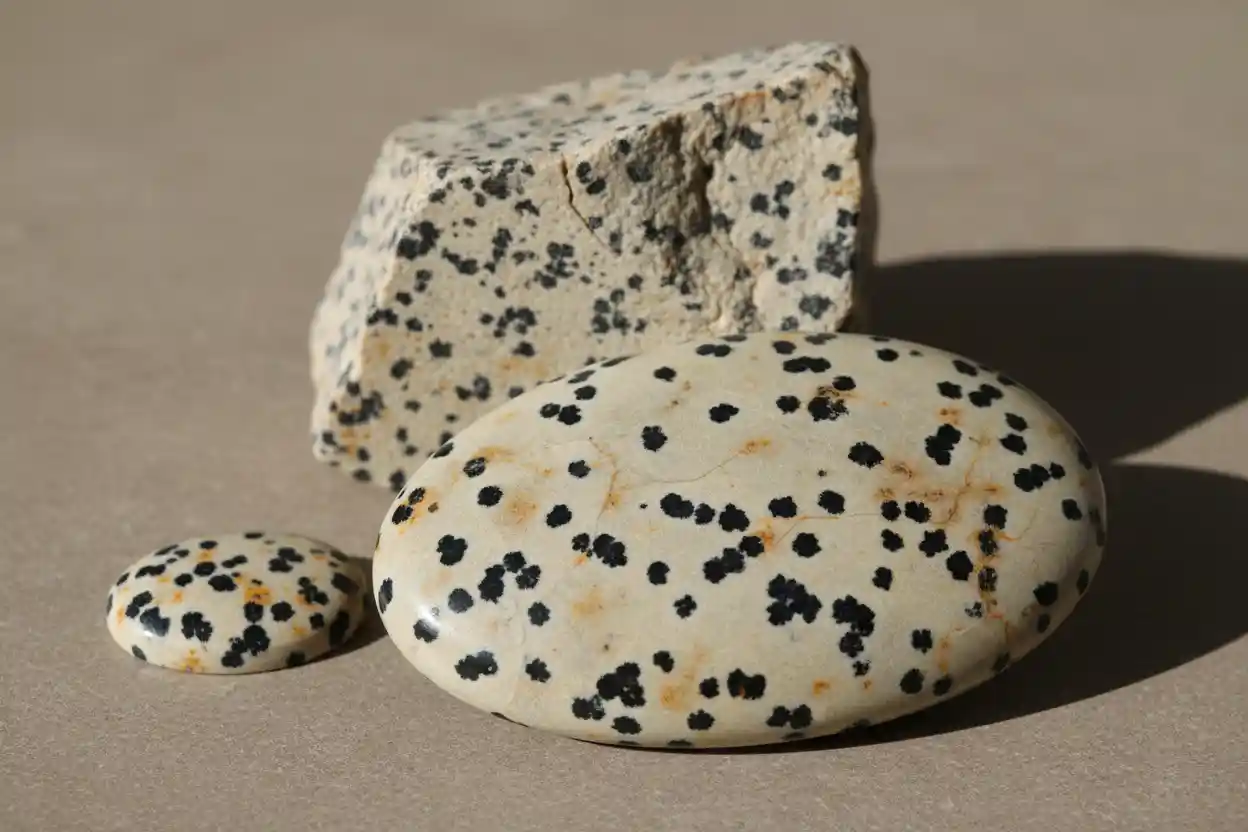
The light portion ranges from cream and beige to pale gray, while black to dark gray spots create the Dalmatian-dog appearance that inspired the trade name. Polished pieces typically show a smooth vitreous to somewhat dull luster depending on which minerals dominate the exposed surface and how well the stone has been finished.
Because it is a multi-mineral rock, assigning one exact Mohs hardness to every point on every specimen is not scientifically ideal. Its principal feldspar and quartz components are relatively hard, with feldspar around Mohs 6 and quartz at 7, so polished Dalmatian stone generally behaves as a moderately hard decorative gemstone. Dark amphibole areas can respond somewhat differently. It has no single rock-wide cleavage system either; individual constituent minerals may possess cleavage even though a polished piece behaves as an interlocking aggregate.
The dalmatian jasper meaning used in crystal culture should therefore be kept separate from this petrological identity. The stone’s spotted appearance is real, while the symbolic interpretation of those spots is personal or cultural.
Dalmatian Stone Geology, Naming History, Provenance, and Lookalikes
Dalmatian stone is classified as a peralkaline rock and has been described mineralogically as having affinities with microgranite, aplite, or rhyolitic material. Its light feldspar-rich background and dark arfvedsonite spots reflect igneous mineral formation rather than the fine silica texture expected of traditional jasper.
The trade name comes directly from its resemblance to the spotted coat of a Dalmatian dog. That is a modern commercial identity, not an ancient mineral name. Consequently, ancient references to jasper should not automatically be applied to Dalmatian stone. Historical peoples certainly worked jasper and many spotted rocks, but that does not demonstrate ancient recognition of this specific feldspar-quartz-amphibole rock under its current trade identity or ancient use of today’s Dalmatian jasper healing beliefs.
Provenance has historically been a point of uncertainty in scientific discussion. Modern mineral databases list Dalmatian stone from Chihuahua, Mexico, including Ahumada Municipality, but individual commercial pieces may not have documented mine-to-market provenance. Sellers should therefore be cautious about presenting an exact mine or geological origin without supporting documentation.
Lookalikes include spotted jasper, pale granitoid rocks, dyed or printed stones, resin composites, and other feldspar-rich decorative rocks. Black spots are sometimes incorrectly marketed as black tourmaline. Mineralogical examination has instead identified arfvedsonite as the principal dark spotting mineral in studied Dalmatian stone, making “black tourmaline inclusions” an unreliable sales claim.
Grounding, Joy, Emotional Balance, and Confidence Claims
1. Grounding and Stability Through Sensory Attention
Dalmatian jasper is frequently described as grounding. The stone does not physically stabilize the nervous system or connect the body to the Earth through a demonstrated therapeutic energy pathway. It can, however, work as a tactile grounding object. A person can hold it and deliberately identify its temperature, weight, surface, contrasting spots, and surrounding sounds while slowing their breathing. The shift toward sensory information is the relevant practice.
2. Joy and Playful Thinking
Its spotted pattern gives Dalmatian stone a playful visual identity, and crystal traditions often associate it with rediscovering fun. The rock cannot biologically create joy. A useful ritual is to make it a prompt for one small enjoyable activity that is easy to postpone, such as drawing, walking somewhere pleasant, calling a friend, playing music, or spending ten minutes on a hobby. The object reminds; the activity supplies the experience.
3. Emotional Balance During Difficult Moments
Another popular belief is that Dalmatian jasper balances emotions. That should not be interpreted as the rock controlling neurotransmitters, hormones, or mood disorders. Instead, use it as a pause signal before reacting. Identify what happened, what emotion is present, what interpretation may be intensifying it, and what response would still make sense after an hour. The stone doesn’t perform the regulation. The reflective sequence might help a person regulate their response.
4. Confidence and Self-Trust
Dalmatian stone is also used symbolically for confidence and trusting personal judgment. There is no known mineral mechanism for increasing self-esteem. A more practical approach is to hold the stone before a decision and state the evidence you have, the uncertainty you cannot eliminate, and the action you are willing to take. Confidence then develops from preparation and experience instead of being assigned to a crystal.
Motivation, Loyalty, Boundaries, and Practical Focus Claims
5. Motivation and Follow-Through
Some practitioners associate Dalmatian jasper with persistence and completing tasks. Rather than expecting the stone to supply energy, assign it a specific behavioral role. When it is placed beside a planner or work area, use it as the signal to start the next scheduled task for a defined period. The ritual can strengthen task initiation because it reduces ambiguity about what happens next.
6. Loyalty and Relationship Awareness
The Dalmatian-dog association has also encouraged themes of loyalty, trust, and friendship. A stone cannot make another person loyal or repair a damaged relationship. It can become a reflection prompt: Am I being consistent? Have I communicated clearly? Am I expecting something I have never actually asked for? These questions place responsibility on observable relationship behavior rather than supernatural influence.
7. Protection and Personal Boundaries
Dalmatian jasper is sometimes described as protective or capable of deflecting negative energy. No reliable evidence shows that it forms a protective field or prevents harm. As symbolism, however, protection can be translated into practical boundary-setting. Before a difficult interaction, decide what behavior you will accept, what you will decline, and when you will leave or seek assistance. The protective action is the boundary, not the rock.
8. Focus and Practical Thinking
The contrasting black-and-light pattern is sometimes linked with sorting through choices or seeing situations clearly. Dalmatian stone has not been shown to improve cognition. It can nevertheless serve as a desk cue to list the facts, remove irrelevant tasks, and choose one next action before opening new tabs or notifications. That is ordinary behavioral organization supported by a visual reminder.
Social Connection, Resilience, and Relaxation Claims
9. Social Connection and Communication
Because Dalmatian stone is frequently associated with friendship, some practitioners use it before social situations or important conversations. It cannot guarantee rapport or change another person’s response. A practical ritual could involve choosing one conversation opener, one question to ask, and one point that needs to be expressed clearly. Preparation can reduce uncertainty even though the mineral itself is not creating connection.
10. Resilience Through Change
Dalmatian jasper is also linked with bouncing back after disappointment. The spotted stone’s contrasting pattern can symbolically represent mixed experiences without requiring every part of life to feel positive. After a setback, use it as a prompt to separate the irreversible part from the part that can still be influenced. This is a reflection practice, not a healing mechanism.
11. Relaxation and Mental Release
Some users keep Dalmatian stone nearby during evening relaxation. There is no evidence that its feldspar, quartz, or arfvedsonite components directly produce sleep or reduce clinical anxiety. A repeatable routine can still be useful: lower stimulation, write down unfinished tasks, put the phone away, breathe slowly, and use the stone as the visual endpoint of the workday. The routine provides the transition.
Dalmatian Jasper Chakra Associations and Spiritual Practice
Modern crystal systems commonly associate Dalmatian jasper with the root chakra because of its grounding symbolism. Some practitioners also connect it with the sacral chakra, especially when emphasizing playfulness, pleasure, creativity, or emotional movement. Chakras are a spiritual framework rather than an anatomical one, and there is no established biological pathway connecting Dalmatian stone with a physical chakra structure.
Someone using the root-chakra association might meditate on stability, security, practical responsibilities, and boundaries. A sacral-focused ritual might instead examine creativity, enjoyment, flexibility, or relationships. These practices can function as structured contemplation while remaining clearly separate from mineral science.
Dalmatian Jasper Physical Care: Variable Hardness, Water, Chemicals, Heat, and Cleaning
Because Dalmatian stone is a multi-mineral igneous rock, care advice should not pretend that every spot and every specimen has one identical hardness. Quartz components are around Mohs 7, while feldspar is around Mohs 6, giving polished stones reasonable scratch resistance for beads, pendants, earrings, and many cabochons. Harder gemstones such as corundum and diamond can still scratch it, while Dalmatian stone may scratch softer gems. Store polished pieces separately when surface finish matters.
The rock’s interlocking texture gives it useful durability, but flaws, mineral boundaries, small fractures, and exposed grains can create weak points. A hard fall may produce chips. Individual feldspars and amphiboles also have cleavage characteristics that are not captured by describing the entire rock as though it were uniform quartz.
Brief contact with plain water is generally reasonable for a sound, untreated polished piece, but prolonged soaking is unnecessary. Dalmatian stone contains multiple mineral phases, and commercial pieces may also have dyes, coatings, adhesives, fillers, or metal findings that respond differently from the natural rock. Mild soap, lukewarm water, and a soft cloth are the safest default for ordinary cleaning, followed by prompt drying.
Avoid strong acids, aggressive alkalis, bleach, and unverified chemical cleaners. Steam cleaning introduces heat that is unnecessary for routine maintenance and may worsen existing fractures or stress mineral boundaries. Ultrasonic cleaners should also be avoided as a default because vibrations can exploit hidden cracks, loosen treated areas, or affect mounted pieces. Sudden temperature changes should be minimized.
Grinding, drilling, cutting, or polishing requires a different level of caution because the stone contains silicate minerals, including quartz and feldspar. Fine airborne silica-bearing dust should not be inhaled. Lapidary work should use wet methods, appropriate extraction, eye protection, and suitable respiratory protection rather than dry grinding without controls.
Ritual Cleansing Dalmatian Jasper With Gentle, Dry Methods
Ritual cleansing is symbolic and should not be confused with removing actual dust or oils. In crystal practice, people may cleanse a stone when changing an intention, after using it during an emotionally significant event, or simply as part of a personal routine. There is no established scientific evidence that unwanted spiritual energy accumulates in Dalmatian stone.
Sound, dry placement, quiet reflection, intention-setting, or placing the stone somewhere clean and undisturbed are low-risk approaches. A person might wipe it physically, sit with it briefly, acknowledge the previous use, and decide what the object will represent next. That is enough for the ritual without exposing the mixed-mineral rock to unnecessary treatment.
Long saltwater soaking, strong chemical solutions, steam, repeated heating, and burying polished jewelry in damp soil are not required. Simple handling protects both the stone and the clarity between symbolic cleansing and actual physical maintenance.
Conclusion
Dalmatian jasper is especially useful as an example of why crystal symbolism and geology should be kept distinct. The wellness market calls it jasper, yet mineralogical examination identifies it as a spotted peralkaline igneous rock dominated by feldspar and quartz with arfvedsonite-rich dark spots. Its eleven common healing themes can still function as prompts for grounding, preparation, boundaries, relationships, resilience, and rest, but those practices do not transform the stone into a medical treatment.
Frequently Asked Questions About Dalmatian Jasper Healing Properties
What are the main Dalmatian jasper healing properties people claim?
Common claims include grounding, joy, emotional balance, confidence, motivation, loyalty, protection, focus, social connection, resilience, and relaxation. These are wellness and spiritual beliefs rather than scientifically established therapeutic effects.
Is Dalmatian jasper actually jasper?
Mineralogical research indicates that the commercial name is misleading. Dalmatian stone is a peralkaline igneous rock composed mainly of feldspar, quartz, and alkali amphiboles rather than a conventional jasper.
What are the black spots in Dalmatian jasper?
Detailed analysis of studied specimens identified the dark spots mainly as arfvedsonite, a sodium-rich iron amphibole. Claims that the spots are black tourmaline should not be assumed to be correct.
What is Dalmatian jasper made of?
It is a multi-mineral rock rather than a single mineral with one formula. Major components include mesoperthitic feldspar, quartz, and alkali amphiboles, with lesser hematite and epidote reported in studied material.
How hard is Dalmatian jasper?
There is no single exact Mohs hardness for the entire rock because its constituent minerals differ. The major feldspar and quartz components are around Mohs 6 and 7 respectively, so polished Dalmatian stone is generally moderately hard.
Is Dalmatian jasper scientifically proven to reduce anxiety or stress?
No. It has not been demonstrated to treat anxiety or directly alter stress physiology. Holding it during breathing, sensory grounding, journaling, or reflection may support a routine, but the action rather than the stone provides the plausible mechanism.
Which chakra is Dalmatian jasper associated with?
It is most commonly associated with the root chakra and sometimes the sacral chakra in modern crystal practice. Chakra associations are spiritual symbolism rather than verified anatomical relationships.
Can Dalmatian jasper go in water?
Brief washing with plain lukewarm water is generally reasonable for sound untreated stone. Prolonged soaking is unnecessary because Dalmatian stone contains several mineral phases and commercial pieces may have treatments, adhesives, or settings with different tolerances.
How should Dalmatian jasper be cleaned?
Use lukewarm water, mild soap, and a soft cloth, then dry the stone. Avoid aggressive chemicals, steam, thermal shock, and routine ultrasonic cleaning, particularly with fractured, treated, mounted, or uncertain specimens.
What should buyers check when choosing Dalmatian jasper?
Look for a sound polish, natural-looking spotted texture, disclosure of dyes or treatments, and accurate descriptions of the stone’s identity. The workbook-verified where to buy Dalmatian jasper topic focuses specifically on sourcing and buying considerations.
Crystal healing claims are traditional or personal beliefs and should not replace qualified medical or mental health care.