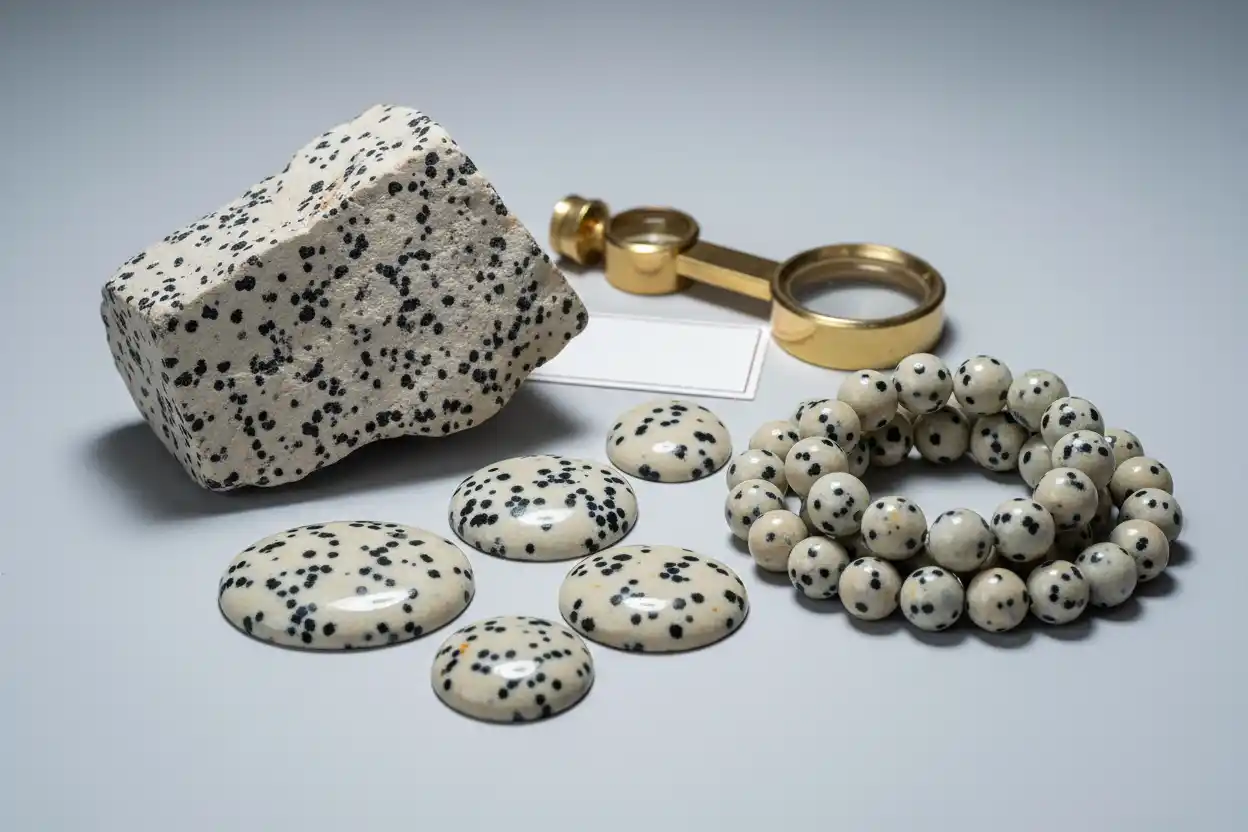
Where to Buy Real Dalmatian Jasper and Avoid Painted Fakes
Dalmatian Jasper is an established trade name for a cream, beige or pale gray rock marked by irregular black spots. Its appearance resembles the coat of a Dalmatian dog, which explains the commercial name.
Despite that name, mineralogical research indicates that commonly studied Dalmatian Stone is not true jasper. It is better described as a feldspar–quartz-rich peralkaline rock, potentially classifiable as fine-grained microgranite, aplite or rhyolite depending on texture and geological context.
The black spots in analyzed material were identified mainly as the alkali amphibole arfvedsonite rather than black tourmaline. However, commercial parcels may vary, so one study should not be used to claim that every spotted stone on the market has an identical composition.
The Dalmatian Jasper meaning and properties guide covers the trade material’s identity and traditional symbolism. This guide focuses on accurate naming, seller knowledge, spotting painted or molded imitations and choosing durable rough, beads, cabochons and jewelry.
Dalmatian Stone Is a More Accurate Name
“Dalmatian Jasper” remains the dominant search and retail term, so it is reasonable to use it when the description explains the mineralogical limitation.
Dalmatian Stone is more accurate because the material does not fit the conventional definition of jasper as opaque microcrystalline silica.
The broader jasper guide explains true jasper and its chalcedony-family relationship. The types of jasper guide covers commercial varieties without requiring every trade name to represent pure jasper.
A careful listing might state:
“Natural Dalmatian Stone, commonly sold as Dalmatian Jasper; a spotted feldspar–quartz rock rather than true jasper.”
That language preserves the familiar name without repeating an inaccurate composition claim.
What Genuine Dalmatian Stone Contains
Detailed analysis of studied material found a pale matrix dominated by feldspar and quartz. The feldspar occurred as mesoperthitic intergrowths, while the black spots consisted primarily of alkali amphibole identified as arfvedsonite.
Smaller amounts of hematite and epidote were also reported. Natural commercial material can contain additional accessory minerals depending on the source.
The feldspar guide explains the dominant pale mineral family, while the quartz guide covers the other major component.
The arfvedsonite guide provides context for the dark amphibole identified in the spots.
Because Dalmatian Stone is a rock rather than a single mineral, testing one spot cannot describe the whole object. A laboratory may need to examine both the pale matrix and the dark inclusions.
Choose the Product Form
| Product form | Best source | Main buying concern |
|---|---|---|
| Natural rough | Lapidary supplier or rock dealer | Correct trade identification, fractures and source claims |
| Slab | Lapidary supplier | Spot continuity, resin, cracks and usable yield |
| Cabochon | Independent cutter or gem dealer | Painted spots, backing, polish and structural seams |
| Tumbled stone | Reputable crystal retailer | Resin, porcelain or generic spotted rock |
| Bead strand | Established bead supplier | Printed spots, dye, mixed materials and drill-hole damage |
| Sphere or tower | Lapidary retailer | Hidden fractures, filler and artificial pattern |
| Carving | Skilled stone seller | Polymer, painted details and repaired projections |
| Jewelry | Jeweler with treatment disclosure | Glue, backing and weak drill holes |
| Collector sample | Mineral dealer with testing or provenance | Overconfident species and locality claims |
The planned general Jasper buying guide will cover true jasper-family concerns. This page remains specific to the Dalmatian trade material.
Where to Buy Genuine Dalmatian Jasper
Specialist lapidary suppliers
Lapidary suppliers are normally the best source for rough and slabs. They should show dry sawn faces rather than only wet or polished surfaces.
Ask whether the pale matrix and dark spots continue through the block. Surface paint or printed pattern may appear convincing from the front but disappear at an edge.
A good supplier should recognize that the material is a spotted igneous rock rather than insisting that it is pure chalcedony.
Gem and mineral shows
Shows allow direct comparison with true jasper, granite, tourmaline-bearing aplite, dyed howlite and resin.
Use a loupe to examine the black spots. Natural amphibole grains should have irregular boundaries and enter the pale matrix rather than sit as round painted dots on the surface.
Inspect the reverse and edges. An artificial coating or printed design often becomes obvious away from the display face.
Established online shops
The online gemstone buying guide explains protected payment methods, seller identity and return policies.
Request exact-item photographs for carvings, spheres and jewelry. Batch photography may be acceptable for low-cost tumbles, provided the seller shows representative variation.
Ask whether color saturation, contrast or background removal altered the appearance. Increased contrast can make weak gray spots appear jet black.
Independent jewelry makers
A maker who drilled or cut the stone can often explain whether the material behaved as a granular feldspar–quartz rock or a resin composite.
For expensive custom pieces, ask to see the loose stone before setting. Closed backs can hide paint, filler or a joined layer.
What Real Dalmatian Stone Looks Like
The pale matrix commonly ranges from cream and ivory to beige or light gray. It may contain subtle yellow, peach, pinkish or greenish undertones.
Black or dark gray spots should vary in size, outline and distribution. Some are compact and nearly round, while others are irregular, elongated or connected.
Natural spots generally have mineral-grain boundaries. They should continue into chipped edges and drill holes when the cut intersects them.
The pale background may show small gray grains, faint feldspar texture or minor fractures. It does not need to be completely uniform.
A perfectly smooth white body covered with identical circular black dots is atypical. That appearance is more consistent with painted ceramic, resin or an artificial print.
Black Spots Are Not Automatically Tourmaline
Many retail descriptions claim that Dalmatian Jasper contains black tourmaline. Analytical work on studied material instead identified the dark spots as arfvedsonite.
Other spotted pale rocks can contain tourmaline. For example, some aplites and granitic rocks have black tourmaline nodules. Therefore, the presence of dark spots alone cannot establish Dalmatian Stone or its specific amphibole composition.
A seller should not use a spiritual association with tourmaline as mineralogical proof.
If a high-value specimen’s exact dark mineral matters, Raman spectroscopy or chemical analysis can provide a safer answer than visual identification.
Dalmatian Jasper Versus True Jasper
True jasper is generally opaque microcrystalline silica. Dalmatian Stone is a crystalline rock dominated by feldspar and quartz.
Under magnification, jasper usually looks dense and fine-grained. Dalmatian Stone may reveal separate feldspar, quartz and amphibole grains.
The chalcedony guide explains the silica family to which true jasper is commonly assigned.
The trade name can remain useful, but buyers should not pay for claims that Dalmatian Stone is a rare jasper species.
Dalmatian Stone Versus Picture Jasper
Picture Jasper is typically an opaque silica-rich material with landscape-like brown, tan and cream patterns.
Dalmatian Stone has discrete dark spots within a pale feldspar–quartz matrix rather than sediment-like scenic bands.
The future guide to buying Picture Jasper will address landscape patterns, dye and locality claims in that distinct market.
Dalmatian Stone Versus Red Jasper
Red Jasper is an opaque iron-colored silica material with red, rust or brown body color.
Dalmatian Stone does not become red jasper merely because its pale matrix has rusty staining. Likewise, red-painted spots do not create a recognized Dalmatian variety.
Dalmatian Stone Versus Granite or Aplite
Dalmatian Stone is related texturally and compositionally to fine-grained igneous rocks. Aplite is typically a pale, fine-grained intrusive rock composed largely of quartz and feldspar.
Some granites or aplites can resemble Dalmatian Stone, especially when they contain dark amphibole or tourmaline grains.
The commercial identity depends on the characteristic spotted pattern and accepted supply-chain name rather than a unique mineral formula.
A similar rock from another locality can be natural but should not automatically receive a premium Dalmatian label without provenance.
Painted Stone
Painted spots are one of the easiest imitations to produce. Black pigment may sit over scratches, bridge pores or collect in surface depressions.
Inspect the edges of each spot under magnification. A natural mineral boundary enters the rock, whereas paint may form a thin layer with a slight ridge.
Do not scrape the stone or apply solvents. Those tests damage the item and can remove legitimate surface treatments.
Dyed Howlite, Magnesite and Porous Stone
Pale porous stones can be dyed or marked to imitate Dalmatian Stone. Howlite and magnesite often show natural veining rather than isolated amphibole spots, but treatment can alter the appearance.
Color may concentrate in fractures and drill holes. The pale body may also feel softer than the feldspar–quartz rock.
Visual separation can remain uncertain in polished beads, so a supplier’s mineral knowledge and return policy matter.
Resin, Polymer Clay and Ceramic Imitations
Resin can be mixed with black particles or printed with spots. Polymer-clay beads can also reproduce the pattern convincingly.
Look for mold seams, identical spot placement, rounded bubbles and soft scratches. Resin-rich material may show a uniform plastic luster.
Ceramic or porcelain imitations can feel cool and hard but may reveal a white fired body beneath a chipped painted surface.
The fake-crystal buyer’s guide provides broader checks for resin, glass and molded products.
Reconstituted Material
Crushed rock can be combined with polymer and cast into beads or carvings. The object may contain genuine mineral powder while lacking the natural structure of one solid rock.
Composite boundaries, resin-rich areas and repeated internal patterns are warning signs.
The gemstone treatments guide explains the distinction between stabilization and substantial composite construction.
How to Evaluate Rough and Slabs
Request a fresh or sawn face. The spotted pattern should continue through the interior.
Inspect for fractures along mineral boundaries. Fine-grained rock can be durable, but a slab may contain weak seams that open during cutting.
Ask whether the material has been stabilized. Resin may improve cutting yield, although it should be disclosed.
A large pale block with only a few surface spots may produce little attractive material. Pattern density matters more than weight alone.
How to Judge Cabochons
A good cabochon balances spot size and distribution. The cutter should avoid placing one large black grain directly on a thin edge where it could create a weakness.
The dome needs an even polish. Different minerals can polish at slightly different rates, so mild texture may occur, but deep undercutting reduces quality.
Inspect the back for paint, resin and composite joins. Black spots should continue through any area where the cut intersects them.
Buying Beads and Bracelets
A natural bead strand should contain related but nonidentical spots. Every bead may show a different number and arrangement.
Inspect drill holes. Natural dark mineral grains may appear inside some holes, while printed surface dots stop at the opening.
The spots should not rub away during ordinary handling. However, do not perform abrasive tests on merchandise.
Ask whether the strand contains solid natural rock, stabilized material or resin composite.
Buying Spheres, Towers and Carvings
Request a complete rotation. A sphere should display spots around the entire surface rather than only on the photographed side.
Towers need stable bases and points that do not cross a major fracture. The tower shape is carved rather than naturally crystallized.
Carvings should avoid extremely thin projections. Deep recesses can conceal pigment, glue or polymer filler.
Buying Dalmatian Jasper Jewelry
The material’s feldspar and quartz components provide moderate to good scratch resistance, but its overall behavior depends on grain boundaries, fractures and treatment.
The gemstone hardness chart provides component-level context. The gemstone toughness-versus-hardness guide explains why a multi-mineral rock does not have one perfectly uniform durability value.
Pendants and earrings are practical. Rings should use a protective bezel and avoid thin exposed corners.
Ask whether the stone is drilled, glued or backed. Bead bracelets should not remain under excessive elastic tension.
Locality Claims
Commercial sellers frequently associate Dalmatian Stone with Chihuahua, Mexico. However, the provenance of the samples analyzed in a major gemological study could not be proven conclusively.
Therefore, “Mexican origin” should be treated as a supply-chain claim rather than a visual fact.
A precise mine or municipality requires invoices, labels or direct sourcing records. Similar spotted feldspar–quartz rocks may occur elsewhere.
Price and Value
Dalmatian Stone is generally affordable. Price reflects attractive spot distribution, size, structural condition, polish, cutting and seller transparency.
A natural strand with well-centered drilling and varied spots may cost more than mass-produced composite beads.
Large carvings are priced partly for labor and material loss. However, weight does not create rarity when the rock itself is common.
Avoid “AAA,” “master healer” and “investment jasper” premiums unless the seller explains observable criteria.
The gemstone pricing guide explains how workmanship, treatment and documentation influence retail cost.
Questions to Ask the Seller
Ask whether the seller recognizes Dalmatian Jasper as a trade name for Dalmatian Stone rather than true jasper.
Request the country of origin and the basis for that claim. Then confirm whether the object contains paint, dye, resin, coating, backing or reconstructed material.
For rough, request dry sawn-face photographs. For beads, ask for close-ups of drill holes. For carvings, obtain a full rotation.
Finally, determine whether the pictured item will ship and whether the return period allows magnified inspection.
Professional Identification
Raman spectroscopy can identify quartz, feldspar and the dark amphibole grains. Chemical analysis may distinguish arfvedsonite from related sodium-rich amphiboles.
Microscopy reveals the rock texture and whether black spots belong within the matrix. It can also expose paint, resin and composite construction.
Testing should sample more than one area because Dalmatian Stone is multi-mineral. A result from the white matrix does not identify a black spot, and one spot does not describe the full rock.
Responsible Buying and Care
The ethical gemstone sourcing guide provides practical questions about extraction, cutting labor and origin claims.
Clean a sound untreated piece with lukewarm water, mild soap and a soft cloth. Avoid prolonged soaking if the stone is painted, resin-treated or glued.
Do not use steam or ultrasonic equipment on fractured or assembled jewelry. Store polished pieces away from harder gems that may scratch the feldspar-rich surface.
Frequently Asked Questions
1. Is Dalmatian Jasper real jasper?
No. Mineralogical research indicates that commonly studied Dalmatian Stone is a feldspar–quartz-rich peralkaline rock rather than true jasper.
2. Why is it still called Dalmatian Jasper?
The trade name is well established because the black-and-cream pattern resembles a Dalmatian dog’s coat.
3. What forms the black spots?
In analyzed material, the spots were primarily arfvedsonite, an alkali amphibole.
4. Are the black spots black tourmaline?
Not in the studied Dalmatian Stone samples. Similar pale rocks can contain tourmaline, so exact identification requires testing.
5. Does genuine material come from Mexico?
Commercial material is frequently associated with Chihuahua, but a precise origin requires supply-chain evidence.
6. How can I recognize painted spots?
Paint may sit on the surface, bridge scratches or stop at an edge. Natural mineral spots continue into the rock.
7. Can Dalmatian Jasper be made from resin?
Yes. Resin, polymer clay and reconstructed stone can imitate the spotted appearance.
8. Should every bead have the same number of spots?
No. Natural beads should vary because each was cut from a different section of rock.
9. Is Dalmatian Stone suitable for daily jewelry?
Sound material is practical for many designs, although fractures, drill holes and high settings require care.
10. Can it be dyed?
Yes. Pale rocks or imitations may be dyed or painted. Any treatment should be disclosed.
11. Do ordinary pieces need laboratory reports?
Usually not. Testing is more useful for expensive collections, disputed composition or large wholesale parcels.
12. What is the biggest warning sign in a listing?
Be cautious when identical black dots cover a perfectly white object and the seller claims the spots are tourmaline without showing edges, drill holes or mineral evidence.
Buy the Spotted Rock the Seller Can Describe Correctly
Dalmatian Stone does not become less attractive because it is not true jasper. Its contrast comes from a genuine multi-mineral igneous rock whose pale matrix and dark amphibole grains create a distinctive pattern.
The D crystal directory, D gemstone directory, crystals-versus-gemstones guide and visual gemstone guide provide wider classification context. Choose the seller who explains the trade name rather than inventing a jasper or tourmaline composition.
Safety note: Dalmatian Stone contains quartz and other silicate minerals. Intact polished pieces are appropriate for normal handling, but cutting, drilling, sanding or grinding can create hazardous mineral dust. Never dry-work the material; use professional wet methods, local extraction and appropriate respiratory and eye protection.