9 Popular Fire Agate Benefits: Helpful Traditions, Verified Facts & Safe Limits
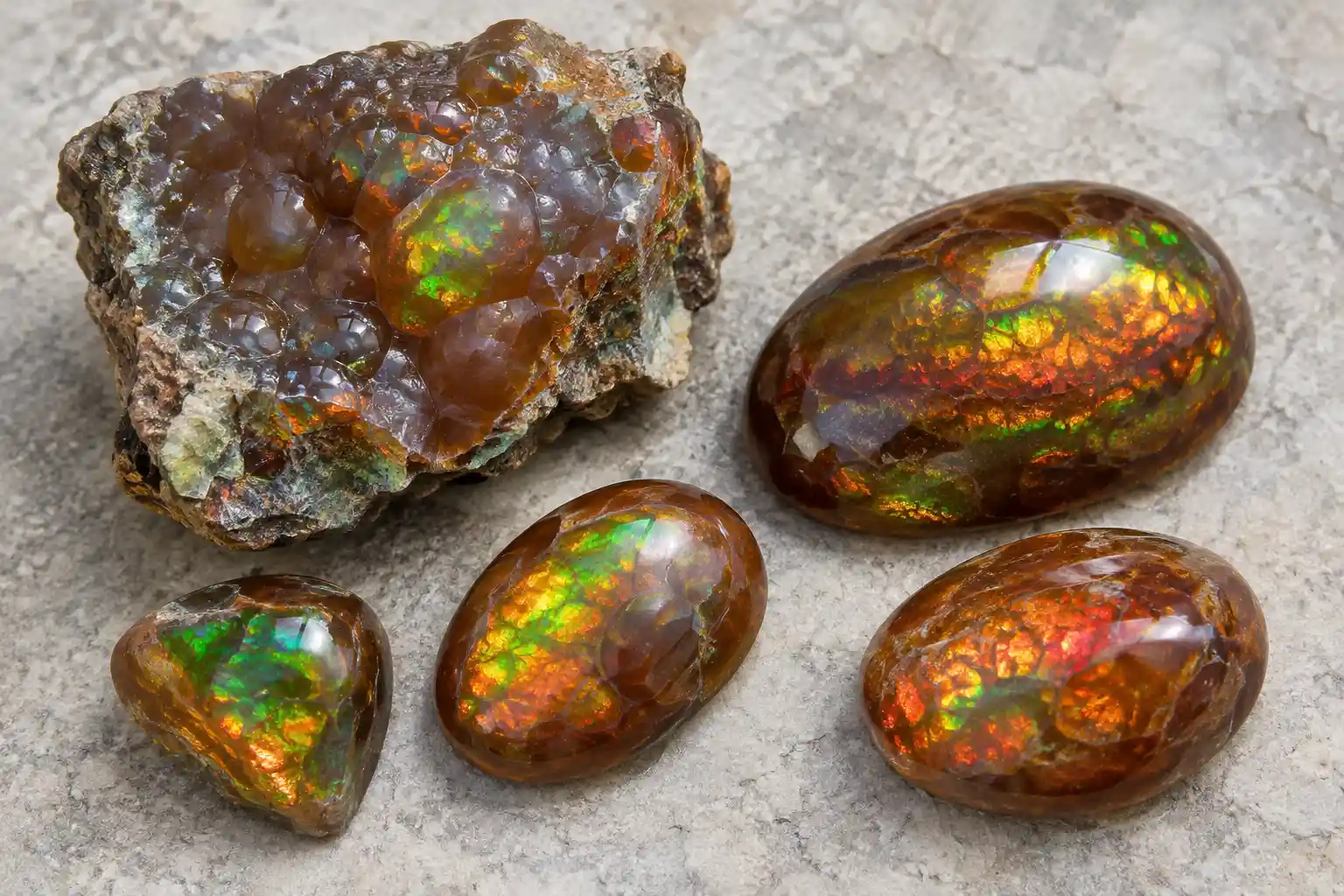
Fire Agate benefits begin with an optical effect that is completely different from ordinary agate banding. Fine stones can flash green, golden yellow, orange, red, and occasionally cooler hues over a brown to reddish-brown background, creating a metallic or glowing appearance that seems to follow curved botryoidal structures inside the chalcedony. Fire Agate is a variety of chalcedony, the microcrystalline quartz family, and typically forms as rounded or grape-like layers rather than as a single transparent crystal.
Its famous “fire” is iridescence, not heat and not the same structural phenomenon responsible for precious opal’s play-of-color. Current gemological research points to thin-film interference associated with extremely fine iron-rich layers, commonly described in connection with iron (hydr)oxides such as goethite, as the most likely explanation. The detailed nanoscale mechanism is still not completely resolved, which makes Fire Agate especially interesting scientifically. The visible effect can sit on top of a predominantly brown body and often follows rounded internal surfaces, producing eyes, arcs, ribbons, and irregular flashes.
These physical characteristics create substantial Fire Agate benefits for jewelry, collecting, lapidary work, geological study, gem identification, and mineral education. Modern spiritual traditions may add themes involving courage, motivation, protection, confidence, or vitality, but those interpretations are symbolic. Fire Agate does not medically increase energy, regulate circulation, treat anxiety, improve metabolism, or protect the body through an established gemstone-specific mechanism.
9 Fire Agate Benefits at a Glance
- Natural iridescence can produce vivid green, yellow, orange, red, and multicolored flashes.
- Chalcedony hardness around 6.5 to 7 gives Fire Agate useful resistance to everyday scratching.
- Botryoidal growth creates three-dimensional patterns that reward skilled lapidary cutting.
- Iron-rich internal layers provide unusual geological and optical study.
- Southwestern United States and Mexican occurrences offer strong locality and collecting interest.
- Cabochons and freeforms can preserve irregular color zones better than standardized cutting.
- Identification helps distinguish Fire Agate from precious opal, ordinary agate, coated stones, and imitations.
- Jewelry designers gain a durable phenomenal gemstone with an earthy brown base and bright spectral accents.
- Modern symbolism can represent confidence, persistence, or purposeful action when kept separate from medical claims.
Iridescence Gives Fire Agate Its Most Valuable Visual Benefit
The strongest Fire Agate benefits come from iridescence. A polished stone may appear predominantly brown at first glance and then reveal brilliant green, orange, yellow, or red as light reaches the curved internal layers. The colors can appear concentrated in eyes, arcs, ribbons, patches, or irregular flame-like forms, creating an effect that changes with viewing conditions and the geometry of the polished surface.
This phenomenon differs from simple pigmentation. Brown body color is associated with iron-rich components, but the brightest rainbow flashes arise from optical interference. Extremely thin internal layers reflect and refract light so that some wavelengths reinforce one another while others cancel, producing visible spectral colors. Thin-film interference is the leading explanation for Fire Agate’s optical effect, although detailed research into the exact nanoscale structure remains limited.
That scientific uncertainty does not weaken Fire Agate benefits. It makes the stone more interesting because an attractive jewelry effect also presents an active mineralogical question. Unlike a dyed surface or applied coating, genuine fire arises from internal structures developed during natural formation.
Chalcedony Durability Makes Fire Agate Practical for Jewelry
Fire Agate belongs to the chalcedony family and generally shares quartz-family hardness around 6.5 to 7. This gives it considerably better resistance to ordinary scratching than softer gems such as calcite, fluorite, turquoise, or opal. The very fine-grained quartz structure also provides useful toughness, allowing well-cut Fire Agate to perform successfully in jewelry when reasonable care is used.
These practical Fire Agate benefits are especially useful in pendants, earrings, bracelets, brooches, and protected rings. Rings receive more frequent impacts and abrasion, so bezel settings or designs that protect irregular edges can be helpful. The stone’s natural shapes frequently suit freeform settings better than highly standardized commercial mountings.
Hardness still does not mean invulnerability. A strong blow can chip a thin edge, and contact with sapphire, diamond, topaz, or other harder gemstones can scratch the polished surface during storage. Jewelry should therefore be separated rather than dropped loosely into a container with harder pieces.
The general agate benefits of polish, toughness, and quartz-family durability are particularly useful in Fire Agate because they allow a delicate-looking iridescent effect to exist within a comparatively practical gemstone.
Botryoidal Growth Creates Exceptional Lapidary Possibilities
Fire Agate is famous for botryoidal growth, meaning rounded structures develop in forms resembling clusters of grapes or overlapping bubbles. The iridescent layers commonly follow these curved surfaces, which means lapidaries cannot simply cut straight across the rough and expect the best color to appear automatically.
Skilled cutting becomes one of the most important Fire Agate benefits. The cutter gradually removes overlying chalcedony while following the contours of the color-bearing structures underneath. Cutting too deeply can remove an attractive iridescent layer completely, while stopping too early may leave dull chalcedony obscuring the best fire. The process therefore rewards patience, observation, and careful grinding.
This is why many fine Fire Agates have sculpted, freeform, or uneven surfaces rather than symmetrical flat cabochons. The final shape follows the internal geology. A standardized oval may sacrifice the strongest color, while an irregular outline can preserve several bright eyes or ribbons.
In Fire Agate, successful lapidary work is less about forcing rough into a predetermined shape and more about revealing what the stone already contains.
Southwestern United States and Mexican Sources Add Geological Interest
Fire Agate is strongly associated with volcanic regions of the southwestern United States and Mexico. Important occurrences have produced botryoidal chalcedony with iron-rich layers capable of generating the characteristic iridescence, making locality part of the stone’s collecting appeal.
Arizona is particularly famous among Fire Agate collectors, while Mexican deposits have also supplied exceptional rough and polished gems. Locality can influence body tone, pattern, botryoidal structure, thickness of color layers, and the style of finished stones encountered in the market, although appearance alone should not be used as definitive proof of geographic origin.
These Fire Agate benefits become more interesting when the gem is viewed as part of a volcanic geological system. Silica-bearing fluids entered cavities and open spaces, depositing successive chalcedony layers while iron-rich components became incorporated into the developing structures. Repeated growth created the rounded forms that later interact with light so dramatically.
A documented rough specimen can therefore preserve both locality and geological information, while a polished cabochon emphasizes the optical result of that formation process.
Collectors Can Appreciate Rough, Cut Stones, and Optical Structure
Fire Agate benefits collectors because several stages of the stone can be interesting for different reasons. Natural rough can show botryoidal surfaces, host-rock relationships, brown chalcedony, and partially visible iridescence. A carefully opened specimen may expose internal layers, while a finished cabochon reveals the optical effect at its strongest.
Collecting both rough and polished examples can demonstrate how much skilled cutting contributes to the final appearance. An unimpressive brown exterior may conceal intense color only a short distance below the surface, while another promising piece may contain weak or discontinuous fire.
Quality therefore cannot be judged through size alone. Brightness, color range, coverage, pattern, three-dimensional depth, polish, absence of distracting fractures, and craftsmanship all matter. Red and green combinations can be especially striking, but a stone with intense golden or orange fire may be equally attractive depending on pattern.
These Fire Agate benefits reward close observation rather than reliance on one simplified grading rule.
Fire Agate Identification Builds Useful Gemological Skills
Fire Agate can occasionally be confused with other phenomenal stones because buyers may use the word fire loosely. Precious opal, iris agate, iridescent glass, coated chalcedony, labradorite, and various treated products can all display colorful optical effects, but the mechanisms and structures differ.
Genuine Fire Agate generally shows iridescence associated with brown botryoidal chalcedony and curved internal layers. Precious opal produces play-of-color through ordered silica spheres, while labradorite belongs to the feldspar family and shows labradorescence from internal structures of its own. Similar-looking colors therefore do not establish the same gemstone identity.
Someone considering where to buy Fire Agate should pay attention to realistic videos, multiple viewing angles, dimensions, surface condition, whether the piece is natural or assembled, and whether the seller accurately describes the stone as chalcedony rather than confusing it with opal.
These identification-focused Fire Agate benefits reinforce an important gemological habit: name the phenomenon correctly before deciding what gemstone produced it.
Earthy Body Color and Bright Fire Create Strong Jewelry Contrast
Jewelry designers gain unusual possibilities from Fire Agate because its background and optical colors behave almost like two different visual systems. Brown, reddish-brown, and golden chalcedony can look earthy and subdued, while bright internal fire introduces sudden green, orange, red, or yellow flashes.
This contrast allows the gemstone to work particularly well in silver, oxidized silver, gold, copper, and handmade settings. A darkened metal can emphasize golden or green fire, while yellow gold may reinforce warmer colors. Because polished stones frequently have irregular outlines, custom settings can highlight the natural pattern more effectively than standardized mounts.
The visual Fire Agate benefits are strongest when the design gives the color-bearing surface enough room to remain visible. Crowded settings or excessive metal over the face can hide the very feature that makes the stone distinctive.
A modestly sized cabochon with concentrated bright fire may therefore create more impact than a substantially larger stone whose color is weak or scattered.
Modern Symbolism Can Represent Confidence Without Promising Protection
Fire Agate benefits in contemporary crystal culture often include courage, confidence, grounding, vitality, motivation, protection, and renewed enthusiasm. The fiery appearance makes these themes understandable as visual symbolism, especially when glowing colors seem to emerge from a darker brown background.
A person may wear Fire Agate before an important event because it represents courage, or keep a polished stone near a workspace because the visible flashes remind them to keep working through a difficult project. Those are personal uses rather than measurable gemstone effects.
Claims surrounding Fire Agate healing properties may extend into physical energy, circulation, sexual health, metabolism, pain relief, or protection from harmful forces. These interpretations belong to spiritual traditions and have not been established as clinical effects of chalcedony.
The stone can symbolize confidence without causing confidence biologically, just as it can represent protection without creating a scientifically demonstrated protective field.
Safe Care Preserves Both Iridescence and Surface Polish
Fire Agate is relatively straightforward to care for compared with softer phenomenal gems. Lukewarm water, mild soap, and a soft brush or cloth are suitable for many untreated stones, followed by careful rinsing and drying. Harsh chemicals, strong thermal shock, and aggressive abrasive cleaning are unnecessary and can threaten the setting even when the chalcedony itself remains stable.
Because the optical effect depends on precisely exposed curved layers, repolishing should be approached carefully. Removing too much from the surface can change or even eliminate a particular area of fire. A badly scratched valuable stone is therefore better handled by a lapidary who understands Fire Agate rather than polished indiscriminately.
Cutting rough introduces the usual crystalline-silica precautions. Wet grinding, adequate ventilation, eye protection, and appropriate dust controls are important because dry cutting of chalcedony can create respirable silica dust.
These practical limits help preserve the real Fire Agate benefits of iridescence, durability, collector value, and long-term jewelry use.
Conclusion
Fire Agate benefits include natural iridescence, chalcedony durability, botryoidal geological structure, skilled lapidary possibilities, locality interest, collecting value, gemstone identification, jewelry versatility, and meaningful modern symbolism. Its glowing colors arise from highly specialized internal structures rather than pigment alone, giving the stone scientific interest as well as visual appeal.
The strongest Fire Agate benefits come from appreciating how geology, iron-rich layers, light interference, and careful cutting work together. Modern associations involving courage, motivation, or protection can add personal significance when they remain symbolic instead of being presented as medical or supernatural effects.
FAQs
What are the main Fire Agate benefits?
The most verifiable Fire Agate benefits include iridescent color, chalcedony durability, jewelry use, collecting, lapidary artistry, volcanic geology, and gemological education.
What is Fire Agate made of?
Fire Agate is a variety of chalcedony, composed mainly of microcrystalline silica, with very thin iron-rich internal layers associated with its brown body and iridescent appearance.
What causes the fire in Fire Agate?
The leading explanation involves thin-film interference associated with extremely fine iron (hydr)oxide layers, although the exact nanoscale mechanism is still an area where detailed study is limited.
Is Fire Agate the same as fire opal?
No. Fire Agate is chalcedony and displays iridescence from layered internal structures. Fire opal is opal and is defined primarily by yellow, orange, or red body color, with some specimens also showing play-of-color.
How hard is Fire Agate?
Fire Agate generally shares chalcedony’s Mohs hardness of about 6.5 to 7.
Where is Fire Agate found?
Important occurrences are associated with the southwestern United States and Mexico, with Arizona particularly famous among collectors.
Is Fire Agate good for jewelry?
Yes. Its quartz-family durability makes it suitable for many jewelry styles, although protective settings and normal gemstone care remain sensible.
Why are Fire Agate stones often irregularly shaped?
The best iridescent layers follow curved botryoidal structures, so cutters often use freeform shapes that preserve the strongest fire rather than forcing every piece into a standard outline.
Does Fire Agate have healing benefits?
There is no established clinical evidence that Fire Agate treats pain, circulation, anxiety, metabolism, sexual health, or other medical conditions.
Fire Agate benefits described as healing, protective, grounding, motivational, vitality-related, chakra, or energetic effects remain spiritual and personal beliefs and should not replace qualified medical or mental-health care.