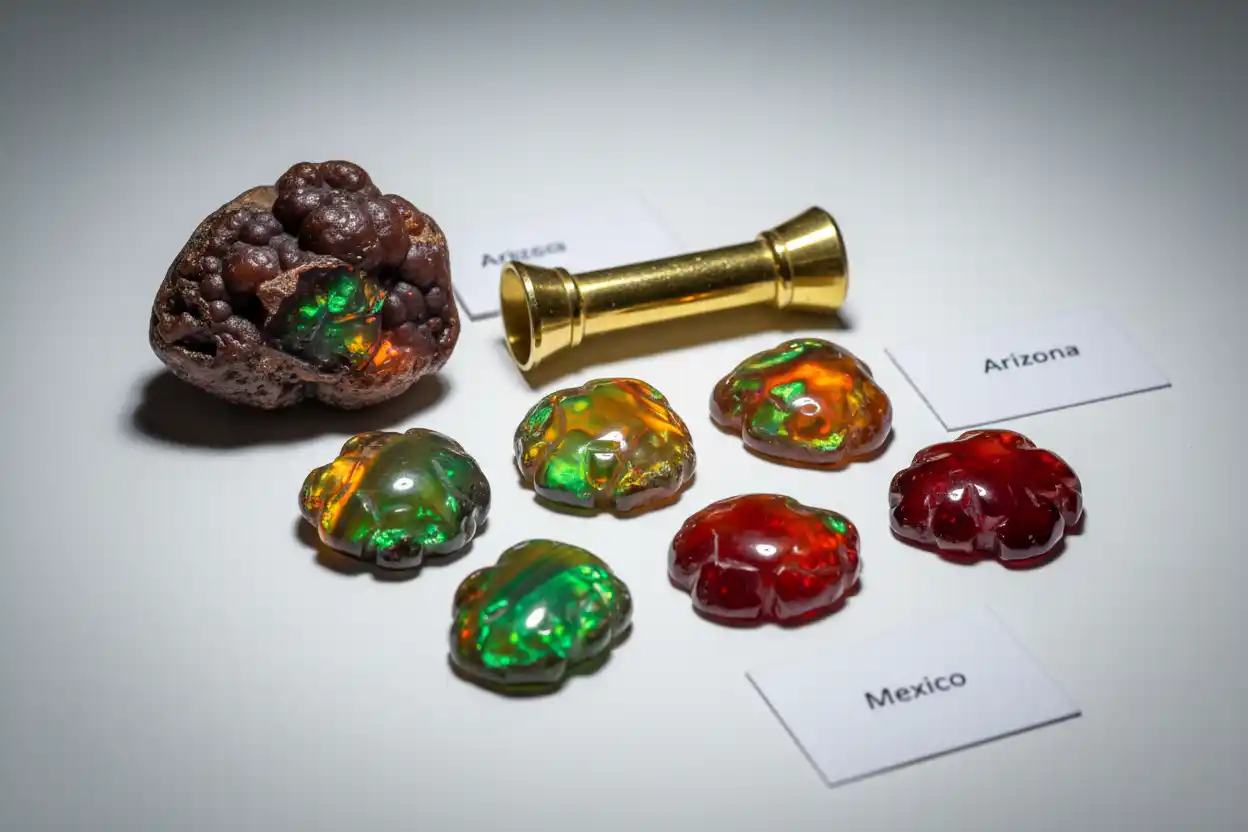
Where to Buy Real Fire Agate and Avoid Glass or Foil Fakes
Real Fire Agate is an iridescent chalcedony prized for flashes of green, gold, yellow, orange and red over a predominantly brown body. Its visual effect comes from thin internal layers associated with iron oxides or hydroxides over botryoidal chalcedony surfaces.
Buying Fire Agate is challenging because much of its quality depends on expert cutting. A rough piece may conceal exceptional color beneath ordinary brown chalcedony, while an inexperienced cutter can remove the iridescent layer or leave so much covering material that the fire remains hidden.
The market also contains ordinary agate photographed under colored lights, foil-backed glass, coated cabochons, resin composites, iridescent coatings and Fire Opal sold under the wrong name.
The Fire Agate meaning and properties guide covers formation and traditional symbolism. This page focuses on sellers, optical quality, cutting, locality, treatment, imitations and value.
Fire Agate Is Not Fire Opal
Fire Agate and Fire Opal are separate gem materials.
Fire Agate is chalcedony, a microcrystalline quartz material. Its “fire” is an iridescent reflected-light effect associated with fine internal layers over rounded botryoidal structures.
Fire Opal is opal with a yellow, orange or red body color. It may or may not display precious opal play-of-color.
The Fire Opal buying guide and Fire Opal price guide own Fire Opal clarity, body color, stability and treatment.
A seller should never use the names interchangeably merely because both materials display warm colors.
How Fire Agate Produces Its Optical Effect
Fire Agate commonly forms as botryoidal chalcedony, meaning its surface develops rounded, grape-like or bubble-like forms.
Extremely thin layers associated with iron oxide or iron hydroxide occur along or over these rounded surfaces. Reflected light interferes within the layered structure, producing iridescent colors.
The effect is structural rather than pigment alone. A brown area can show green, yellow or orange flashes as light strikes the curved layers.
Unlike precious opal’s play-of-color, Fire Agate’s colors may remain comparatively stable as the viewing angle changes. However, brightness and visible pattern still depend strongly on lighting, polish and orientation.
The Agate meaning guide provides family context, while the types of Agate guide separates Fire Agate from lace, moss, plume and fortification varieties.
Choose the Product Form Carefully
| Product | Best source | Main buying concern |
|---|---|---|
| Natural rough | Fire Agate specialist or lapidary supplier | Hidden color, excessive grinding risk and fractures |
| Windowed rough | Specialist lapidary dealer | Whether the exposed fire represents the whole piece |
| Partly carved preform | Experienced Fire Agate cutter | Remaining color depth and surface damage |
| Finished cabochon | Specialist dealer or lapidary | Fire coverage, brightness, carving quality and backing |
| Freeform collector carving | Established cutter | Thin iridescent layers and repair |
| Bead | Requires caution | Weak fire, glass or coated material |
| Ring | Jeweler familiar with irregular cabochons | Protective construction and raised surfaces |
| Pendant | Specialist jeweler | Backing, glue and color visibility |
| Natural specimen | Mineral dealer | Unpolished fire, locality and natural surface condition |
Fire Agate is not generally suited to mass-produced calibrated cutting because the iridescent layers have irregular depth and shape.
Where to Buy Genuine Fire Agate
Specialist Fire Agate cutters
A cutter who regularly works with Fire Agate is often the best source for finished stones.
Expert cutting follows the rounded fire-bearing layers rather than imposing a conventional flat cabochon dome. Finished stones may have carved contours, valleys and freeform edges that preserve the strongest color.
Ask for before-and-after images when available. They can show whether the seller cut the material and understands the rough.
Lapidary suppliers
Rough sellers should provide dry images, close-ups and videos under one neutral light.
Windowed rough has small areas ground away to reveal potential fire. However, one bright window does not guarantee that the color extends deeply or widely.
Ask how much material remains over the iridescent layer and whether the piece has open fractures. Fire can disappear if a cutter removes even a thin layer too aggressively.
Gem and mineral shows
Shows allow you to compare brightness, pattern and cutting directly.
Move a single small light rather than relying on several bright display lamps. Multiple reflections can make an ordinary glossy surface appear more active.
Inspect the stone from the side. Genuine fire should lie within the chalcedony rather than sitting as a colored film on the top or underside.
Established online dealers
The online gemstone buying guide explains protected payment methods and return policies.
For Fire Agate, video is essential. Still images can capture one exceptional flash while hiding dull areas.
Request a continuous unedited rotation under white light. The seller should also show the back, edge and any natural matrix.
Southwestern mineral and jewelry specialists
Arizona, New Mexico, California and northern Mexico have strong historical connections with Fire Agate. Dealers in the southwestern United States may have greater familiarity with the material.
Nevertheless, location of the seller does not prove source. Ask for mine, district or country information and its documentation.
What Genuine Fire Agate Looks Like
Fire Agate usually has a brown, reddish-brown, orange-brown or dark chalcedony body. Iridescent colors can include green, gold, yellow, orange, red and occasionally violet or blue.
The fire may form bubbles, arcs, eyes, ribbons, patches or scale-like patterns following botryoidal contours.
Color coverage varies widely. One stone may have a single concentrated green eye, while another displays several layers of orange and gold across most of its face.
The strongest colors should appear associated with internal rounded structures. They should not resemble flat glitter or a rainbow coating spread evenly over the surface.
Natural stones can contain clear or milky chalcedony, matrix, fractures and colorless areas. A completely uniform face is uncommon.
Fire Agate Versus Precious Opal
Opal can show play-of-color produced by an ordered silica-sphere structure. Its flashes frequently shift in pattern and hue with changing viewing angle.
Fire Agate relies on thin layered interference over chalcedony’s botryoidal surfaces. It is generally harder and less sensitive to ordinary moisture changes than many opals.
The materials also differ in internal structure, refractive properties and appearance.
Do not buy a stone described only as “fire gemstone.” The listing should identify whether it is Agate, Fire Opal, precious opal or another iridescent material.
Fire Agate Versus Iris Agate
Iris Agate is a finely banded Agate that can display rainbow colors when thin slices are viewed in transmitted light.
Fire Agate shows iridescence in reflected light over rounded surfaces and is commonly brown-bodied.
A thin backlit Agate slice may be genuine Iris Agate without being Fire Agate. Conversely, Fire Agate should not require strong backlighting to reveal its main effect.
Fire Agate Versus Ammolite and Labradorite
Ammolite can display vivid red, green, blue and gold iridescence from thin fossil ammonite shell layers. It commonly has different pattern and backing requirements.
Labradorite is feldspar whose labradorescence appears as broad blue, green, gold or multicolored flashes from internal lamellae.
Neither material has Fire Agate’s botryoidal brown chalcedony structure. Nevertheless, edited close-up photographs can make all three appear similar.
Glass Imitations
Glass can imitate brown chalcedony and may contain metallic or iridescent coatings.
Round bubbles, flow lines, mold seams and an unusually uniform body can support glass identification.
Foil-backed glass may create bright color that seems to come from inside. Inspect the edges and back for a reflective layer, paint or adhesive.
The glass-versus-crystal guide and fake-crystal buyer’s guide provide broader identification context.
Coated and Foil-Backed Stones
A transparent or translucent cabochon can be placed over iridescent foil. The reflected colors may look convincing from the front.
Coatings can also create rainbow effects directly on ordinary Agate, glass or quartz.
Inspect the girdle and back. A true internal effect should continue through the stone’s natural structure, while foil usually ends at an assembly line.
A coating can show scratches, peeling, unusually uniform iridescence or color concentrated only on the surface.
Dyed and Enhanced Agate
Fire Agate is not usually valued for a single body color in the same way as dyed blue or pink Agate. However, ordinary chalcedony can be dyed brown, orange or red and marketed as Fire Agate even when it lacks structural fire.
Color treatment cannot manufacture authentic internal iridescence by itself.
The treated-agate guide covers dye, heat, bleaching and other enhancement. The real-versus-fake Agate guide owns broader identity checks.
Ask separately whether the chalcedony is natural and whether its color or fractures have been treated.
Resin and Composite Imitations
Resin can be molded over foil, pigment or iridescent film. It may also contain real Agate fragments.
Bubbles, casting seams, soft scratches and a uniform plastic surface support resin construction.
Some assembled stones use a thin genuine Fire Agate layer attached to backing. Such a doublet can be attractive, but it must be disclosed.
The gemstone treatments guide explains assembly, filling and coating terminology.
How to Evaluate Rough
Rough should be examined as a cutting project rather than a guaranteed finished gem.
Ask whether the seller has exposed any fire-bearing layers. Natural brown chalcedony can contain no visible color or only a very thin iridescent section.
Look for botryoidal contours, iron-rich layers and small windows of fire. Strong natural fire on an unpolished surface is encouraging but still requires skilled cutting.
Fractures can intersect the best layers. A large heavy piece may yield only a small finished stone.
Do not expect the seller to guarantee color hidden under every surface. Instead, pay according to visible evidence and reasonable cutting potential.
How to Judge a Finished Fire Agate
Brightness
The color should remain visible under ordinary directional light, not only under a specialized fiber-optic lamp.
Coverage
More fire can increase value, but one exceptionally bright concentrated eye may be more desirable than broad weak color.
Color range
Green, gold, orange and red are commonly valued. Rare-looking blue or violet should be judged carefully to ensure it is not an artificial reflection.
Pattern
Rounded bubbles, eyes and layered contours create visual depth. The pattern should follow the natural botryoidal structure.
Cutting
The cutter should reveal color without grinding through it. Deep tool marks, cloudy polish and exposed dead brown areas reduce quality.
Thickness
A stone should retain enough chalcedony to remain structurally sound. Cutting too close to the fire layer can leave it fragile.
Back
Inspect for foil, resin, dye, glue and assembly. A natural rough back is not automatically a defect.
Buying Rings
Fire Agate’s chalcedony host provides useful hardness and toughness, but irregular carved surfaces and thin exposed color layers need protection.
The gemstone hardness chart places chalcedony around Mohs 6.5 to 7. The toughness-versus-hardness guide explains why open fractures and carved high points can still chip.
A bezel or custom protective frame is generally better than minimal prongs. Ensure that metal does not press directly on a thin raised bubble.
Buying Pendants and Collector Jewelry
Pendants allow larger freeform stones to display fire with less impact risk. However, they should move enough for the optical effect to become visible.
Ask whether the setting has an open back. A closed backing may hide glue, foil or matrix.
Designer jewelry prices can exceed the raw stone value because every irregular Fire Agate requires custom fitting.
Locality and Provenance
Commercial Fire Agate is strongly associated with the southwestern United States and northern Mexico.
Arizona is an important commercial source, with deposits reported in several counties. Material also occurs in New Mexico and California, while notable Mexican Fire Agate comes from northern districts.
Appearance alone rarely proves a mine. A Deer Creek, Slaughter Mountain or specific Mexican locality premium requires credible supplier information.
The ethical gemstone sourcing guide offers practical questions about legal collecting, claim access, lapidary labor and provenance.
Price and Value
Fire Agate is priced primarily by visible optical quality rather than weight.
Value factors include brightness, color range, coverage, pattern, depth, cutting skill, structural condition, size, treatment and provenance.
A small stone with vivid green and orange fire can command more than a large cabochon with weak brown sheen.
Cutting labor is especially important. Experienced cutters may spend many hours following thin irregular layers with small tools.
Avoid seller-created grades such as “AAA rainbow fire” unless photographs and videos demonstrate the stated quality.
The gemstone pricing guide explains why rarity, labor and usable yield frequently outweigh raw weight.
Questions to Ask the Seller
Ask whether the optical effect is natural internal Fire Agate iridescence, surface coating, foil backing or another phenomenon.
Request a continuous video under one white light. Ask whether color editing was applied.
Determine whether the stone is solid, backed, filled, coated or assembled. For rough, ask how much fire is exposed and whether fractures cross the color-bearing layers.
Request the locality and the basis for that claim. Finally, obtain a return policy that allows inspection under ordinary light.
Professional Identification
A gemologist can confirm chalcedony through refractive index, specific gravity, microscopy and Raman spectroscopy.
Microscopy helps reveal internal iridescent layers, glass bubbles, coatings, foil and resin boundaries.
Testing one brown area can confirm chalcedony without establishing that every visible color is natural. Treatment assessment should focus directly on the iridescent region and stone construction.
Cleaning and Storage
Clean a sound untreated Fire Agate with lukewarm water, mild soap and a soft cloth.
Avoid ultrasonic cleaning when the stone is fractured, filled, backed or glued. The planned ultrasonic-cleaner guide explains why assembly and internal damage matter.
Store the polished face away from harder gemstones. Remove rings before manual work and protect deeply carved surfaces from sharp impacts.
Frequently Asked Questions
1. Is Fire Agate a type of opal?
No. Fire Agate is iridescent chalcedony, while Fire Opal is hydrated silica with yellow, orange or red body color.
2. What creates the fire effect?
Thin internal layers associated with iron oxides or hydroxides over botryoidal chalcedony most likely produce interference colors.
3. Does Fire Agate display play-of-color like opal?
It displays iridescence, but the optical behavior differs from precious opal and may change less dramatically with viewing angle.
4. Is all brown botryoidal Agate Fire Agate?
No. The stone must show a genuine internal iridescent effect, not merely brown rounded chalcedony.
5. Can Fire Agate be dyed?
Agate can be dyed, but dye alone does not create the authentic layered fire effect.
6. Can glass imitate Fire Agate?
Yes. Iridescent glass, foil-backed glass and coated glass can imitate the colors.
7. Why are many Fire Agate cabochons irregularly shaped?
The cutter follows thin curved fire-bearing layers, so freeform carving preserves more color than standardized shapes.
8. Can the fire disappear during cutting?
Yes. Removing too much material can grind through the thin iridescent layer.
9. Is Mexican Fire Agate better than Arizona material?
Not automatically. Value depends on the individual stone’s brightness, color, cutting and condition rather than country alone.
10. Is Fire Agate suitable for daily rings?
Sound stones can be wearable in protective settings, although raised carved areas and fractures require care.
11. Do ordinary stones need laboratory reports?
Usually not. Testing is most useful for expensive pieces, suspected coatings or disputed assembled construction.
12. What is the biggest warning sign in a listing?
Be cautious when rainbow colors appear only under colored studio lights and the seller refuses to show the back, edge or a neutral-light video.
Buy the Fire That Exists Inside the Chalcedony
A strong Fire Agate purchase should remain colorful under one ordinary white light. Its iridescence should follow the stone’s rounded internal structure rather than a flat coating or hidden foil.
The completed general Agate buying guide, F crystal directory, F gemstone directory and visual gemstone guide provide broader context. Choose the piece whose fire, cut and construction remain convincing after the dramatic display lighting is removed.
Safety note: Fire Agate is silica-rich chalcedony. Intact polished pieces are suitable for normal handling, but grinding, carving, drilling or sanding can generate hazardous respirable silica dust. Never dry-work Agate; use professional wet methods, effective extraction and appropriate respiratory and eye protection.