11 Fire Agate Healing Claims: Gentle Traditions, Verified Facts & Safe Use
Fire agate healing properties are usually described through themes of courage, grounding, motivation, confidence, emotional steadiness, protection, creativity, focus, resilience, passion, and purposeful action. The gem’s brown base and flashes of red, gold, orange, green, and occasional violet-blue make those associations visually intuitive, yet appearance does not demonstrate a therapeutic mechanism. Fire agate has not been shown to treat anxiety, depression, fatigue, pain, circulatory problems, hormonal disorders, inflammation, sexual dysfunction, or any other medical condition, nor is there evidence that its iridescence transfers energy into the body. Mineralogically, fire agate is a variety of chalcedony composed predominantly of microcrystalline silica, SiO₂, with iron-rich layers or inclusions involved in its characteristic color effect. Its quartz-based hardness, lack of cleavage, fracture behavior, optical structure, and geological occurrence are measurable properties that should be separated from its wellness symbolism.
11 Fire Agate Claims Inspired by Its Flame-Like Color and Earthy Appearance
- Courage during difficult situations
- Grounding and present-moment awareness
- Motivation and purposeful action
- Confidence and self-belief
- Emotional steadiness under pressure
- Protection and stronger boundaries
- Creativity and energetic thinking
- Concentration and task persistence
- Resilience after setbacks
- Passion and enthusiasm
- Decisive action toward personal goals
These eleven themes are meaningfully different as symbolic or behavioral practices, but they are not eleven scientifically confirmed healing effects. Many fire agate benefits become more useful when translated into actions the reader controls, such as preparing for an uncomfortable task, setting a boundary, reducing distractions, reflecting after a setback, or using a familiar object as a cue to begin.
Fire Agate Mineral Science: Chalcedony Composition, Iridescence, Hardness, and Structure
Fire agate belongs to the chalcedony family and is composed predominantly of extremely fine-grained silica associated with quartz and the microscopic structural complexity typical of chalcedony. Its idealized chemical formula is therefore SiO₂. Chalcedony is commonly described as microcrystalline to cryptocrystalline quartz, often with moganite in the fine intergrowth, rather than as a single large transparent quartz crystal.
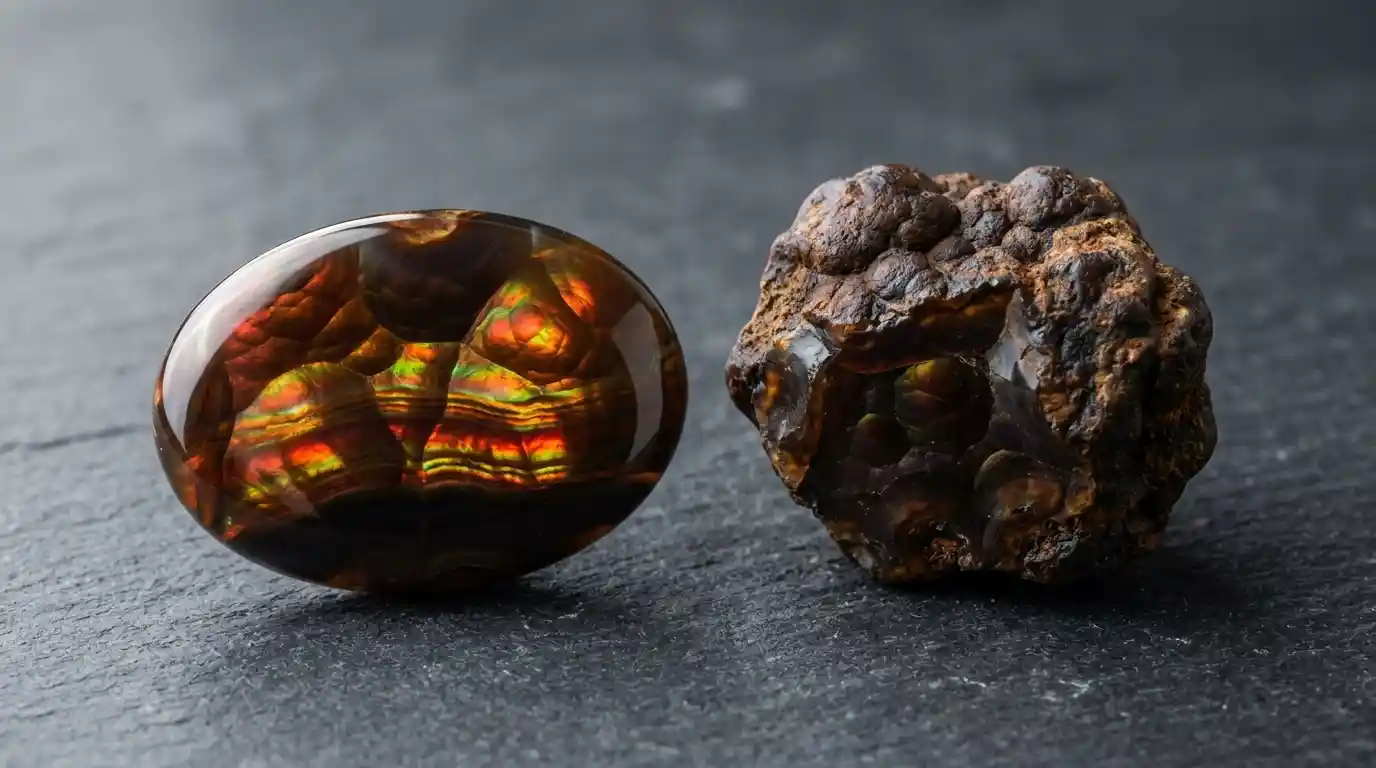
The gemstone usually has a brown to reddish-brown bodycolor and a botryoidal, grape-like growth structure. What makes fire agate distinctive is its iridescent “fire,” which can display red, orange, gold, green, and occasionally violet or blue. Thin iron-rich layers, particularly iron hydroxide phases such as goethite, are strongly associated with the phenomenon. Optical research indicates that thin-film interference is the most probable explanation for the intense reflected colors, although the exact nanoscale structure responsible for the effect remains an active area of study.
This distinction matters because fire agate does not produce color in the same way as precious opal. Its iridescence is associated with very thin iron-rich layers within chalcedony, whereas precious opal’s play-of-color arises from light interacting with an ordered silica-sphere structure. Fire agate’s color can therefore remain relatively stable from certain viewing directions compared with the shifting spectral display of opal.
Fire agate is generally around 6.5 to 7 on the Mohs hardness scale. It has no useful cleavage and is considerably more durable against scratching than opal, calcite, or fluorite. The stone remains brittle, however, and may fracture unevenly or conchoidally when struck. A polished cabochon can withstand normal jewelry wear well, but thin edges and raised contours can still chip.
Its luster ranges from vitreous to waxy depending on surface finish and chalcedony texture. Transparency generally falls from translucent to opaque. Fire agate should not be confused with fire opal simply because both names contain “fire.” Fire opal is hydrated amorphous silica, while fire agate is silica-rich chalcedony with a much harder and more structurally crystalline aggregate.
Fire Agate Formation, Naming, and Important Southwestern Localities
Fire agate forms in silica-rich geological environments where chalcedony develops in cavities and fractures, often in volcanic rocks. Repeated mineral deposition creates botryoidal silica layers, while iron-rich films or inclusions develop between layers. When lapidaries carefully grind and polish the surface to expose these structures without cutting through the color-producing layers, the finished stone can reveal vivid iridescence.
The name is descriptive rather than mineral-species terminology. “Fire” refers to the flashes of warm and spectral color, while “agate” places the gem within the chalcedony-agate family. Fire agate does not have a formal type locality because it is a variety rather than an independently recognized mineral species.
Important occurrences are concentrated in the southwestern United States and Mexico. Arizona is particularly well known, including localities in the Black Mountains and around Saddle Mountain, while material also occurs in parts of California and New Mexico. Mexico has produced significant fire agate as well, including material from northern and central regions. These limited geographic occurrences distinguish fire agate from ordinary chalcedony, which is found worldwide.
The commercial fire agate identity is relatively modern, so its current crystal-healing symbolism should not be projected backward into ancient agate traditions. Agate itself has a long archaeological history, but evidence for ancient societies recognizing this specific iridescent variety and assigning today’s eleven wellness meanings to it is lacking. The fire agate meaning is therefore best understood as a mixture of modern symbolism and the stone’s striking visual character.
Courage, Grounding, and Motivation Claims
1. Courage Before an Uncomfortable Action
Fire agate is often described as a courage stone, perhaps because its flashes resemble flame. The gemstone does not suppress fear or alter the neurological systems involved in threat perception. A practical ritual is to hold or look at the stone before an uncomfortable but appropriate task and identify the exact action being avoided. Send the message, begin the application, make the appointment, or speak the prepared opening sentence. Courage comes from acting despite discomfort rather than from chalcedony transferring bravery.
2. Grounding Through Sensory Attention
The stone’s substantial feel and earthy brown colors have encouraged grounding symbolism. Fire agate does not electrically ground the body in a therapeutic sense, but it can work as a tactile anchor during a stressful moment. Notice its weight, temperature, polished contours, changing flashes, breathing rhythm, and surrounding sounds. The exercise directs attention toward immediate sensory information, which is different from claiming the stone changes physiology through an invisible field.
3. Motivation and Purposeful Action
Another common belief says fire agate stimulates motivation. There is no evidence that silica or iron-rich layers increase dopamine, stamina, or physical energy. A more useful approach is to assign the stone to a specific start ritual. When it is placed beside the planner or computer, begin one predetermined task before checking notifications. The routine can reduce hesitation because the cue has a defined behavioral meaning.
Confidence, Emotional Steadiness, and Protection Claims
4. Confidence Through Preparation
Fire agate’s strong visual character makes confidence a natural symbolic theme. Wearing it does not biologically increase self-esteem. Before a meeting, presentation, or difficult conversation, use the stone as a reminder to identify what you know, rehearse the first point, anticipate one likely challenge, and decide how you will respond. Preparation supports confidence more plausibly than expecting a mineral to create it.
5. Emotional Steadiness Under Pressure
Some practitioners say fire agate stabilizes emotions. There is no demonstrated mechanism by which chalcedony regulates mood or stress hormones. The stone can instead become a pause cue: do not respond immediately, slow the breathing, state the facts of the situation, and decide whether the problem requires action now. The stone does not perform emotional regulation; the structured delay may help the person regulate their response.
6. Protection as a Boundary Practice
Fire agate is frequently described as protective. No gemstone has been shown to form a barrier against bad luck, hostility, accidents, or harmful “energy.” Protection can be reframed as practical boundary-setting. Before entering a difficult environment, decide what behavior you will accept, how you will communicate a limit, and what you will do if that limit is ignored. The protective mechanism is the plan.
Creativity, Focus, and Resilience Claims
7. Creativity Through Deliberate Exploration
The unexpected shifts of color in polished fire agate can make it a stimulating object for creative work. There is no evidence that it directly enhances creativity in the brain. A writer, designer, or artist might instead use the stone as a cue for an unedited brainstorming interval in which ideas are generated before they are judged. The value comes from creating room for exploration.
8. Concentration and Task Persistence
Fire agate is also associated with focus and determination. The gemstone cannot lengthen attention span through its mineral structure. A useful desk ritual is to place it beside the active task, silence notifications, and work for a fixed period without switching projects. If another thought appears, record it and return to the task. The ritual controls the environment rather than relying on a crystal effect.
9. Resilience After Setbacks
The gem’s layered formation makes resilience another appealing metaphor. Fire agate does not make the nervous system more resilient, but it can become a reminder to examine a setback constructively. Identify what failed, what was outside your control, what remains recoverable, and what should change next time. This turns resilience into learning and adjustment.
Passion and Decisive Action Claims
10. Passion and Enthusiasm
Warm orange and red flashes often lead to claims that fire agate awakens passion, sexuality, or life force. There is no evidence that it changes libido, reproductive hormones, cardiovascular performance, or physical vitality. A safer interpretation is to use the stone as a reminder to make time for something genuinely engaging, whether creative work, exercise appropriate to your abilities, a relationship conversation, or a neglected interest.
11. Decisive Action Toward a Goal
Fire agate is sometimes presented as helping people move from thought into action. The stone does not make decisions. It can mark a useful decision rule: once enough information has been gathered, identify the smallest reversible next step and take it. This reduces endless planning while keeping control with the person rather than assigning agency to the gemstone.
Fire Agate Chakra Associations: Root Stability and Sacral or Solar Plexus Symbolism
Modern crystal systems commonly associate fire agate with the root chakra because of its brown bodycolor and grounding reputation. Its orange and red flashes also lead some practitioners to connect it with the sacral chakra, while gold and yellow tones may be linked with the solar plexus chakra. These associations usually represent stability, creativity, confidence, motivation, and personal power.
Chakras are a spiritual framework rather than anatomical structures. Fire agate has not been shown to influence the spine, reproductive organs, digestive system, endocrine function, or another body system through chakra placement. Someone who values the framework can still use it as an organized meditation practice, moving from stability to creativity and then purposeful action without presenting symbolism as physiology.
Fire Agate Physical Care: Scratch Resistance, Fracture, Water, Chemicals, Heat, and Cleaning
Fire agate is relatively durable for jewelry because its chalcedony base is around Mohs 6.5 to 7 and has no useful cleavage. Pendants, earrings, beads, and well-designed cabochons can tolerate normal use, while rings and bracelets face more frequent impacts. Hardness protects against many scratches but does not prevent chipping, especially along thin edges or sculpted contours.
Quartz, chalcedony, and fire agate can scratch softer gemstones, while topaz, corundum, diamond, and some other harder stones can scratch fire agate. Separate storage helps protect polished surfaces. Hard impacts against tile, concrete, metal edges, or other gemstones should also be avoided.
Plain water is generally safe for brief cleaning of natural untreated fire agate. Chalcedony is not a hydrated mineral and is not readily soluble in ordinary water. Warm water, mild soap, and a soft cloth or brush are suitable for routine care. Long soaking is unnecessary, particularly when a stone is mounted with adhesives or has uncertain treatment.
Avoid hydrofluoric acid and industrial fluoride chemicals because they attack silica and are highly hazardous. Strong alkaline cleaners and aggressive household chemicals are also unnecessary. Steam adds avoidable thermal stress. Although robust untreated chalcedony may sometimes tolerate ultrasonic cleaning, it is safer to avoid ultrasonics when a fire agate has fractures, glued components, unusual coatings, thin carved layers, or an uncertain treatment history.
Fire agate also requires skilled lapidary work because the iridescent layers can be removed if cutting goes too deep. Grinding and polishing silica-rich gemstones generate respirable dust, so dry cutting should be avoided. Proper wet cutting, extraction, eye protection, and suitable respiratory controls are important.
Ritual Cleansing Fire Agate With Low-Risk Dry Practices
Ritual cleansing does not require changing the gemstone physically. In spiritual practice, it can simply mark the end of one intention and the beginning of another. There is no scientifically demonstrated unwanted energy that must be washed out of fire agate.
Sound, reflection, intention-setting, dry placement, or briefly holding the stone while deciding what it will represent next are gentle options. If physical dirt is present, clean it separately with mild soap and water rather than treating ordinary washing as proof that invisible energy has been removed.
Saltwater immersion, chemical sprays, flame, high heat, abrasive powders, and prolonged exposure to extreme conditions are unnecessary. A simple ritual protects the polished optical surface that makes fire agate valuable.
Conclusion
Fire agate’s most remarkable verified property is not healing energy but an unusual optical structure within durable chalcedony. Its iron-rich layers can produce extraordinary red, gold, green, and orange iridescence, while its quartz-based composition provides much greater everyday durability than opal. The eleven wellness themes can still function as cues for courage, focus, boundaries, creativity, and action as long as those symbolic uses remain separate from medical claims.
Frequently Asked Questions About Fire Agate Healing Properties
What are the main fire agate healing properties people claim?
Common claims include courage, grounding, motivation, confidence, emotional steadiness, protection, creativity, focus, resilience, passion, and decisive action. These are contemporary spiritual or wellness themes rather than proven therapeutic effects.
What is fire agate made of?
Fire agate is an iridescent variety of chalcedony composed predominantly of silica, SiO₂. Thin iron-rich layers, often involving goethite or related iron hydroxides, are associated with its brown bodycolor and iridescent fire.
Is fire agate the same as fire opal?
No. Fire agate is chalcedony, while fire opal is hydrated amorphous silica. Fire agate is generally harder and its iridescence is produced differently from opal’s play-of-color.
How hard is fire agate?
Fire agate is generally around Mohs 6.5 to 7. It has no useful cleavage and is fairly durable, although it remains brittle enough to chip or fracture after a hard impact.
Where is fire agate found?
Important occurrences are concentrated in the southwestern United States and Mexico, particularly Arizona and neighboring regions. This restricted distribution makes high-quality fire agate less common than ordinary chalcedony.
Is fire agate scientifically proven to provide protection or energy?
No. There is no evidence that fire agate creates a protective field or transfers therapeutic energy. It can instead be used symbolically as a reminder to set boundaries, prepare carefully, or begin a planned action.
Which chakras are associated with fire agate?
Modern crystal systems commonly connect fire agate with the root chakra and may also associate its orange, red, or gold colors with the sacral and solar plexus chakras. These are spiritual associations rather than anatomical relationships.
Can fire agate go in water?
Natural untreated fire agate can generally tolerate brief contact with plain water. Warm water and mild soap are suitable for ordinary cleaning, while prolonged soaking is unnecessary.
How should fire agate be physically cleaned?
Use warm water, mild soap, and a soft cloth or brush. Avoid harsh chemicals, hydrofluoric acid, excessive heat, hard impacts, and ultrasonic cleaning when fractures, coatings, glue, or treatments are present.
What should buyers look for in fire agate?
Strong iridescence, attractive color range, careful cutting that preserves the fire-producing layers, good polish, and minimal distracting damage are important. The workbook-verified where to buy fire agate topic focuses specifically on sourcing and buying risks.
Crystal healing claims are traditional or personal beliefs and should not replace qualified medical or mental health care.