11 Hidden Garden Quartz Benefits: Helpful Uses, Evidence, Safe Use & Clear Limits
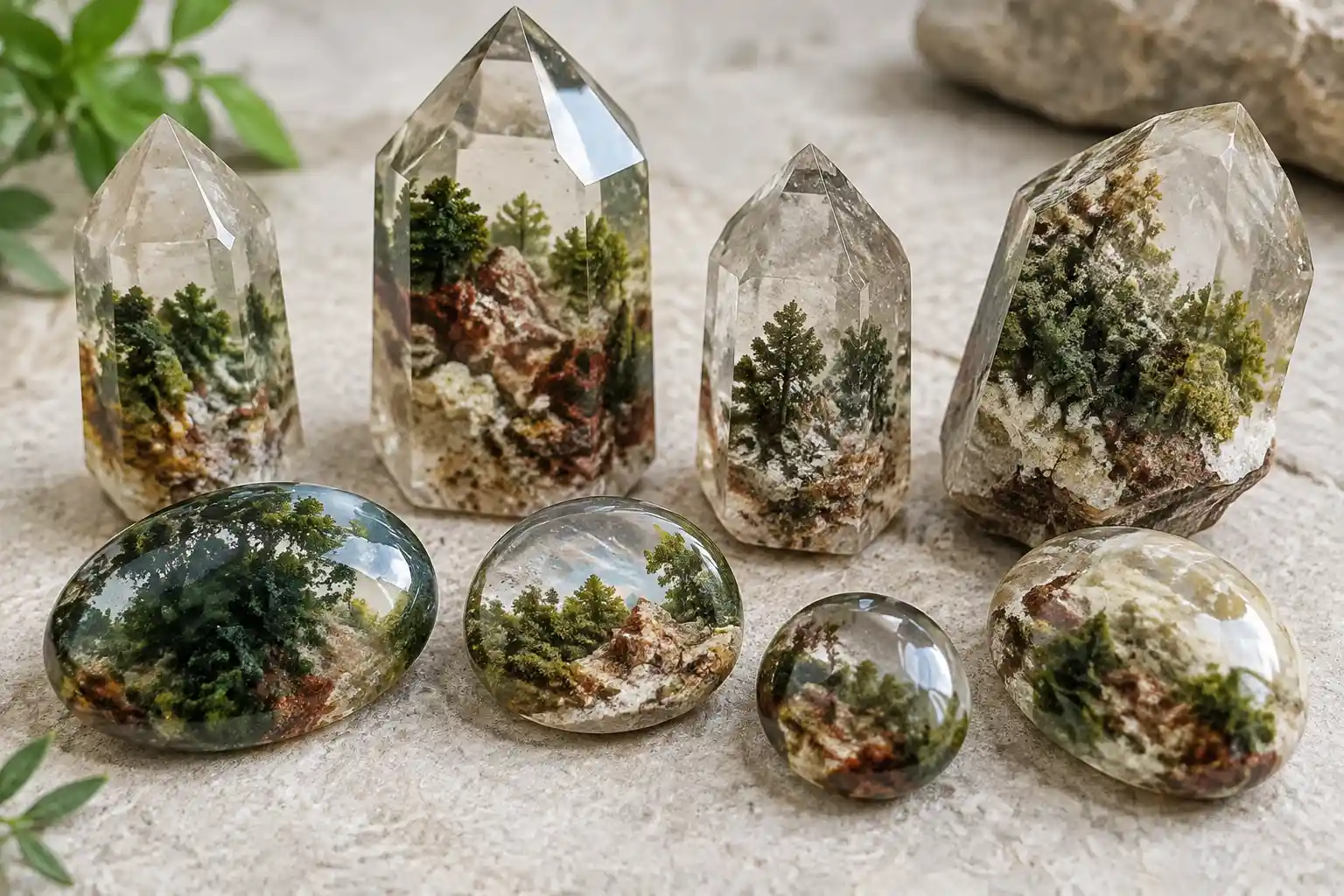
Garden Quartz benefits begin with an extraordinary feature: the most desirable stones contain natural internal inclusions that can resemble forests, moss, clouds, underwater scenes, mountains, or miniature landscapes. Garden Quartz is not a separate mineral species. It is quartz, SiO₂, containing visually interesting inclusions, and it is also widely sold under the trade name lodolite. The name describes appearance rather than one fixed inclusion chemistry.
This distinction is important because Garden Quartz inclusions vary considerably. Chlorite, iron oxides or hydroxides, clay-like particles, mineral coatings, fluid inclusions, growth features, and combinations of several substances may occur. Some specimens also contain true phantoms, where an earlier stage of quartz growth was coated or outlined before later transparent quartz enclosed it. Not every Garden Quartz is phantom quartz, however, and not every green or brown inclusion can be identified confidently from color alone.
Because the host is quartz, many practical Garden Quartz benefits come from Mohs hardness 7, good polish, transparency, crystal habit, and the ability to preserve internal geological scenes within a durable gemstone. Modern crystal traditions additionally associate Garden Quartz with growth, grounding, memory, connection with nature, manifestation, or emotional reflection. Those interpretations can be meaningful symbolically, but the inclusions do not medically detoxify the body, improve memory, treat anxiety, or transfer healing minerals through skin contact.
11 Garden Quartz Benefits at a Glance
- Scenic natural inclusions give individual stones highly distinctive landscape-like appearances.
- Quartz hardness of 7 provides useful durability for many jewelry and decorative applications.
- Transparent crystal allows inclusions to be viewed three-dimensionally rather than only from one polished surface.
- Phantom growth structures can preserve evidence of earlier stages in crystal development.
- Varied inclusions provide opportunities for mineralogical and geological investigation.
- Cabochons, freeforms, spheres, and polished points can emphasize different internal scenes.
- Natural crystal specimens allow collectors to study the relationship between inclusions and quartz growth.
- Identification helps separate genuine included quartz from glass, resin, composite products, and misleading trade descriptions.
- Jewelry designers gain stones that can function like miniature natural artworks without requiring intense body color.
- Photography and macro viewing can reveal inclusion details difficult to notice with the unaided eye.
- Modern symbolism can represent growth, perspective, or connection with nature when kept separate from medical claims.
Scenic Inclusions Create the Most Distinctive Garden Quartz Benefit
Visual individuality is at the center of Garden Quartz benefits. A transparent crystal may contain wispy green inclusions that resemble moss, reddish-brown forms that look like soil, pale clouds, suspended particles, layered mineral coatings, or combinations that create surprisingly landscape-like scenes. The resemblance is interpretive, but the inclusions themselves are natural geological features when the specimen is genuine.
The strongest examples have enough clear quartz around the inclusions for the internal scene to remain readable. Transparency creates depth because one inclusion may lie near the front of a cabochon while another sits much farther inside. Rotating the stone changes the apparent relationship among these features and can reveal structures that were hidden from the first angle.
These Garden Quartz benefits make the gem very different from uniformly colored stones. A buyer is not simply choosing green versus red or light versus dark. They are selecting an individual internal composition.
That uniqueness also means photographs should show the actual stone whenever possible. Stock imagery is especially unhelpful for included quartz because another specimen from the same parcel may contain a completely different internal scene.
Quartz Hardness Gives Included Stones Useful Jewelry Durability
Garden Quartz is fundamentally quartz, so it generally shares quartz’s Mohs hardness of 7 and lack of prominent easy cleavage. These physical properties provide useful Garden Quartz benefits for pendants, earrings, beads, bracelets, cabochons, polished points, and appropriately protected rings.
Quartz resists ordinary scratching better than many softer ornamental gems, but inclusions and fractures still matter. A heavily included crystal may contain internal weaknesses that make one specimen less durable than a cleaner piece. Thin points, sharp corners, surface-reaching fractures, and heavily included zones deserve particular attention when the stone will be worn rather than displayed.
Jewelry settings can compensate for some of these vulnerabilities. A bezel around a cabochon protects its perimeter, while pendants and earrings expose the stone to fewer impacts than rings.
The important point is that the words quartz hardness do not override the condition of the individual gem. Garden Quartz benefits from a durable host, but internal structures remain part of its physical reality.
Transparent Quartz Turns Inclusions into Three-Dimensional Geological Scenes
One reason Garden Quartz feels unusually immersive is that the inclusions are enclosed inside transparent or translucent quartz. Instead of sitting only on the surface, they occupy several depths within the crystal, allowing the viewer to look through one layer toward another.
This three-dimensional character provides some of the most interesting Garden Quartz benefits for collectors. A stone that appears to contain a flat green patch from one direction may reveal a complex mineral coating when rotated. A pale internal veil may intersect darker particles and suddenly resemble a mountain ridge or underwater landscape.
These images are visual associations rather than literal objects. The crystal does not contain tiny plants, forests, soil gardens, or preserved ecosystems. The scenery arises because mineral and fluid inclusions happen to create forms that the human eye recognizes as familiar natural environments.
Understanding that difference preserves both wonder and accuracy. The inclusions are remarkable precisely because geological processes created forms that look unexpectedly organic.
Phantom Growth Can Preserve Earlier Stages of Quartz Formation
Some Garden Quartz contains phantom structures, and these provide especially valuable evidence of crystal growth. A phantom forms when an earlier crystal surface becomes coated with another substance or otherwise marked, after which quartz growth resumes and encloses that earlier outline.
The result can resemble a crystal inside another crystal.
This creates important Garden Quartz benefits for mineral education because a phantom is effectively a preserved boundary between two stages of growth. The coating may be chlorite, iron-rich particles, clay-like substances, or another mineral depending on the specimen and geological environment.
Not every included quartz is a phantom. Randomly distributed particles, wisps, fluid inclusions, and irregular mineral masses do not become phantom quartz simply because they are visually interesting.
That distinction matters in the marketplace because the terms Garden Quartz, lodolite, included quartz, and phantom quartz are sometimes used too loosely. Accurate description makes the specimen more interesting because it tells the buyer what type of geological feature is actually present.
Inclusion Chemistry Can Be More Complicated Than Color Suggests
Green inclusions are often labeled chlorite, red inclusions may be called hematite, and brown areas may be assigned specific mineral names with little evidence. Some of those identifications may be correct, but appearance alone is not always enough.
This complexity creates one of the more educational Garden Quartz benefits. Mineral identification may require microscopy, spectroscopy, Raman analysis, X-ray methods, or other testing when the exact inclusion species matters.
Garden Quartz is a trade description rather than a fixed formula. One stone may contain chlorite-rich inclusions, another iron oxides, another clay-like particles, and another a mixed inclusion scene whose components cannot be identified reliably from photographs.
A responsible seller can describe color and morphology without pretending certainty that does not exist. Phrases such as green mineral inclusions or iron-rich reddish inclusions may be more accurate than naming a species solely from appearance.
For collectors, uncertainty can become part of the investigation rather than a reason to invent a simple answer.
Lapidary Cutting Can Reveal Very Different Scenes from the Same Rough
The orientation of a cut has enormous influence on Garden Quartz benefits. A slice made through one side of a crystal may expose a dramatic inclusion cluster, while a perpendicular cut can reveal open clear quartz with only a small trace of the same internal structure.
Cabochons work well when inclusions are concentrated near one visual plane, while polished freeforms can preserve irregular scenic areas that would be lost in a calibrated oval. Spheres can create a completely different experience because the curved surface allows the viewer to explore inclusions from almost every direction.
Natural crystal points may need very little alteration when the inclusions are already visible through polished or naturally clear faces.
A skilled cutter therefore works more like a curator than a decorator. The internal features already exist, and the challenge is deciding which orientation reveals them most effectively while preserving structural stability.
These lapidary Garden Quartz benefits are one reason large rough should not be cut blindly simply to maximize the number of finished pieces.
Garden Quartz Collecting Combines Mineralogy with Visual Storytelling
Collectors often choose Garden Quartz because individual stones invite interpretation. One specimen may resemble a forest, another a desert, another a cloudy sky, and another an underwater garden. These perceived scenes are subjective, but they make collecting highly personal.
At the same time, serious collections can retain scientific value. Natural crystal habit, locality, matrix, inclusion type, phantom structure, transparency, fractures, and provenance all contribute information that exists independently of visual resemblance.
Documented Brazilian material, particularly included quartz associated with Minas Gerais, is well known in the trade under the lodolite name. Other localities can also produce interesting included quartz, so the trade term should not automatically be treated as proof of one exact mine or one inclusion chemistry.
Someone considering where to buy Garden Quartz benefits from realistic photographs, multiple angles, actual dimensions, treatment disclosure, origin information when known, and an explanation of whether the item is natural crystal, polished freeform, cabochon, or composite.
Identification Protects Buyers from Glass, Resin, and Misleading Trade Claims
Included quartz can be imitated because bubbles, colored fragments, metallic particles, and plant-like objects can be enclosed inside glass or resin to create convincing decorative pieces. Some manufactured products may be attractive in their own right, but they should not be sold as naturally included quartz.
Identification therefore creates practical Garden Quartz benefits. Quartz has characteristic hardness, refractive properties, crystal growth features, fracture behavior, and inclusions that differ from many plastics and glasses. Natural internal fractures and mineral particles can be useful clues, although no single home test is reliable in every case.
Buyers should be especially cautious when inclusions look unnaturally bright, perfectly arranged, or impossible for the claimed geological environment. Drilled or assembled pieces may also conceal glue or interfaces.
The goal is not to distrust every unusually beautiful specimen. It is to separate natural geological inclusion scenes from decorative objects manufactured to imitate them.
Garden Quartz Jewelry Functions Like Wearable Natural Artwork
Garden Quartz benefits jewelry designers because a stone can serve as the entire visual focus without strong body color or intense brilliance. The transparent quartz acts almost like a window through which the internal scene becomes the design.
Minimal settings often work well. Silver-colored metal can keep attention on green or brown inclusions, while yellow or rose gold may warm iron-rich red and amber tones. A large freeform pendant can preserve an inclusion landscape that would be diminished if the cutter forced it into a small calibrated shape.
Matching pairs are difficult because inclusion patterns rarely repeat, so earrings may work better as complementary rather than identical stones.
Jewelry also gives personal meaning to the internal landscape. A stone that resembles a forest may appeal to someone because of their connection with hiking or a particular place, while another person may simply enjoy the mineralogical complexity.
The design succeeds through the natural inclusion scene rather than through claims that the quartz contains actual botanical life.
Macro Photography Reveals Details Hidden from Casual Viewing
Photography adds another dimension to Garden Quartz benefits because magnification can reveal structures too small to appreciate with the unaided eye. Fine needles, coatings, tiny negative crystals, fluid inclusions, particle layers, phantom boundaries, and fracture patterns may all emerge under close inspection.
Lighting direction is crucial. Backlighting can emphasize transparency, while side lighting may reveal reflective inclusions and surface relief. Rotating the stone can dramatically change which internal structures become visible.
Accurate photography should avoid turning natural colors into unrealistic neon shades. Strong editing can misrepresent green chlorite-like inclusions, deepen red iron-rich areas, or create contrast that the buyer will not see in hand.
For collectors, photographs can become part of the specimen record, documenting internal features before the stone is mounted, repolished, or transferred to another owner.
Modern Symbolism Can Represent Growth and Connection with Nature
The visual resemblance to moss, forests, gardens, soil, or miniature landscapes explains why modern spiritual traditions commonly connect Garden Quartz benefits with nature, growth, grounding, patience, manifestation, or personal development.
These associations work well as symbolism because the stone genuinely looks landscape-like. Someone may keep a Garden Quartz specimen near a plant collection because its inclusions remind them of natural environments, or wear one because it represents a period of personal growth.
Beliefs surrounding Garden Quartz healing properties may extend into emotional healing, grounding, memory, immune support, detoxification, abundance, or energetic cleansing. These ideas belong to spiritual practice rather than established medicine.
The mineral inclusions also do not transfer nutritional benefits through the skin. Iron-bearing particles, chlorite, or other components remain geological inclusions rather than supplements.
Safe Care Preserves Quartz and Its Internal Inclusion Features
Garden Quartz is relatively durable because the host is quartz, but care should still reflect the individual stone. Fractures, cavities, inclusions reaching the surface, coatings, and repaired areas can make one specimen more vulnerable than another.
Lukewarm water, mild soap, and a soft cloth or brush are suitable for many stable untreated pieces. Aggressive heat, thermal shock, harsh chemicals, and unnecessary ultrasonic cleaning should be avoided when fractures or unknown treatments are present.
Cutting and drilling create crystalline-silica dust, so lapidary work requires wet methods, ventilation, eye protection, and appropriate respiratory precautions. Finished jewelry does not create the same airborne exposure as dry grinding.
Garden Quartz should also not be ground for ingestion or placed into homemade drinking remedies simply because its inclusions resemble natural landscapes. Its genuine value lies in geology, collecting, jewelry, and symbolism rather than internal consumption.
Conclusion
Garden Quartz benefits include scenic natural inclusions, quartz-family durability, three-dimensional internal structure, phantom growth, mineralogical investigation, lapidary versatility, collecting, identification, jewelry design, photography, and meaningful modern symbolism. The stone is quartz with inclusions rather than a separate mineral species, and the exact inclusion chemistry varies considerably between specimens.
The strongest Garden Quartz benefits come from appreciating those differences honestly. A genuine stone can preserve an extraordinary geological scene without containing literal moss or plants, while modern themes involving growth, nature, or perspective can add personal meaning without becoming medical claims. Accurate identification, careful cutting, realistic seller disclosure, and safe quartz handling allow these included crystals to remain both beautiful and scientifically interesting.
FAQs
What are the main Garden Quartz benefits?
The most verifiable Garden Quartz benefits include quartz durability, collecting, geological study, scenic inclusions, phantom growth, jewelry use, identification practice, lapidary work, and photography.
What is Garden Quartz?
Garden Quartz is a trade name for quartz containing visually interesting natural inclusions. It is also commonly sold as lodolite.
Is lodolite a separate mineral?
No. Lodolite is an unofficial trade name used for included quartz, especially material associated with Brazil.
What are the inclusions in Garden Quartz?
They vary by specimen and may include chlorite, iron oxides or hydroxides, clay-like particles, mineral coatings, fluid inclusions, phantoms, or combinations of several features.
Does Garden Quartz contain real moss or plants?
No. Landscape-like or mossy appearances are produced by mineral and fluid inclusions rather than preserved miniature vegetation.
Is Garden Quartz the same as phantom quartz?
Not necessarily. Some Garden Quartz contains true phantom growth structures, but many stones contain irregular inclusions without a recognizable earlier crystal outline.
How hard is Garden Quartz?
Because the host gemstone is quartz, Garden Quartz generally has a Mohs hardness of 7.
Is Garden Quartz suitable for jewelry?
Yes. Many stones are durable enough for pendants, earrings, bracelets, beads, and protected rings, although fractures and heavy inclusions should be considered individually.
Can Garden Quartz be fake?
Glass, resin, composites, and other manufactured products can imitate included quartz, so identification and trustworthy seller disclosure matter.
Does Garden Quartz help with grounding or manifestation?
Grounding, manifestation, and nature-connection themes are modern spiritual interpretations rather than scientifically demonstrated effects of the gemstone.
Does Garden Quartz have healing benefits?
There is no established clinical evidence that Garden Quartz treats physical or mental-health conditions through ordinary wearing or handling.
Garden Quartz benefits described as healing, grounding, manifestation-related, emotional, abundance-related, detoxifying, or energetic effects remain spiritual and personal beliefs and should not replace qualified medical, mental-health, or financial advice.