Where to Buy Real Garden Quartz and Avoid Artificial Inclusions
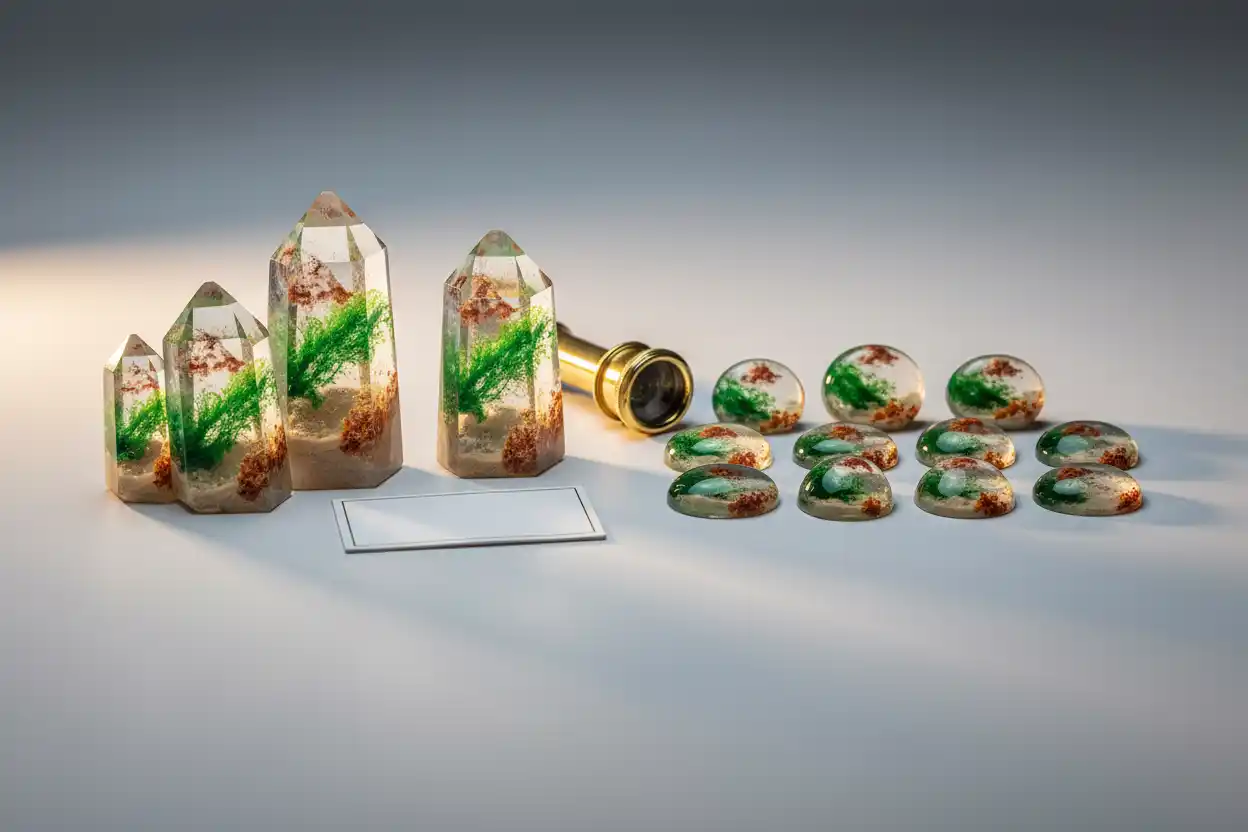
Real Garden Quartz is transparent or translucent quartz containing mineral inclusions that create landscape-like scenes. Green, cream, brown, red, orange, gray and black inclusions may resemble moss, forests, clouds, underwater gardens, mountains or miniature worlds suspended inside the crystal.
The material is also sold as Lodolite, Scenic Quartz and Landscape Quartz. Under the tracker’s canonical boundary, Lodolite is an alternate trade name for Garden Quartz rather than a separate gemstone requiring another page.
Garden Quartz is not defined by one inclusion mineral. Chlorite is common in many commercial pieces, but iron oxides, clay minerals, other silicates, mineral crystals and natural fluid-filled cavities may also contribute to the scene. Therefore, a seller who claims that every inclusion is chlorite may be oversimplifying the material.
The Garden Quartz meaning and properties guide covers its identity and traditional symbolism. This buying guide focuses on natural inclusion structures, seller evidence, polished versus natural forms, artificial color, filling, assembly and value.
Understand What the Garden Quartz Name Means
Garden Quartz is a descriptive trade name rather than a separate mineral species. The host is quartz, SiO2, while its distinctive appearance comes from material enclosed during one or more stages of crystal growth.
The quartz family guide covers quartz formation and mineral properties. Garden Quartz occupies a narrower market centered on scenic inclusions rather than colorless clarity.
Some pieces contain mineral material entirely enclosed within the quartz. Others have inclusions connected to the surface through fractures, channels or partially open cavities.
That distinction matters because surface-reaching inclusion zones can accept dye, oil or resin. They can also collect dirt during cutting and polishing.
The clear quartz guide explains the colorless host, while the types of clear quartz guide separates included, phantom, optical and growth-habit varieties.
Choose the Product Form Before Shopping
| Product form | Best source | Main buying concern |
|---|---|---|
| Natural crystal point | Specialist mineral dealer | Natural termination, repaired tip, surface-reaching inclusions and locality |
| Partly polished specimen | Mineral or lapidary dealer | Which faces are natural, hidden fractures and filler |
| Cabochon | Included-quartz specialist | Natural inclusions, backing, resin and polish |
| Faceted collector gem | Specialist gem dealer | Inclusion stability, identity and internal fractures |
| Sphere | Experienced lapidary retailer | Glass, resin, glued halves and inclusion editing |
| Carved tower | Crystal retailer with exact-item video | Artificial point, repaired tip and color enhancement |
| Tumbled stone | Reputable dealer | Weak inclusion scene, dye and mixed quartz varieties |
| Pendant | Independent jeweler | Drilling, glue, backing and fracture stability |
| Bead strand | Established bead supplier | Artificial inserts, resin, glass and drill-hole fractures |
| Collector inclusion specimen | Mineral dealer with provenance | Accurate inclusion identification and source evidence |
A natural crystal point should be evaluated for growth surfaces and termination condition. A sphere or cabochon should instead be judged for lapidary construction, inclusion placement and polish.
Where to Buy Genuine Garden Quartz
Specialist included-quartz dealers
A seller who regularly handles Garden, Phantom, Rutilated and Tourmalinated Quartz is usually more reliable than a shop that labels every included stone Lodolite.
The listing should show the exact piece from several directions. Ask for a slow video over both dark and light backgrounds because inclusion depth and fracture visibility change with the background.
A knowledgeable seller should separate observations from certainty. “Green inclusion believed to be chlorite” is more credible than an unsupported list of five precisely named minerals.
Mineral dealers
Mineral dealers are the strongest source for naturally terminated crystals, specimens with matrix and pieces supported by locality labels.
Request photographs of the base, termination and every major face. A polished window may reveal the interior while preserving most natural crystal surfaces, but the description should identify the altered face.
Ask whether the specimen was repaired, acid-cleaned, filled or mounted permanently. Repairs can be acceptable when disclosed and reflected in the price.
Gem and mineral shows
Shows allow you to compare natural inclusions with dyed fractures, resin, glass and assembled pieces.
Use a loupe to trace inclusions through the quartz. Genuine mineral scenes commonly change focus as the stone rotates because their components occur at different depths.
Inspect areas where an inclusion meets a fracture or surface. Artificial color may accumulate in those pathways.
Do not scratch, heat or apply solvents. The crystal identification guide explains why microscopy, optical behavior and instrumental analysis provide better evidence.
Established online shops
The online gemstone buying guide explains seller identity, protected payment methods and return policies.
For Garden Quartz, avoid listings that show only one backlit photograph. Strong backlighting can make pale inclusions appear vivid and can conceal surface scratches.
Request continuous video under neutral white light. Also ask whether the item was photographed wet, oiled or digitally saturated.
Independent lapidaries and jewelry makers
A cutter who selected the rough may know whether the inclusions were surface-reaching and whether resin entered any fracture during polishing.
For custom pendants, request photographs before drilling or setting. Drilling through an inclusion-rich area can open a cavity or destabilize an internal fracture.
What Genuine Garden Quartz Looks Like
The quartz host can be colorless, smoky, pale yellowish, milky or partly clouded. It may contain clear zones alongside dense inclusion fields.
Green inclusions are often described as chlorite, while red, orange, yellow or brown areas may involve iron-bearing minerals such as Hematite or Goethite. Dark inclusions may include other mineral grains or dense clay-rich material.
The Hematite guide and Goethite guide provide context for common iron-bearing inclusion possibilities without implying that every red or brown scene contains those minerals.
Natural inclusions can form wisps, clouds, layers, tufts, plates, threads and irregular masses. They may look organized without being symmetrical.
An inclusion scene should occupy three-dimensional space. As the stone rotates, foreground and background features should shift relative to one another.
The scene can reach the surface. That does not make the stone fake, although surface access increases treatment and durability concerns.
Garden Quartz Versus Phantom Quartz
Phantom Quartz contains visible outlines of earlier crystal-growth stages. A phantom commonly resembles a smaller crystal shape enclosed inside a later quartz layer.
Garden Quartz is defined more broadly by scenic inclusions. Its internal features do not need to reproduce a former quartz termination.
One stone can contain both a phantom and garden-like mineral inclusions. In that case, the seller may accurately use both descriptions, provided the photographs show the relevant features.
The planned guide to buying real Phantom Quartz will own phantom-growth authenticity, artificial color zoning and claims about complete internal crystal outlines.
Garden Quartz Versus Rutilated Quartz
Rutilated Quartz contains rutile needles that commonly appear gold, copper, red, brown or black.
Garden Quartz may contain needle-like minerals, but its defining scene usually involves broader clouds, layers or mixed inclusions rather than a dominant field of rutile needles.
The Rutile guide covers the inclusion mineral. The future guide to buying Rutilated Quartz will address artificial wires, resin, heat and needle identification separately.
Garden Quartz Versus Tourmalinated Quartz
Tourmalinated Quartz contains Tourmaline crystals, commonly black Schorl, enclosed within quartz.
Its inclusions are usually more distinctly crystalline or needle-like than Garden Quartz’s scenic chlorite- and iron-rich patterns.
One specimen can contain Tourmaline alongside other scenic inclusions. The seller should name the dominant visual identity rather than stacking several trade names without explanation.
The planned guide to buying Tourmalinated Quartz will own inserted-needle, broken-crystal and Tourmaline-specific checks.
Garden Quartz Versus Moss Agate
Moss Agate is translucent chalcedony containing branching or moss-like inclusions. Its host has a microcrystalline structure rather than the larger single-crystal quartz host expected in classic Garden Quartz.
Both can produce landscape-like scenes, so polished cabochons may appear similar. Garden Quartz is more likely to show rock-crystal transparency, visible crystal fractures and inclusions suspended at several depths.
A seller should identify the host rather than relying only on the visual word “moss.”
Garden Quartz Versus Clear Quartz with Random Inclusions
Not every included clear quartz stone belongs in the Garden Quartz market. A single isolated mineral grain or ordinary cloudy fracture may be better described simply as included quartz.
The Garden Quartz name generally implies a scene complex enough to evoke a landscape or garden. That threshold is subjective, but the listing photographs should justify the trade term.
The completed guide to buying genuine Clear Quartz covers natural versus synthetic quartz, glass, polished points and reconstructed clusters without duplicating this inclusion-scene market.
Dyed Inclusions and Fractures
A natural quartz crystal may contain fractures or inclusion channels that reach its surface. Dyes can enter those openings and intensify green, red, orange, blue or purple areas.
Inspect where color meets a fracture. An artificial color may be strongest near the surface and fade farther inside.
Dyed material can still be natural quartz with natural inclusions. However, the introduced color changes the appearance and should be disclosed.
The treated or synthetic Clear Quartz guide owns quartz treatment identification. The real-versus-fake Clear Quartz guide covers the broader natural-host question.
Resin-Filled Fractures and Cavities
Clear resin can enter open fractures, stabilize weak areas and make internal breaks less visible.
Colored resin can also strengthen the garden scene or create inclusion-like patches. Bubbles, a different surface luster and strong ultraviolet fluorescence may support polymer treatment.
Some filler is limited to one small cavity. In other pieces, substantial resin occupies the fracture network.
The gemstone treatments guide explains why limited fracture filling and polymer-rich composite construction should not receive the same description.
Artificially Inserted Material
A quartz object can be drilled, filled with pigment or mineral fragments and resealed. Thin layers of clear quartz may also be assembled around decorative material.
Warning signs include a straight cylindrical channel, inclusion material ending against a polished plug, a flat internal seam or adhesive that differs optically from quartz.
A natural inclusion can intersect a polished surface, so an opening alone does not prove insertion. The complete geometry must be examined.
Expensive specimens represented as exceptional natural inclusion scenes justify professional testing.
Glass and Resin Imitations
Glass can contain colored swirls, particles and bubbles that mimic Garden Quartz. Molded points and spheres may look convincing in still photographs.
Round isolated bubbles, flow lines, mold seams and an absence of quartz optical behavior support glass.
Resin can suspend dried plants, pigment, mineral fragments or glitter. Bubbles, casting seams, soft scratches and repeated inclusions suggest manufacture.
The fake-crystal buyer’s guide provides broader checks for glass, resin and composites.
Glued Doublets and Assembled Spheres
Two pieces of quartz or glass can be joined around an inclusion-bearing layer. A sphere can also be assembled from hemispheres.
Inspect the entire circumference for a straight seam. Under magnification, adhesive may contain bubbles or show a different refractive appearance.
A doublet can be an attractive decorative object when disclosed. It should not be sold as one naturally included quartz crystal.
How to Evaluate a Natural Crystal Point
Termination
Natural terminations show growth faces, slight irregularity and relationships with the prism surfaces. A polished or recut point may look more geometrically perfect.
Prism faces
Horizontal striations, growth hillocks, etching and contact marks support natural crystal surfaces. One polished window should differ visibly from the surrounding growth faces.
Inclusion depth
Rotate the crystal and observe how the scene changes. Natural inclusions should occupy several focal planes.
Fractures
Look for internal veils and surface-reaching cracks. Determine whether they threaten the termination or base.
Condition
Fresh chips, repaired tips and polished damage affect value. A contact where another mineral grew against the quartz is different from a recent break.
Locality
Brazil, especially Minas Gerais, is strongly associated with commercial Lodolite and Garden Quartz. Similar included quartz can occur elsewhere.
A precise mine claim needs documentation. Appearance alone cannot prove Brazilian origin.
How to Judge Cabochons
A skilled cutter places the most interesting scene beneath the dome without cutting through the inclusion field.
The polish should be clear enough to view the interior. Surface haze and scratches can obscure depth.
Inspect the back for resin, a drilled cavity, backing or artificial color. A dark backing may improve contrast and should be disclosed.
Open cavities can be natural, but their edges must be stable enough for setting.
Buying Spheres and Towers
Request a complete rotation. One camera angle may make a dense inclusion field look like a complete miniature landscape while the reverse side remains largely clear.
A sphere should have no straight assembly seam. Internal fractures should be evaluated for whether they reach the surface.
Most towers are carved rather than naturally terminated. Ask whether the tip was repaired and whether the base exposes a resin-filled cavity.
Buying Beads and Jewelry
Natural bead strands should show different scenes from bead to bead. Perfectly repeated inclusion arrangements suggest printed or molded manufacture.
Inspect drill holes for fractures, dye and filler. Drilling can expose an inclusion cavity that was previously sealed within the quartz.
Quartz has useful scratch resistance, but internal fractures reduce toughness. The gemstone hardness chart and gemstone toughness-versus-hardness guide explain that distinction.
Pendants are more practical than rings for heavily included stones. A protective setting should avoid pressure on a major internal fracture.
Price and Value
Garden Quartz value depends on scene quality, host transparency, inclusion color, depth, composition, cut, size, structural condition, treatment and provenance.
A small cabochon with a sharply defined three-dimensional landscape may be more desirable than a large sphere containing diffuse brown clouds.
Natural crystal form can add collector value, particularly when an attractive inclusion scene appears within an intact termination.
Rare-looking color does not justify a premium when dye or resin is undisclosed. Similarly, unsupported claims that a scene contains several rare minerals should not influence price.
The gemstone pricing guide explains how rarity, cutting skill, evidence and retail overhead interact.
Questions to Ask the Seller
Ask whether Lodolite is being used as an alternate name for Garden Quartz rather than as a separate species.
Request the seller’s basis for identifying the inclusions. Then ask whether any color was introduced through dye, coating or resin.
Determine whether the quartz is natural or synthetic and whether the shape is naturally crystallized, partly polished or fully carved.
For points, request photographs of the base and termination. For spheres, obtain a complete rotation. For cabochons, request front, back and edge views.
Finally, confirm whether any fracture was filled and whether the return policy allows examination under magnification.
Professional Identification
Standard gemological tests can separate quartz from most glass and resin.
Microscopy is particularly valuable because it can reveal inclusion geometry, surface-reaching channels, dye concentrations, filler and assembly seams.
Raman spectroscopy can identify quartz and many mineral inclusions. Testing several inclusions may be necessary because one Garden Quartz scene can contain more than one mineral.
Infrared spectroscopy can assist in detecting resin. A report identifying the host as natural quartz does not automatically prove that every inclusion or color is untreated.
Ethical Sourcing, Cleaning and Storage
The ethical crystal sourcing guide provides practical questions about legal extraction, lapidary labor and provenance.
Clean sound untreated quartz with lukewarm water, mild soap and a soft cloth. Avoid prolonged soaking when fractures, filler or drilled cavities are present.
Do not use steam or ultrasonic equipment on heavily included, fractured or repaired pieces. Sudden temperature changes can extend internal cracks.
Store points so their terminations cannot strike other stones. Pendants should be removed before exercise or manual work.
Frequently Asked Questions
1. Is Lodolite the same as Garden Quartz?
Yes. Lodolite is a common trade-name synonym for included quartz sold as Garden Quartz.
2. Is Garden Quartz a separate mineral species?
No. It is quartz containing scenic natural inclusions rather than a separate approved mineral species.
3. Are all Garden Quartz inclusions chlorite?
No. Chlorite is common, but iron oxides, clays, other silicates, mineral crystals and fluid cavities may also contribute.
4. Is Garden Quartz the same as Phantom Quartz?
No. Phantom Quartz displays former crystal-growth outlines. Garden Quartz is defined more broadly by scenic inclusions, although one stone can show both.
5. Can Garden Quartz be dyed?
Yes. Dye can enter surface-reaching fractures and inclusion channels, intensifying natural scenes.
6. Can its inclusions be artificial?
Yes. Pigment, mineral fragments or decorative material can be inserted through drilled channels or enclosed within assembled products.
7. Does a natural-looking landscape prove authenticity?
No. Glass and resin can imitate landscape scenes, while digital photography can exaggerate color and depth.
8. Is every carved Garden Quartz point a natural crystal?
No. The quartz may be natural, but most polished towers are shaped by a lapidary rather than naturally terminated.
9. Can Garden Quartz contain resin?
Yes. Open fractures and cavities can be filled or stabilized. Treatment should be disclosed.
10. Is Brazilian origin guaranteed by the Lodolite name?
No. Brazil is an important commercial source, but the trade name alone does not prove geographic origin.
11. Do ordinary pieces need laboratory reports?
Usually not. Testing is more useful for costly specimens, unusual inclusion claims or suspected assembly and treatment.
12. What is the biggest warning sign in a listing?
Be cautious when a vivid multicolored inclusion scene has no side views, no treatment disclosure and a seller who claims several rare minerals without testing.
Buy a Scene That Remains Natural in Three Dimensions
Garden Quartz is most convincing when the inclusion landscape changes naturally as the stone turns. Depth, irregularity and mineral relationships should create the scene—not a flat printed image, injected color or hidden seam.
The G crystal directory, G gemstone directory and visual gemstone guide provide wider comparison points. Choose the piece whose host, inclusions, treatment and preparation method can all be explained.
Safety note: Garden Quartz contains crystalline silica. Intact specimens are appropriate for normal handling, but cutting, drilling, sanding or grinding can create hazardous respirable silica dust. Never dry-work quartz; use professional wet methods, effective local extraction and suitable eye and respiratory protection.