Garden Quartz Healing Properties: 10 Claims, Modern Traditions & Safe Limits
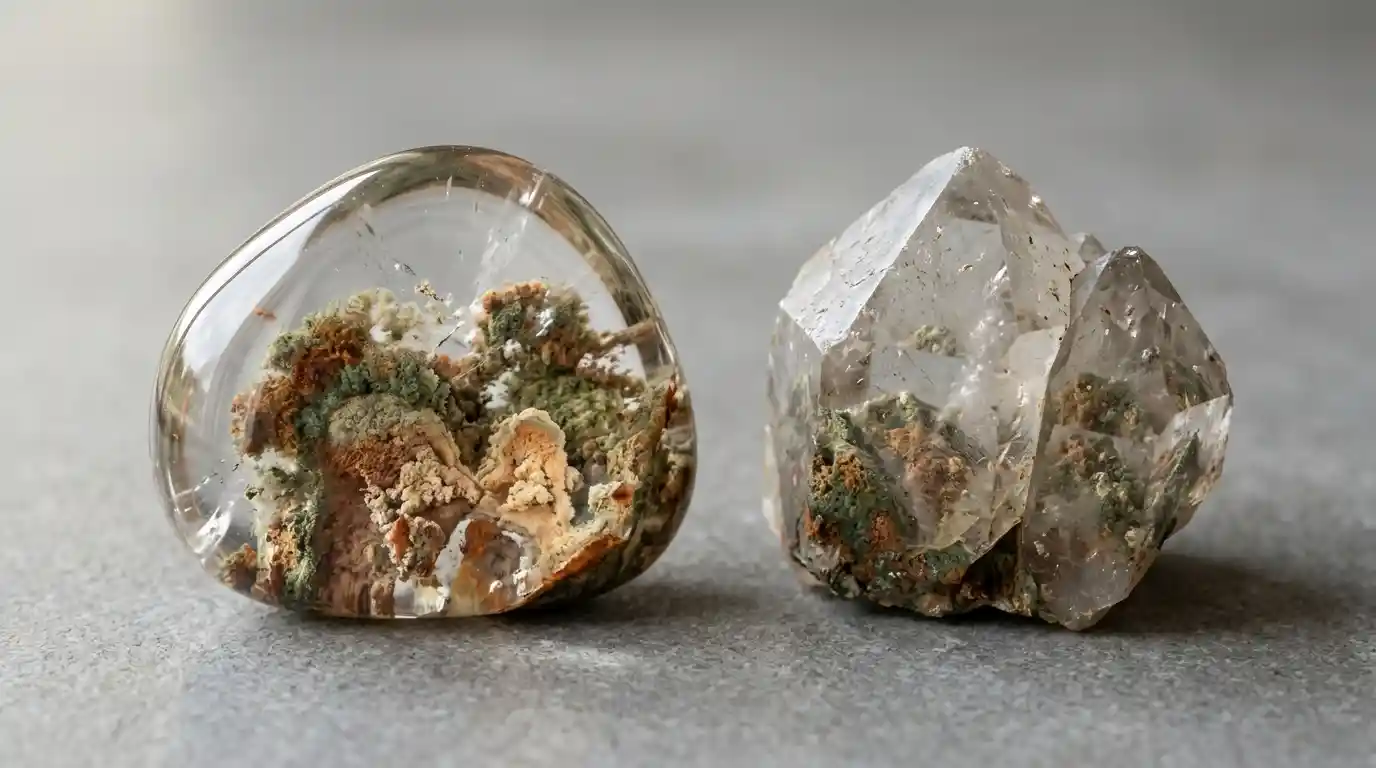
Garden quartz healing properties are often described through themes of grounding, reflection, personal growth, calm, creativity, patience, emotional perspective, connection with nature, meditation, and renewal. The stone’s appeal comes largely from its internal inclusions, which can resemble moss, forests, clouds, underwater scenes, or miniature landscapes suspended inside transparent quartz. Those natural patterns can be compelling meditation objects, but they do not demonstrate a therapeutic mechanism. Garden quartz has not been shown to treat anxiety, depression, trauma, insomnia, pain, immune disorders, inflammation, hormonal conditions, or other disease, and there is no evidence that its inclusions transmit healing energy into the body. Mineralogically, “garden quartz” is not a separate mineral species. It is a modern trade term, often used alongside lodolite, scenic quartz, or landscape quartz, for quartz containing visually striking mineral and fluid inclusions. The host mineral remains quartz, SiO₂, with trigonal crystallography, Mohs hardness 7, vitreous luster, brittle tenacity, no useful cleavage, and typically conchoidal fracture.
10 Garden Quartz Claims Drawn From Its Landscape-Like Inclusions
- Grounding and present-moment awareness
- Deeper self-reflection
- Personal growth and gradual change
- Calm during periods of mental overload
- Creativity and imaginative thinking
- Patience with long-term goals
- Emotional perspective after difficult experiences
- Connection with nature and the physical environment
- Meditation and sustained observation
- Renewal during major life transitions
These ten themes fit the stone’s appearance without needing to be treated as ten scientifically proven healing effects. Many garden quartz benefits make practical sense when the crystal is used as a visual cue for journaling, observation, breathing, planning, creative work, or spending deliberate time outdoors rather than being credited with changing physiology.
What Garden Quartz Really Is: Included Quartz, SiO₂ Chemistry, Hardness, and Natural Inclusions
Garden quartz is best understood as inclusion-bearing quartz rather than a separate mineral species. The host crystal is quartz, with the chemical formula SiO₂, belonging to the silica group and crystallizing in the trigonal system. Transparent specimens often display the familiar six-sided prismatic appearance of macrocrystalline quartz, although polished cabochons, freeforms, spheres, and carvings may obscure the original crystal habit.
The names garden quartz, lodolite, scenic quartz, and landscape quartz are commercial descriptions inspired by appearance. “Lodolite” sounds mineralogical but is not an official mineral species name. What matters scientifically is the quartz host and the identity of the inclusions it contains.
Those inclusions vary considerably. Green chlorite is one of the most familiar components and can create mossy or leafy-looking textures. Hematite and other iron oxides may introduce red, rust, orange, yellow, brown, or dark areas. Feldspar, clay-like phases, rutile, other mineral grains, fluid inclusions, gas bubbles trapped in natural fluid cavities, and growth features can also occur depending on the specimen and locality. Not every visually similar piece contains the same mineral assemblage, so descriptions such as “chlorite garden quartz” should ideally be based on actual identification rather than assumption.
Quartz has Mohs hardness 7 and a vitreous luster on fresh crystal surfaces. It has no useful cleavage and breaks characteristically with conchoidal fracture, though natural fractures, internal veils, inclusion boundaries, and healed cracks can influence how an individual included specimen behaves. Tenacity is brittle. Garden quartz is therefore resistant to many ordinary scratches but can still chip or break after impact.
Quartz is not a hydrated mineral. Water is not an essential part of the SiO₂ formula. Individual garden quartz specimens may nevertheless contain microscopic or visible fluid inclusions trapped during crystal growth. Those sealed geological fluids are not evidence that quartz itself is structurally hydrated, and they should not be deliberately opened, ingested, or interpreted as therapeutic liquids.
Garden Quartz Formation, Brazilian Sources, Modern Naming, and the Ancient-Traditions Problem
Included quartz forms when other substances become trapped as quartz grows. Hydrothermal fluids carrying dissolved silica can move through fractures and open spaces in rock. As quartz crystallizes, pre-existing minerals, newly forming mineral coatings, fluid droplets, gas, or particulate matter may become sealed beneath later quartz growth. Repeated pauses and resumptions of growth can create layered scenes that look surprisingly like landscapes.
Minas Gerais, Brazil, is especially associated with material sold as garden quartz or lodolite and supplies a large share of the specimens seen in the gem and mineral trade. Included quartz occurs elsewhere as well, but not every inclusion-rich quartz crystal should automatically be sold under the same trade identity. Origin claims should be based on reliable provenance rather than appearance alone.
The historical distinction is important. Quartz itself unquestionably has ancient human use in tools, ornaments, carvings, and symbolic objects across numerous cultures. Garden quartz as a specific trade category is different. Names such as lodolite, scenic quartz, landscape quartz, and “shaman dream stone” belong to much more recent collecting and metaphysical markets.
Claims that unnamed ancient shamans universally used lodolite for vision quests are particularly weak because they often fail to identify a culture, archaeological object, historical term, or primary evidence. The workbook-verified garden quartz meaning can therefore discuss contemporary symbolism and the genuine geology of included quartz without presenting a modern marketing identity as an ancient gemstone tradition.
Grounding, Self-Reflection, and Personal Growth Claims
1. Grounding Through Detailed Observation
Garden quartz is often described as grounding because its inclusions resemble soil, moss, plants, or miniature landscapes. The stone does not physically connect the nervous system to the Earth through a therapeutic energy pathway. It can, however, support a sensory grounding exercise. Observe the crystal’s temperature, weight, reflections, internal shapes, colors, and depth while noticing breathing and surroundings. The practice redirects attention toward immediate sensory information.
2. Self-Reflection Through Visual Metaphor
The layered scenes inside garden quartz make introspection a natural symbolic theme. A person may see different forms depending on angle and lighting, which can be used as a metaphor for examining a situation from more than one perspective. The stone does not reveal hidden truths or retrieve unconscious information. A useful journal prompt is simply, “What changes when I look at this problem from another viewpoint?” The reflection does the work.
3. Personal Growth as a Gradual Process
Because quartz grows over time and preserves earlier stages inside later growth, garden quartz is frequently associated with development and transformation. The crystal cannot make someone grow psychologically. It can instead represent gradual improvement. Choose one behavior worth repeating and track it consistently rather than expecting a dramatic change from intention alone. Geological growth provides the metaphor; repeated behavior provides the personal change.
Calm, Creativity, and Patience Claims
4. Calm During Mental Overload
Gazing into a visually complex but non-demanding object can create a useful pause when attention feels scattered. Garden quartz has not been shown to lower anxiety biologically or regulate stress hormones. Someone can nevertheless use it while stepping away from screens, slowing the breath, and reducing the number of tasks competing for attention. The calmer environment and deliberate pause are the plausible mechanisms.
5. Creativity and Imaginative Thinking
Garden quartz is unusually suited to visual imagination because its inclusions can resemble forests, mountains, underwater scenes, clouds, or abstract worlds. That does not mean the gemstone stimulates creativity neurologically. An artist or writer could use the crystal as a prompt by describing what the inclusions resemble, building a scene around them, or generating several interpretations before judging any of them. The object supplies visual stimulus, not supernatural inspiration.
6. Patience With Long-Term Goals
The apparent layers and preserved growth stages inside included quartz have encouraged symbolism around patience. The crystal itself cannot improve impulse control or endurance. A practical ritual is to connect it with reviewing a long-term project once a week rather than repeatedly judging progress day by day. Looking at slow geological growth can be a useful reminder that some results emerge through accumulation rather than immediate change.
Emotional Perspective, Nature Connection, Meditation, and Renewal Claims
7. Emotional Perspective After Difficult Experiences
Garden quartz is sometimes said to help people see emotional situations more clearly. It cannot remove grief, trauma, anger, or anxiety from the body. A reflective practice can use its depth and layered appearance as a cue to separate the event, the emotion, the interpretation, and the next available response. That structure can make a complicated experience easier to think about without pretending the quartz performs emotional healing.
8. Connection With Nature
The landscape-like inclusions naturally encourage associations with forests, gardens, soil, and geological processes. The stone cannot substitute for actual contact with the natural world. A more useful interpretation is to let it prompt real behavior: go outside, notice local plants, walk somewhere quiet, observe weather and seasonal changes, or learn about the geology of the region. The crystal becomes an invitation rather than a replacement for experience.
9. Meditation and Sustained Observation
Garden quartz can be an effective visual meditation object simply because there is so much detail to examine. A person might focus on one inclusion, notice when attention wanders, and return to the object without judgment. This resembles ordinary focused-attention practice. There is no need to claim that the crystal changes consciousness, opens psychic perception, or transmits visions for the meditation to feel meaningful.
10. Renewal During Life Transitions
Modern crystal practice often associates garden quartz with beginnings, endings, and personal evolution. During a transition, the stone can symbolize continuity between an earlier stage and what comes next. Write down what has ended, what lessons are worth retaining, and what action will define the new phase. Renewal comes from decisions and behavior, while the crystal marks the transition.
Garden Quartz Chakra Associations: Root, Heart, and Crown Symbolism From Its Mixed Colors
Garden quartz does not have one universally agreed chakra association because its appearance varies so widely. Green chlorite-rich specimens are often connected with the heart chakra, earthy brown or red inclusions may be linked with the root chakra, while clear quartz portions can be associated with the crown chakra. Some practitioners therefore describe garden quartz as spanning several centers rather than belonging to only one.
Chakras are a spiritual framework rather than anatomical structures. Garden quartz has not been demonstrated to affect the heart, brain, spine, circulation, hormones, or other organs according to inclusion color. A person who values chakra practice can still use the mixed colors to organize reflection around stability, relationships, perspective, and meaning without treating those symbolic correspondences as biology.
Garden Quartz Physical Care: Hardness 7, Internal Fractures, Water, Chemicals, Heat, and Ultrasonics
The quartz host gives garden quartz good scratch resistance at Mohs 7. It can scratch many softer gemstones and can itself be scratched by harder substances such as topaz, corundum, and diamond. Separate storage protects both the quartz and neighboring softer stones.
Garden quartz has no useful cleavage, which generally makes it tougher in everyday handling than fluorite or calcite. It is still brittle, and included specimens may contain internal fractures, healed cracks, cavities, mineral boundaries, or fluid inclusions that create local weaknesses. A highly included piece should therefore not be treated as though it were identical in toughness to flawless rock crystal.
Plain water is generally safe for brief cleaning of sound natural garden quartz because quartz is not readily soluble in ordinary water and is not a hydrated mineral. Warm water, mild soap, and a soft cloth are suitable for many polished pieces. Prolonged soaking is unnecessary, particularly when the specimen contains open cavities, attached matrix, surface-reaching inclusions, adhesives, coatings, repairs, or unidentified associated minerals.
Strong chemicals should be avoided. Hydrofluoric acid attacks silica and is extremely hazardous, while aggressive alkaline solutions can also damage quartz surfaces under suitable conditions. Household gemstone care does not require such products.
Steam cleaning is not the best default for highly included quartz. Although clean untreated quartz itself can tolerate considerable heat, internal fractures, fluid inclusions, repairs, and associated minerals make sudden heating and cooling less predictable. Ultrasonic cleaners pose a similar concern because vibration can exploit existing fractures or loosen material in surface-reaching cavities. Gentle hand cleaning provides more control.
Cutting or grinding garden quartz creates silica-bearing dust, so dry lapidary work should be avoided. Wet methods, extraction, eye protection, and suitable respiratory protection are important when shaping quartz.
Ritual Cleansing Garden Quartz Without Damaging Its Included Structure
Ritual cleansing can remain entirely separate from physical washing. No verified unwanted energy accumulates inside garden quartz, and the landscape-like inclusions do not need to be “cleared” chemically or energetically for a person to assign the stone a new symbolic purpose.
Sound, quiet reflection, intention-setting, dry placement, or simply observing the stone for a few minutes are gentle approaches. One useful ritual is to identify what the crystal represented previously, decide whether that purpose has ended, and choose a new journal prompt or behavior to associate with it.
Saltwater soaking, prolonged immersion, intense heat, flame, chemical sprays, and burying polished pieces in damp soil are unnecessary. Dry methods are especially sensible for specimens with open cavities, attached matrix, unidentified inclusions, or internal fractures.
Conclusion
Garden quartz is compelling without an invented ancient lineage. Its genuine story lies in quartz crystallization preserving chlorite, iron oxides, fluids, and other geological features that can resemble miniature landscapes. Those inclusions make it a naturally effective object for observation and symbolism. Its ten wellness themes can support grounding, creativity, patience, reflection, and deliberate transitions, but the meaningful part of those practices comes from attention and behavior rather than an unproven healing mechanism.
Frequently Asked Questions About Garden Quartz Healing Properties
What are the main garden quartz healing properties people claim?
Common claims include grounding, self-reflection, personal growth, calm, creativity, patience, emotional perspective, nature connection, meditation, and renewal. These are contemporary wellness and spiritual themes rather than proven therapeutic effects.
What is garden quartz made of?
Garden quartz is inclusion-bearing quartz. The host mineral is silicon dioxide, SiO₂, while inclusions may include chlorite, hematite, iron oxides, feldspar, rutile, fluids, and other substances depending on the specimen.
Is garden quartz the same as lodolite?
The names are commonly used for the same general trade category of included quartz with scenic or landscape-like internal patterns. Lodolite is a trade term rather than an official mineral species name.
How hard is garden quartz?
The quartz host is Mohs 7. This provides good scratch resistance, although internal fractures and abundant inclusions can influence the toughness of an individual specimen.
Does garden quartz really have ancient healing traditions?
Quartz itself has genuine ancient human use, but the specific identities garden quartz and lodolite are modern trade concepts. Evidence does not establish an ancient healing tradition using this modern included-quartz category in the way contemporary crystal sellers describe it.
Is garden quartz scientifically proven to help with grounding or emotional healing?
No. Garden quartz has not been shown to treat emotional or mental health conditions through a mineral-specific mechanism. It can function as a visual or tactile cue for grounding exercises, journaling, meditation, or reflection.
Which chakra is associated with garden quartz?
Associations vary with inclusion color. Green material may be linked with the heart chakra, earthy red or brown inclusions with the root chakra, and clear quartz portions with the crown chakra. These are spiritual correspondences rather than anatomical effects.
Can garden quartz go in water?
Brief washing with plain water is generally acceptable for sound untreated quartz. Avoid prolonged soaking when a specimen has open cavities, matrix, repairs, coatings, surface-reaching inclusions, or associated minerals of uncertain water tolerance.
How should garden quartz be physically cleaned?
Use lukewarm water, mild soap, and a soft cloth when wet cleaning is appropriate. For heavily included or fractured specimens, gentle hand cleaning is preferable to steam or ultrasonic cleaning.
Where does garden quartz come from?
Minas Gerais, Brazil, is particularly associated with quartz sold as garden quartz or lodolite, although included quartz occurs in many geological regions. The workbook-verified where to buy garden quartz topic focuses on sourcing and purchasing considerations.
Crystal healing claims are traditional or personal beliefs and should not replace qualified medical or mental health care.