7 Hidden Grandidierite Benefits: Helpful Traditions, Verified Facts & Safe Limits
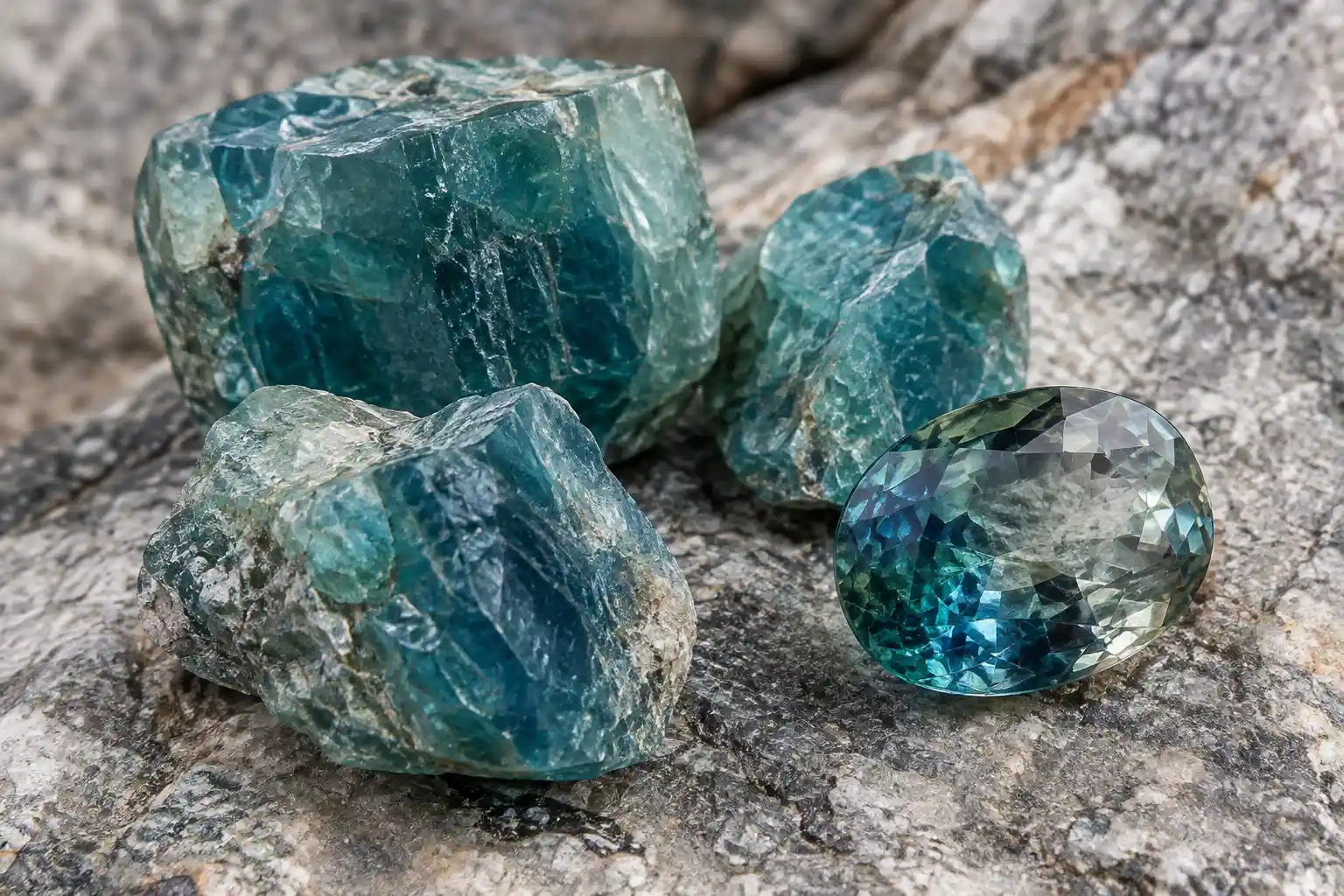
Grandidierite benefits begin with a combination that is unusual even among rare gemstones: blue-green to greenish-blue color, strong pleochroism, relatively high hardness, distinctive borosilicate chemistry, and an exceptionally limited supply of transparent facetable rough. Grandidierite is an orthorhombic magnesium-iron aluminum borosilicate whose composition can be represented approximately as (Mg,Fe)(Al,Fe)₃(BO₃)(SiO₄)O₂. Most specimens are opaque to translucent, while transparent crystals suitable for cutting are much less common, which helps explain why fine faceted stones attract significant collector attention.
The mineral was first described from southern Madagascar and named in honor of French naturalist Alfred Grandidier. Later gem-quality discoveries, particularly near Tranomaro in Madagascar, revealed material capable of producing small transparent gems with attractive bluish-green color. Grandidierite can show pronounced pleochroism, with different crystal directions revealing pale yellow to nearly colorless, greenish-blue, and deeper blue-green tones. That optical behavior gives cutters and gemologists far more to consider than body color alone.
These physical properties create genuine Grandidierite benefits in collecting, gemology, mineral education, lapidary work, geological study, and carefully protected jewelry. Modern crystal traditions sometimes attach meanings involving perspective, confidence, self-expression, or personal growth to its blue-green appearance, but these associations are symbolic rather than medical. Grandidierite does not treat anxiety, respiratory conditions, neurological illness, hormonal problems, or other health concerns through ordinary wearing or handling.
7 Grandidierite Benefits at a Glance
- Rare blue-green color gives transparent Grandidierite strong visual and collector appeal.
- Pronounced pleochroism allows one crystal to display substantially different colors according to viewing direction.
- Mohs hardness around 7.5 provides useful resistance to everyday scratching in carefully designed jewelry.
- Rare transparent crystals offer unusual faceting opportunities for experienced lapidaries.
- Its borosilicate chemistry and geological occurrence provide substantial mineralogical value.
- Identification teaches collectors how color, pleochroism, cleavage, refractive properties, and transparency work together.
- Modern symbolism can represent perspective, individuality, or persistence when kept separate from medical claims.
Blue-Green Color Gives Grandidierite Immediate Gemstone Appeal
The most obvious Grandidierite benefits come from color. Fine transparent stones can display an attractive range between blue-green and greenish blue, while more included or thicker crystals may appear deeper, darker, or more muted. Iron within the mineral influences color, and variation in composition helps explain why specimens from different occurrences do not all present the same balance of blue and green.
Fine color becomes especially important because transparent Grandidierite is uncommon. A large opaque crystal may be scientifically interesting, but it does not provide the same optical experience as a small transparent gem whose color remains vivid after faceting. This rarity of transparent material means that clarity, saturation, cutting, and crystal orientation interact strongly when quality is judged.
Color should therefore never be evaluated in isolation. A vivid stone with serious fractures or weak transparency may be less desirable than a slightly softer-toned gem with better brilliance and structural integrity. Factors such as hue, transparency, pleochroism, cutting, durability, and overall face-up appearance all belong within a thoughtful assessment of Grandidierite quality, particularly because the market contains far fewer reference stones than it does for sapphire, emerald, or aquamarine.
Strong Pleochroism Makes Grandidierite Gemologically Fascinating
Pleochroism is one of the most distinctive Grandidierite benefits because the gemstone can display noticeably different colors when viewed along different crystallographic directions. Transparent examples may show pale yellow to nearly colorless, greenish-blue, and deeper blue-green tones, creating a trichroic effect that becomes especially clear when the stone is examined carefully.
This property has practical consequences for cutting. A lapidary cannot treat every direction through the rough as visually equivalent. Orientation determines which color dominates face-up, how much unwanted pale or yellowish tone remains visible, and whether the finished gem appears strongly saturated or comparatively weak. Cutting therefore requires balancing pleochroism against shape, fractures, cleavage, weight retention, and transparency.
The same effect gives gemology students an excellent example of anisotropic behavior. A stone that changes apparent color when rotated is not necessarily changing because of the light source. Pleochroism reflects directional absorption within the crystal itself. That distinction separates it from true color-change phenomena, in which different illumination spectra cause a gemstone to appear different under different light sources.
For collectors, strong pleochroism adds another reason to examine a Grandidierite from several angles rather than judging it from a single photograph.
Mohs Hardness Around 7.5 Provides Useful Scratch Resistance
Grandidierite has a Mohs hardness of approximately 7.5, giving it better scratch resistance than quartz and many popular ornamental stones. This provides practical Grandidierite benefits for jewelry because a well-cut stone can retain polish under normal wear more effectively than softer gems such as fluorite, calcite, or opal.
Hardness, however, does not describe the entire durability picture. Grandidierite has pronounced cleavage, and that structural weakness means a hard impact delivered in an unfavorable direction can chip or split a gemstone even though its polished surface resists many scratches. This distinction matters particularly in rings, which encounter more knocks and pressure than earrings or pendants.
Protective settings can reduce exposure around vulnerable edges, while removing jewelry during heavy manual work lowers unnecessary risk. Pendants and earrings are generally easier environments because they experience much less direct impact.
These Grandidierite benefits become most useful when hardness and toughness are treated as separate properties. A hardness number can describe resistance to abrasion, but good ownership also requires understanding cleavage, fractures, setting design, and how the jewelry will actually be worn.
Transparent Grandidierite Offers Rare but Demanding Faceting Opportunities
Transparent gem-quality Grandidierite is much rarer than opaque or translucent material, so faceting occupies a specialized place among Grandidierite benefits. The cutter has to make several important decisions before removing significant rough because color direction, pleochroism, fractures, cleavage, transparency, and finished weight may all compete with one another.
A piece with strong blue-green color may yield a disappointing gem if oriented through a weak color direction, while a theoretically attractive orientation may be impossible because of cleavage or internal fractures. Small transparent areas inside a much larger translucent crystal can also limit the final size dramatically. This helps explain why fine cut stones can be much smaller than the rough crystals from which they were recovered.
The finished gemstone rewards careful work because strong color can combine with good transparency and a distinctive optical identity that differs from tourmaline, aquamarine, apatite, and other blue-green gems. Grandidierite does not need exceptional dispersion to be visually interesting. Its value lies more in color, rarity, pleochroism, and the technical challenge of transforming scarce clean rough into a balanced gem.
Grandidierite Geology Adds Scientific Value Beyond Jewelry
Grandidierite is scientifically interesting because it contains magnesium, aluminum, boron, silicon, oxygen, and variable iron within an orthorhombic structure. It has been reported from boron-rich geological environments including pegmatitic rocks, gneisses, aplites, and rocks affected by high-temperature, relatively low-pressure metamorphic conditions.
This geological setting creates Grandidierite benefits for mineral collectors who want more than a polished gemstone. A natural specimen may preserve associated minerals, crystal habit, cleavage, fractures, and relationships with the surrounding rock that disappear once the crystal is removed and cut. In some southern Madagascar occurrences, Grandidierite occurs with minerals such as feldspar, phlogopite, diopside, enstatite, tourmaline-group minerals, and sapphirine, creating assemblages that reveal much more about the local geological environment.
The type locality in southern Madagascar also gives the species historical importance in mineralogy. Its name links the stone with Alfred Grandidier, whose work was closely associated with the natural history of Madagascar. The mineral therefore carries a genuine scientific and geographic story without needing invented ancient gemstone traditions.
Identification Helps Separate Grandidierite from Other Blue-Green Gems
Blue-green gemstones can overlap visually, which makes identification another important area of Grandidierite benefits. Aquamarine, blue-green tourmaline, apatite, glass, synthetic products, and other stones may resemble certain Grandidierite specimens in photographs, especially when lighting and color adjustment affect the image.
Professional identification can consider refractive index, birefringence, pleochroism, density, optical character, inclusions, cleavage, spectroscopy, and mineral chemistry. Strong directional color differences can provide a useful clue, but no single visual feature should be treated as absolute proof.
This is particularly important because rarity can encourage overenthusiastic labeling. A blue-green stone should not be described as Grandidierite merely because the color seems similar. Reliable identification protects both buyers and serious collectors.
Someone preparing to buy Grandidierite should therefore prioritize accurate species identification, realistic photographs, dimensions, transparency, fracture condition, cutting quality, and disclosure of any relevant treatment or origin claims. Rarity makes careful purchasing more important, not less.
Collector Value Comes from Rarity, Locality, and Different Forms of the Mineral
Grandidierite benefits collectors in several forms. Transparent faceted gems emphasize rarity and optical beauty, translucent polished pieces highlight blue-green color, while natural crystals preserve mineralogical structure and locality information. Each form should be evaluated according to what it actually offers rather than by one universal standard.
A rough crystal with important locality documentation may have scientific or specimen value even if it cannot produce a fine gem. Conversely, a small transparent faceted stone may command substantial interest because clean rough is exceptionally scarce. The relationship between specimen value and gem value therefore changes according to crystal quality, rarity, provenance, and transparency.
Market price can vary sharply because the difference between ordinary translucent rough and high-quality transparent facetable material is enormous. Color, clarity, cut, size, origin documentation, rarity, and collector demand all influence Grandidierite price, which is why simple per-carat comparisons can be misleading without considering the quality category involved.
Collectors benefit most when they understand whether they are buying a mineral specimen, ornamental stone, or genuinely transparent gem rather than treating all Grandidierite as interchangeable.
Modern Symbolism Can Represent Perspective and Individuality
The strong pleochroism of Grandidierite provides a natural symbolic foundation for perspective. The same crystal can present pale, greenish-blue, or deeper blue-green directions while remaining the same mineral, making it an effective visual metaphor for situations that reveal different aspects when examined from another angle.
Individuality is equally appropriate because Grandidierite is not simply a substitute for a better-known blue-green gemstone. Its chemistry, orthorhombic structure, pleochroism, rarity, geological history, and Malagasy type locality give it an identity separate from aquamarine, tourmaline, or sapphire.
A person may choose the gemstone to symbolize seeing a situation more carefully, valuing uncommon qualities, or remaining open to multiple viewpoints. Those meanings arise through human interpretation rather than a measurable influence from the crystal.
Grandidierite does not improve cognition, emotional regulation, confidence, or mental-health conditions through ordinary contact. Its symbolic value can remain meaningful without being presented as medical treatment.
Responsible Care Protects Cleavage and Preserves Polish
The combination of good hardness and prominent cleavage means Grandidierite requires thoughtful care. A faceted stone may resist scratching reasonably well yet remain vulnerable to a sharp blow that reaches a cleavage direction. Jewelry should therefore be removed before activities involving tools, sports, heavy lifting, or repeated contact with hard surfaces.
Lukewarm water, mild soap, and gentle cleaning are appropriate for many stable stones, while ultrasonic or steam methods should not be treated as universal choices when fractures or cleavage-related weaknesses are present. Valuable pieces benefit from periodic setting inspection because loose prongs can allow movement and increase the risk of impact.
Cutting and grinding also require ordinary mineral workshop precautions. Wet methods, ventilation, eye protection, and suitable dust control reduce unnecessary exposure during lapidary work.
These limitations do not reduce Grandidierite benefits. They simply reflect the real structural properties of a rare gem that deserves care proportionate to its scarcity and value.
Conclusion
Grandidierite benefits include rare blue-green color, strong pleochroism, useful scratch resistance, specialized faceting potential, geological importance, gemological identification value, collector interest, and meaningful modern symbolism. Its scarcity becomes most significant when combined with transparency because clean facetable crystals are far less common than opaque or translucent material.
The strongest Grandidierite benefits come from appreciating the gemstone according to its real mineral identity. Pleochroism, cleavage, orthorhombic structure, Madagascar geology, rarity, and skilled cutting already give it substantial value. Symbolic associations involving perspective or individuality can add a personal layer without introducing unsupported medical claims.
FAQs
What are the main Grandidierite benefits?
The most practical Grandidierite benefits include gemstone collecting, jewelry use, mineralogical study, strong pleochroism, geological education, gem identification, and personal symbolism.
What color is Grandidierite?
Grandidierite is typically bluish green to greenish blue, while pleochroism can reveal paler yellowish or nearly colorless directions as well as stronger blue-green tones.
How hard is Grandidierite?
Grandidierite has a Mohs hardness of about 7.5, giving it useful scratch resistance.
Is Grandidierite durable?
Its hardness is good, but pronounced cleavage means the gemstone can still chip or split under strong impact, so protected jewelry settings are advisable.
Why is transparent Grandidierite rare?
Most known Grandidierite occurs as opaque or translucent crystals. Material with enough transparency, color, and structural integrity for fine faceting is much less common.
Where was Grandidierite discovered?
The mineral was first described from southern Madagascar and was named after French naturalist Alfred Grandidier.
Does Grandidierite have healing benefits?
There is no established clinical evidence that Grandidierite treats physical or mental-health conditions through ordinary wearing or handling.
Grandidierite benefits described as healing, calming, confidence-enhancing, protective, chakra, or energetic effects remain spiritual and personal beliefs and should not replace qualified medical or mental-health care.