Grandidierite Price: What Buyers Pay For, What Raises or Lowers Cost
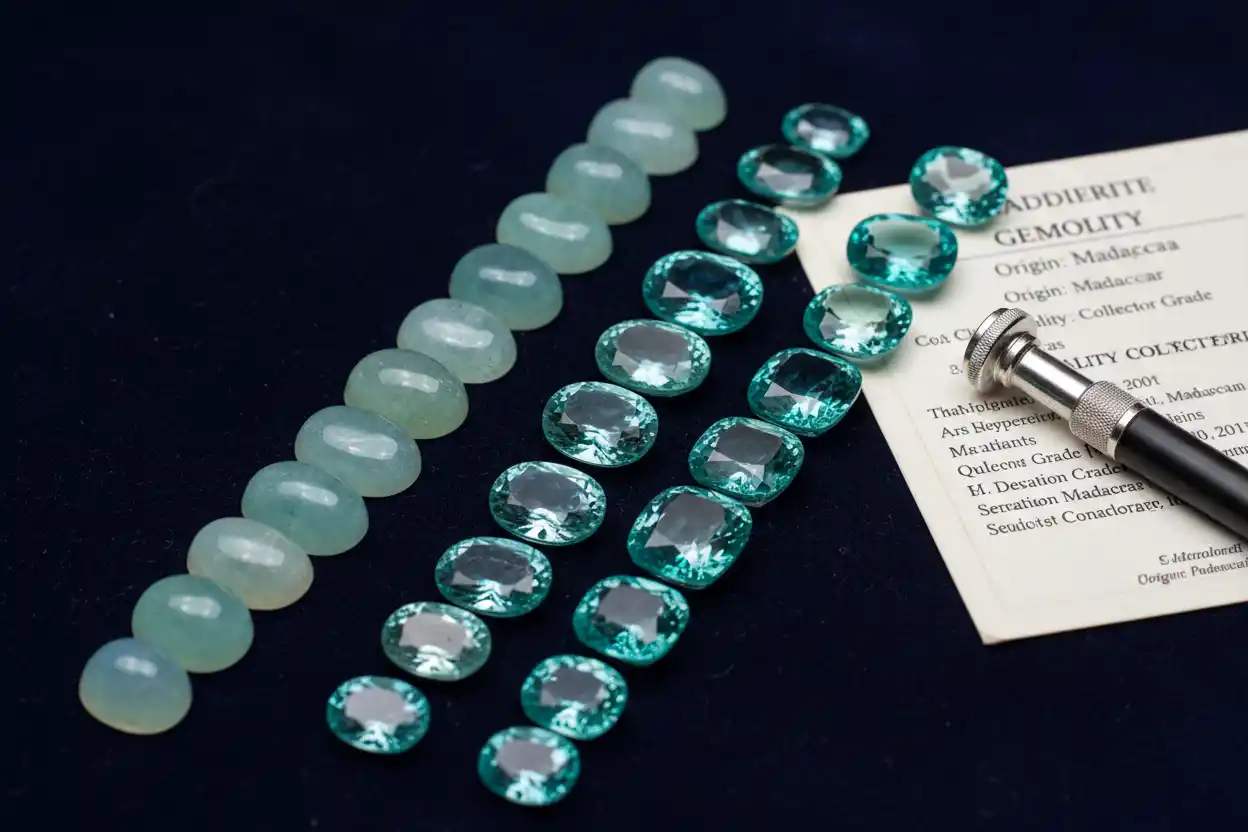
Grandidierite prices span one of the widest ranges found among uncommon colored gemstones. Current included and translucent Madagascar stones can sell for only a few tens of dollars per carat, while fine transparent grandidierite offered by specialist sellers reaches roughly $3,000 to $5,000 per carat. The gap exists because transparent, attractive, facetable grandidierite is far scarcer than ordinary translucent or heavily included stones.
A current 3.56-carat untreated Madagascar grandidierite with SI clarity is offered around $156, or about $44 per carat. A 2.10-carat translucent example is approximately $50, or about $24 per carat. At the opposite end of the market, specialist listings place a 0.98-carat grandidierite at $2,940 and a 2.91-carat stone at $8,730, both exactly $3,000 per carat. Larger premium examples are listed around $4,000 to $5,000 per carat.
The most important pricing distinction is therefore not simply carat weight. Transparency, clarity, color, size within the transparent tier, cutting, provenance, condition, and seller positioning determine where an individual stone belongs.
Grandidierite Price At a Glance
| Current retail example | Total asking price | Approx. price per carat |
|---|---|---|
| 2.10 ct Madagascar, translucent | $50.39 | $24/ct |
| 3.56 ct Madagascar, SI, untreated | $156.02 | $44/ct |
| 2.29 ct Madagascar, SI | $100.36 | $44/ct |
| 1.45 ct Madagascar, VS-SI | $722.10 | $498/ct |
| 1.80 ct Madagascar, VS-SI | $986.04 | $548/ct |
| 4.58 ct Madagascar, translucent | $1,003.57 | $219/ct |
| 0.98 ct specialist grandidierite | $2,940 | $3,000/ct |
| 2.91 ct specialist grandidierite | $8,730 | $3,000/ct |
| 3.43 ct specialist grandidierite | $13,720 | $4,000/ct |
| 5.64 ct specialist grandidierite | $28,200 | $5,000/ct |
| 7.86 ct specialist grandidierite | $39,300 | $5,000/ct |
These figures are current retail asking prices rather than completed-sale values. They show how dramatically the market separates ordinary included or translucent grandidierite from stones positioned in the premium collector tier.
Transparency Creates the Largest Price Difference
No single factor explains grandidierite pricing better than transparency. Translucent stones are available in comparatively substantial sizes, while genuinely transparent facetable crystals have historically represented only a tiny portion of mined rough.
GIA’s study of the Tranomaro deposit in southern Madagascar documented roughly 800 kilograms of rough production between 2014 and early 2016. Of that volume, only about 60 grams consisted of eye-clean crystals, and fewer than ten faceted stones above one carat had been produced during the period studied.
Those historical figures apply to that deposit and production interval rather than today’s entire supply, but they explain why transparent gems occupy a very different market from ordinary stock.
The grandidierite quality grading should therefore begin by separating transparent, translucent, and heavily included stones before finer quality factors are considered.
Included Stones Can Still Be Relatively Affordable
Rarity claims sometimes create the impression that every piece of grandidierite must cost thousands of dollars. Current inventory proves otherwise.
A 2.10-carat translucent oval is listed for about $50.39, while a 3.56-carat SI oval is around $156.02. Another 2.29-carat SI example is about $100.36.
These rates place many included or translucent stones around roughly $24 to $45 per carat, although individual listings can move higher.
Some larger translucent examples cost more. A current 4.58-carat oval is around $1,003.57, approximately $219 per carat, while a 7.22-carat translucent stone is around $1,582, also close to $219 per carat.
The variation shows that clarity terminology alone does not establish value. Color, individual appearance, size, cutting, and seller positioning still matter.
Cleaner Stones Can Jump Into the Hundreds Per Carat
The transition from ordinary included stock to stronger VS-SI examples can create a substantial price increase even before reaching the elite specialist tier.
A current 1.45-carat Madagascar grandidierite described as VS-SI is listed at $722.10, about $498 per carat. A 1.80-carat VS-SI stone is around $986.04, approximately $548 per carat.
These examples cost more than ten times the per-carat rate of some SI stones from the same general market.
That difference illustrates why a general average grandidierite price is not useful. Two stones with similar weight can belong to completely different commercial levels when one has better transparency and fewer distracting inclusions.
The grandidierite price per carat is therefore meaningful only after stones have been grouped into comparable quality tiers.
Premium Specialist Asking Prices Reach Thousands Per Carat
Specialist grandidierite inventory shows another sharp price jump. Current listings place stones from 0.98 to 2.91 carats at exactly $3,000 per carat.
Examples include 0.98 carat at $2,940, 1.18 carats at $3,540, 1.60 carats at $4,800, and 2.43 carats at $7,290.
Above three carats, the same specialist inventory increases the asking rate. A 3.43-carat stone is listed at $13,720 and a 4.56-carat stone at $18,240, both $4,000 per carat. A 5.64-carat example is $28,200 and a 7.86-carat stone $39,300, both $5,000 per carat.
This is one seller’s current retail structure, not an industry-wide fixed schedule. It does demonstrate how strongly large premium grandidierite can be positioned when scarcity and collector demand intersect.
Size Matters Most After Quality Is Already High
A large translucent grandidierite does not necessarily command a greater per-carat price than a small transparent stone.
Current inventory includes a 22.47-carat translucent oval at about $1,723, roughly $77 per carat. That very large gemstone remains far below the $3,000-per-carat specialist pricing applied to sub-three-carat premium inventory.
This is a key point in grandidierite valuation. Size produces the strongest premium when high transparency, attractive color, limited inclusions, and strong cutting survive at larger weights.
A five-carat translucent stone and a five-carat premium transparent stone should not be considered equivalent just because their scale readings match.
The practical checks in buy grandidierite help establish which quality tier a stone actually belongs to before size premiums are considered.
Color Influences Demand Within Each Tier
Grandidierite is known for greenish-blue to bluish-green color, with iron contributing to the blue component. Fine stones can show attractive teal-like hues without becoming excessively dark.
A brighter medium tone can be more appealing than a deeply saturated stone that loses transparency and brilliance.
Pleochroism adds complexity. Grandidierite can show pale yellow to nearly colorless, greenish blue, and deeper blue directions depending on orientation. Cutters therefore need to choose an orientation that presents the most desirable color face up.
Color differences may explain part of the price variation between stones that have otherwise similar clarity and weight.
A seller’s photographs should show the gemstone under neutral lighting because camera processing can exaggerate blue or green saturation.
Cut Quality Can Protect or Reduce Value
Grandidierite has strong directional cleavage, which makes cutting valuable transparent rough challenging. A cutter must preserve weight while also managing color orientation, inclusions, symmetry, and durability.
Good cutting should provide attractive face-up color and useful brightness without severe windowing. A large transparent center where light passes straight through can weaken visual impact.
Excessive depth creates the opposite problem. The gem may retain more weight but look smaller from above than another stone with similar carat weight.
This matters especially at $3,000 to $5,000 per carat. Hidden weight can add thousands of dollars to the asking price without adding an equivalent increase in visible size.
Millimeter dimensions should therefore be compared alongside carat weight.
Madagascar Origin Dominates Current Gem Supply
Grandidierite was first identified in southern Madagascar, and the country remains the most important source of gem-quality stones in the current market.
The Tranomaro discovery significantly increased available grandidierite, particularly translucent crystals, while still producing only a small fraction of transparent eye-clean rough.
Sri Lanka has also produced transparent grandidierite, including documented faceted examples, but such stones remain unusual.
Origin contributes useful context, yet Madagascar alone does not guarantee premium quality. Most current inexpensive listings are also Madagascar stones.
A fine provenance claim becomes most valuable when it accompanies exceptional transparency, color, size, and reliable identification rather than replacing those factors.
The grandidierite meaning provides additional geological and historical context without treating source locality as an automatic price grade.
Treatment Usually Has Less Influence Than Transparency
Current grandidierite listings commonly state that the stones are untreated. Routine heat treatment or clarity enhancement is not a defining feature of the market in the way it is for several other colored gems.
That means untreated status alone does not explain why one grandidierite costs $40 per carat while another costs $4,000 per carat.
Transparency, clarity, color, size rarity, and cut are usually much more important.
Treatment disclosure should still be requested, especially for a high-value stone. A seller should describe known enhancement clearly rather than relying on vague wording such as natural or genuine.
For premium transparent grandidierite, independent laboratory identification can also provide greater confidence that the stone has been represented correctly.
Laboratory Documentation Matters More at High Prices
A $100 grandidierite and a $20,000 grandidierite create very different documentation needs.
For inexpensive included inventory, a reputable seller, clear disclosure, photographs, and return rights may provide reasonable practical protection. Once prices rise into thousands of dollars, independent gemological identification becomes much more important.
A laboratory can help establish identity and record observable characteristics. Depending on the laboratory and testing performed, additional information may also be available.
The report does not determine the stone’s monetary value. A $5,000-per-carat asking price remains a market decision rather than a laboratory conclusion.
Documentation simply reduces uncertainty around what is being purchased.
Rarity Claims Need Precise Context
Grandidierite is genuinely rare as a fine transparent faceted gem, but that fact is often simplified into statements such as “the second-rarest gemstone in the world.”
Numbered rarity rankings are difficult to support because rarity can refer to mineral occurrence, known deposits, total production, transparent rough, faceted stones, or high-quality examples above a particular weight.
Historical GIA research gives a more useful framework: transparent eye-clean crystals represented only a tiny fraction of the Tranomaro rough examined.
The grandidierite benefits may discuss modern symbolic associations, but spiritual claims and rarity marketing should remain separate from objective gemstone valuation.
Retail Asking Price Is Not the Same as Resale Value
The highest current grandidierite figures discussed here are seller asking prices. They show how retailers position scarce transparent inventory, but they do not prove that every comparable stone will sell at the same rate.
A dealer buying from an individual needs room for authentication, inventory risk, marketing, and future resale. Cash offers can therefore sit below retail.
Grandidierite also has a relatively specialized buyer base. Its rarity attracts collectors, but public recognition is lower than for diamond, ruby, sapphire, or emerald.
Fine transparent stones may attract serious collector demand, yet liquidity remains different from simply quoting a retail rate from an online listing.
Auction results, dealer offers, retail listings, and insurance replacement figures should always be treated as separate value contexts.
How to Judge a Reasonable Grandidierite Price
Begin with transparency. A translucent or visibly included stone should first be compared with similar mainstream inventory, where current examples can sit from roughly $24 per carat into the low hundreds per carat.
Cleaner VS-SI examples currently reach around $500 per carat in some listings. That provides another useful intermediate tier.
Premium specialist inventory is currently positioned far higher, around $3,000 per carat below three carats, around $4,000 per carat for some three-to-five-carat stones, and around $5,000 per carat for larger examples.
Then compare color, dimensions, cut, inclusions, condition, provenance, documentation, and seller reputation. An asking price is most credible when these qualities visibly support the tier being claimed.
Conclusion
Grandidierite prices range from only a few tens of dollars per carat for some translucent or included stones to several thousand dollars per carat for premium collector inventory. Transparency creates the largest divide, while clarity, blue-green color, size within the high-quality tier, cut, provenance, condition, documentation, and demand refine the final price. Compare stones within the same transparency and quality level rather than using one average value for every grandidierite.
FAQs
How much is grandidierite worth per carat?
Current retail listings range from roughly $24 to $50 per carat for some included or translucent examples to around $3,000 to $5,000 per carat for premium specialist inventory.
Why is grandidierite so expensive?
Fine transparent grandidierite is exceptionally scarce. Historical research from Madagascar found that eye-clean transparent crystals represented only a tiny fraction of mined rough.
How much does a 1-carat grandidierite cost?
Current premium specialist listings around one carat are approximately $3,000 per carat, while included or translucent stones can cost far less.
How much does a 5-carat grandidierite cost?
The answer depends heavily on quality. A translucent five-carat stone may cost hundreds or around a thousand dollars, while premium specialist stones above five carats are currently listed around $5,000 per carat.
Is transparent grandidierite more valuable?
Yes. Transparency is one of the strongest value factors because fine transparent grandidierite is much less common than translucent or included stones.
Does blue-green color increase grandidierite value?
Attractive greenish-blue to bluish-green color can support stronger pricing, particularly when transparency and clarity are also high.
Does Madagascar origin make grandidierite expensive?
Not by itself. Madagascar produces both inexpensive included stones and rare premium gems. Quality remains more important than country name alone.
Is untreated grandidierite more valuable?
Most current inventory is already sold as untreated, so untreated status alone does not create the enormous difference between ordinary and premium stones.
Does carat weight always increase grandidierite price per carat?
No. Size creates the strongest premium when transparency and other quality factors remain exceptional. Very large translucent stones can cost much less per carat than small transparent gems.
Are AAA grandidierite grades reliable?
AAA and similar seller labels are not a universal international grading standard. Transparency, clarity, color, cut, size, provenance, condition, and documentation provide better comparison points.
Does a laboratory report determine grandidierite value?
No. A laboratory report supports gemological identification and other findings but does not establish a guaranteed retail or resale price.
Does grandidierite have strong resale value?
Resale depends on transparency, color, clarity, size, provenance, documentation, condition, rarity, and access to specialist buyers. Retail asking prices should not be assumed to equal future cash resale value.
Price disclaimer: Grandidierite prices vary sharply with transparency, clarity, color, size, cut, provenance, condition, documentation, seller margins, rarity, and market demand, so current retail figures should be treated as comparison benchmarks rather than guaranteed resale values.