11 Hidden Heliodor Benefits: Gentle Uses, Verified Facts & Safe Limits
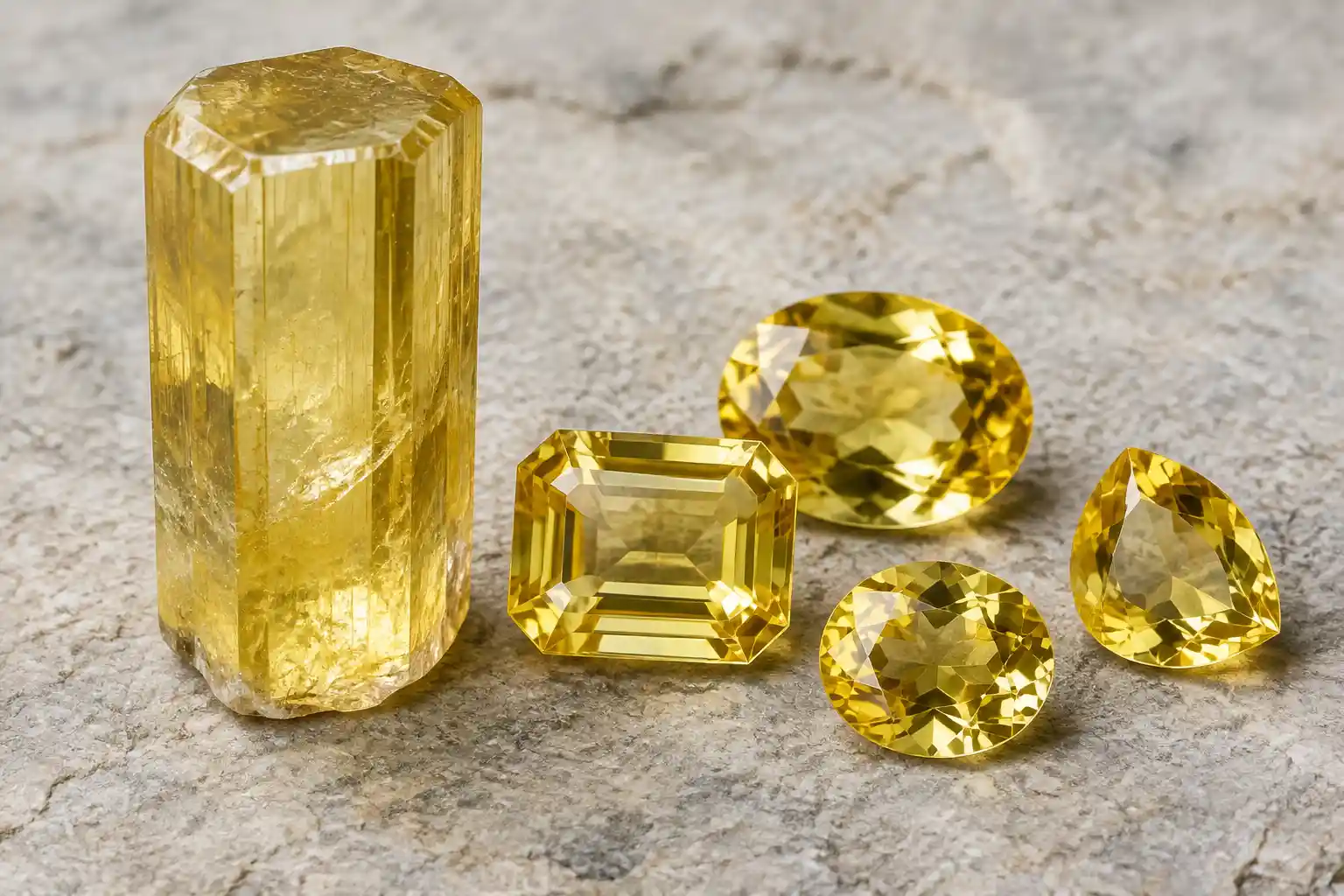
Heliodor benefits begin with the qualities that make yellow beryl distinctive: golden to lemon-yellow color, strong transparency in fine specimens, beryl hardness, attractive hexagonal crystals, and enough availability in larger sizes for impressive faceted gemstones. Heliodor belongs to the beryl family, Be₃Al₂Si₆O₁₈, alongside emerald, aquamarine, morganite, goshenite, and red beryl. Its yellow coloration is associated mainly with iron-related absorption in the crystal structure, particularly ferric iron and related charge-transfer effects that absorb portions of violet and blue light, leaving a yellow to golden appearance.
Heliodor generally has a Mohs hardness of about 7.5 to 8, giving it useful scratch resistance for rings, pendants, earrings, and other jewelry when the gemstone is structurally sound. Like other beryls, it is brittle rather than exceptionally tough, so fractures, inclusions, setting design, and impact exposure still matter. The combination of durability, transparency, color, and large crystal potential creates substantial Heliodor benefits for faceting, collecting, jewelry design, gem education, and geological study.
Modern crystal traditions sometimes associate Heliodor benefits with confidence, optimism, personal power, creativity, mental clarity, or vitality because its golden color resembles sunlight. These themes can work as personal symbolism, but they should not be presented as physiological effects. Heliodor does not medically increase energy, treat digestive illness, improve liver function, regulate hormones, or cure emotional disorders through ordinary wearing or handling.
11 Heliodor Benefits at a Glance
- Golden to lemon-yellow color gives Heliodor a distinctive place within the beryl family.
- Mohs hardness around 7.5 to 8 provides useful resistance to everyday scratching.
- Transparent crystals can yield large faceted gems with attractive brightness and color.
- Hexagonal crystal form gives natural specimens strong mineralogical and collector appeal.
- Iron-related color provides an excellent example of how trace chemistry influences beryl varieties.
- Gem identification teaches the differences among Heliodor, golden beryl, yellow sapphire, citrine, topaz, glass, and other yellow stones.
- Pegmatite occurrences connect Heliodor with the geology that produces many important gem beryls.
- Jewelry designers can use yellow beryl in both understated and substantial center-stone settings.
- Collector specimens can combine transparency, crystal form, locality, inclusions, and unusual size.
- Treatment awareness helps buyers understand how heating or irradiation may alter color in some beryl.
- Modern symbolism can represent optimism, confidence, or purposeful action when kept separate from medical claims.
Golden Yellow Color Is the Most Recognizable Heliodor Benefit
Color provides the most immediate Heliodor benefits because fine stones can range from pale yellow and greenish yellow through lemon, honey, and strong golden tones. Iron plays the central role in producing yellow color in beryl. Spectroscopic studies show that iron-related absorption, particularly ferric iron associated with absorption toward the ultraviolet and violet-blue region, can leave transmitted light with a yellow appearance, while changes in iron valence, structural position, and associated defects influence whether a beryl appears yellow, greenish, or blue.
This relationship makes Heliodor especially useful for understanding the beryl family. Goshenite represents colorless beryl, aquamarine owes its blue appearance mainly to iron-related mechanisms, emerald receives green coloration primarily from chromium and/or vanadium, and morganite is associated with manganese-related color. Heliodor therefore demonstrates how one basic crystal structure can produce several famous gemstones when trace chemistry changes.
The term Heliodor itself is often used for golden or yellow beryl, although boundaries between Heliodor, golden beryl, and yellow beryl are not perfectly standardized across every part of the trade. Buyers are better served by considering actual color, clarity, cut, treatment, and identity rather than assuming that one commercial label automatically describes a superior category.
Beryl Hardness Makes Heliodor Practical for Fine Jewelry
A hardness around 7.5 to 8 gives Heliodor useful resistance to scratching, making it more practical for regular jewelry than softer yellow gems such as calcite, fluorite, or opal. This durability is one of the strongest Heliodor benefits because the stone can be used in substantial rings, pendants, earrings, bracelets, and brooches when the individual gem is appropriately cut and set.
Hardness still does not mean complete resistance to damage. Beryl is brittle, and heavily included stones can contain fractures that reduce toughness. Sharp corners and exposed girdles can also chip after a strong blow, particularly in rings worn during manual tasks. Setting design therefore matters, with protective prongs, bezels, or halos helping reduce direct impact without hiding too much color.
Heliodor’s relatively high hardness also allows facet edges and polish to remain attractive under normal jewelry wear when reasonable precautions are used. This gives it an advantage over softer yellow collector gems while preserving a visual character that differs from sapphire, topaz, or diamond.
Transparent Rough Can Produce Large and Impressive Faceted Gems
Beryl crystals can reach substantial size, and transparent yellow sections may yield large cut stones without the extreme rarity associated with equally large fine emerald. This creates valuable Heliodor benefits for lapidaries and jewelry designers who want significant visual scale combined with natural transparency.
Cutters must still balance several factors. The orientation of the rough influences color, while overly deep cutting may retain unnecessary weight without improving face-up appearance. A shallow stone can show windowing, especially because beryl has moderate rather than exceptionally high refractive index. Good cutting therefore emphasizes proportion, symmetry, brightness, and efficient use of the available color.
Large stones can look particularly elegant in emerald-style cuts, cushions, ovals, pears, and specialty shapes because the golden body color remains visible across a wide surface. Fine clarity allows light to move through the gem cleanly, while small inclusions may add gemological interest without dominating the face-up appearance.
Someone assessing Heliodor quality should therefore consider hue, saturation, transparency, cut, internal condition, size, treatment history, and overall visual performance together rather than treating carat weight as the main measure of quality.
Natural Hexagonal Crystals Give Heliodor Strong Collector Value
Heliodor can form attractive prismatic hexagonal crystals that reveal its beryl identity immediately. Natural faces, growth striations, termination structures, inclusions, and associated matrix can all give an uncut specimen scientific and collector value that would disappear after faceting.
This creates an important distinction among Heliodor benefits. A transparent crystal may be suitable for cutting, but a well-formed natural specimen with strong color and reliable locality information may be more interesting intact. Collectors often consider crystal perfection, damage, transparency, termination quality, matrix association, and provenance alongside color.
Large natural beryl crystals also demonstrate how pegmatitic environments allow coarse crystal growth. Quartz, feldspar, mica, tourmaline, and other minerals may occur in the same geological systems, giving an intact specimen context that a loose cut gem cannot preserve.
For this reason, the decision to facet a crystal should not be automatic. The best use depends on whether the specimen’s greatest value lies in optical gem quality or in preserving natural mineral form.
Heliodor Shows How Iron Changes the Appearance of Beryl
Mineral chemistry provides one of the most educational Heliodor benefits. Pure beryl is colorless, yet iron incorporated into the structure can produce yellow, blue, or greenish appearances depending on oxidation state, structural environment, and absorption behavior. Spectroscopic study of yellow beryl has linked the characteristic yellow component strongly with ferric iron-related absorption toward the violet and blue portion of visible light.
This makes Heliodor useful for teaching that elemental content alone does not always predict color simply. Total iron concentration, oxidation state, site occupancy, structural defects, and charge-compensation mechanisms can all influence the final result. Two beryls with similar total iron can still look different if that iron interacts with the crystal structure differently.
These Heliodor benefits therefore extend beyond gem collecting. The stone provides a practical example of how mineral color emerges from interactions between chemistry and crystal physics rather than from one simplistic rule that a certain element always creates one certain color.
Gem Identification Separates Heliodor from Similar Yellow Stones
Yellow gemstones overlap considerably in photographs. Citrine, yellow sapphire, topaz, zircon, chrysoberyl, glass, synthetic products, and yellow beryl can all appear golden under favorable lighting, which makes reliable identification one of the most useful Heliodor benefits for gemological study.
Beryl has characteristic refractive indices, birefringence, density, optical character, inclusions, and crystal form that distinguish it from many lookalikes. Natural hexagonal rough provides obvious clues, while faceted stones usually require more careful testing because the original crystal habit has been removed.
Color alone does not establish species. A highly saturated golden stone is not automatically Heliodor, and a pale yellow beryl should not be dismissed simply because it lacks dramatic color. Professional testing becomes particularly valuable when the stone is large, expensive, or accompanied by strong origin or treatment claims.
Someone preparing to buy Heliodor should therefore prioritize accurate identification, color, transparency, cutting, dimensions, fracture condition, and treatment disclosure rather than relying only on a seller’s description of golden brilliance.
Pegmatite Geology Connects Heliodor with Major Gem-Beryl Environments
Heliodor commonly occurs in granitic pegmatites, the coarse-grained geological environments responsible for many important beryl crystals. Pegmatites develop from late-stage granitic melts and fluids capable of concentrating elements such as beryllium that are not abundant enough in ordinary rocks to form large beryl crystals easily.
These geological Heliodor benefits become especially clear in natural specimens where yellow beryl appears alongside feldspar, quartz, mica, tourmaline, or other pegmatite minerals. Large crystal size reflects the unusual conditions under which pegmatites can grow exceptionally coarse mineral grains.
Gem-quality yellow beryl has been found in countries including Brazil, Madagascar, Namibia, Ukraine, Afghanistan, Pakistan, and other regions, with individual deposits producing differences in color, inclusions, crystal habit, and associated minerals. Locality information therefore adds scientific and collecting context even when geographic origin cannot be established from color alone.
A faceted Heliodor emphasizes color and transparency, while a natural crystal preserves more information about the geological process that created it. Both forms offer legitimate but different Heliodor benefits.
Heliodor Gives Jewelry Designers Warm Color Without Requiring an Opaque Stone
Transparent yellow gemstones occupy an important place in jewelry because warm color can be combined with brilliance and visual depth. Heliodor offers a softer optical character than diamond but can produce luminous golden stones whose transparency works effectively in both modern and traditional settings.
Yellow gold can intensify the warm appearance, while platinum or white gold creates stronger contrast and may make pale yellow stones appear visually cleaner. Rose gold can introduce another warm tone, particularly with honey-colored gems. Large Heliodor center stones can also be surrounded by colorless diamonds or other gems without losing their own identity.
These jewelry-focused Heliodor benefits are strongest when the design respects the stone rather than trying to make it imitate yellow sapphire or diamond. Beryl has its own refractive behavior, color distribution, and luster, and a well-cut stone succeeds through those properties rather than through comparison with a different species.
Collector Interest Extends from Faceted Gems to Crystal Localities
Heliodor benefits collectors at several levels. Faceted stones allow comparison of color, cutting, transparency, and treatment, while natural crystals emphasize growth, morphology, inclusions, associated minerals, and provenance. A collector may focus on golden beryl from several localities, assemble different beryl colors, or compare natural crystal and cut-gem forms of the same species.
Inclusion study can add another dimension. Fluid inclusions, growth tubes, healed fissures, mineral crystals, and other internal features may provide information about formation and sometimes contribute to separating natural from laboratory-grown or treated products. Such features are not automatically defects from a scientific perspective because they can preserve evidence about growth conditions.
The market also spans relatively accessible yellow beryl and much rarer high-quality examples with exceptional color, size, and clarity. This range allows collectors to approach Heliodor according to either mineralogical interest or fine-gem standards rather than one narrow definition of value.
Treatment Awareness Is Important When Evaluating Yellow Beryl
Color treatment deserves attention because beryl colors can sometimes be altered by heat or irradiation. Irradiation can produce or intensify certain yellow colors in beryl by changing electronic states or defect centers, while heating may modify color in some iron-bearing stones. Treatment effects depend on the starting stone and the mechanism responsible for its color.
This creates important Heliodor benefits for gemological education because it shows why color should not automatically be assumed to represent untreated geological appearance. A beautiful yellow beryl can remain attractive whether treated or untreated, but disclosure matters when treatment influences rarity, value, or buyer expectations.
Laboratory examination may be necessary when treatment determination has commercial importance, since visual inspection alone cannot resolve every case. Sellers should therefore avoid presenting unsupported assumptions about natural color as certainty.
Treatment awareness becomes part of responsible ownership rather than a reason to reject every altered gemstone automatically.
Modern Heliodor Symbolism Can Represent Optimism and Deliberate Confidence
Golden color makes optimism one of the most intuitive modern Heliodor benefits. Yellow and gold are frequently associated with sunlight, warmth, visibility, confidence, achievement, and positive beginnings, which explains why contemporary crystal culture often describes Heliodor as uplifting or empowering.
Someone may choose the gemstone to mark a promotion, graduation, new business, or personal achievement. Another person may simply enjoy the color because it feels bright and energetic. Over time, those real experiences can give the stone more personal significance than any standardized crystal definition.
Beliefs involving Heliodor healing properties may extend into claims about digestion, liver function, hormones, physical vitality, emotional disorders, or energetic cleansing. These interpretations belong to spiritual traditions rather than established clinical medicine. The iron responsible for yellow color also does not act as a nutritional iron source through ordinary gemstone contact.
Heliodor can therefore symbolize optimism and confidence without being described as a physiological stimulant.
Responsible Care Preserves Color, Facet Edges, and Structural Integrity
Heliodor’s hardness makes routine care relatively straightforward, but good ownership still requires protection from strong impacts, thermal shock, and unknown chemical exposure. Lukewarm water, mild soap, and a soft brush are appropriate for many stable untreated stones, while fractured or heavily included specimens deserve greater caution.
Jewelry should be stored away from harder gemstones such as sapphire and diamond to reduce unnecessary abrasion, and rings should be removed during heavy manual work. Valuable pieces benefit from periodic inspection because loose prongs can turn ordinary wear into a risk of stone loss or impact.
Lapidary work should use wet methods, ventilation, eye protection, and appropriate dust controls because mineral dust should not be inhaled unnecessarily. Heliodor also should not be ground, ingested, dissolved for homemade remedies, or treated as a source of iron or beryllium for the body.
These limits leave the genuine Heliodor benefits of color, jewelry durability, mineralogy, collecting, and symbolism fully intact.
Conclusion
Heliodor benefits include golden color, beryl-family durability, faceting potential, natural crystal collecting, iron-related color science, gem identification, pegmatite geology, jewelry versatility, locality collecting, treatment awareness, and meaningful modern symbolism. Its position within the beryl family makes it particularly useful for understanding how one crystal structure can produce several famous gemstone varieties through relatively small chemical differences.
The strongest Heliodor benefits come from appreciating yellow beryl as a distinct gemstone rather than measuring it only against sapphire, topaz, or diamond. Transparent color, substantial crystal size, useful hardness, geological history, and attractive cutting already provide significant value. Modern themes involving optimism or confidence can add personal meaning when they remain separate from unsupported medical claims.
FAQs
What are the main Heliodor benefits?
The most practical Heliodor benefits include jewelry durability, transparent golden color, faceting potential, mineral collecting, beryl-family education, geological study, gem identification, and treatment awareness. Its warm color also supports modern symbolism involving optimism or confidence, but those associations are personal and cultural rather than demonstrated medical effects.
What is Heliodor made of?
Heliodor is yellow to golden beryl with the general beryl formula Be₃Al₂Si₆O₁₈. Iron-related absorption is chiefly responsible for the yellow coloration, while variations in iron valence, structural position, defects, and crystal chemistry can shift the appearance from pale yellow through greenish yellow to stronger golden tones.
How hard is Heliodor?
Heliodor generally has a Mohs hardness of about 7.5 to 8, giving it useful resistance to everyday scratching and making it suitable for many jewelry styles. Beryl is still brittle, however, so strong impacts, fractures, exposed corners, and poorly protected settings can cause chipping even when the surface remains relatively resistant to abrasion.
Is Heliodor suitable for everyday jewelry?
A well-cut, structurally sound Heliodor can work successfully in rings, pendants, earrings, bracelets, and other fine jewelry when reasonable care is used. Rings require more caution than pendants because they encounter more direct impact, while protective settings and removal during heavy work help preserve facet edges and reduce the risk of breakage.
Is Heliodor the same as yellow beryl?
Heliodor is widely used as a name for yellow to golden beryl, although the exact commercial boundary between Heliodor, golden beryl, and yellow beryl is not perfectly standardized across every seller or market. Buyers should therefore focus on actual color, transparency, cutting, identity, and treatment rather than assuming the terminology alone establishes a particular quality level.
What causes Heliodor’s yellow color?
Spectroscopic research links yellow beryl primarily with iron, especially ferric-iron-related absorption and charge-transfer effects extending from the ultraviolet into the violet-blue part of the visible spectrum. By absorbing those shorter wavelengths, the crystal can appear yellow or golden, while other iron configurations can contribute blue or green components in related beryls.
Can Heliodor be treated?
Yes. Irradiation and heat can alter color in some beryls, and irradiation may create or intensify yellow coloration by changing electronic states or defect centers. Treatment cannot always be determined from visual appearance alone, so laboratory examination and seller disclosure become important when untreated status has a meaningful effect on value.
Where does Heliodor form?
Heliodor commonly forms in granitic pegmatites, geological environments capable of concentrating beryllium and producing large crystals of beryl alongside minerals such as quartz, feldspar, mica, and tourmaline. Important yellow beryl has been found in several countries, and individual localities can differ substantially in crystal size, inclusions, color, and associated minerals.
Is Heliodor valuable?
Heliodor value depends on color, transparency, cutting, size, treatment status, crystal quality, locality or provenance when relevant, and current collector or jewelry demand. Fine saturated transparent gems can be considerably more desirable than pale, heavily included, poorly cut, or damaged stones even when the lower-quality specimen weighs more.
Does Heliodor provide physical energy or confidence?
There is no established scientific evidence that wearing Heliodor directly increases physical energy, confidence, motivation, or cognitive performance. Someone may use the stone as a personal symbol of optimism or achievement, but the meaningful effect comes from association, intention, and behavior rather than a demonstrated physiological action of beryl.
Does Heliodor have healing powers?
There is no established clinical evidence that Heliodor treats digestive disease, liver conditions, hormonal problems, fatigue, depression, anxiety disorders, or other medical concerns through ordinary wearing or handling. Heliodor benefits described as healing, vitality-related, confidence-enhancing, chakra, cleansing, or energetic effects remain spiritual and personal beliefs and should not replace qualified medical or mental-health care.