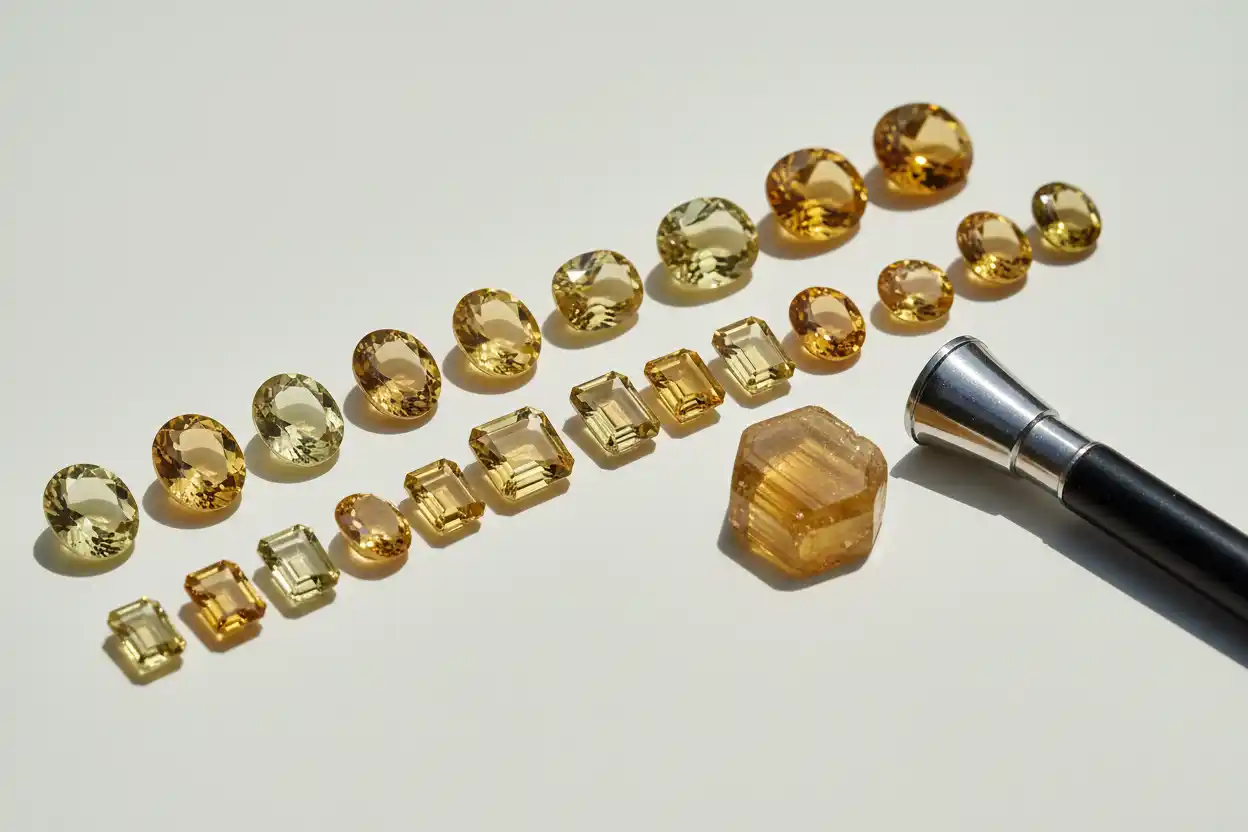
Buy Heliodor: How to Judge Quality, Color, Clarity & Value
To buy heliodor intelligently, evaluate the stone as yellow beryl rather than treating every yellow transparent gemstone as interchangeable. Heliodor belongs to the beryl mineral species alongside emerald, aquamarine, morganite, and goshenite. GIA describes chemically pure beryl as colorless and identifies yellow heliodor and blue aquamarine as iron-colored members of the family. GIA’s detailed research on blue-to-yellow beryl classifies heliodor in the greenish-yellow to yellow range and attributes yellow beryl color principally to iron-related absorption in the violet-blue region of the visible spectrum.
For buyers, that means color quality matters, but it must be judged alongside transparency, clarity, cut, dimensions, natural-versus-synthetic status, treatment disclosure, condition, provenance, and seller protection. Heliodor can occur in substantial sizes, so carat weight alone should never be used as proof of elite rarity. GIA’s Gübelin collection includes documented heliodor examples above ten carats from Brazil, Ukraine, and Zimbabwe, illustrating that large fashioned material exists.
Buy Heliodor At a Glance
| Buying Factor | What to Inspect | Why It Matters |
|---|---|---|
| Identity | Natural yellow or greenish-yellow beryl | Yellow appearance alone does not prove heliodor |
| Color | Hue, tone, saturation, brightness, uniformity | Color is one of the strongest visual value factors |
| Transparency | Bright, transparent appearance | Clean transparency supports brilliance and saturated color |
| Clarity | Crystals, fingerprints, two-phase inclusions, fractures | Visible features can affect beauty and durability |
| Cut | Windowing, extinction, symmetry, polish, face-up spread | Cutting strongly influences how yellow color is presented |
| Size | Carat weight plus millimeter dimensions | Large heliodor exists, so size must be judged with quality |
| Natural/Synthetic Status | Natural beryl versus synthetic yellow beryl | Synthetic yellow beryl exists and belongs to a different market |
| Treatment | Irradiation or other color modification | Some beryl can have color altered by irradiation |
| Color Stability | Whether an induced color may fade in strong light | Relevant when irradiation is suspected or disclosed |
| Condition | Chips, abrasion, scratches, fractures | Important in pre-owned jewelry |
| Origin | Seller provenance rather than assumption from color | Heliodor comes from multiple beryl-producing regions |
| Documentation | Independent identification and treatment testing | Useful when value or treatment claims are significant |
Heliodor Is Yellow Beryl
The most useful starting point is mineral identity. Heliodor is part of the beryl family rather than a form of topaz, citrine, sapphire, or chrysoberyl. GIA’s Gübelin Gem Project identifies yellow heliodor as an iron-colored beryl variety, while its research into blue-to-yellow beryl describes heliodor samples ranging from greenish yellow through lemon yellow to golden yellow.
This relationship explains why heliodor shares many basic physical properties with aquamarine and goshenite while occupying a separate color market. The Gems Lore guides to buy aquamarine and buy goshenite can therefore provide useful beryl context, but their color and value rules should not be transferred mechanically to heliodor.
A transparent yellow stone described as heliodor should ultimately test as beryl rather than merely resemble it visually.
Heliodor and Golden Beryl Terminology Can Vary
Yellow beryl terminology is not always used consistently throughout the trade. GIA’s broad beryl reference uses “yellow heliodor,” while its scientific color study classifies greenish-yellow, lemon-yellow, and golden samples within heliodor.
Some sellers use heliodor more narrowly for greenish-yellow material and golden beryl for stronger pure-yellow or golden colors, while others use heliodor broadly for gem-quality yellow beryl.
Buyers should therefore focus less on whether a merchant prefers one trade term and more on the measurable facts: the stone is beryl, its actual hue and saturation are visible, and the seller has disclosed natural-versus-synthetic status and known treatment.
Color Is One of the Most Important Heliodor Quality Factors
Heliodor can range from greenish yellow through lemon yellow to richer golden tones. GIA’s spectroscopy research shows that yellow color in beryl is linked with iron-related absorption behavior and that the position and strength of the violet-blue absorption edge influence how yellow the material appears.
A buyer should judge hue, tone, saturation, and brightness together. A richly saturated yellow can be attractive, but an overly dark or brownish stone may lose brilliance. Very pale material can remain elegant but may occupy a lower market tier if buyers are seeking stronger yellow.
Evenness matters as well. Strong color zoning or areas that appear nearly colorless can make the stone look less cohesive face-up, depending on the cut.
Color Should Be Judged Under Neutral Lighting
Yellow gems can change appearance significantly under warm retail lights. A heliodor that looks intensely golden beneath a warm lamp may appear lighter, greener, or less saturated under daylight-equivalent illumination.
Request photographs or video under neutral white light when color accounts for a major part of the asking price. A white or gray reference object in the image can make camera white-balance shifts easier to detect.
The most useful purchase is one whose color remains attractive under the lighting environments in which it will actually be worn.
Transparency Is Especially Important in Faceted Heliodor
Fine heliodor is commonly faceted because transparent beryl can produce bright, clean gems with considerable face-up presence. GIA research on blue-to-yellow beryl describes transparent samples and documents the same fundamental refractive behavior across the color range.
Cloudiness, dense inclusions, or fractures can reduce brilliance even when the bodycolor is attractive. A transparent yellow stone with strong polish can look luminous, while a similarly colored but hazy stone may appear dull.
Transparency should therefore be evaluated independently from saturation. Deep yellow is not automatically fine if the stone lacks light return.
Clarity Expectations Are Generally Favorable in Heliodor
Beryl can form in clean crystals, and transparent heliodor can occur with relatively unobtrusive internal features. GIA’s yellow-bryl research documented common two-phase inclusions in study samples, including elongated fluid features parallel to the crystal axis in heliodor.
Natural inclusions do not make a stone undesirable by themselves. They can even help support natural origin when interpreted by a professional gemologist.
The buyer should focus on whether inclusions are eye-visible, centrally positioned, reflective, surface-reaching, or associated with fractures that could affect durability.
Do Not Pay a Large Premium for Undefined “Flawless” Language
Retailers may advertise heliodor as flawless, VVS, AAA, AAAA, or investment quality. GIA does not issue overall colored-stone quality grades because there is no broadly accepted universal system for colored gemstones.
A clean-looking stone can legitimately cost more than a heavily included comparable gem, but the buyer should inspect the actual transparency and inclusion pattern rather than relying on a borrowed diamond-style term.
The seller should be able to explain the quality difference in observable terms.
Cut Quality Controls Brightness and Face-Up Color
Heliodor’s yellow color can become stronger or weaker depending on cut depth, orientation, windowing, and light return. A stone that is too shallow can develop a transparent window through the center, while excessive depth can retain weight but reduce face-up spread.
Check whether the stone appears lively across its entire face rather than bright only around the edges. Facet junctions should meet cleanly, and polish should not show obvious scratches or drag lines.
Emerald cuts, ovals, cushions, rounds, pears, and other shapes can all work well in heliodor. Shape quality depends on execution rather than the outline itself.
Millimeter Dimensions Matter Alongside Carat Weight
Heliodor can occur in fairly large fashioned stones. GIA’s Gübelin collection lists documented heliodors of approximately 8.41 and 14.44 carats from Brazil, 14.67 carats from Ukraine, and 11.46 and 4.72 carats from Zimbabwe.
These examples should not be interpreted as current market averages, but they show that double-digit carat heliodor is physically plausible and that size alone does not prove extraordinary rarity.
Compare length, width, and depth along with carat weight. A well-proportioned eight-carat stone may offer more visible impact than a deep ten-carat stone carrying excess weight underneath.
Size Becomes More Valuable When Quality Remains Strong
A larger heliodor can deserve a premium when it combines rich attractive yellow color, strong transparency, limited distracting inclusions, good cutting, and sound condition.
A large pale or windowed stone does not automatically outrank a smaller gem with superior color and brilliance. Size acts most effectively as a multiplier of quality rather than a substitute for it.
Buyers should therefore resist sales language that makes carat weight the first and only argument for value.
Synthetic Yellow Beryl Exists
GIA states that synthetic beryl can be manufactured in several colors, including yellow, red, blue, and green. Hydrothermal processes have been used commercially to grow synthetic beryl.
A synthetic yellow beryl can be attractive and genuinely beryl in composition, but it did not form naturally in the Earth and belongs to a different commercial category from mined heliodor.
High-value natural-heliodor purchases should therefore include clear natural-versus-synthetic disclosure. GIA’s Colored Stone Identification Report can determine whether polished material is natural or laboratory-grown and list detectable treatments.
Irradiation Can Alter Beryl Color
GIA’s treatment guidance states that some varieties of beryl can be irradiated to deepen an existing color or change the color altogether. It also warns that irradiated colors in some beryls can be relatively unstable and may fade upon exposure to bright light.
This does not mean that every bright yellow heliodor is irradiated. Natural iron-related yellow color is well documented.
It does mean that an unusually intense color sold with a substantial untreated premium deserves reliable disclosure. Laboratory testing is more meaningful than assuming either that all yellow is natural or that all vivid yellow is treated.
Treatment Status and Color Origin Are Separate From Material Identity
A stone can be natural beryl yet possess an artificially modified color. The word natural therefore does not automatically answer every treatment question.
A seller should state whether the material is natural or laboratory-grown and separately disclose any known color modification.
This distinction protects buyers from paying natural-color premiums for material whose appearance was produced or intensified through treatment.
Color Stability Can Matter in Treated Material
GIA specifically warns that irradiated color in some beryl can fade under strong light.
If irradiation is known or suspected, ask the seller about stability and recommended storage. A treated gemstone can still be useful and attractive, but the owner should understand whether prolonged bright-light exposure could alter its appearance.
Natural untreated iron-colored heliodor should not automatically be assumed to share the same light-stability concerns as an unstable induced color.
Heliodor Has Useful Durability for Jewelry
Beryl has a Mohs hardness of about 7.5 to 8. GIA gives that range for aquamarine, another beryl variety, and notes that it is durable for jewelry when protected from scratches and hard knocks. Research on natural Volyn beryl likewise records hardness corresponding roughly to 7–8 on the Mohs scale.
Hardness refers to scratch resistance rather than absolute resistance to breakage. Inclusions, fractures, sharp corners, and setting design can still influence vulnerability.
Heliodor can work well in rings, pendants, earrings, and bracelets when the individual stone is sound and mounted appropriately.
Cleaning Should Reflect the Condition of the Stone
Warm soapy water is a conservative cleaning method for beryl jewelry. GIA notes that ultrasonic and steam cleaning are usually safe for aquamarine when no significant fractures or liquid inclusions are present, but fractured or filled stones deserve gentler handling.
Because heliodor shares the same beryl structure, a careful owner should inspect the actual gem rather than assuming every stone can tolerate aggressive cleaning.
A valuable antique or heavily included specimen may deserve professional assessment before ultrasonic cleaning.
Origin Can Be Interesting Without Being a Universal Quality Grade
GIA’s beryl collection includes heliodor documented from Brazil, Ukraine, and Zimbabwe, while other research and museum material illustrates the broader geographic distribution of yellow beryl. GIA has also examined yellow beryl associated with Pakistan and material from the Volyn pegmatites of Ukraine.
These localities can interest collectors, but origin does not replace color, transparency, cut, or condition.
A fine Brazilian heliodor should be judged by the stone itself, not simply by Brazil on the label, and the same principle applies to Ukrainian, Pakistani, African, or other provenance.
GIA Does Not Currently Offer Standard Geographic-Origin Reports for Heliodor
GIA’s current Identification & Origin Report is restricted to specified gem types, including alexandrite, demantoid, emerald, jade, opal, Paraíba tourmaline, peridot, red spinel, ruby, and sapphire. Heliodor is not currently on the standard origin-service list.
A seller may still have mine documentation, supplier provenance, or collection records supporting an origin claim.
The buyer should simply distinguish those records from a standard GIA country-of-origin conclusion.
Heliodor and Goshenite Should Be Distinguished by Actual Color
Goshenite occupies the colorless to near-colorless beryl range, while GIA’s research classifies heliodor from greenish yellow to yellow.
Very pale yellow material can approach that boundary visually. Buyers should examine the stone under neutral lighting rather than paying a large heliodor premium for a gem that appears virtually colorless under ordinary conditions.
The Gems Lore buy goshenite guide provides the appropriate framework when the material is colorless or nearly so.
Heliodor and Aquamarine Share Beryl Identity but Different Color Markets
Aquamarine is blue to greenish-blue beryl, whereas heliodor is yellow to greenish-yellow beryl. GIA’s research demonstrates that iron plays a central role in the color of both varieties, with different absorption behavior producing blue versus yellow appearance.
The Gems Lore aquamarine price guide should therefore not be used as a direct heliodor benchmark even though the stones share hardness and mineral structure.
Market preference for particular colors, sizes, and treatments creates different commercial behavior.
Heliodor and Emerald Should Not Be Valued by the Same Beryl Logic
Emerald belongs to the same mineral species but follows a much more intense market around vivid green color, inclusion tolerance, fracture filling, origin, and rarity. The Gems Lore emerald price guide explains that market separately.
A yellow beryl does not inherit emerald pricing because it shares the beryl formula.
This is an important general gemological principle: mineral species establishes identity, while variety, color, scarcity, quality, and demand establish the commercial category.
Common Red Flags When You Buy Heliodor
Be cautious when:
A seller cannot explain that heliodor is yellow beryl.
A stone is sold as natural heliodor without addressing synthetic origin or treatment.
Vivid color carries a large untreated premium with no basis given.
AAA or AAAA is presented as a universal laboratory grade.
Large carat weight is treated as proof of exceptional rarity.
A pale nearly colorless stone is marketed as top yellow heliodor.
A seller claims GIA has confirmed country of origin when the document is only an Identification Report.
Deep cutting is hidden behind an impressive carat number.
Heavy color editing makes the listing look much more golden than neutral-light video.
A laboratory identification report is presented as a monetary appraisal.
Guaranteed appreciation is used to justify the asking price.
A reputable seller should be willing to discuss the gem in specific, testable terms.
How to Compare Heliodor Listings Fairly
Compare:
Natural versus synthetic beryl.
Hue, tone, saturation, and color uniformity.
Transparency.
Eye-visible inclusions and fractures.
Cut proportions.
Windowing and extinction.
Polish and symmetry.
Carat weight.
Millimeter dimensions.
Treatment disclosure.
Color stability where treatment is present.
Condition.
Provenance documentation.
Laboratory identification.
Loose stone versus finished jewelry.
Return and independent inspection rights.
Only then does the asking price become meaningfully comparable.
Conclusion
To buy heliodor confidently, begin with the fact that it is yellow to greenish-yellow beryl whose color is strongly associated with iron. GIA’s beryl research confirms both the shared mineral identity with aquamarine, emerald, goshenite, and morganite and the distinct iron-related color behavior that produces heliodor’s yellow appearance.
The strongest purchase combines attractive yellow color, useful transparency, appropriate clarity, effective cutting, sensible face-up dimensions, sound condition, and clear natural-versus-synthetic and treatment disclosure. Size matters, but GIA’s documented double-digit-carat heliodors show why weight alone should not be treated as proof of exceptional rarity.
Buyers should also remember that synthetic yellow beryl exists and that irradiation can alter color in some beryl, making independent identification valuable when the price or treatment claim is significant. Undefined retailer grades and unsupported origin claims should never carry more weight than the actual gemstone.
Frequently Asked Questions
What is heliodor?
Heliodor is yellow to greenish-yellow beryl. GIA identifies yellow heliodor as an iron-colored member of the beryl family.
What causes heliodor’s yellow color?
GIA research attributes yellow color in beryl to iron-related absorption, particularly an absorption edge in the violet-blue region of the spectrum.
Is heliodor the same mineral as aquamarine?
Yes. Both are beryl. Their different colors result from different iron-related absorption behavior and chemical environments.
Is heliodor the same as goshenite?
They are the same mineral species but different color varieties. Goshenite is colorless to near-colorless beryl, while heliodor is greenish yellow to yellow.
Is golden beryl the same as heliodor?
Trade usage varies. GIA broadly identifies yellow beryl as heliodor and includes greenish-yellow, lemon-yellow, and golden heliodor samples in its scientific research. Buyers should focus on actual color and beryl identity rather than terminology alone.
Does synthetic heliodor exist?
Synthetic beryl is available in yellow and other colors. GIA notes that hydrothermal synthetic beryl is commercially produced.
Can heliodor be irradiated?
Some beryl can have color deepened or changed by irradiation. GIA also warns that certain irradiated beryl colors may fade under strong light.
Is heliodor durable?
Beryl is approximately 7.5 to 8 on the Mohs scale and is suitable for jewelry with sensible protection from scratches and hard knocks.
Are large heliodors rare?
Large fashioned examples exist. GIA’s Gübelin collection includes heliodors above ten carats from several sources. Large size can still add value when strong color, transparency, and cutting remain present.
Does GIA grade heliodor AAA?
No. GIA does not issue overall quality grades for colored stones because no broadly accepted universal colored-stone grading system exists.
Can GIA identify heliodor?
Yes. GIA Colored Stone Identification Reports identify polished gemstone material, natural or synthetic status, and detectable treatments.
Can GIA confirm heliodor geographic origin?
Heliodor is not currently among the gemstones eligible for GIA’s standard Colored Stone Identification & Origin Report.
Is heliodor a guaranteed investment?
No. Future value depends on color, quality, size, treatment, condition, provenance, demand, and market liquidity. No seller grade or origin claim guarantees appreciation.