11 Real Moonstone Benefits: Gentle Traditions, Verified Facts, Safe Limits
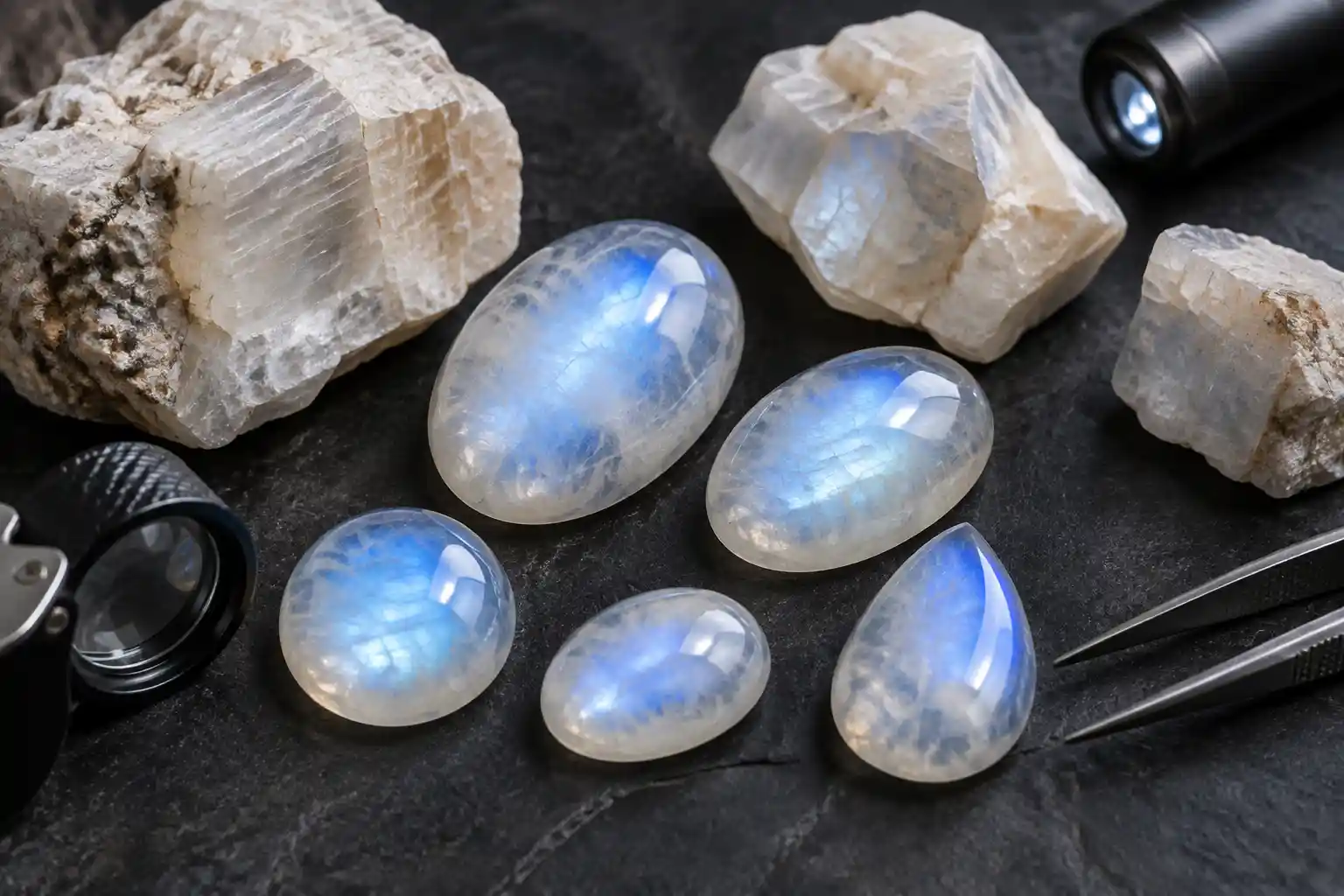
Moonstone benefits begin with a distinctive optical effect that has fascinated gemstone wearers for generations. True moonstone belongs to the feldspar family and is best known for adularescence, the floating white or bluish light that appears to glide beneath the surface as a polished stone moves. This glow results from light interacting with microscopic intergrowths or layered structures within the feldspar rather than from an actual light source inside the gem.
Traditional moonstone is commonly associated with potassium feldspar containing fine intergrowths of sodium-rich feldspar. Its characteristic internal structure scatters light and creates the soft floating effect that gave the stone its lunar name. The finest transparent to translucent examples can display a strong blue adularescence against a nearly colorless body, while other stones may show white, silvery, cream, peach, gray, or softer optical effects.
Moonstone benefits extend beyond visual beauty. The gem is useful in jewelry, mineral collecting, optical education, design, and cultural symbolism. Historical associations with moonlight, femininity, love, fertility, intuition, and changing cycles have developed in different traditions, while modern crystal culture adds many wellness claims. These symbolic ideas can remain personally meaningful, but they should not be confused with proven effects on hormones, pregnancy, fertility, menstruation, mood, or sleep.
11 Moonstone Benefits at a Glance
- Adularescence creates a distinctive floating blue-white or silvery glow.
- Feldspar mineralogy offers valuable insight into how microscopic structures control gemstone optics.
- Cabochons display the optical effect beautifully without requiring conventional faceting.
- Jewelry versatility supports pendants, earrings, rings, brooches, necklaces, and artistic designs.
- Transparent specimens with strong blue adularescence can have substantial collector appeal.
- Color varieties provide options ranging from colorless and white to cream, peach, gray, and other tones.
- Cultural associations with moonlight and changing cycles give the stone a long symbolic identity.
- Personal symbolism can connect moonstone with reflection, transition, relationships, or important life milestones.
- Mineral identification teaches useful distinctions between traditional moonstone and visually related feldspars.
- Gentle care practices help preserve a stone that is reasonably hard but vulnerable to cleavage and impact.
- Evidence-safe spiritual use allows meditation and personal ritual without turning moonstone into medical treatment.
Adularescence Is the Most Distinctive Moonstone Benefit
Adularescence is central to nearly every discussion of moonstone benefits. Unlike ordinary surface reflection, the glow seems to originate from within the gemstone and move across its surface as the viewing angle changes.
The phenomenon develops when light interacts with fine feldspar layers or intergrowth structures. Light entering the stone is scattered by these internal boundaries, producing the characteristic floating sheen. The thickness and regularity of the layers influence the color and strength of the effect.
Fine blue adularescence is particularly prized because it can appear sharply defined against a transparent or nearly colorless body. White or silvery adularescence is also attractive, especially when it moves broadly across the stone rather than remaining weak or confined to a small area.
Cut orientation is crucial. A lapidary needs to position the feldspar correctly so the strongest glow appears on the top of the finished cabochon. Poor orientation can make excellent rough look disappointing, while skillful cutting can reveal a dramatic optical effect that was difficult to see before polishing.
Feldspar Mineralogy Gives Moonstone Scientific Value
One of the less obvious moonstone benefits is educational. Feldspar minerals make up a major part of Earth’s crust, yet moonstone demonstrates how subtle structural relationships within a common mineral family can create a rare and beautiful gem effect.
Traditional moonstone is commonly described in relation to orthoclase and albite feldspar intergrowths. As suitable feldspar cools, components that were mixed at higher temperatures can separate on a microscopic scale. These fine internal structures interact with light and produce adularescence.
This geological explanation makes moonstone valuable for understanding that gemstone beauty does not always require unusual chemistry. Sometimes the arrangement of common elements at a microscopic scale creates the defining optical feature.
Moonstone also teaches a useful identification lesson. Several feldspars can display attractive sheen, but not every commercial stone carrying a moonstone-related name has exactly the same mineralogical identity. Correct terminology becomes especially important when comparing traditional moonstone with rainbow moonstone.
Moonstone Jewelry Uses the Gem’s Glow Rather Than Facet Fire
Moonstone is usually cut as a cabochon because a rounded polished surface allows adularescence to move visibly across the stone. Faceting can be used for transparent examples, but conventional brilliance is generally secondary to the floating light effect.
Pendants and earrings are particularly practical because they allow movement to reveal the sheen while protecting the stone from many direct impacts. Rings can also display moonstone beautifully, especially in bezel or protective settings.
Moonstone typically has a Mohs hardness around 6 to 6.5, providing moderate scratch resistance. Hardness is only part of durability, however. Feldspar has cleavage, and a sharp impact can cause a stone to split or chip even when its polished surface has resisted ordinary scratching.
This combination means jewelry should be designed around the stone rather than assuming it behaves like sapphire or diamond. A beautiful moonstone ring can last for years with sensible wear, but heavy manual work and repeated knocks are unnecessary risks.
Color and Transparency Give Buyers Many Moonstone Options
Moonstone benefits include considerable visual variety. Stones may be colorless, white, cream, peach, gray, brownish, or show other subtle body colors. Transparency ranges from nearly transparent through translucent to more opaque examples.
The optical effect interacts with body color. A transparent stone with a vivid blue sheen creates a very different appearance from a warm peach stone with soft white adularescence. Neither style needs to be considered universally superior because collectors and jewelry buyers often have different preferences.
For traditional high-end evaluation, strong centered adularescence, attractive transparency, minimal distracting inclusions, good cutting, and appealing body color can influence desirability. The effect should be visible in normal movement rather than only under one extremely precise lighting angle.
Anyone planning to buy Moonstone benefits from examining the actual optical effect rather than relying exclusively on a seller’s color description. Video under several lighting conditions is often more informative than a single still photograph because adularescence depends on movement.
Moonstone Has Strong Collector Appeal When Optics and Provenance Align
Collectors may value moonstone for optical quality, locality, crystal form, rarity, transparency, unusual color, or the strength of adularescence. A fine cabochon and a natural feldspar crystal can therefore appeal for entirely different reasons.
Sri Lanka has long been associated with fine moonstone, and deposits elsewhere have also produced important stones. India is known for moonstone of several body colors, while sources in countries such as Tanzania, Madagascar, Myanmar, and others contribute different qualities to the market.
Locality claims should be treated carefully unless documentation exists. Appearance alone is not always sufficient to establish geographic source.
Collector value also differs from commercial jewelry appeal. A mineral collector may prize an unusual natural crystal with geological context, while a jeweler may prefer clean rough that produces a strong blue sheen after cutting.
These different priorities help explain why moonstone price can vary significantly according to optical strength, body color, transparency, cutting, size, treatment status, provenance, and overall visual quality.
Moonstone Benefits Include a Long Lunar Symbolism
Moonstone’s name and appearance naturally created associations with moonlight. The floating glow resembles light moving across clouds or water, making lunar symbolism more intuitive than in many gemstones whose traditional meanings have little connection with appearance.
Historical traditions in different regions associated moonstone with the moon, love, fertility, travel, intuition, or changing cycles. These associations should be described within their cultural context rather than blended into one supposedly universal ancient belief.
Modern symbolism frequently uses the lunar theme more generally. Someone may associate moonstone with transition because the Moon visibly changes phases. Another person may connect it with reflection, cycles, beginnings, or the passage of time.
These meanings are symbolic. Moonstone does not physically control lunar cycles, reproductive systems, emotions, or human behavior.
Reflection and Transition Are Evidence-Safe Personal Uses
Reflection is one of the most practical symbolic moonstone benefits. The moving optical glow can serve as a visual reminder that perception changes with angle, lighting, and time.
Someone beginning a new stage of life may choose moonstone to symbolize transition. A graduation pendant might represent movement into a career. A ring purchased after relocation could become associated with starting again. A person marking an anniversary may connect the gem with the cycles of a long relationship.
The stone does not cause those transitions. Its value comes from giving the owner an object that represents them.
This approach also avoids dependence on exaggerated metaphysical claims. A gemstone can be emotionally important because of memory, visual beauty, cultural symbolism, and personal intention without needing to change biological systems.
Moonstone and Rainbow Moonstone Need Clear Identification
One important practical moonstone benefit is the identification knowledge it can encourage. Traditional moonstone and rainbow moonstone can look superficially related because both display moving light effects, but they are commonly associated with different feldspar compositions.
Rainbow moonstone is generally a trade name applied to transparent to translucent labradorite feldspar that displays colorful blue or rainbow labradorescence. Traditional moonstone is associated more closely with orthoclase-albite feldspar structures producing adularescence.
Both can be attractive and both belong to the feldspar family, but they should not automatically be treated as identical.
This distinction matters when comparing price, durability, optical appearance, and mineralogical descriptions. A buyer should know whether a seller is using moonstone terminology in a strict mineralogical sense or a commercial one.
Moonstone Care Requires Attention to Cleavage
Moonstone is harder than calcite, malachite, or fluorite, but it is not highly resistant to impact. Feldspar cleavage can make a stone vulnerable to splitting if struck sharply in an unfavorable direction.
Gentle cleaning is therefore preferable. Lukewarm water, mild soap, and a soft cloth are suitable for many uncomplicated moonstone pieces. Aggressive ultrasonic cleaning, steam, harsh chemicals, and sudden temperature changes are unnecessary risks, particularly when fractures or inclusions are present.
Jewelry should be stored separately from harder stones such as sapphire, ruby, topaz, or diamond. A soft pouch or lined compartment reduces scratching and prevents pieces from knocking together.
Rings should be removed for manual work, exercise, gardening, household cleaning, or activities involving hard surfaces. These habits protect the optical polish and reduce the risk of cleavage damage.
Modern Spiritual Moonstone Benefits Need Medical Boundaries
Contemporary crystal traditions frequently associate moonstone with intuition, femininity, hormonal balance, fertility, pregnancy, menstruation, sleep, emotional regulation, and spiritual awareness.
Several of these claims move directly into medical territory and require clear limits. There is no established evidence that wearing moonstone regulates hormones, improves fertility, supports pregnancy outcomes, treats menstrual disorders, changes sleep physiology, or treats anxiety or depression.
Beliefs described around Moonstone healing properties can be understood as spiritual or cultural interpretations rather than clinical treatment.
Someone may still use moonstone during meditation, journaling, prayer, or reflective practice. The object’s beauty and symbolism may make the routine meaningful, but health concerns require appropriate professional care.
Personal Symbolism Can Be More Important Than Standard Meanings
One of the most enduring moonstone benefits is its ability to become personally significant. Jewelry given during an engagement, anniversary, journey, graduation, or major transition can accumulate emotional meaning over time.
The adularescence itself may become connected with that memory. A wearer may think of a particular person whenever the blue glow appears, making the stone valuable for reasons no grading report can measure.
This emotional role is common across jewelry and does not require mystical explanation. Human beings use objects to represent relationships, promises, identities, achievements, and memories.
Moonstone’s lunar appearance simply gives those personal meanings a particularly evocative visual foundation.
Conclusion
Moonstone benefits combine beautiful adularescence, feldspar mineralogy, jewelry versatility, collector appeal, cultural history, educational value, and powerful personal symbolism. Its moving blue-white glow results from internal feldspar structure and makes the gem visually distinctive without relying on conventional facet brilliance.
The stone requires reasonable care because its moderate hardness is accompanied by cleavage vulnerability. Lunar symbolism, intuition, reflection, and transition can remain meaningful cultural or personal themes, while claims involving fertility, hormones, sleep, or medical healing require evidence that moonstone does not provide.
FAQs
What are the main Moonstone benefits?
The strongest Moonstone benefits include adularescence, distinctive feldspar mineralogy, jewelry beauty, collector interest, educational value, cultural symbolism, and personal meaning. Its moving internal glow makes it visually unusual, while modern traditions associate it with reflection, transition, intuition, and lunar cycles. Medical or hormonal effects are not scientifically established.
What causes Moonstone’s glow?
The floating glow known as adularescence results from light scattering within microscopic feldspar structures or intergrowths. Light entering the stone interacts with these internal layers and produces a sheen that appears to move as the stone changes angle. The effect is optical rather than an internal light source or supernatural energy.
Is blue Moonstone more valuable?
Transparent or nearly transparent moonstone with a strong, centered blue adularescence is often highly prized. Value still depends on several factors, including size, body color, inclusions, cutting, transparency, strength and coverage of the optical effect, treatment status, and overall beauty. A softer white or peach stone may still be desirable for jewelry even if it falls into a different market category.
Is Moonstone durable enough for everyday jewelry?
Moonstone has a Mohs hardness around 6 to 6.5, so it provides moderate scratch resistance. Feldspar cleavage makes it vulnerable to hard impacts, however. Pendants and earrings are relatively protected, while frequently worn rings should have secure settings and be removed before demanding physical activities.
Is Rainbow Moonstone the same as Moonstone?
Not exactly. Rainbow moonstone is generally a trade name for transparent to translucent labradorite feldspar with colorful labradorescence. Traditional moonstone is more closely associated with orthoclase-albite feldspar intergrowths and adularescence. Both belong to the feldspar family but have different gemological identities and optical details.
Why is Moonstone associated with the Moon?
Its floating silvery or blue-white glow resembles moonlight, making lunar symbolism visually intuitive. Historical and modern traditions have connected the gem with the Moon, cycles, love, intuition, travel, and transition. These are cultural interpretations rather than evidence that moonstone is physically affected by lunar phases in ways that change human health.
Does Moonstone help fertility or hormones?
There is no established scientific evidence that moonstone improves fertility, regulates hormones, treats menstrual disorders, changes pregnancy outcomes, or provides reproductive-health treatment. These claims arise from spiritual and symbolic traditions. Reproductive or hormonal concerns should be addressed through qualified medical care.
Can Moonstone be used for meditation?
Yes. A polished stone can serve as a visual or tactile focus during meditation, journaling, prayer, or reflection. Its moving glow may make it especially engaging as a symbolic object. The usefulness of the practice comes from attention, routine, and personal meaning rather than a proven medical effect of the gemstone.
How should Moonstone be cleaned?
Gentle cleaning with lukewarm water, mild soap, and a soft cloth is suitable for many uncomplicated moonstone pieces. Harsh chemicals, steam, aggressive ultrasonic cleaning, sudden temperature changes, and strong impacts should be avoided. Separate storage helps protect the surface from harder gemstones.
Is Moonstone good for engagement rings?
Moonstone can make a beautiful engagement ring for someone willing to accept greater care requirements than diamond, sapphire, or moissanite. A protective setting and mindful wear are important because the stone can scratch and may cleave if struck. Its suitability depends on lifestyle as much as appearance.
Are Moonstone healing benefits scientifically proven?
No. Moonstone has not been shown to diagnose, treat, cure, or prevent physical or mental-health conditions. Claims involving hormonal balance, fertility, pregnancy, emotional disorders, sleep, or other medical effects belong to belief traditions rather than established evidence.
Moonstone benefits involving fertility, hormonal balance, emotional healing, intuition, or spiritual energy reflect cultural, personal, or metaphysical interpretations and should not replace qualified physical or mental-health care.