7 Real Opal Benefits: Gentle Uses, Evidence, Safe Use & Clear Limits
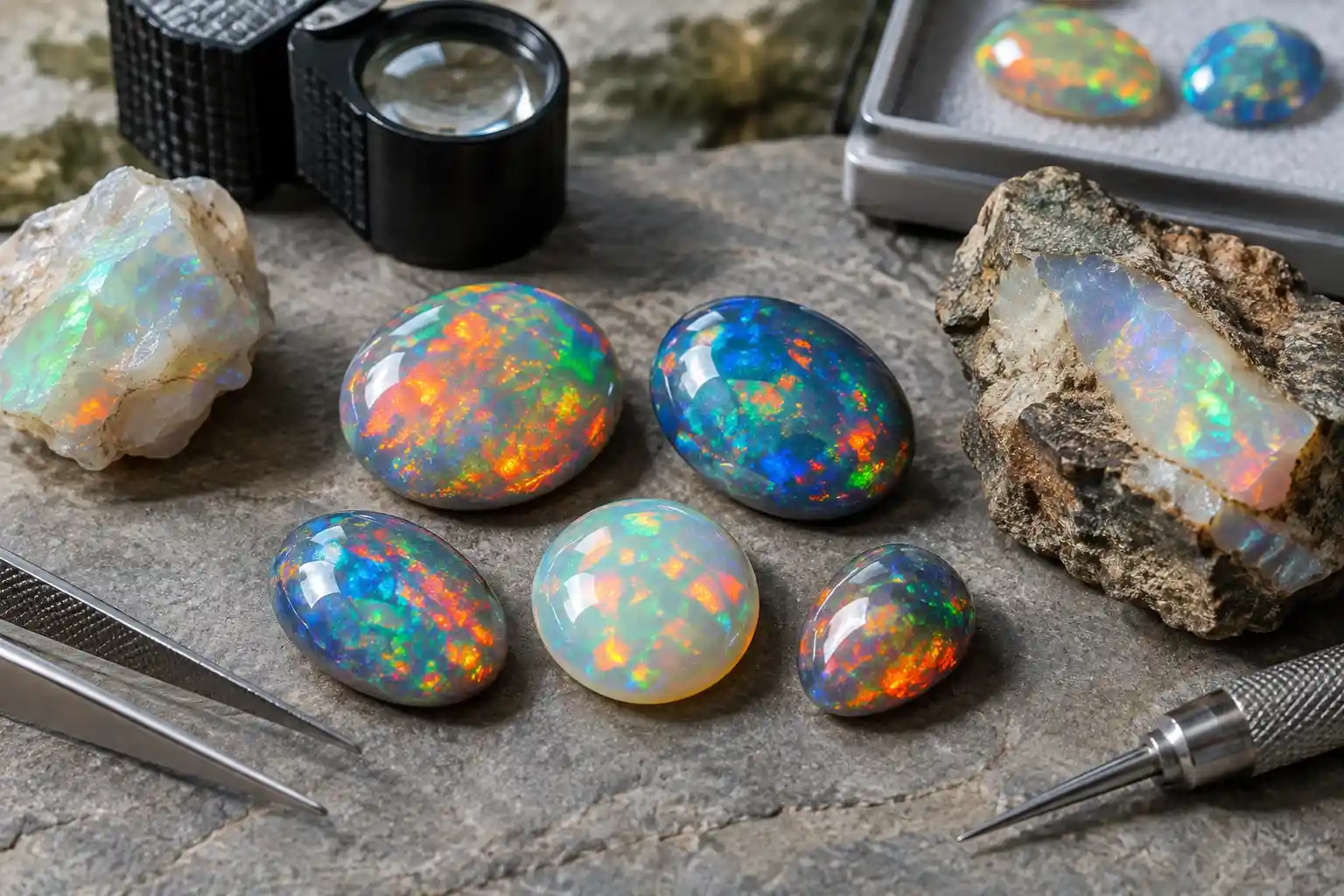
Opal benefits are rooted in one of the most distinctive optical structures found in gemstones. Opal is hydrated silica, generally represented as SiO₂·nH₂O, and unlike crystalline quartz it lacks a conventional long-range crystal lattice. Precious opal can display brilliant flashes of red, orange, yellow, green, blue, and violet known as play-of-color, an effect created when light interacts with ordered arrays of microscopic silica spheres inside the gem.
Not every opal shows this phenomenon. Precious opal displays play-of-color, while common opal can have attractive body color without spectral flashes. White, black, crystal, boulder, fire, pink, blue, and other commercial varieties differ considerably in appearance, transparency, geology, and value. Some names describe body color, some describe host-rock relationships, and others reflect locality or commercial tradition.
The strongest Opal benefits therefore include optical beauty, geological and gemological interest, exceptional individuality, jewelry versatility, collector appeal, and substantial cultural symbolism. Its comparatively low hardness and water-bearing structure demand more care than sapphire, ruby, or diamond, but careful wear allows fine opal jewelry to remain beautiful for many years. Spiritual interpretations involving creativity, emotion, hope, intuition, or love can be personally meaningful without turning opal into a treatment for physical or mental-health conditions.
7 Opal Benefits at a Glance
- Precious opal can display extraordinary play-of-color created by diffraction within ordered silica structures.
- Every stone can show a highly individual combination of body color, pattern, transparency, and spectral flashes.
- Opal provides valuable geological and gemological insight into hydrated silica formation and optical diffraction.
- Cabochons, freeform cuts, doublets, triplets, and naturally host-rock-backed gems support many jewelry styles.
- Collector appeal comes from color, pattern, locality, transparency, rarity, natural formation, and preservation.
- Historical and modern symbolism can connect opal with creativity, hope, imagination, individuality, and important personal milestones.
- Understanding durability, treatments, hydrophane behavior, and care allows owners to enjoy Opal benefits responsibly.
Play-of-Color Is the Most Distinctive Opal Benefit
The most visually remarkable Opal benefit is play-of-color. In precious opal, microscopic silica spheres can become arranged with enough regularity that they behave somewhat like a three-dimensional diffraction structure. Light entering the gem is separated into spectral colors, and those flashes move or change as the stone, observer, or light source changes position.
Sphere size and arrangement influence which colors appear. Larger structural spacing can allow longer wavelengths such as orange and red to become visible, while smaller structures may emphasize blue or green. This helps explain why vivid red play-of-color is particularly desirable in many market contexts.
Pattern matters as much as hue. Broad flashes, rolling color, pinfire, patchwork, harlequin-like arrangements, and other appearances can create dramatically different visual experiences. A stone showing several bright colors across most of its face may command much more attention than one with weak flashes confined to a small area.
The effect is not paint, fluorescence, or a surface coating in untreated natural precious opal. It comes from the internal silica structure, which is why cutting orientation can make an enormous difference to the finished gem.
Hydrated Silica Gives Opal Exceptional Geological Interest
One of the less obvious Opal benefits is educational value. Opal is hydrated silica and can contain a meaningful amount of water within its structure. This distinguishes it from quartz even though both are dominated chemically by silica.
Opal can form when silica-bearing fluids move through cavities, fractures, sedimentary environments, volcanic rocks, or other suitable geological settings. As conditions change, silica can be deposited as extremely fine particles or spheres. Where those spheres develop sufficient regularity, precious play-of-color may result.
Australia is famous for several important opal types, including black opal, white opal, and boulder opal. Ethiopia has become particularly significant for hydrophane opal, while Mexico is renowned for fire opal. Other sources occur around the world, and their geological settings can influence appearance and physical behavior.
This source diversity makes collecting valuable for education. Comparing Australian sedimentary opal with Ethiopian volcanic opal or Mexican fire opal demonstrates that stones grouped under one gem name can have noticeably different formation histories.
Individuality Makes Opal Especially Valuable in Jewelry
Uniformity is often prized in gemstone suites, but individuality is one of the strongest Opal benefits. Two stones of similar size can look completely different because body color, transparency, color pattern, brightness, and spectral distribution vary independently.
A black opal may show intense green and red flashes against a dark background. A white opal can produce softer rainbow colors against a pale body. Crystal opal may be transparent enough for light to enter deeply, while boulder opal can preserve natural ironstone backing as part of the finished gem.
This individuality allows jewelry to be designed around one particular stone rather than around standardized dimensions. Freeform cuts are common because cutters often preserve the area displaying the strongest play-of-color instead of sacrificing it for perfect symmetry.
Anyone planning to buy Opal benefits from watching the actual stone move under several lighting conditions. Still photographs can capture one attractive flash while failing to show brightness, dead zones, pattern distribution, or how color performs from ordinary viewing angles.
Opal Supports Several Distinct Jewelry Styles
Opal benefits jewelry designers because the gem can appear delicate, dramatic, fiery, subtle, transparent, opaque, patterned, or intensely multicolored depending on type.
Cabochons are common because a smooth domed surface preserves weight and allows play-of-color to move naturally. Freeform outlines can follow the strongest color areas, particularly in rare rough where every millimeter matters.
Boulder opal may retain ironstone matrix on the back or within the face, creating strong contrast and supporting thin veins of precious opal that could not be cut independently. Doublets combine a thin precious-opal layer with a dark backing, while triplets usually add a transparent protective cap above a thin opal layer.
These assembled stones can be attractive and affordable, but they should be disclosed because construction affects durability and care. Soaking can be especially problematic for some doublets and triplets if moisture enters between glued layers.
Rings are possible, yet pendants and earrings generally expose opal to fewer knocks. Protective bezels can be useful for stones intended for frequent wear.
Opal Durability Requires Realistic Expectations
Responsible care is central to Opal benefits because opal is softer and often more fragile than many familiar faceted gems. Its Mohs hardness generally ranges from about 5 to 6.5, while toughness can vary from poor to fair depending on type and condition.
Scratching is therefore a realistic concern. Quartz-rich dust, harder gemstones, and abrasive cleaners can damage the surface. A polished opal should not be stored loose against diamond, sapphire, topaz, or quartz jewelry.
Heat and rapid temperature changes can also be risky. Some opals may develop fine fractures known as crazing if internal stress and moisture changes become severe. This is one reason jewelry should be protected from strong heat, sudden thermal shock, and aggressive cleaning methods.
Warm soapy water is the conservative cleaning method for solid opal. Steam and ultrasonic cleaners should be avoided. Assembled doublets and triplets deserve even more caution because adhesives and layer boundaries introduce additional vulnerabilities.
Hydrophane Opal Has Special Water-Absorption Behavior
Some Ethiopian opal is hydrophane, meaning its porous structure can absorb water. When immersed, a hydrophane stone may temporarily become more transparent, lose apparent play-of-color, change body appearance, or take time to return to its original state as moisture leaves.
This behavior does not automatically mean the opal is damaged or false. It reflects porosity and should instead influence cleaning and wearing habits.
Repeated exposure to water containing soap, cosmetics, oils, dyes, or other substances can create additional concerns because the stone may absorb contaminants rather than clean water alone. Owners of hydrophane opal should therefore minimize unnecessary soaking.
The distinction illustrates why generalized care rules cannot describe every opal perfectly. Knowing the actual type of stone is more useful than assuming all opals behave alike.
Opal Treatments and Assembled Stones Need Clear Disclosure
Another important Opal benefit is the opportunity to understand gemstone enhancement. Natural opal can be treated in several ways to change apparent color, contrast, clarity, or durability.
Some dark opals may receive smoke or sugar-acid treatment to create a darker background that makes play-of-color appear stronger. Oil, wax, resin, or other impregnation may also occur in certain stones. Doublets and triplets are assembled products rather than solid single pieces.
Synthetic opal also exists and can reproduce play-of-color through manufactured structures. Imitations made from glass, plastic, or other substances form a separate category.
None of these products must be unattractive. The key issue is disclosure. A buyer should know whether a stone is natural untreated opal, treated natural opal, synthetic opal, an assembled doublet or triplet, or an imitation.
The factors behind Opal price therefore extend beyond carat weight and include type, body tone, brightness, play-of-color, pattern, transparency, origin, treatment, construction, stability, and overall visual appeal.
Historical Symbolism Gives Opal Cultural Depth
Opal has attracted symbolic interpretations for centuries because its shifting colors make it visually unlike most other gems. Ancient Roman admiration for opal is well documented, and later European attitudes ranged from associations with hope and good fortune to periods when superstition portrayed the stone negatively.
One famous development in opal’s unlucky reputation came from literature rather than gemology. Fiction helped reinforce superstition in parts of Europe, demonstrating how cultural stories can influence gemstone reputation independently of physical properties.
Opal later became deeply associated with Australia as commercial mining expanded, and modern jewelry culture has largely reclaimed the stone as a symbol of individuality, creativity, imagination, and spectacular natural color.
Historical beliefs should be attributed carefully rather than blended into one supposedly universal tradition. Different societies understood and used opal in different ways.
Creativity and Imagination Are Natural Modern Symbols
Creativity is one of the more intuitive symbolic Opal benefits. A stone can display several colors and patterns that change continuously with movement, inviting different interpretations each time it is viewed.
An artist may associate opal with changing ideas. A writer may choose it as a personal symbol of imagination, while someone working in design might simply appreciate the complexity of light and pattern.
The stone does not directly stimulate creative brain function. Its appearance can instead act as a visual cue that the owner connects with creative work.
The same distinction applies to emotional claims. Beliefs grouped under Opal healing properties may describe emotional expression, intuition, love, or spiritual awareness, but opal has not been shown to treat anxiety disorders, depression, trauma, hormonal conditions, neurological illness, or other health concerns.
Collector Value Extends Beyond Bright Play-of-Color
Play-of-color is a major value factor, but collecting Opal benefits from a much wider range of qualities. Some collectors focus on locality, while others seek unusual patterns, transparent crystal opal, dark body tone, fossil replacement, matrix relationships, or exceptional natural rough.
Common opal can also be scientifically or aesthetically interesting even without play-of-color. Pink, blue, green, yellow, and other varieties may owe their appeal mainly to body color, inclusions, or geological origin.
Opalized fossils provide another fascinating area. Silica can replace or fill biological structures during fossilization, preserving shapes while transforming the original substance. Such specimens can connect paleontology, mineralogy, and gem collecting in one object.
For collectors, documentation and stability matter alongside beauty. A spectacular unstable specimen may be less desirable for long-term preservation than a slightly less colorful stone with excellent structural integrity.
What Opal Benefits Do Not Include
Opal benefits do not include scientifically demonstrated treatment for physical or mental-health conditions. There is no reliable evidence that wearing opal regulates hormones, improves eyesight, treats infections, changes fertility, cures depression, detoxifies the body, or repairs neurological problems.
The water present within opal does not hydrate the wearer. Likewise, spectral color does not indicate that the stone transfers therapeutic light or energy into tissues.
Opal already offers extraordinary real value through optical physics, geological formation, jewelry, collecting, artistic design, cultural history, and personal symbolism.
Conclusion
Opal benefits combine extraordinary play-of-color, hydrated silica geology, individuality, jewelry versatility, collector value, cultural history, and personal symbolism. Precious opal’s spectral flashes come from ordered microscopic silica structures, while common opal demonstrates how diverse hydrated silica can appear even without play-of-color.
Its softness, variable toughness, possible water absorption, treatments, and sensitivity to heat require informed care. Creativity, hope, love, individuality, and intuition can remain meaningful symbolic themes when they are kept separate from unsupported medical claims.
FAQs
What are the main Opal benefits?
The strongest Opal benefits include spectacular play-of-color, highly individual appearance, geological and optical interest, jewelry versatility, collector appeal, cultural history, and personal symbolism. Modern traditions also connect opal with creativity, hope, love, and intuition, but these themes are not scientifically established medical effects.
What is Opal made of?
Opal is hydrated silica, commonly represented by the formula SiO₂·nH₂O. It contains silica together with variable water content and lacks the conventional long-range crystal structure of quartz. Precious play-of-color develops when microscopic silica spheres are arranged regularly enough to diffract visible light.
Why does precious Opal show rainbow colors?
Ordered silica spheres inside precious opal interact with light and produce diffraction. Different structural spacing causes different wavelengths of visible light to emerge, creating red, orange, yellow, green, blue, and violet flashes. The colors can move as the gem or viewing angle changes.
Is every Opal colorful?
Opal occurs in many body colors, but not every stone displays play-of-color. Precious opal shows spectral play-of-color, while common opal does not. Common opal can still be attractive because of body color, translucency, inclusions, or geological origin.
Is Opal durable enough for jewelry?
Yes, but it needs more care than many harder gemstones. Opal generally measures about 5 to 6.5 on the Mohs scale and may be vulnerable to scratches, impact, heat, and sudden temperature change. Protective settings and careful wear are particularly useful for rings.
Should Opal be stored in water?
Routine water storage is generally unnecessary for most stable opal. Some hydrophane stones readily absorb water, while other opals can be affected by environmental changes in different ways. Owners should know the type of opal they have and avoid extreme heat or unnecessary prolonged soaking.
Are Opal healing benefits scientifically proven?
No. Opal has not been shown to diagnose, treat, cure, or prevent physical or mental-health conditions. Claims involving emotional healing, fertility, hormones, eyesight, detoxification, or neurological effects belong to spiritual traditions rather than established medical evidence.
Opal benefits involving healing energy, emotional treatment, fertility, intuition, or physical wellness reflect cultural, spiritual, or personal interpretations and should not replace qualified physical or mental-health care.