Opal Healing Properties: 10 Claims, Ancient Lore & Safe Care
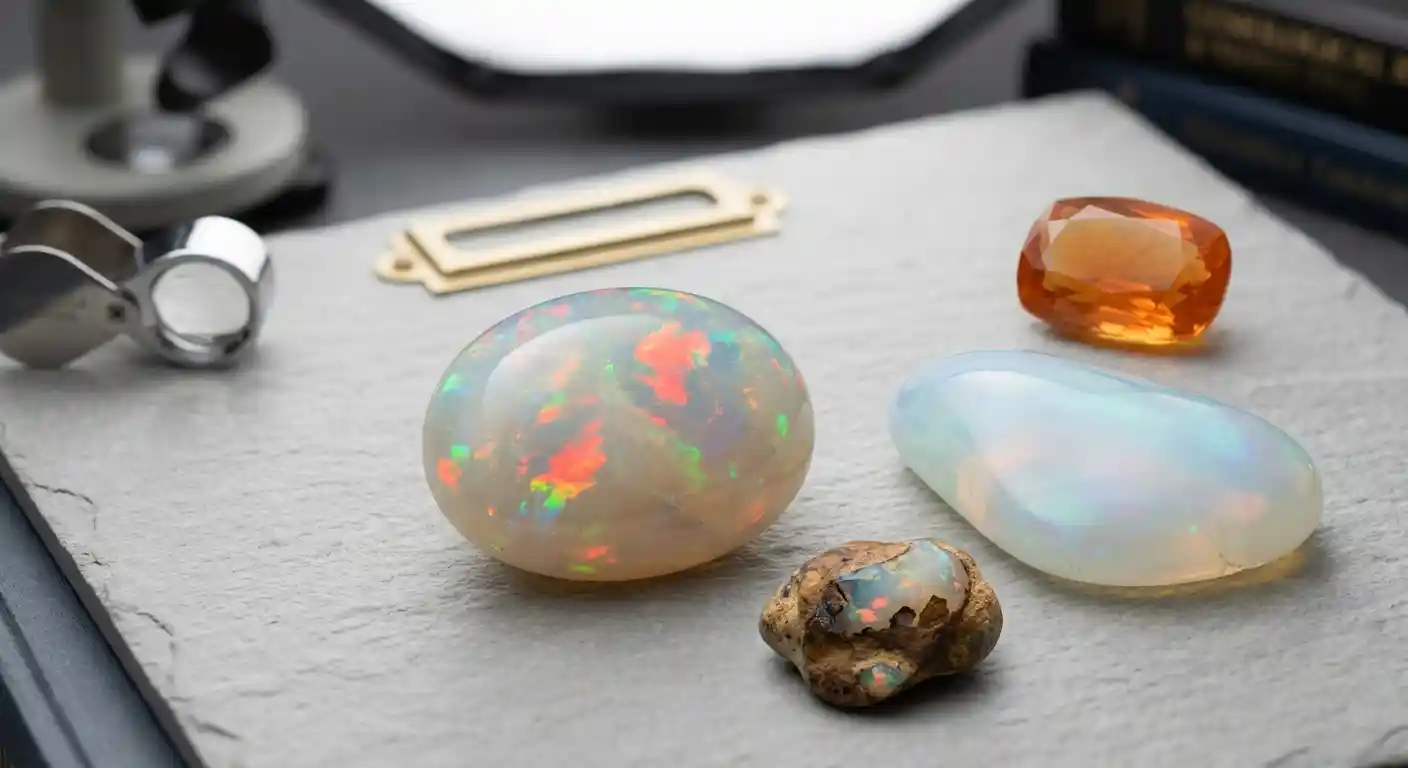
Opal healing properties are commonly associated with creativity, emotional awareness, confidence, self-expression, optimism, resilience, relationship reflection, intuition, meditation, and spiritual renewal. Few gemstones make symbolism feel as immediate as precious opal because red, green, blue, orange, and violet flashes can appear to move across the stone as the viewing angle changes. That play-of-color is a genuine optical phenomenon, but it does not establish a healing mechanism. Opal has not been demonstrated to treat anxiety, depression, eye problems, hormonal conditions, fertility issues, pain, inflammation, sleep disorders, neurological illness, or another medical condition. Scientifically, opal is hydrated silica commonly represented as SiO₂·nH₂O. It is amorphous to poorly crystalline rather than a conventional crystal with one ordered lattice, generally measures about Mohs 5 to 6.5, contains variable amounts of water, and requires more careful handling than quartz, sapphire, or many other popular gems.
10 Opal Healing Claims
- Creativity and imaginative thinking
- Emotional awareness and reflection
- Confidence in self-expression
- Optimism during difficult periods
- Resilience after setbacks
- Relationship awareness and communication
- Intuition and reflective judgment
- Meditation and focused attention
- Adaptability during personal change
- Spiritual renewal and personal meaning
These ten themes can support different reflective practices without becoming ten scientifically proven effects. Many Opal benefits become more useful when translated into actions such as brainstorming without immediate judgment, journaling honestly, preparing for a difficult conversation, reviewing a setback, or using a familiar gemstone as a cue for meditation.
Opal Mineral Facts
Opal is a hydrated form of silica represented by the general formula SiO₂·nH₂O. Its water content varies and can reach substantial levels in some specimens. Unlike quartz, opal does not normally possess a fully ordered long-range crystal lattice, which is why it is often described as a mineraloid or amorphous to poorly crystalline silica substance.
This structural difference is central to opal’s appearance. Precious opal contains highly organized arrays of submicroscopic silica spheres. When visible light enters the stone, those regularly arranged structures diffract light into spectral colors.
The size and spacing of the spheres influence which colors appear. Smaller structures favor shorter wavelengths such as blue and violet, while larger sphere spacings can produce orange and red. The pattern, brightness, color range, and viewing direction all influence how impressive the play-of-color appears.
Common opal lacks this organized structure and therefore does not display play-of-color. It can still occur in attractive white, pink, blue, green, yellow, orange, brown, black, and other bodycolors.
The distinction between precious and common opal is optical rather than a completely different basic chemistry. Both are silica-rich and contain water, but only precious opal produces the characteristic spectral flashes.
Opal normally measures about Mohs 5 to 6.5. Toughness ranges from very poor to fair depending on the type, internal structure, cracks, inclusions, and water content. It has no conventional mineral cleavage but can fracture irregularly or conchoidally.
Precious Opal and Play-of-Color
Play-of-color is the defining optical property of precious opal. It should not be confused with iridescence from thin films or the labradorescence of feldspar. In precious opal, light diffraction occurs because similarly sized silica particles are arranged in an ordered three-dimensional structure.
As the stone or observer moves, different wavelengths satisfy the diffraction conditions, making patches of color seem to appear, disappear, or migrate. The effect can range from tiny pinfire flashes to broad rolling bands, harlequin-like patches, ribbons, mosaics, or other complex patterns.
Black opal has a dark bodycolor that provides strong contrast with play-of-color. White opal has a lighter bodycolor, while crystal opal is transparent to semitransparent enough for color effects to appear suspended within the stone.
Fire opal is identified primarily by yellow, orange, or red bodycolor. Some fire opal displays play-of-color and qualifies as precious opal, while other examples do not.
Boulder opal consists of thin precious-opal seams naturally associated with host rock and commonly cut with part of that rock attached. Doublets and triplets are different because they are intentionally assembled from layers.
The workbook-verified opal quality grading topic focuses on play-of-color, bodycolor, pattern, clarity, cut, condition, and other physical factors that actually influence quality.
Opal History and Ancient Lore
Opal has a genuine ancient cultural history. Roman writers valued it highly because a single gem could appear to contain several colors admired in other precious stones. Pliny the Elder described its unusual display and helped preserve early written accounts of the gem.
The exact linguistic origin of the modern name is debated. Connections have been proposed with Latin opalus and possibly Sanskrit upala, meaning stone or precious stone, although the path between these words is not completely certain.
Roman tradition often treated opal as desirable and auspicious rather than unlucky. Later European stories changed its reputation in several directions, showing how gemstone meanings can evolve independently of geology.
Bedouin lore famously imagined opals as carrying lightning or falling from the sky during storms. Such stories reflect attempts to explain a remarkable visual gemstone before modern optical science was available.
Australia later became central to the global opal trade, with major commercial production developing during the nineteenth century. Lightning Ridge became famous for black opal, while South Australian fields such as Coober Pedy and Andamooka became important sources of light and other opal varieties.
Mexico is strongly associated with transparent yellow, orange, and red fire opal, while Ethiopia became a major modern source of precious hydrophane opal.
These traditions make opal’s cultural history genuinely deep, but they do not prove that ancient wearers recognized the same ten healing effects promoted in contemporary crystal practice.
Creativity and Emotional Awareness
Creativity Through Visual Stimulation
Opal is frequently associated with creativity because no two stones display exactly the same combination of color and pattern. The gemstone does not biologically increase artistic ability. A practical use is to study its shifting color for several minutes and then begin a brainstorming session without judging ideas too early. The visual stimulus can mark the transition into creative work.
Emotional Awareness Through Reflection
Modern crystal traditions often describe opal as intensifying or revealing emotion. There is no evidence that hydrated silica extracts hidden feelings from the nervous system. A more grounded practice is to use the stone during journaling and separate what happened, what emotion appeared, what interpretation followed, and what action remains under personal control.
Confidence and Optimism
Confidence in Self-Expression
The dramatic appearance of precious opal encourages symbolism around individuality and self-expression. A gemstone cannot biologically create confidence. Before a conversation, presentation, or creative performance, use it as a cue to identify the central point and rehearse how you want to communicate it.
Optimism During Difficult Periods
Opal’s flashes can appear suddenly against a pale or dark background, making hope an understandable metaphor. The stone cannot guarantee improvement. A practical optimism exercise is to acknowledge one real difficulty, identify one reason progress remains possible, and choose one action that improves the situation.
Resilience and Relationships
Resilience After Setbacks
Opal is sometimes associated with emotional recovery or renewal. It cannot heal grief, trauma, or disappointment through mineral energy. After a setback, use it as a reminder to identify what cannot be changed, what remains possible, and what the next attempt should do differently.
Relationship Awareness
Opal has a long romantic reputation and is frequently associated with love, passion, loyalty, or emotional openness. It cannot make another person trustworthy or compatible. A more reliable relationship practice is to compare promises with repeated behavior, communicate expectations clearly, and notice whether boundaries are respected.
Intuition and Meditation
Intuition With Evidence
Opal is often linked with intuition because its shifting colors can seem unpredictable. The stone does not transmit future information or provide extrasensory knowledge. A useful exercise is to record your first instinct about a decision and then compare it with evidence, realistic risks, missing information, and likely consequences.
Meditation With Play-of-Color
Precious opal can be an absorbing meditation object. Slowly changing the viewing angle and following one flash of color can provide a stable focus. When attention wanders, return to the gemstone or the breath. The concentration exercise is genuine even though no opal-specific alteration of consciousness has been established.
Change and Spiritual Renewal
Adaptability During Change
Because opal’s appearance changes continuously with movement, adaptability is a natural symbolic theme. The stone cannot increase psychological flexibility biologically. It can instead serve as a reminder to separate the underlying goal from the method being used to reach it. Changing the route does not always mean abandoning the goal.
Spiritual Renewal
Opal has accumulated centuries of mythology involving luck, prophecy, love, purity, lightning, and unusual color. Someone may use it during prayer or reflection on change, gratitude, or personal meaning. Those practices can be valuable without claiming that silica spheres emit spiritual information.
Opal Chakra Meaning
Opal receives varied chakra associations because it appears in many colors. White and crystal opal are often linked with crown-centered themes, blue opal with throat symbolism, pink opal with heart-centered practice, and orange or fire opal with sacral or solar plexus themes.
Chakras are a spiritual framework rather than anatomical structures. Opal has not been demonstrated to affect the brain, endocrine glands, heart, reproductive organs, nervous system, or another physiological system through chakra placement.
The wide variety of chakra claims reflects color symbolism more than a single consistent opal property.
Opal Water and Heat Risks
Opal care requires more nuance than the common advice to either “keep it in water” or “never get it wet.” Warm soapy water is generally the safest routine cleaning method for solid opal, but different types can respond differently to prolonged immersion.
Hydrophane opal, especially much Ethiopian Wollo material, is porous enough to absorb water readily. Immersion can temporarily change transparency, bodycolor, play-of-color, and weight. Water absorption can also interact unpredictably with existing cracks or dyes.
Because of that porosity, long soaking is unnecessary and can complicate both appearance and durability. A brief controlled cleaning is preferable.
High heat and rapid temperature change pose greater general risks. Opal can craze, meaning networks of fine cracks develop as internal stress changes. Intense heat, sudden drying, or rapid shifts in temperature can contribute to cracking.
Steam and ultrasonic cleaning should be avoided. GIA recommends warm soapy water as the safe cleaning method.
Opal can also be treated with oils, waxes, polymers, smoke, sugar-acid techniques, dyes, and other methods. Doublets and triplets contain adhesives and assembled layers that require additional caution around prolonged water exposure.
The workbook-verified buy opal topic addresses solid stones, assembled opals, treatments, quality, and authenticity before purchase.
Safe Ritual Cleansing
Opal does not need prolonged soaking, saltwater, sunlight, heat, or chemical treatment for symbolic cleansing. There is no scientifically demonstrated negative energy that must be extracted from the gem.
Sound, intentional breathing, quiet reflection, dry placement, or a brief gentle wipe are safer choices. A creativity-focused ritual can involve choosing one project to begin rather than expecting the gemstone to generate inspiration automatically.
Avoid flame, prolonged strong sunlight that heats the stone, steam, ultrasonic devices, abrasive salt, harsh chemicals, and repeated immersion of hydrophane or assembled opals.
Conclusion
Opal’s real optical behavior is already extraordinary. Organized silica structures can diffract light into shifting spectral colors, while its hydrated nature, variable porosity, and moderate hardness make care especially important. Its ten healing themes can support creativity, reflection, relationships, meditation, and personal change when cultural symbolism remains separate from medical claims.
FAQs
What are the main opal healing properties?
Common claims include creativity, emotional awareness, confidence, optimism, resilience, relationship reflection, intuition, meditation, adaptability, and spiritual renewal. These are traditional or contemporary beliefs rather than scientifically proven therapeutic effects.
What is opal made of?
Opal is hydrated silica generally represented by the formula SiO₂·nH₂O.
Is opal a crystal?
Opal does not have the fully ordered long-range crystal structure typical of quartz and many other gems. It is commonly described as amorphous or poorly crystalline hydrated silica.
What causes opal play-of-color?
Precious opal contains highly ordered submicroscopic silica structures that diffract visible light into different spectral colors.
Does every opal show rainbow colors?
No. Precious opal displays play-of-color, while common opal does not. Fire opal may or may not show play-of-color.
Does opal have genuine ancient traditions?
Yes. Opal was valued in antiquity and discussed by Roman writers, while several later cultures developed their own legends around the gem. Historical use does not prove modern healing effects.
Which chakra is opal associated with?
Associations vary by color. White opal is often linked with the crown chakra, pink with the heart, blue with the throat, and orange fire opal with sacral or solar plexus themes. These are spiritual rather than anatomical correspondences.
Can opal go in water?
Brief cleaning with warm soapy water is generally safe for solid opal, but prolonged immersion should be avoided, particularly with hydrophane Ethiopian opal, doublets, triplets, dyed stones, or treated gems.
Can opal be cleaned with steam or ultrasound?
No. Warm soapy water is the safer method. Heat, vibration, internal fractures, treatments, and opal’s relatively low toughness make steam and ultrasonic cleaning poor choices.
How hard is opal?
Opal generally ranges from Mohs 5 to 6.5. It can scratch and chip more easily than quartz, sapphire, ruby, and many common jewelry gemstones.
Crystal healing claims are traditional or personal beliefs and should not replace qualified medical or mental health care.