Buy Opal: Smart Buying Tips & Red Flags
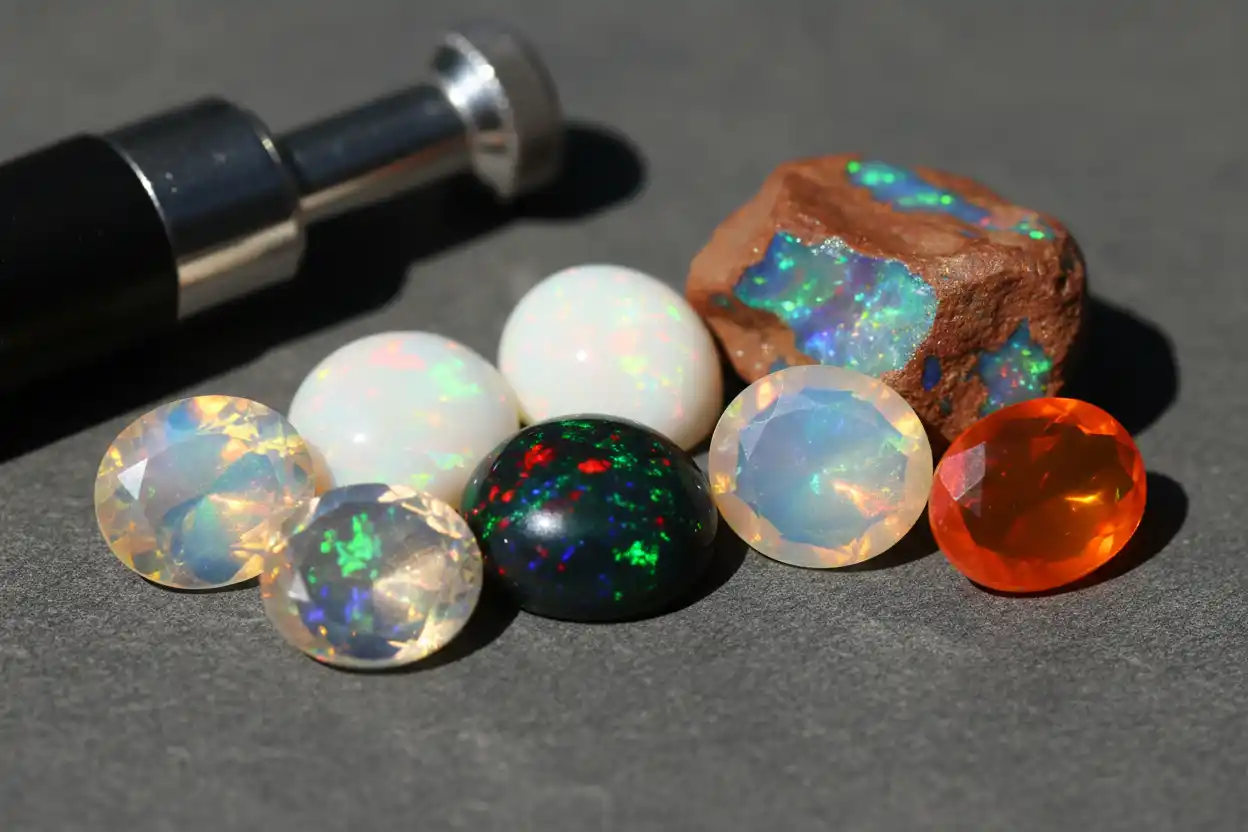
If you want to buy opal intelligently, begin with opal type and play-of-color performance before carat weight, country of origin, or a prestigious pattern name. Opal is a hydrated amorphous silica material whose appearance varies more dramatically than almost any mainstream gemstone: one stone may be opaque black with electric red flashes, another transparent with suspended green and orange color, another pale white with pinfire, another fiery orange with no play-of-color at all, while boulder opal may carry only a thin precious-opal seam naturally attached to ironstone.
That diversity means a universal “best opal” formula does not work. Fine black opal, crystal opal, Ethiopian hydrophane opal, white opal, boulder opal, and fire opal need different expectations for body tone, transparency, structure, treatment, and cutting, even though brightness and attractiveness remain central throughout. The first serious question when you buy opal is therefore not whether the gemstone is AAA, investment grade, or full spectrum; it is exactly what type of opal is being offered and what creates its visible appearance.
The strongest methodology when you buy opal is material and construction identity first, play-of-color brightness second, coverage and viewing range third, pattern fourth, body color and transparency fifth, structural stability sixth, cut seventh, treatment disclosure eighth, dimensions and thickness ninth, documentation tenth, and price last. Following that order prevents one red flash, one dramatic macro photograph, one famous locality, or one seller-created pattern label from replacing the qualities you will actually see and live with.
The broader opal properties guide explains opal formation, silica structure, physical properties, colors, uses, and traditional symbolism. This page focuses specifically on how to buy opal as a loose cabochon, faceted stone, bead, boulder piece, doublet, triplet, specimen, or finished jewel while separating genuine quality from weak play-of-color, hidden treatment, instability, misleading construction, and photography designed around one perfect angle.
What to Judge First When You Buy Opal
Opal can occur with or without play-of-color. Precious opal displays shifting spectral colors produced by the interaction of light with an orderly internal arrangement of silica spheres, while common opal lacks that phenomenon and is valued more for body color, translucency, pattern, or unusual material character.
When you buy opal, use this decision hierarchy:
| Priority | What to evaluate | Why it matters |
|---|---|---|
| 1 | Opal type and construction | Solid, boulder, matrix, doublet, triplet, synthetic, and imitation products have different value structures |
| 2 | Play-of-color brightness | In precious opal, vivid color normally matters more than pattern names |
| 3 | Coverage | Large active areas usually outperform small isolated flashes |
| 4 | Viewing range | Color should remain visible through useful normal movement |
| 5 | Pattern | Broad coherent patterns can add substantial collector appeal |
| 6 | Body color | Dark, light, transparent, orange, or other backgrounds change how color is judged |
| 7 | Transparency | Appropriate transparency depends on opal type |
| 8 | Stability | Crazing, open fractures, chips, and hydrophane behavior can affect durability |
| 9 | Cut and thickness | Dome, polish, orientation, color-bar thickness, and backing affect appearance |
| 10 | Treatment | Smoke, sugar-acid, dye, impregnation, filling, coating, and assembly need disclosure |
| 11 | Documentation | Expensive or ambiguous opal deserves proportionate independent verification |
| 12 | Price | Price makes sense only after type, quality, stability, and treatment are established |
When you buy opal through this sequence, the gemstone has to perform as an individual piece rather than relying on a category reputation.
Identify the Opal Type Before Comparing Prices
One of the easiest ways to overpay is comparing fundamentally different opals as though they were the same product.
When you buy opal, first establish whether you are looking at:
- black or dark opal;
- white or light opal;
- crystal opal;
- boulder opal;
- fire opal;
- hydrophane opal;
- matrix opal;
- common opal;
- a solid precious-opal cabochon;
- an assembled doublet;
- an assembled triplet;
- synthetic opal;
- or an imitation.
The types of opal guide explains these categories in broader detail.
A transparent crystal opal should not be penalized for lacking black body tone, while a fine black opal should not be judged according to transparency standards developed for crystal opal. Fire opal may be desirable because of its orange or red body color even if play-of-color is weak or absent.
When you buy opal, identify the category before assigning quality.
Play-of-Color Is the First Quality Factor in Precious Opal
Play-of-color is the moving spectral display that makes precious opal distinctive.
A good stone can show flashes of:
red, orange, yellow, green, blue, violet, or several colors together.
The important factor is not merely whether those colors exist, but how brightly they appear.
When you buy opal, compare stones under ordinary directional white light rather than only beneath intense jewelry-store spotlights. Fine play-of-color should appear clearly without requiring the seller to hold the gemstone one centimeter from a powerful light.
A bright green-and-blue display covering most of the stone can be more successful than one tiny red speck marketed aggressively because red is desirable.
Brightness Comes Before a Prestigious Color Name
Red play-of-color often attracts a premium because it occurs less commonly and can create dramatic contrast, particularly against dark body color.
However, brightness still matters.
When you buy opal, ask whether the red is:
bright, visible face-up, broad enough to matter, and present through useful movement.
A faint reddish dot that appears only at one extreme angle should not outrank intense green, orange, and blue covering almost the complete face.
The hierarchy should be:
brightness first, usable coverage second, color range third, then individual hue preference.
Full Spectrum Is Desirable Only When the Colors Are Strong
A seller may describe an opal as full spectrum because several colors can technically be found somewhere in the stone.
When you buy opal, do not pay a major premium until you see how those colors actually perform.
A strong full-spectrum stone should display several distinct hues with convincing brightness.
If red appears only in one microscopic corner while the rest of the stone shows weak blue haze, the full-spectrum label tells you less than the photograph suggests.
Judge Coverage Across the Entire Face
Coverage describes how much of the visible gemstone becomes active with play-of-color.
When you buy opal, slowly rotate the stone and estimate the percentage of the surface that participates.
A stone may show:
nearly complete active coverage, broad active regions interrupted by smaller dead areas, one concentrated color zone, or scattered flashes separated by large inactive sections.
Dead areas are not automatically disqualifying.
They should influence price.
A broad active field usually gives stronger visual impact than one brilliant but isolated patch.
Coverage Must Be Evaluated Through Movement
A still photograph can make a small color patch fill the visual frame while hiding the inactive remainder.
When you buy opal online, request an unedited continuous rotation of the complete stone.
Do not evaluate coverage from a macro photograph alone.
The gemstone should move from:
weakest position, through several active angles, into maximum color, and onward until the display fades again.
This reveals whether the color truly occupies the stone or merely occupies one photographic moment.
Viewing Range Is an Underrated Value Factor
Two opals can look equally spectacular at their best angle yet behave very differently in jewelry.
The first may retain color while tilted broadly.
The second may go completely blank after a tiny movement.
When you buy opal for a ring, earrings, or bracelet, the first stone will generally look more active during normal wear.
A narrow viewing range can be acceptable in a pendant positioned predictably, particularly if maximum color is exceptional.
The important point is to know what you are buying.
Ask for One Slow Video Rather Than Ten Short Clips
Short clips can conceal exactly how directional an opal is.
When you buy opal remotely, request one continuous video that begins with the stone inactive, moves slowly through maximum color, rotates beyond the best position, and shows the back and sides.
This reveals:
brightness, coverage, pattern, viewing range, body tone, transparency, dead areas, polish, cracks, thickness, and construction.
A seller who repeatedly rocks the stone through the same small angle may be demonstrating only its photographic sweet spot.
Pattern Matters After Brightness and Coverage
Opal pattern describes the arrangement of play-of-color.
Trade terminology can include:
pinfire, broad flash, rolling flash, flame, floral, mosaic, harlequin, chaff, ribbon, flagstone, and other descriptive names.
When you buy opal, pattern can substantially influence value, especially when large bright patches form an unusual coherent arrangement.
However, pattern terminology is not one universal grading system.
The pattern must be visible in the actual gemstone.
Harlequin Claims Deserve Particularly Close Inspection
Harlequin is one of the most prestigious and heavily overused opal pattern terms.
When you buy opal advertised as harlequin, ask whether the stone actually displays broad, closely arranged, angular color patches that form a distinct repeated or mosaic-like structure.
A few irregular colored squares should not automatically create a harlequin premium.
Request:
full-face images, continuous movement, neutral lighting, and a view that shows the claimed pattern without extreme magnification.
Pay for what you can see.
Pinfire Can Be Beautiful Without Being Rare Pattern Material
Pinfire consists of many small points or patches of play-of-color.
When you buy opal, strong pinfire can create a sparkling, starry effect across a large area and may offer excellent visual value.
It generally belongs to a different pricing category from exceptional large-block or true high-end mosaic patterns when all other factors are comparable.
That does not make pinfire low quality.
Brightness and coverage can make a pinfire stone spectacular.
Broad Flash Can Produce Exceptional Jewelry Presence
Broad flash opal displays large regions of color that can illuminate much of the stone at once.
When you buy opal for jewelry, this can be particularly effective because the pattern remains visible at normal viewing distance.
One broad orange-green sheet may create greater visual impact than dozens of tiny pinpoints.
Again, brightness and range matter more than terminology.
Dead Spots Should Be Shown Honestly
A dead spot is an area that shows little or no play-of-color.
When you buy opal, inspect whether these areas are:
small and unobtrusive, concentrated near the edge, positioned beneath a future prong, or dominating the center.
A seller may position a large dead zone away from the camera while presenting only the active half.
Continuous rotation prevents that problem.
Body Color Changes the Entire Quality Context
Body color is the background against which play-of-color appears.
A dark background increases contrast, making spectral flashes appear especially vivid.
A pale background produces a softer appearance.
Transparent opal creates a sense of depth.
Orange or red fire opal emphasizes body color as much as the spectral effect.
When you buy opal, judge the stone according to its category rather than assuming dark body color is universally superior.
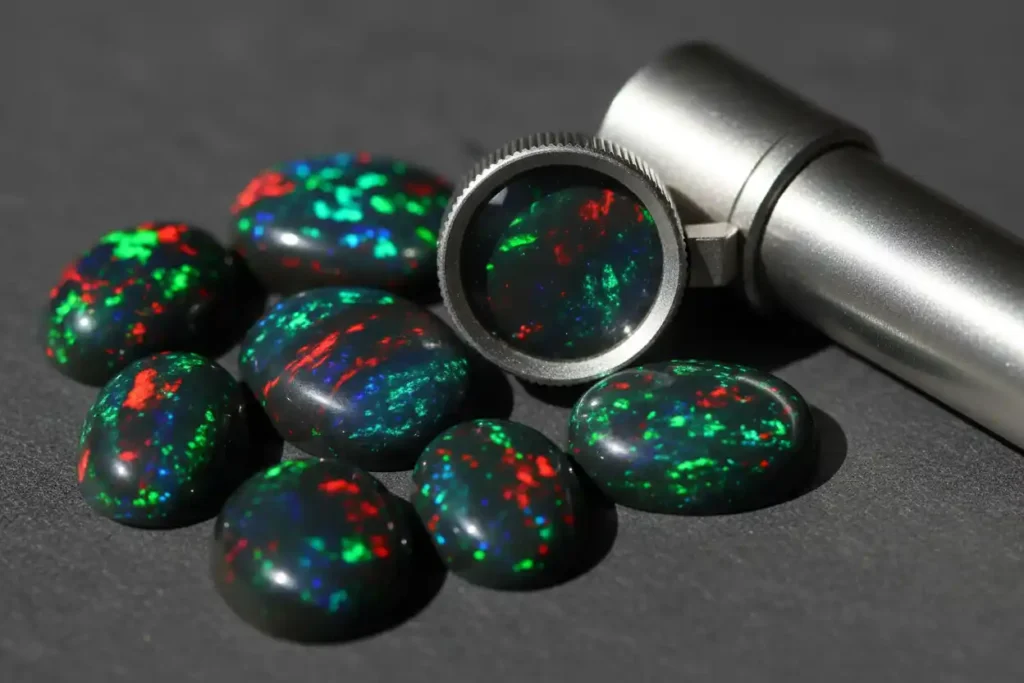
Black Opal Needs Genuine Dark Body Tone
Black opal generally refers to precious opal with naturally dark body tone rather than an ordinary light opal sitting over black material.
The black opal guide explains the broader material category.
When you buy opal described as black opal, ask whether the dark appearance belongs to:
the natural solid stone, natural matrix or host material, smoke treatment, sugar-acid treatment, a dark backing, or a doublet construction.
Those possibilities can all create stronger contrast.
They do not occupy the same value category.
Dark Does Not Mean Completely Black
Fine black opal can range through dark gray, charcoal, blue-gray, dark brownish, or nearly black body tone.
When you buy opal, do not reject a natural dark gemstone merely because the base is not jet black.
Likewise, an extremely black body should not automatically receive a premium before treatment has been considered.
The darkness must be understood.
White Opal Has a Different Aesthetic
White or light opal has a pale body tone, commonly white, cream, light gray, or related shades.
The white opal guide explains why these stones should be judged through brightness, coverage, pattern, body clarity, and stability rather than compared directly with black opal.
When you buy opal with a light body, look for play-of-color strong enough to stand above the background.
A milky stone with faint color can look washed out.
A bright multicolor light opal can be exceptional.
Milky Body Color Can Reduce Transparency and Contrast
Cloudiness can be part of ordinary light opal appearance, but excessive milkiness can make play-of-color seem buried or hazy.
When you buy opal, distinguish attractive soft opacity from chalky weak material.
A cloudy body can also make internal fractures harder to inspect, so side and transmitted-light views can be useful.
Crystal Opal Should Show Depth
Crystal opal is transparent to semitransparent precious opal whose play-of-color appears within a relatively clear body.
When you buy opal in this category, transparency becomes a major part of the visual appeal.
The strongest stones can show:
floating red, orange, green, or blue patches at different apparent depths.
Inspect whether the body is attractively transparent rather than cloudy, while still checking cracks and crazing carefully.
Do not confuse crystal opal with colorless glass containing reflective foil or artificial flakes.
Fire Opal Is Judged Differently
Fire opal is usually transparent to translucent with yellow, orange, orange-red, or red body color.
Some fire opal shows strong play-of-color.
Some displays little or none.
The fire opal guide explains why body color itself can be an important value factor.
When you buy opal in this category, evaluate:
body-color saturation, transparency, cut, clarity, stability, and play-of-color where present.
A vivid transparent orange stone does not need rainbow play to be desirable.
Faceted Fire Opal Needs Windowing Inspection
Unlike many opaque precious opals, transparent fire opal can be faceted.
When you buy opal in a faceted fire variety, examine the pavilion for:
windowing, excessive extinction, hidden depth, weak symmetry, and surface-reaching fractures.
A transparent center should return useful light rather than merely showing the background clearly.
Boulder Opal Is Naturally Attached to Host Rock
Boulder opal forms as precious-opal seams within ironstone or other host rock and is commonly cut with that natural matrix remaining attached.
The boulder opal guide explains the material more fully.
When you buy opal of this type, the natural backing is not automatically a doublet.
The crucial distinction is whether the opal and matrix formed together geologically or were cemented together later.
Natural host rock can be an integral part of genuine solid boulder opal.
Boulder Opal Needs Color-Bar Inspection
Fine boulder opal can contain an extremely thin but brilliantly colored precious-opal layer.
When you buy opal in boulder form, inspect:
the color-bar thickness, continuity, fractures, ironstone stability, surface polish, and whether the brightest color persists across the stone.
A thin seam can still be valuable when the play-of-color is exceptional.
Do not value boulder opal simply by the amount of opal compared with ironstone.
The visible display matters.
Matrix Is Not Always a Defect
In some opal categories, host rock is part of the intended appearance.
When you buy opal, learn whether matrix is:
natural and aesthetically integrated, undesirable material interrupting the precious-opal field, or artificially darkened material enhancing contrast.
The word matrix alone does not determine quality.
Ethiopian Hydrophane Opal Needs a Separate Buying Method
Much Ethiopian opal in the market is hydrophane, meaning it contains enough connected porosity to absorb water and certain other liquids.
The Ethiopian opal guide explains this behavior in more detail.
When you buy opal of hydrophane type, the stone’s appearance can temporarily change after absorbing liquid.
Transparency, body tone, weight, and play-of-color may shift.
This makes dry-condition evaluation essential.
Never Judge Hydrophane Opal While Wet
Water can change how porous opal transmits and scatters light.
When you buy opal, ask whether the stone was recently:
immersed, washed heavily, photographed while damp, or stored in liquid.
A wet hydrophane stone may look much more transparent than it will after drying.
Its play-of-color may also change temporarily.
Evaluate the gemstone only after it has returned to its stable dry appearance.
Do Not Use Water Immersion as an Authentication Trick
Some buyers deliberately soak Ethiopian opal because hydrophane behavior can confirm porosity.
This is not a good routine test for a valuable purchase.
When you buy opal, immersion can alter appearance for an extended period, introduce contaminants, stress an unstable stone, or interfere with return eligibility.
Professional observation and appropriate testing are safer.
Oils and Lotions Matter More With Hydrophane Opal
A porous stone can potentially absorb substances other than water.
When you buy opal of hydrophane type for a ring, keep it away from:
oils, cosmetics, perfumes, colored liquids, lotions, household chemicals, and greasy cleaning products.
Some absorbed substances can be far more difficult to remove than water.
This is especially important because hydrophane opal may be attractive enough that owners assume ordinary hand jewelry habits are harmless.
Hydrophane Does Not Mean Low Quality
Some Ethiopian hydrophane opal displays exceptional play-of-color, broad pattern, transparency, and impressive spectral range.
When you buy opal, do not dismiss material simply because it is hydrophane.
Instead, price it within the appropriate category and understand its additional care requirements.
A beautiful stable dry hydrophane stone can be an excellent purchase.
Australian and Ethiopian Opal Should Not Be Ranked by Country Alone
Country stereotypes are a weak buying method.
When you buy opal, evaluate the individual gemstone.
Australian material includes black, light, crystal, boulder, and other categories.
Ethiopian material includes varied hydrophane and non-hydrophane opals with a wide range of patterns and quality.
Origin can influence collector demand and treatment expectations.
It should not replace play-of-color evaluation.
Smoke Treatment Can Create a Darker Body
Porous hydrophane opal can be darkened through smoke treatment, improving contrast and making play-of-color appear much stronger.
When you buy opal with a black or dark body, especially porous material, treatment disclosure is essential.
Smoke-treated opal can remain visually attractive.
It should not be sold as equivalent to naturally dark black opal.
The treated opal guide explains the broader treatment landscape.
Smoke Treatment Can Be Convincing
Darkening can penetrate porous material enough that the treated stone does not simply look painted on the surface.
When you buy opal, visual inspection alone may therefore be insufficient to establish whether a dark body is natural.
An unusually dark hydrophane opal at a surprisingly accessible price should raise the treatment question quickly.
Sugar-Acid Treatment Also Darkens Opal
A traditional treatment can introduce sugar into porous opal and then use acid to carbonize material within the pores, creating a darker body.
When you buy opal, this darkening can substantially improve the contrast of play-of-color.
The stone may remain natural opal mineralogically.
Its dark appearance is treated.
That distinction should be disclosed because naturally dark opal and artificially darkened opal occupy different market categories.
Dye Can Produce Unnatural Body Colors
Porous opal can accept dye, creating blue, pink, purple, black, green, or other body colors.
When you buy opal with unusual saturation, inspect:
surface pits, scratches, drill holes, cracks, porous regions, and concentration around cavities.
Dye may accumulate where the material is most open.
However, stable treatment can be subtle enough that professional testing is preferable for valuable ambiguous stones.
Do Not Use Solvents to Test Dye Yourself
Acetone, bleach, peroxide, acids, and other chemicals can alter treated material, damage settings, or create new cracks.
When you buy opal, do not attempt to remove suspected dye during the return period.
A destructive or chemical treatment test can turn a disputed purchase into a damaged non-returnable gemstone.
Use professional non-destructive analysis.
Oil Impregnation Can Modify Transparency
Hydrophane opal can absorb oil, changing transparency and appearance.
When you buy opal, ask whether the stone has been impregnated or treated with oil, polymer, resin, or another substance.
Oil can alter the body appearance and may affect play-of-color differently from water.
It should not be treated as routine cleaning.
Resin Impregnation Can Improve Appearance and Stability
A porous or fractured opal can potentially absorb a clear polymer that fills pore spaces, improves transparency, or strengthens the material.
When you buy opal, this can create a durable attractive product.
It also changes the construction and treatment category.
A resin-impregnated hydrophane opal should not be priced as an equivalent untreated specimen without disclosure.
Fracture Filling Is a Separate Treatment
An opal can contain localized cracks filled with resin, adhesive, oil, or another substance.
When you buy opal, inspect surface-reaching fractures for:
bubbles, flow structures, differences in luster, transparent material bridging an opening, or flash effects that seem confined to the crack.
A filled fracture remains a structural feature beneath the treatment.
Coatings Can Alter Color or Luster
A coating can darken the surface, intensify color, protect porous material, or create an artificial optical effect.
When you buy opal, inspect high-contact edges and worn areas for:
peeling, color loss, scratches exposing a different layer, or a film-like luster.
Do not scrape the stone to test it.
“Natural Opal” Does Not Mean Untreated
This distinction should be explicit whenever you buy opal.
A gemstone can be naturally formed opal and still be:
smoke treated, sugar-acid treated, dyed, impregnated, fracture filled, coated, glued into a doublet, or incorporated into another assembled product.
Natural origin answers one question.
Treatment answers another.
Construction answers a third.
All three matter.
Solid Opal, Doublet, and Triplet Are Different Products
One of the most important checks when you buy opal is whether the stone is solid or assembled.
A solid opal consists of opal material throughout the finished gem, apart from natural host rock in categories such as boulder opal.
A doublet uses a thin precious-opal layer cemented to a darker backing.
A triplet generally adds a transparent domed cap above the thin opal layer and a dark backing below.
Each product can be attractive.
They should not be priced as though they contain the same amount and construction of natural precious opal.
Doublets Can Look Extremely Strong Face-Up
A dark backing increases contrast behind a thin opal layer, allowing impressive play-of-color at a relatively accessible price.
When you buy opal as a doublet, inspect the side.
You may see:
a thin color layer above black glass, dark chalcedony, natural common opal, plastic, or another backing.
The join should be disclosed.
A good doublet can make beautiful jewelry.
It simply belongs to an assembled category.
Triplets Add a Clear Protective Cap
A triplet typically uses a thin opal layer between a dark backing and a transparent top.
The top may be glass, quartz, or another clear material depending on construction.
When you buy opal as a triplet, the dome you touch may therefore not be opal.
The clear cap can enlarge the apparent color pattern and protect the delicate opal layer.
It also means care and value differ from solid opal.
Inspect Doublets and Triplets From the Side
Face-up inspection may not reveal an assembled product clearly.
When you buy opal, request side photographs against a neutral background.
Look for:
straight layer boundaries, glue planes, black backing, clear top cap, trapped bubbles, separation, or color confined to a very thin middle layer.
A closed-back setting makes this inspection more difficult and raises the need for written disclosure.
Boulder Opal Is Not a Doublet
Natural ironstone attached to boulder opal formed with the gemstone.
A doublet backing was cemented to the opal after mining and cutting.
When you buy opal, this distinction is fundamental.
Natural matrix can carry collector and geological value.
Artificial assembly creates a different product category.
Matrix Opal Also Needs Construction Clarity
Some opal occurs throughout porous host rock or matrix rather than as one clean seam.
When you buy opal described as matrix opal, determine whether the color is:
natural precious opal dispersed through host rock, treated matrix material, impregnated material, or a manufactured composite.
The name alone does not resolve treatment.
Synthetic Opal Is Genuine Lab-Created Opal Material
Synthetic opal can reproduce the essential silica-based structure and play-of-color of natural precious opal through laboratory growth.
When you buy opal, synthetic material should be disclosed clearly rather than described as natural.
The real versus fake opal guide explains the distinction among natural, synthetic, assembled, and imitation material.
Synthetic opal can be beautiful and durable enough for many jewelry applications.
Its value structure is different because the material can be manufactured.
Synthetic Pattern Can Look Unusually Regular
Some synthetic opals show highly organized columnar, cellular, scale-like, or mosaic structures that appear more repetitive than many natural patterns.
When you buy opal, this can be a useful clue.
However, natural opal can also display extraordinary geometric patterning, and modern synthetic material can become increasingly convincing.
Do not authenticate an expensive gemstone solely from one pattern stereotype.
Plastic and Resin Imitations Can Reproduce Play-of-Color
Manufactured polymers can contain reflective flakes, films, or structured particles that imitate opal extremely well in photographs.
When you buy opal, possible warning signs include:
low density, soft surface, mold marks, repeated patterns, bubbles, and flakes that remain at one fixed depth.
Do not scratch or heat the object to test it.
Professional identification is safer.
Glass Can Be Used as Both Imitation and Assembly Material
Glass can imitate opal itself or appear as the backing or cap in an assembled product.
When you buy opal, inspect whether the play-of-color seems embedded in natural silica or produced by foil, glitter, layered film, or a separate transparent dome.
The complete construction matters.
Crazing Is One of the Most Serious Condition Problems
Crazing is a network of fine cracks that develops within unstable opal.
When you buy opal, inspect carefully under magnification for spiderweb-like fracture networks.
Crazing can begin subtly.
Once extensive, it can:
reduce transparency, interrupt play-of-color, weaken the stone, and eventually lead to breakage.
A heavily crazed gemstone should not receive a fine untreated-stable premium regardless of how attractive the remaining color appears.
Distinguish Crazing From Ordinary Inclusions
Not every line inside an opal is crazing.
Natural opal can contain:
matrix, internal features, potch boundaries, sand, cavities, color bars, healed features, and isolated fractures.
When you buy opal, a true network of multiple fine intersecting cracks deserves greater concern than one stable isolated internal line.
If condition affects a meaningful price, have the stone examined professionally.
Fresh Fractures Matter Too
An opal does not need to be crazed to be damaged.
When you buy opal, inspect the girdle and back for:
fresh chips, impact fractures, open cracks, edge damage, and missing sections.
A polished front can remain spectacular while a significant crack reaches inward from the back.
Always request full-object imagery.
Stability Is Different From Brightness
An unstable opal can display spectacular play-of-color.
When you buy opal, never let beauty distract you from physical condition.
A slightly less bright stable stone may be a stronger jewelry purchase than a vivid stone carrying an active fracture network.
Dryness and Extreme Heat Are Unnecessary Risks
Opal contains water within its structure, although water content and stability vary among deposits and individual stones.
When you buy opal, avoid exposing it to:
extreme heat, rapid temperature changes, prolonged harsh dryness, or direct high-temperature jewelry repair.
The goal is not to keep the gemstone permanently wet.
The goal is to avoid unnecessary environmental extremes.
Do Not Store Solid Opal Submerged in Water
A common myth suggests that every opal should be kept in water.
That is unnecessary for ordinary stable jewelry opal and can create additional problems, especially with hydrophane, doublets, triplets, glue, and other assembled or treated products.
When you buy opal, follow care appropriate to the exact type rather than one universal soaking rule.
Inspect the Cabochon Dome
Fine precious opal is commonly cut as a cabochon because the curved surface can present play-of-color effectively.
When you buy opal cabochons, inspect:
dome height, symmetry, polish, girdle, back, thickness, color orientation, and stability.
A smooth moderate dome often gives good play-of-color and practical setting options.
An excessively flat stone can be more vulnerable and may present color through a narrower viewing range.
A Very High Dome Can Add Hidden Weight
A high dome can improve appearance when the color layer supports it.
It can also add weight without contributing proportionally to face-up size.
When you buy opal, compare:
carat weight, length, width, and total thickness.
If two stones look similar from above but one weighs far more, determine whether the extra mass improves visual quality.
Thin Edges Need Caution
A cutter may follow a thin precious-opal seam closely to maximize play-of-color.
When you buy opal with delicate edges, consider how the stone will be set.
A very thin edge can chip more readily under prong or bezel pressure.
A good jeweler should understand opal before mounting it.
Freeform Cutting Can Preserve Better Color
Exceptional opal rough rarely obeys standard calibrated jewelry shapes.
When you buy opal, an irregular freeform can be far more valuable than a symmetrical oval if the cutter preserved a stronger pattern or avoided dead areas.
Do not penalize asymmetry automatically.
Ask whether the shape follows the best color intelligently.
Poor Symmetry Still Matters When It Adds Nothing
There is a difference between purposeful freeform cutting and careless workmanship.
When you buy opal, inspect whether the outline appears deliberate.
An awkward flat edge, uneven dome, or badly polished girdle that does not preserve meaningful color should reduce the workmanship premium.
Polish Matters
Opal is softer than sapphire, ruby, spinel, topaz, and quartz.
A premium polished gemstone should still have a clean surface.
When you buy opal, rotate it under broad reflected light and inspect for:
scratches, flat spots, orange-peel texture, pits, polish lines, edge abrasions, and repaired chips.
Play-of-color can distract the eye from surface damage.
Turn the color away and inspect the polish separately.
Opal Is Relatively Soft
Opal generally falls around 5–6.5 on the Mohs scale.
When you buy opal for jewelry, expect its surface to require more protection than sapphire, ruby, moissanite, or diamond.
Quartz-containing dust can scratch it gradually.
Hard gemstone edges can scratch it quickly if stored together.
High hardness is not opal’s strength.
Its strength is optical beauty.
Brittleness Matters More Than Many Buyers Expect
Opal lacks the toughness needed for careless impact.
When you buy opal, consider how exposed the stone will be.
A pendant or earring receives fewer hard knocks than a ring.
A bracelet encounters desks and doors frequently.
A large high-domed ring is more vulnerable than a low protected setting.
Choose the jewelry format according to your willingness to protect the gem.
Rings Require the Highest Standard of Structural Condition
The opal ring guide explains ring construction in greater detail.
When you buy opal for a ring, avoid:
active crazing, major open fractures, excessively thin edges, weak doublet separation, and damaged triplet caps.
A low protective setting can reduce impact exposure.
The strongest gemstone should be chosen before the strongest setting.
Metal cannot rescue unstable opal.
Bezel Settings Can Offer Useful Protection
A well-made bezel surrounds much of the opal’s edge, reducing direct impact.
When you buy opal for bezel mounting, the stone still needs adequate thickness and sound edges because the setter must apply pressure while forming metal around it.
A large existing fracture near the girdle makes that process riskier.
Prongs Need Careful Placement
Prongs can work well, particularly with solid cabochons, but should not press directly over thin or cracked areas.
When you buy opal intended for prong mounting, ask the jeweler to inspect the entire perimeter before setting.
Point pressure and opal do not combine well when the stone already contains structural weakness.
Earrings Are a Safer Opal Format
The opal earrings guide covers matching and construction in more detail.
When you buy opal earrings, compare:
play-of-color brightness, activation angle, body tone, pattern scale, dimensions, dome, and setting height.
Two opals do not need identical patterns.
They should look intentionally related under the same lighting.
Matching Viewing Angle Matters in Earrings
A pair can contain two individually beautiful stones yet look mismatched when worn because one displays color face-up while the other requires a different head angle.
When you buy opal earrings, rotate both stones together.
Their strongest displays should occur within reasonably similar positions.
Pendants Allow Larger Opal With Less Impact
The opal necklace guide explains pendant orientation and construction.
When you buy opal as a pendant, larger freeforms and boulder opals can be practical because the chest exposes the gemstone to less impact than the hand.
Check whether the strongest play-of-color appears while the pendant hangs vertically rather than only when the stone lies flat.
Beads Need Individual Inspection
Opal beads can contain cracks, matrix, treatments, or inconsistent play-of-color that disappear within a whole-strand photograph.
When you buy opal beads, inspect:
drill holes, polish, fractures, color consistency, transparency, treatment, and how many beads actually display precious-opal color.
A premium strand should not contain only a few active beads hidden among mostly common opal.
Drill Holes Are Weak Points
When you buy opal beads, inspect both openings of each important bead.
Look for:
chips, radial fractures, glue, filler, dark treatment concentration, and weakened material.
Repeated string tension can extend a crack that begins at a rough hole.
Origin Can Influence Value but Should Come After Quality
Opal is associated with important producing regions in Australia, Ethiopia, Mexico, and other areas.
When you buy opal, country of origin can help explain:
opal type, hydrophane behavior, body color, treatment risk, matrix, collector demand, and historical reputation.
However, a famous country name does not convert weak material into fine material.
Evaluate the stone first.
Australian Origin Is Not One Quality Grade
Australian opal includes light, black, crystal, boulder, and other material from several distinct fields.
When you buy opal described as Australian, ask what specific type is being sold.
Do not assume every Australian stone is:
non-hydrophane, black, rare, expensive, or superior to all Ethiopian material.
The individual opal still needs a quality assessment.
Lightning Ridge Claims Need Appropriate Evidence
Lightning Ridge is famous for black opal and can create a meaningful provenance premium.
When you buy opal specifically because the seller represents it as Lightning Ridge material, ask what supports the source claim.
A natural dark body tone is consistent with high-value black opal but does not by itself establish a particular mining field.
Dealer provenance can be more useful than appearance alone.
Ethiopian Origin Should Not Be Used as a Synonym for Low Quality
Ethiopian opal can display extraordinary brightness, pattern, and color range.
When you buy opal from Ethiopia, focus on:
dry-condition appearance, hydrophane behavior, treatment disclosure, stability, and individual quality.
A strong untreated Ethiopian stone can be far more visually impressive than an ordinary opal from a more prestigious market category.
Mexican Fire Opal Needs Body-Color Evaluation
Mexico is strongly associated with transparent yellow-to-red fire opal.
When you buy opal under this category, judge body color, transparency, cut, stability, and any play-of-color separately.
A saturated orange-red transparent gem can be valuable without looking anything like black or white precious opal.
Origin Claims and Treatment Claims Are Different
A laboratory or dealer may have evidence that a stone comes from a particular source while treatment remains a separate question.
When you buy opal, do not allow an origin name to imply untreated status.
An Ethiopian opal can be natural and smoke treated.
An Australian opal can be assembled into a doublet.
A Mexican fire opal can be modified or mounted in ways that affect value.
Ask each question separately.
Laboratory Reports Become More Important as the Price Rises
Most modest commercial opal does not require advanced laboratory testing.
When you buy opal at substantial value, a report becomes increasingly useful when:
- natural black body tone matters;
- smoke or sugar treatment is suspected;
- hydrophane treatment is uncertain;
- the stone may be synthetic;
- solid versus assembled construction is unclear;
- a high-value pattern claim affects price;
- unusual body color may be dyed;
- or the complete jewel carries significant financial risk.
The gemstone certification guide explains why independent identification is different from a seller’s own certificate.
A Report Should Answer the Actual Buying Question
If your main concern is whether a dark opal is naturally black or smoke treated, a basic card saying “natural opal” is incomplete.
When you buy opal, determine which question needs resolution:
Is it natural or synthetic?
Is it solid or assembled?
Is the body color treated?
Is dye present?
Is the gemstone hydrophane?
Is polymer impregnation present?
Does the report describe the complete finished construction?
Choose testing capable of answering the relevant question.
Match the Report to the Exact Stone
A genuine report is useful only when it belongs to your gemstone.
When you buy opal with documentation, compare:
weight, dimensions, shape, body color, play-of-color pattern, visible matrix, cracks, photograph, and unusual identifying features.
Opal patterns can function almost like fingerprints because individual color arrangements are highly distinctive.
Use that individuality to your advantage.
A Seller Certificate Is Not Independent Evidence
A retailer card can document what the seller promises.
That can be useful contractually.
It is still different from an independent laboratory report.
When you buy opal at high value, ask who examined the gemstone and whether treatment and construction were specifically evaluated.
An Appraisal Is Not Treatment Analysis
An appraisal estimates financial value.
It does not automatically determine whether an opal is:
smoke treated, sugar treated, dyed, impregnated, assembled, synthetic, or naturally dark.
When you buy opal, use gemological testing for material questions and market comparison for pricing.
A high appraisal number cannot convert an assembled triplet into a solid black opal.
Seller Grades Such as AAAA Are Not Universal
Opal is too diverse for one generic AAA, AAAA, 5A, premium, museum, or investment label to communicate enough useful information.
When you buy opal, translate the seller’s grade into actual characteristics.
What opal type is it?
How bright is the play-of-color?
How much coverage is active?
What is the viewing range?
What pattern is actually visible?
What is the body tone?
Is the stone hydrophane?
Is it stable?
Is it treated?
Is it solid?
What are the dimensions?
Once these questions are answered, the letter grade contributes very little.
“Harlequin Grade” Is Not a Substitute for Showing the Pattern
The word harlequin can significantly raise expectations.
When you buy opal, require visual evidence.
A pattern claim should never be accepted solely because it appears on an invoice.
“Investment Opal” Needs Liquidity Context
Exceptional opal can attract collector demand, but resale is not automatic.
When you buy opal with investment expectations, consider:
treatment, provenance, pattern, brightness, condition, report quality, dealer margin, market specialization, and the number of likely future buyers.
A beautiful gemstone can be a good collectible without being a guaranteed financial asset.
Compare Price Within the Correct Opal Category
The opal value guide provides the broader price framework.
When you buy opal, compare like with like.
A natural black opal should not be priced against a smoke-treated hydrophane stone without adjustment.
A doublet should not be compared with a solid opal.
A boulder opal should not be reduced to the percentage of visible ironstone.
A fire opal without play-of-color needs different comparison criteria from black precious opal.
Correct category selection is the beginning of fair pricing.
Price Per Carat Is Only a Starting Point
Two opals of identical weight can have dramatically different value because of:
brightness, spectral range, pattern, body tone, viewing range, transparency, treatment, stability, construction, and provenance.
When you buy opal, carat weight cannot standardize those differences.
Use price per carat only after the stones are genuinely comparable.
Large Opal Is Valuable Only When Quality Continues
Opal can occur in substantial sizes.
When you buy opal in a large cabochon, inspect whether the larger surface remains active.
A ten-carat gemstone with weak color across most of its face can be less desirable than a smaller stone with concentrated high-quality play-of-color.
Size should amplify quality.
Large Black Opal Needs Especially Strong Evidence
Because naturally dark body tone, strong color, and large size can create substantial premiums, high-value black opal deserves thorough documentation.
When you buy opal in this category, investigate:
natural body color, treatment, construction, origin claim, cracks, back appearance, thickness, and report matching.
The larger the premium, the stronger the evidence should become.
Online Photography Can Misrepresent Opal More Easily Than Many Gems
Opal is extraordinarily dependent on:
light direction, light size, camera angle, background, white balance, saturation, and movement.
When you buy opal online, one spectacular photograph proves almost nothing about normal performance.
Actual-item video is essential for a serious purchase.
Ask for Neutral White Balance
Color editing can push blue toward electric cyan, strengthen red, deepen black body tone, or remove grayness.
When you buy opal, inspect the surrounding objects in the video.
A white card should look white.
Skin should look natural.
Metal should not carry strange color casts.
If the environment looks heavily processed, the opal may be too.
Dark Backgrounds Can Exaggerate Transparent Opal
Crystal and hydrophane opal can look dramatically more colorful against black because contrast increases.
When you buy opal, ask to see the stone over both dark and light neutral surfaces.
You are not trying to eliminate the dark-background view.
You are trying to understand how much the background influences the appearance.
Backlighting Can Be Informative but Misleading
Transmitted light can reveal transparency, color bars, internal structure, and fractures.
It can also make an otherwise weak opal look unusually luminous.
When you buy opal, use backlighting as an inspection view rather than the only beauty view.
The gemstone should still look attractive in reflected light.
Ask to See the Stone Completely Dry
This is particularly important with hydrophane opal.
When you buy opal, confirm whether the seller has recently washed, soaked, oiled, or otherwise wetted the stone.
Its stable dry appearance should form the basis of the transaction.
Side and Back Views Are Mandatory for Expensive Opal
The face-up surface can hide:
doublet construction, triplet construction, natural matrix, smoke treatment clues, thin color bars, deep fractures, excessive backing, chips, and flat polish.
When you buy opal at meaningful value, inspect all surfaces.
Return Terms Should Allow Non-Destructive Inspection
A useful return period gives you time to examine the gemstone under ordinary lighting and, where appropriate, obtain independent professional verification.
When you buy opal online, do not:
immerse it, apply oil, use solvents, scratch it, polish it, heat it, remove it from its mounting, or subject it to improvised treatment tests during the return period.
Verification should preserve the item.
The Invoice Should Describe Construction Clearly
When you buy opal at meaningful value, useful written descriptions can include:
natural solid opal, black opal, white opal, crystal opal, boulder opal, fire opal, hydrophane opal, doublet, triplet, synthetic opal, treatment disclosure, weight, dimensions, report number, origin where represented, and jewelry metal purity.
A stone marketed as solid natural black opal should not become merely “opal gemstone” on the invoice.
Specificity protects both sides.
Finished Jewelry Price Includes More Than the Opal
A commercial opal in heavy gold or handmade designer work may cost more than a finer loose stone.
When you buy opal jewelry, separate:
gemstone value, precious-metal value, accent stones, craftsmanship, brand, setting design, and after-sales service.
A high retail price does not automatically prove exceptional opal quality.
Accent Stones Need Disclosure
Opal jewelry may contain:
natural diamonds, laboratory-grown diamonds, cubic zirconia, sapphire, spinel, or other materials.
When you buy opal jewelry at substantial cost, ask what every significant component is.
A bright halo should not be assumed to be diamond.
Cleaning Depends on Opal Type
The opal jewelry cleaning guide explains the material-specific differences.
For a sound solid non-hydrophane opal, brief gentle cleaning with lukewarm water, mild soap, and a soft cloth or brush is generally conservative.
Hydrophane opal, doublets, triplets, glued constructions, filled stones, and treated material need additional caution.
There is no one cleaning method suitable for every product sold as opal.
Avoid Ultrasonic Cleaning
Vibration can interact poorly with:
fractures, crazing, assembled layers, adhesives, porous structure, and treatment.
When you buy opal jewelry, gentle hand cleaning is the safer default.
Avoid Steam and Strong Heat
Rapid or concentrated heat can stress opal and damage glue, resin, coatings, fillers, and surrounding jewelry.
When you buy opal, tell future jewelers exactly what the stone is before soldering or repair.
Avoid Harsh Chemicals
Bleach, strong acids, strong alkalis, solvents, and aggressive jewelry dips can damage treatments and assembled construction.
Hydrophane opal can absorb some liquids.
When you buy opal, conservative care protects both natural material and any disclosed treatment.
Store Opal Separately From Harder Gems
Opal can be scratched by quartz, topaz, sapphire, ruby, diamond, and many other common jewelry stones.
When you buy opal, keep it in a padded individual compartment or soft pouch.
Do not allow a diamond ring to rub directly against an opal pendant in one jewelry box.
Major Red Flags When You Buy Opal
| Red flag | Why it matters |
|---|---|
| Seller does not state the opal type | Different categories require different quality standards |
| Play-of-color appears only under an intense spotlight | Normal brightness may be weak |
| One red flash is used to justify the entire premium | Coverage and brightness may be poor |
| Only one face-up photograph is supplied | Directionality and dead areas remain hidden |
| Seller refuses continuous rotation video | Viewing range cannot be evaluated |
| Harlequin is claimed without showing a coherent pattern | Prestigious terminology may be overused |
| Large dead zones are hidden | Face-up quality may be substantially weaker |
| Crystal opal is shown only over black | Background may exaggerate contrast |
| Hydrophane opal is shown wet | Stable dry appearance may be different |
| Seller recommends soaking to prove authenticity | Immersion can alter porous opal unnecessarily |
| Dark Ethiopian opal has no treatment disclosure | Smoke or sugar treatment may be relevant |
| Black body color is treated as proof of natural black opal | Treatment or backing can create darkness |
| Unusual blue, purple, pink, or black body color has no dye disclosure | Porous opal can accept artificial color |
| “Natural opal” is used to imply untreated status | Natural origin and treatment are separate |
| Doublet is sold as solid opal | Amount and construction of precious opal differ |
| Triplet is sold as solid opal | Clear cap and dark backing materially change the product |
| Boulder opal is called a doublet merely because matrix remains | Natural host rock is not glued backing |
| Side and back are hidden in a closed setting | Assembly, fractures, and thickness may be concealed |
| Surface shows spiderweb crazing | Stability and durability are compromised |
| Large fresh fracture is described as character | Structural condition affects jewelry suitability |
| Carat weight is emphasized without dimensions | Excessive dome or backing may hide mass |
| Synthetic opal is represented as natural | Geological rarity and value differ |
| Repetitive manufactured-looking pattern has no disclosure | Synthetic or imitation material deserves investigation |
| Seller certificate is presented as independent treatment analysis | The document may repeat the retailer’s claims |
| Report details do not match the gemstone | Documentation may belong to another opal |
| Origin is inferred solely from appearance | Country or field provenance requires separate support |
| AAAA is presented as a universal grade | Opal grading terminology is not globally standardized |
| Guaranteed appreciation is promised | Collector demand and resale remain uncertain |
| Seller recommends acid, acetone, peroxide, flame, or scratch tests | Destructive methods can damage opal and treatment |
| Final-sale terms accompany unresolved treatment or construction | Buyer cannot verify safely before accepting the risk |
Several of these warning signs together are a strong reason not to buy opal until the seller provides better evidence.
A Practical Buy Opal Decision Matrix
Strong precious-opal purchase: The stone is correctly classified, play-of-color is bright, coverage is substantial, viewing range is useful, pattern is attractive, structural condition is sound, treatment is disclosed, and the price matches the correct opal category.
Strong black-opal purchase: Dark body tone is natural rather than created through treatment or backing, play-of-color has strong contrast, coverage and pattern are attractive, stability is good, and documentation is proportionate to the premium.
Strong white-opal purchase: Light body tone remains attractive, play-of-color is bright enough to rise clearly above the background, dead areas are limited, polish is strong, and the price does not attempt to imitate black-opal scarcity.
Strong crystal-opal purchase: Transparency creates visible depth, play-of-color remains bright through the clear body, fractures are limited, and the gemstone looks attractive over both light and dark backgrounds.
Strong boulder-opal purchase: Natural host rock is disclosed, the precious-opal seam is bright and well positioned, the matrix contributes to design, fractures are controlled, and the cut preserves the strongest color intelligently.
Strong fire-opal purchase: Body color is vivid and attractive, transparency is appropriate, faceting or cabochon cutting is competent, stability is good, and play-of-color is valued separately where present.
Strong Ethiopian purchase: The dry stone shows excellent color and pattern, hydrophane behavior is understood, treatment is disclosed, cracks are absent or limited, and the buyer accepts the additional care requirements.
Strong value purchase: The opal sacrifices a prestigious pattern name, famous locality, full-spectrum display, or perfect coverage while retaining bright attractive color, stability, sound cutting, and honest treatment disclosure.
Doublet purchase: The assembled construction is clearly stated, the color display is excellent, the join is sound, and the price reflects a thin precious-opal layer rather than pretending the stone is solid.
Triplet purchase: The cap and backing are disclosed, glue remains stable, the stone offers attractive play-of-color at an accessible price, and care is adjusted for assembled construction.
Treatment-dependent purchase: Smoke, sugar-acid darkening, dye, resin, oil, coating, or filling is disclosed clearly and the stone is priced within the treated category.
Documentation-dependent purchase: The opal is unusually expensive, represented as natural black opal, difficult to distinguish from treated hydrophane material, potentially synthetic, or unclear in solid-versus-assembled construction.
Jewelry-value purchase: The gemstone is good commercial-to-fine opal while much of the finished price comes from precious metal, diamonds, design, or craftsmanship. Those components justify the additional cost separately.
Poor purchase: The opal is genuine but weakly colored, largely inactive, crazed, heavily fractured, badly polished, excessively thin, unstable, or priced mainly through marketing terminology.
Walk away: Construction is concealed, treatment representations change when questioned, the stone is wet during evaluation, severe crazing is hidden, documentation conflicts with the gemstone, or the seller refuses realistic dry-condition inspection.
Where the Best Value Often Appears
The strongest value when you buy opal often lies one step below the most famous combination of dark body tone, red play-of-color, rare pattern, large size, and elite provenance.
A crystal opal with brilliant green, orange, and blue can provide extraordinary visual impact at a lower price than fine black opal. A white opal with broad vivid coverage can outperform a weak dark stone. A naturally patterned boulder opal can deliver exceptional individuality without requiring a thick seam of pure opal.
Likewise, an untreated Ethiopian hydrophane stone with strong dry-condition play-of-color can offer remarkable beauty when the buyer understands its care.
Value comes from selecting compromises you genuinely do not mind.
Buy Opal for Brightness Before Red
Red is desirable.
Brightness is more important.
When you buy opal, a broad intense blue-green-orange display can be a stronger stone than a mostly inactive gem containing one faint red patch.
Buy Opal for Coverage Before Pattern Vocabulary
Pattern names can influence collector pricing, but only when the pattern is visible and strong.
When you buy opal, broad active coverage should generally come before a prestigious label attached to weak color.
Buy Opal for Stability Before Maximum Beauty
A spectacular crazed stone can become a poor jewelry purchase.
When you buy opal, structural stability deserves a place near the top of the decision rather than being treated as an afterthought.
Buy Opal for Correct Construction Before Size
A large triplet can look more dramatic than a much smaller solid opal.
That does not mean the triplet is deceptive when it is disclosed.
When you buy opal, know whether the apparent dome represents precious opal, clear cap, backing, or a combination.
Buy Opal for Dry Appearance Before Hydrophane Transparency
Hydrophane material can change substantially after liquid absorption.
When you buy opal, its stable dry condition should form the basis of the purchase.
Buy Opal for Individual Quality Before Country
A weak stone from a prestigious region remains weak.
A spectacular stone from a less fashionable source remains spectacular.
When you buy opal, let origin refine the decision rather than dominate it.
Buy Opal With a Low Report Threshold When Treatment Changes the Price
If the difference between natural black body tone and smoke-treated hydrophane material changes the price substantially, independent testing becomes economically rational.
When you buy opal at that level, paying for reliable identification can be cheaper than paying the wrong category price.
Final Buying Method
The smartest way to buy opal is to evaluate type, color performance, stability, construction, and treatment as separate questions.
First establish what product is actually being offered: solid precious opal, black opal, white opal, crystal opal, boulder opal, fire opal, hydrophane opal, matrix opal, doublet, triplet, synthetic opal, or imitation. Do not compare prices until that category is clear.
Next, judge play-of-color where relevant. Evaluate brightness before prestigious hues, coverage before one dramatic patch, viewing range before one perfect angle, and actual pattern before the seller’s pattern name. Use slow continuous movement under realistic neutral light.
Then evaluate body color and transparency according to opal type. Dark body tone can strengthen contrast, transparent crystal opal should show useful depth, light opal needs enough brightness to overcome its pale background, and fire opal can derive substantial value from body color even without strong play-of-color.
After that, inspect stability. Look for crazing, fresh fractures, chips, thin edges, rough drill holes, and other structural weaknesses. For hydrophane material, make sure the stone is dry and ask about water, oil, resin, and other absorbed treatments.
Next, establish treatment and construction. Determine whether darkening comes from natural body tone, smoke, sugar-acid treatment, dye, matrix, or backing. Confirm whether the gemstone is solid, boulder, doublet, triplet, filled, impregnated, coated, synthetic, or otherwise modified.
Then compare cut, dimensions, thickness, report evidence, provenance, jewelry construction, return rights, and price.
When you buy opal through this hierarchy, the strongest purchase is not simply the stone with the most red, the darkest background, the most exotic pattern name, or the highest carat weight. It is the opal whose material category, play-of-color, pattern, body tone, transparency, stability, cutting, treatment, construction, documentation, provenance, and price all support the same credible quality level.
The wider Buying & Value section connects these principles with additional gemstone authentication, treatment, certification, pricing, and purchasing guidance.
Frequently Asked Questions
What should I check first when I buy opal?
Identify the exact opal type and construction, then judge play-of-color brightness, coverage, viewing range, body tone, stability, cutting, and treatment.
What is the most important quality factor in precious opal?
Play-of-color brightness is generally the leading visual factor, followed by coverage, spectral range, pattern, body tone, transparency, and condition.
Is red the best opal color?
Red play-of-color is highly desirable, but brightness and coverage matter more than simply finding one red flash. A broad vivid multicolor display can outperform weak red.
Does full-spectrum opal mean high quality?
Not automatically. The colors should be bright, broad enough to matter, and visible through useful viewing angles.
What is opal play-of-color?
It is the shifting spectral display created when light interacts with an orderly microscopic arrangement within precious opal.
Does common opal have play-of-color?
Common opal lacks the classic play-of-color phenomenon and is valued primarily for body color, translucency, pattern, or other appearance.
What is a dead spot in opal?
A dead spot is an area showing little or no play-of-color. Large central dead areas generally reduce value more than small peripheral ones.
What is harlequin opal?
Harlequin is a prestigious trade pattern characterized by broad, angular, closely arranged color patches. The term is frequently overused, so inspect the actual pattern carefully.
Is pinfire opal low quality?
No. Bright pinfire covering much of the gemstone can be extremely attractive. It simply occupies a different pattern category from rare large-block patterns.
What is black opal?
Black opal is precious opal with a naturally dark body tone that creates strong contrast with play-of-color.
Does black opal need to be jet black?
No. Dark gray, charcoal, dark blue-gray, and other very dark body tones can belong to the black-opal category.
Can black-looking opal be treated?
Yes. Smoke treatment, sugar-acid treatment, dye, dark backing, and assembled construction can all create or strengthen a dark appearance.
What is white opal?
White or light opal has a pale body tone, usually white, cream, light gray, or similar shades, with play-of-color in precious material.
What is crystal opal?
Crystal opal is transparent to semitransparent precious opal whose play-of-color can appear suspended within a clear or translucent body.
What is boulder opal?
Boulder opal is precious opal naturally attached to host rock, commonly ironstone, which remains part of the finished gemstone.
Is boulder opal a doublet?
No. Natural matrix formed with the opal, while a doublet uses a backing cemented to a thin opal layer after mining.
What is fire opal?
Fire opal has yellow, orange, orange-red, or red body color and may be transparent to translucent. It can occur with or without play-of-color.
Does fire opal need rainbow color?
No. Fine fire opal can be valued mainly for saturated body color and transparency even when play-of-color is absent.
What is hydrophane opal?
Hydrophane opal is porous enough to absorb water and certain other liquids, temporarily changing weight and appearance.
Is Ethiopian opal always hydrophane?
A large portion of commercial Ethiopian opal shows hydrophane behavior, but the exact stone should be evaluated rather than applying an absolute rule to every specimen.
Is hydrophane opal low quality?
No. Hydrophane opal can show exceptional brightness, spectral range, and pattern. It simply requires additional care and treatment awareness.
Should I soak Ethiopian opal?
Routine soaking is unnecessary and can change the stone’s appearance temporarily. Avoid immersion as an amateur authenticity test.
Why does hydrophane opal change when wet?
Water enters connected pore spaces and changes how light travels through the material, which can modify transparency, body appearance, and play-of-color temporarily.
Can hydrophane opal absorb oil?
Yes. Porous opal can absorb liquids other than water, which is why oils, lotions, cosmetics, and chemical solutions should be kept away from valuable hydrophane material.
What is smoke-treated opal?
Smoke treatment introduces dark carbonaceous material into porous opal, darkening the body and increasing contrast with play-of-color.
What is sugar-treated opal?
Sugar-acid treatment darkens porous opal by introducing sugar and converting material within the pores into a dark carbonaceous phase.
Is treated black opal fake?
The base material can still be natural opal, but the dark body color is treated and should not be priced or described as naturally dark black opal.
Can opal be dyed?
Yes. Porous opal can accept artificial dyes that produce blue, pink, purple, black, green, and other body colors.
Can opal be resin treated?
Yes. Resin or polymer can enter pores and fractures, altering transparency, stability, or apparent clarity.
Can opal be fracture filled?
Yes. Surface-reaching cracks can potentially be filled with resin, oil, adhesive, or another substance.
What is an opal doublet?
A doublet uses a thin precious-opal layer cemented to a darker backing material.
What is an opal triplet?
A triplet typically places a thin opal layer between a dark backing and a transparent domed cap.
Are opal doublets fake?
No. A doublet contains genuine precious opal, but it is an assembled gemstone and should be sold as such.
Are triplets real opal?
They contain a thin layer of real opal but also include backing and a transparent cap, so they are assembled products rather than solid opals.
How can I spot an opal doublet or triplet?
Inspect the stone from the side for straight layer boundaries, dark backing, glue, a transparent cap, or a thin central color layer.
Does synthetic opal exist?
Yes. Laboratory-grown synthetic opal can reproduce the essential silica-based structure and play-of-color of natural opal.
Is synthetic opal fake?
Synthetic opal is genuine laboratory-created opal material rather than natural geological opal. Imitations made from plastic, resin, or glass belong to a different category.
Can plastic imitate opal?
Yes. Resin and plastic can reproduce colorful optical effects convincingly, especially in photographs.
Can glass imitate opal?
Yes. Glass, foil-backed glass, and other manufactured constructions can imitate opal or form parts of doublets and triplets.
What is crazing in opal?
Crazing is a network of fine cracks that develops within unstable opal and can reduce both durability and beauty.
Is a crazed opal worth buying?
It may have decorative or specimen value at an appropriately reduced price, but heavily crazed material is generally a poor choice for fine jewelry.
Are all lines inside opal crazing?
No. Opal can contain matrix boundaries, isolated fractures, inclusions, color bars, and other internal features. Crazing usually forms a more extensive network.
Is opal hard enough for jewelry?
Opal is around 5–6.5 on the Mohs scale, making it softer than quartz, topaz, sapphire, ruby, and diamond. It can still be worn successfully with suitable protection.
Is opal good for an everyday ring?
It can be worn carefully, but rings expose opal to more scratching and impact than earrings or pendants. Stable material and protective setting design are important.
Are opal earrings safer than rings?
Yes. Earrings generally experience much less impact and abrasion, making them a practical way to wear fine opal.
Is opal good for necklaces?
Yes. Pendants can display large freeform, boulder, or cabochon opals while reducing exposure to hand-level impact.
What should I check when buying opal earrings?
Compare brightness, body tone, pattern scale, dimensions, dome height, and activation angle so both stones look balanced when worn.
What should I check in opal beads?
Inspect drill holes, fractures, polish, treatment, body color, matching, and how many beads actually display play-of-color.
Does origin matter when I buy opal?
It can influence category, hydrophane behavior, collector demand, and treatment expectations, but individual brightness, pattern, stability, construction, and treatment usually matter more.
Is Australian opal always better?
No. Australian material has a strong reputation and includes important black, light, crystal, and boulder opals, but each stone should be judged individually.
Is Ethiopian opal valuable?
Yes. Fine Ethiopian opal can display exceptional play-of-color, broad pattern, and transparency. Hydrophane behavior and treatment disclosure should be considered separately.
Is Mexican opal different?
Mexico is strongly associated with fire opal, whose yellow-to-red body color and transparency form an important part of its value.
Can color prove opal origin?
No. Geographic source should come from credible provenance or appropriate documentation rather than appearance alone.
What does AAA opal mean?
AAA and similar seller grades are not one universal independent opal grading system. Ask what the grade means for brightness, pattern, coverage, treatment, stability, and construction.
Does opal need a laboratory report?
Many ordinary commercial stones do not. A report becomes useful when you buy opal that is expensive, potentially treated, possibly synthetic, difficult to distinguish as solid or assembled, or represented as premium natural black opal.
What should an opal report establish?
Depending on the service, useful findings can include natural or synthetic identity, assembled construction, treatment, body color, weight, dimensions, and gemstone type.
Is a seller certificate enough?
It documents what the seller claims but is not automatically equivalent to independent laboratory analysis.
Is an appraisal proof that opal is untreated?
No. An appraisal estimates monetary value. Treatment, construction, and material identity require appropriate gemological examination.
Should I store opal in water?
Ordinary stable solid opal does not need routine underwater storage, and soaking can create problems for hydrophane or assembled material.
Can opal go in an ultrasonic cleaner?
Avoid ultrasonic cleaning because fractures, crazing, porous material, adhesives, doublets, triplets, and treatments can all create risk.
Can opal be steam cleaned?
Avoid steam. Sudden heat and thermal stress are unnecessary risks for opal and assembled constructions.
How should opal be cleaned?
Cleaning depends on type. Sound solid opal can usually be cleaned gently with lukewarm water, mild soap, and a soft cloth or brush, while hydrophane and assembled opals need stricter care.
Does opal hold its value?
Exceptional natural opal with strong play-of-color, desirable pattern, good condition, credible provenance, and clear treatment status can attract collector demand, but resale is not guaranteed.
What is the biggest mistake when you buy opal?
The biggest mistake is buying the brightest photograph before understanding what type of opal created it. When you buy opal, identify solid versus assembled construction, judge play-of-color brightness and coverage, inspect viewing range and stability, establish treatment and hydrophane behavior, compare dimensions and documentation, and only then decide whether the price is justified.