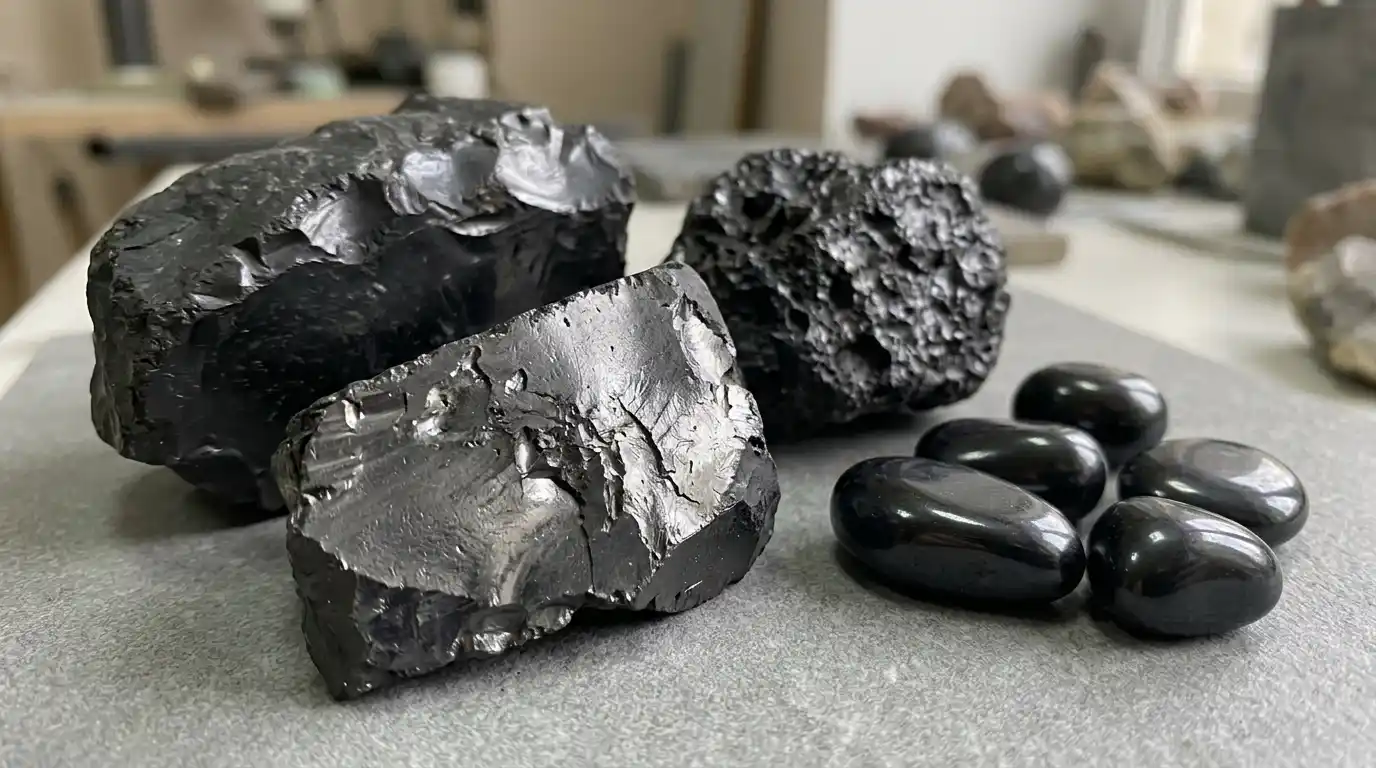
15 Shungite Benefits for Protection & Energy Purification
Shungite benefits begin with the unusual properties of an ancient carbon-rich geological substance rather than with claims about invisible protection or medical healing. The name shungite is used for carbon-rich mineraloid and rock varieties associated especially with the Lake Onega region of Karelia in northwestern Russia, where Paleoproterozoic formations contain exceptionally large accumulations of ancient organic carbon.
Shungite is not one crystal with a single fixed formula or carbon percentage. High-carbon lustrous varieties can contain much more carbon than common shungite-bearing rock, while lower-carbon types contain substantial silicate and other mineral components. This variation affects appearance, density, electrical behavior, porosity, polishing, and the way an individual specimen interacts with water.
Modern crystal traditions add protection, grounding, energy purification, electromagnetic shielding, detoxification, and spiritual cleansing to shungite benefits. Some of these ideas were inspired by genuine carbon chemistry or industrial research, but laboratory findings should not be stretched into claims that a pendant blocks harmful radiation, raw shungite makes drinking water medically safer, or the stone removes disease-causing toxins from the body.
15 Shungite Benefits at a Glance
- Carbon-rich composition makes shungite scientifically unusual among ornamental black rocks and mineraloids.
- Paleoproterozoic age gives Karelian shungite exceptional geological and early-Earth interest.
- Different carbon-rich varieties provide useful examples of how one trade name can cover substantially different compositions.
- Electrical conductivity in carbon-rich shungite makes it useful for studying natural carbon structures.
- Shungite has been investigated as a sorbent for certain dissolved contaminants under controlled conditions.
- Engineered shungite-containing composites can show electromagnetic absorption or shielding behavior under laboratory conditions.
- Trace fullerene and fullerene-like carbon structures make shungite interesting in carbon research.
- Matte black, semi-metallic, and highly lustrous forms give collectors useful visual variety.
- Karelian provenance connects specimens with one of the world’s most unusual ancient carbon-rich geological formations.
- Shungite can help students separate mineraloids, rocks, carbon phases, and crystalline minerals.
- Modern protection symbolism can serve as a reminder to establish practical boundaries and safety habits.
- Energy-purification rituals can support reflection or resetting a space without being mistaken for physical decontamination.
- Grounding symbolism can encourage attention to immediate responsibilities and physical surroundings.
- Safe-water knowledge helps prevent the common mistake of assuming raw shungite automatically purifies drinking water.
- Personal shungite benefits can come from geology, collecting, meditation, décor, personal routines, or meaningful gifts without requiring supernatural effects.
Shungite Benefits Begin With Ancient Carbon-Rich Geology
One of the strongest shungite benefits is geological. The major Karelian shungite-bearing formations near Lake Onega are around two billion years old and preserve an enormous accumulation of ancient organic carbon that was altered during burial, fluid movement, and metamorphism.
The carbon did not begin as a modern lump of black stone. Research on the Zaonezhskaya Formation links much of it with ancient organic-rich sediment and petroleum-like substances that were strongly transformed during later geological processes.
Some shungite occurs dispersed through rock, while very carbon-rich forms can occur in layers, lenses, and veins. That variation helps explain why different specimens sold under the same name may look and behave quite differently.
Knowing where shungite is found adds real meaning to a specimen because the Shunga, Zazhogino, Maksovo, and other Karelian occurrences are tied to a specific Paleoproterozoic geological system rather than to an ordinary black stone found everywhere.
Different Types of Shungite Have Different Carbon Contents
One common mistake is treating every black specimen called shungite as chemically identical. It is more accurate to think of a range of carbon-rich forms whose carbon content can vary dramatically.
The familiar types of shungite are often divided commercially according to carbon percentage and appearance. Very high-carbon pieces can show a bright submetallic or almost glassy luster, while lower-carbon rock is commonly duller, heavier in mineral impurities, and much more abundant.
The term “elite shungite” is especially common in retail descriptions. It usually refers to rare, high-carbon, lustrous shungite rather than to a separate mineral species.
Carbon percentage matters because it affects conductivity, fracture, density, polishing behavior, and likely sorption performance. A claim proven for one carefully characterized sample should not automatically be applied to every shungite stone sold online.
Electrical Conductivity Is a Real Physical Property
Electrical behavior is one of the more interesting real shungite benefits. Carbon-rich varieties can conduct electricity because their noncrystalline and nanostructured carbon creates pathways through which electrical charge can move.
This property makes shungite interesting for conductive fillers, industrial composites, coatings, and experimental electromagnetic applications. It also provides a simple example of how carbon structure can strongly influence physical behavior.
Conductivity does not mean the stone pulls harmful electricity out of the body. A conductive object can interact with electromagnetic fields under particular engineering conditions, but that is very different from claiming that a small pendant creates a protective medical shield.
The distinction matters because a true physical property should not be converted automatically into a health claim.
Electromagnetic Shielding Research Needs Careful Interpretation
Protection from electromagnetic fields is probably the most commercially promoted of all shungite benefits. There is real research showing that finely dispersed shungite used as a filler in engineered composites can contribute to radio-frequency or microwave absorption and shielding.
Those studies involve controlled thicknesses, particle concentrations, frequencies, matrices, and test geometries. A manufactured panel or coating designed as an electromagnetic shield is fundamentally different from a loose stone placed beside a router or worn around the neck.
There is no strong clinical evidence that ordinary shungite jewelry protects a person from Wi-Fi, mobile phones, 5G signals, or household electromagnetic fields. A product claiming a specific shielding percentage should be tested as the complete product under recognized electromagnetic measurement standards.
This is an important example of how legitimate industrial science can become exaggerated in consumer marketing. Shungite’s carbon chemistry is interesting without promising personal radiation immunity.
Sorption Gives Shungite Real Water-Treatment Interest
Shungite has been studied as a sorbent because carbon-rich surfaces and mineral components can interact with dissolved substances. Experiments have reported removal of certain metals and organic contaminants under controlled conditions.
This gives shungite benefits in environmental research and potentially in engineered filtration systems. Sorption depends on particle size, surface area, carbon content, water chemistry, contaminant concentration, contact time, and the properties of the individual shungite sample.
A controlled filtration medium is not the same as dropping rough stones into a drinking glass. The composition of natural rock is variable, and substances can move from the shungite into the water as well as from the water onto the shungite.
That two-way exchange is why water claims require more caution than most crystal-shop instructions suggest.
Shungite Water Can Release Unwanted Metals
The idea that shungite automatically makes water cleaner is one of the most important myths to correct. Research on commercial and non-commercial shungite found that samples could release nickel, cadmium, lead, copper, zinc, chromium, arsenic, and other elements into water while also adsorbing some contaminants.
In the study, concentrations of several metals exceeded drinking-water limits during part of the exposure period. This does not mean every shungite specimen will produce exactly the same result, but it clearly shows why raw rock should not be assumed safe for preparing drinking water.
Questions about whether shungite is safe in water therefore need to consider chemical composition, source, washing, exposure time, water chemistry, and the difference between decorative use and a tested filtration system.
For drinking water, use treatment methods certified for the contaminants of concern. A natural stone should not replace a properly designed and tested filter.
Fullerenes Are Interesting but Usually Only Trace Components
Shungite became famous partly because researchers reported natural fullerenes in Karelian samples. Fullerenes are closed carbon structures whose best-known example is the C60 molecule.
Their presence is scientifically interesting, but marketing often gives the impression that shungite consists largely of fullerenes. That is inaccurate. High-quality mineral references describe fullerenes as trace components rather than the dominant form of carbon in ordinary shungite.
This distinction matters because health claims are sometimes built on fullerene research performed on purified molecules under completely different conditions. The presence of trace carbon structures inside a complex natural rock does not mean wearing the rock reproduces experimental biomedical effects of laboratory-grade compounds.
The real benefit is scientific interest. Shungite gives researchers another natural system in which unusual carbon structures can be investigated.
Shungite Helps Explain Mineraloids and Carbon-Rich Rocks
Another useful shungite benefit is educational. People often call shungite a crystal, but high-carbon shungite does not behave like a conventional crystalline gemstone such as quartz or sapphire.
Very carbon-rich shungite is generally described as a noncrystalline carbon-rich mineraloid, while shungite-bearing rocks contain carbon mixed with silicate and other mineral phases. The same everyday name can therefore refer to related but compositionally different geological substances.
This makes shungite useful for explaining the difference between a mineral, mineraloid, and rock. A mineral has an ordered crystal structure and defined compositional limits, while rocks can contain multiple minerals and other geological components.
Accurate terminology does not make shungite less interesting. It makes the geological story clearer.
Matte and Lustrous Shungite Offer Different Collector Appeal
Shungite appearance varies from dull black or gray-black to highly lustrous, submetallic pieces. Surface character often reflects carbon concentration and the amount of associated mineral matter.
High-carbon pieces may fracture with curved or shell-like surfaces and show a striking silver-black shine. Common lower-carbon shungite tends to look more rock-like, with a matte surface and less dramatic luster.
Collectors should judge specimens according to identity, locality, composition, and natural appearance rather than assuming the shiniest piece has stronger spiritual energy.
The contrast between these varieties is one of the simplest ways to appreciate shungite benefits through geology rather than metaphysics.
Real and Fake Shungite Require More Than One Quick Test
Growing demand has encouraged misleading labels and stones that are simply black rocks, industrial products, or unidentified carbon-rich substances. Appearance alone is not enough because many rocks can be dark and slightly conductive.
A careful comparison of real and fake shungite may consider provenance, carbon content, electrical behavior, fracture, luster, density, microscopy, and laboratory analysis when value justifies testing.
A multimeter can sometimes provide useful information because carbon-rich shungite is conductive, but conductivity alone does not prove Karelian origin. Graphite-rich rocks and manufactured conductive substances can also carry current.
Reliable provenance remains especially important for high-priced high-carbon specimens. A seller should be able to explain where the stone came from rather than relying only on mystical claims.
Protection as Modern Personal Symbolism
Protection is one of the most popular spiritual shungite benefits. The black color, electrical conductivity, carbon content, and reputation for environmental applications make the stone an intuitive symbol for boundaries and safety.
A person may keep shungite near a workspace as a reminder to protect concentration by silencing notifications or limiting interruptions. Another may use it symbolically while thinking about personal boundaries.
The stone does not guarantee safety from accidents, infection, electromagnetic fields, harmful relationships, or bad luck. Real protection comes from evidence-based precautions and practical decisions.
Used symbolically, shungite can still represent the intention to protect time, attention, privacy, or personal wellbeing.
Energy Purification as a Reflective Ritual
Energy purification is another widely repeated shungite benefit. In modern crystal practice, people may place the stone in a room or hold it during meditation with the intention of clearing unwanted emotional energy.
No scientifically established form of negative spiritual energy has been shown to be removed by shungite. The rock does not sterilize a room, remove airborne pollutants merely by sitting on a shelf, or neutralize psychological stress through passive contact.
A purification ritual can still create a useful transition. Someone might use the stone as a cue to tidy a desk, open a window, turn off distracting devices, write down unresolved tasks, or deliberately end the workday.
In that form, purification becomes an intentional reset connected with real actions rather than an invisible promise.
Grounding Can Mean Returning to Practical Facts
Grounding is another natural interpretation of black shungite. A grounded approach means focusing on immediate circumstances, available evidence, and actions that are realistically under one’s control.
Someone dealing with an overwhelming problem might hold a piece of shungite while writing down what is known, what is uncertain, and which next action is possible. The stone provides a tactile reminder to return to the present situation.
Shungite does not physically connect the nervous system to the Earth or discharge emotional distress into the ground. Its conductivity should not be confused with a biological grounding treatment.
The symbolic practice can still be helpful when it encourages practical thinking instead of magical expectations.
Healing Claims Need Strong Limits
The shungite healing properties sometimes include pain relief, immunity, detoxification, inflammation control, cancer treatment, improved sleep, antibacterial effects inside the body, and protection from radiation. These claims go far beyond the evidence for wearing or handling natural shungite.
Laboratory findings involving sorption, microbial effects, engineered composites, or purified carbon structures cannot automatically be converted into therapeutic effects in humans.
Shungite should not be swallowed, powdered for ingestion, or used to prepare untested drinking water for supposed health benefits. Medical symptoms deserve appropriate evaluation and treatment.
The stone can remain part of meditation or spiritual practice without being described as medicine.
Safe Handling and Care
Most solid shungite pieces can be handled normally, but black dust can transfer from rough or lower-grade specimens. Washing hands after extended handling of dusty raw rock is a simple precaution.
Cutting, drilling, sanding, or grinding creates fine particulate matter from both carbon and associated minerals. Lapidary work should therefore use suitable wet methods, ventilation, extraction, eye protection, and respiratory controls.
For ordinary cleaning, a soft dry cloth or brief gentle rinse may be sufficient depending on the specimen. Avoid turning routine care into repeated soaking when the stone’s exact chemistry is unknown.
Preserving locality labels is equally important for collectors because provenance is one of the strongest parts of shungite’s real value.
Conclusion
Shungite benefits include unusual ancient carbon-rich geology, electrical conductivity, scientific interest in carbon structures, sorption research, industrial composite applications, collector appeal, and an excellent opportunity to learn the difference between rocks, mineraloids, and minerals. Protection, grounding, and energy purification can serve as personal symbols, but shungite jewelry does not replace electromagnetic engineering, certified water treatment, medical care, or practical safety measures.
FAQs
What are the main shungite benefits?
Shungite benefits include unusual carbon-rich geology, electrical conductivity, collector value, environmental sorption research, and scientific interest in ancient organic carbon. Modern spiritual traditions also associate it with protection, grounding, and energy purification.
Is shungite really two billion years old?
The major shungite-bearing rocks of the Lake Onega region are Paleoproterozoic and approximately two billion years old. The age refers to the geological formations and carbon-rich rocks, not to modern polished objects as manufactured items.
Does shungite contain fullerenes?
Natural fullerenes have been reported in some Karelian shungite, but they occur only in trace amounts. Shungite should not be described as though it is made primarily from fullerenes.
Does shungite block EMF?
Shungite-containing engineered composites have shown electromagnetic absorption and shielding under controlled conditions. That does not prove that a loose stone, bracelet, pyramid, or pendant protects a person’s body from phones, Wi-Fi, or 5G signals.
Can shungite purify drinking water?
Shungite has shown sorption properties in research, but natural samples can also release metals into water. Raw shungite should not be assumed to make drinking water safe, and certified filtration is preferable when water quality matters.
Is elite shungite a different mineral?
No. “Elite” or “noble” shungite is a commercial name generally used for rare, highly carbon-rich, lustrous shungite. It is not a separate mineral species.
Is shungite electrically conductive?
Many carbon-rich shungite samples can conduct electricity. Conductivity varies with composition and structure and should not be interpreted as evidence of medical energy transfer.
Does shungite detoxify the body?
There is no reliable evidence that wearing or holding shungite removes medically defined toxins from the human body. Detoxification claims should not be confused with laboratory sorption experiments.
Can shungite protect against negative energy?
Protection from negative spiritual energy is a modern belief rather than a scientifically measurable effect. Shungite can still represent boundaries, security, or practical self-protection within a personal spiritual practice.
Can shungite have personal meaning?
Yes. Shungite can represent protection, grounding, geological interest, a trip to Karelia, a personal boundary, a meditation practice, or a collecting milestone. Personal symbolism does not require a universal metaphysical explanation.
Disclaimer: Protection, energy-purification, grounding, healing, detoxification, electromagnetic, chakra, and energetic interpretations of shungite reflect spiritual beliefs, marketing claims, or personal practices unless supported by specific physical testing. Shungite is not a medical treatment, and raw stone should not replace certified water filtration or proven electromagnetic safety measures.