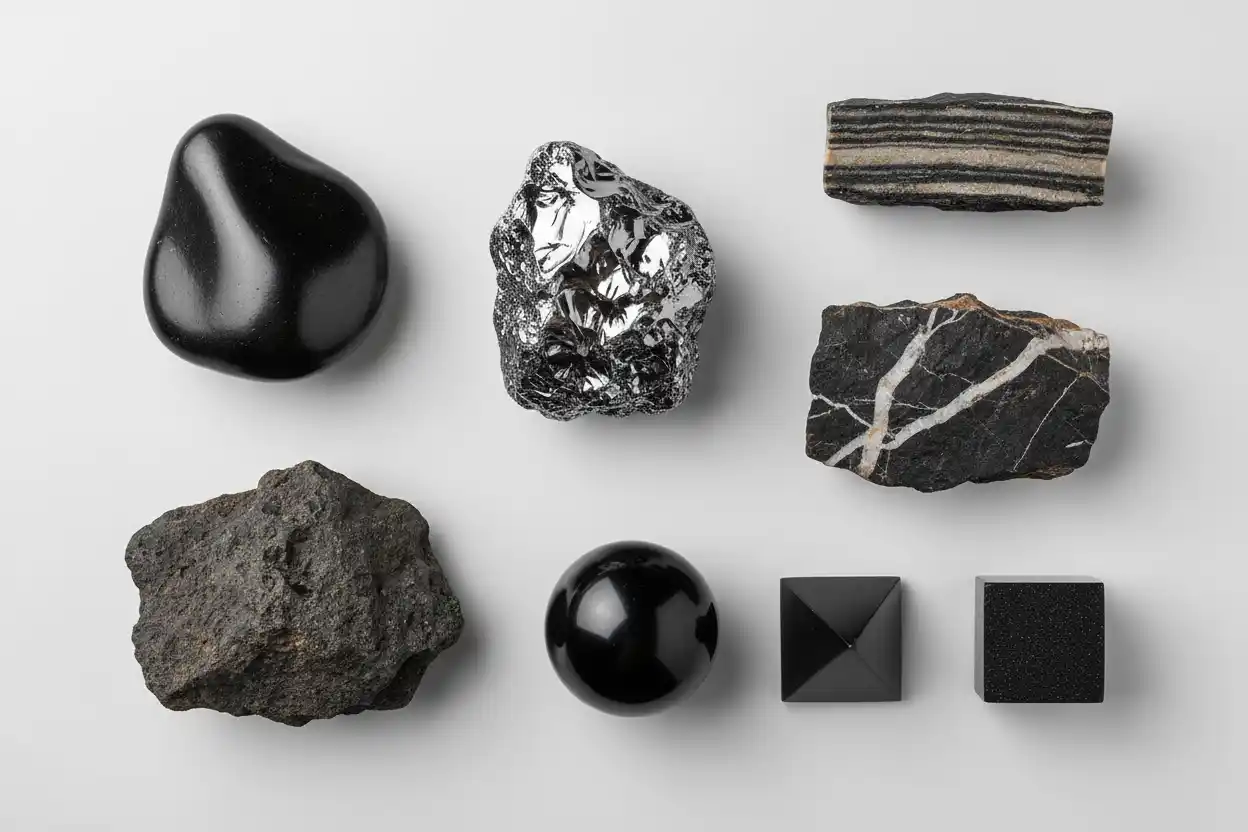
Types of Shungite: Colors and Varieties Explained
Shungite is a carbon-rich material associated principally with Paleoproterozoic rocks in Karelia, northwestern Russia. The word can refer narrowly to extremely carbon-rich noncrystalline material or more broadly to metamorphosed rocks containing variable amounts of shungite carbon mixed with silicates, sulfides, carbonates, and other minerals.
Commercial sellers commonly divide shungite into elite, Petrovsky, ordinary, and low-carbon grades. Geologists may instead classify it by carbon percentage, luster, host rock, or whether the carbon occurs as disseminated layers, lenses, breccia cement, or cross-cutting veins. The main shungite meaning and properties guide covers the material broadly, while this page separates those overlapping classifications.
Shungite at a Glance
| Property | Shungite and Shungite-Bearing Rock |
|---|---|
| Composition | Variable noncrystalline carbon with quartz, silicates, carbonates, sulfides, oxides, and other minerals |
| Material group | Carbon-rich mineraloid or metamorphosed carbonaceous rock, depending on composition and usage |
| Main colors | Silver-black, metallic black, blue-black, matte black, dark gray, brown-black, and black with white or metallic veins |
| Structure | Amorphous to poorly ordered carbon with nanoscale graphitic or graphene-like domains mixed with mineral matter |
| Typical form | Veins, lenses, layers, disseminated carbon, breccia matrix, massive rock, chips, polished blocks, spheres, pyramids, beads, and pendants |
| Luster | Metallic to submetallic, semi-bright, dull, earthy, or polished vitreous |
| Transparency | Opaque |
| Mohs hardness | Variable, commonly approximately 3.5–4 for high-carbon material; mineral-rich rock may differ |
| Cleavage | None in the usual mineral sense |
| Tenacity | Brittle; high-carbon elite material fractures especially easily |
| Common uses | Carbon feedstock, sorbent research, metallurgical and construction applications, pigments, electrodes, decorative carvings, jewelry, and mineral specimens |
| Main care concern | Brittleness, carbon residue, resin or polish, misleading carbon claims, heavy-metal-bearing mineral matter, and unsupported health or electromagnetic claims |
Shungite Is Not One Uniform Mineral
Shungite does not have a fixed composition comparable with quartz or calcite.
High-carbon vein material may contain more than 90% carbon. Common shungite-bearing rock may contain roughly 20–35%, while lower-grade host rocks can contain less than 10%.
Quartz, mica, chlorite, feldspar, carbonate minerals, pyrite, other sulfides, and metal-bearing phases may occur alongside the carbon. Therefore, hardness, weight, conductivity, polish, streak, and chemical behavior vary between specimens.
The broader types of gemstones guide explains why shungite is better treated as a carbonaceous mineraloid or rock than as a conventional crystal species.
Scientific and Commercial Classification
Several classification systems circulate simultaneously.
A five-class geological system divides shungite-bearing material by approximate carbon content. Commercial retailers often compress those classes into Type I elite, Type II Petrovsky or high-grade, and Type III ordinary shungite.
The boundaries are not enforced by one international gemological authority. One seller may describe 50% carbon as Type II, while another may use the same label for a wider range.
Carbon percentage should ideally come from analytical testing rather than visual appearance. Metallic luster suggests higher carbon but does not provide an exact measurement.
Type I Elite or Noble Shungite
Elite shungite is the highest-carbon commercial grade.
It commonly contains roughly 90–98% carbon, although published measurements and seller claims vary. Natural pieces have a silver-black, metallic, or submetallic surface and a pronounced conchoidal fracture.
Elite material occurs mainly in relatively small veins, lenses, or migrated carbon bodies rather than extensive uniform beds. Its rarity compared with ordinary shungite contributes to a higher price per gram.
Despite the prestigious name, elite shungite is not mechanically superior. High carbon content makes it light and electrically conductive, but also extremely brittle. Thin edges flake, and raw pieces can break during shipping.
Elite shungite is generally sold as natural fragments, pendants held by wire, small collector specimens, or chips. Large perfectly shaped “elite” pyramids and spheres deserve scrutiny because the material is difficult to carve without reinforcement.
Silver Shungite
Silver shungite is another retail name for elite or high-carbon material with a silvery metallic luster.
The term does not indicate silver metal. The shine comes from the carbon-rich surface and fracture texture.
Freshly broken areas may appear brighter than weathered exteriors. Handling can leave black carbon residue on the fingers.
A bright silver surface alone does not guarantee 98% carbon. Graphite, anthracite, industrial carbon, coated stone, and metallic slag can create similar appearances.
Noble Shungite
Noble shungite is a translation-based trade name for elite high-carbon material.
It should not be interpreted as a precious gemstone grade or a formal mineralogical species. Value comes from carbon content, provenance, natural form, lack of repair, and specimen aesthetics.
The terms noble, elite, silver, and Type I often overlap in retail listings.
Type II or Petrovsky Shungite
Petrovsky shungite is a commercial middle-grade category commonly described as containing approximately 50–70% carbon.
It may have a semi-metallic, semi-bright, or dark gray-black appearance. Mineral inclusions are more abundant than in elite material, which can make it denser and structurally easier to shape.
The name is not consistently defined in scientific literature. Some sellers use Petrovsky for attractive semi-lustrous material from particular Karelian deposits, while others apply it broadly to any intermediate-carbon shungite.
A precise listing should provide an analysis or realistic carbon range rather than relying on the Petrovsky label alone.
Type III Ordinary Shungite
Ordinary shungite is the most common commercial grade.
It generally contains approximately 20–35% carbon mixed with substantial mineral matter. The surface is matte black, dark gray, or dull rather than strongly metallic.
Ordinary material can be cut into pyramids, spheres, cubes, beads, tiles, massage shapes, and pendants more readily than brittle elite shungite. Its mineral matrix provides greater body, though fractures and pyrite inclusions remain possible.
Most polished shungite products belong to this category. A black polished pyramid should not be assumed to contain 90% carbon merely because it is smooth and opaque.
Low-Carbon Shungite Rock
Types IV and V in some classification systems contain progressively less carbon.
These rocks may hold approximately 10–20% carbon or below 10%, with silicates, carbonates, quartz, mica, and other minerals dominating.
They can still be geologically described as shungite-bearing rock. However, they should not be priced or marketed like elite material.
Low-carbon pieces may appear gray, brown-black, layered, granular, or visibly stony. Polishing can create an attractive dark decorative rock even when carbon content is modest.
Bright, Semi-Bright, Semi-Dull, and Dull Shungite
Geologists also classify shungite by luster and texture.
Bright shungite has a strong glassy or metallic reflection and generally corresponds with high-carbon migrated material. Semi-bright types contain more mineral matter but retain noticeable shine.
Semi-dull and dull shungite appear matte, earthy, or rock-like. Their carbon is more dispersed through the host.
Luster classification is useful in the field but remains approximate. Weathering, polishing, oil, wax, and fresh fracture surfaces can change apparent brightness.
Vein Shungite
Vein shungite fills fractures that cut across the surrounding rock.
It commonly represents carbonaceous material that migrated from an original organic-rich source and later solidified under metamorphic conditions.
High-carbon elite material often occurs in this form. Veins may be only centimeters to meters thick and can contain quartz, carbonate minerals, pyrite, and wall-rock fragments.
Collectors value sharp contacts between silver-black carbon and pale host rock. However, thin vein pieces can be fragile and may separate along the contact.
Layer or Stratified Shungite
Layer shungite follows the bedding or layering of the host rock.
Carbon-rich zones may alternate with quartz-rich, carbonate-rich, or silicate-rich layers. The result can appear striped, banded, laminated, or slab-like.
This material reflects the original sedimentary environment more clearly than cross-cutting veins. It may preserve structures from ancient organic-rich sediments later altered by burial and metamorphism.
Layered pieces are commonly used for slabs, tiles, carvings, and geological specimens.
Disseminated Shungite
Disseminated shungite contains carbon spread through the host rock rather than concentrated into one solid vein.
The rock may resemble dark shale, dolostone, slate, or fine-grained metamorphic material. Carbon content can vary substantially across a single block.
A polished face can look uniformly black even when the interior consists mostly of silicate and carbonate grains.
Breccia and Fragmental Shungite
Some shungite occurs as a matrix around broken rock fragments or as carbon-rich cement within breccias.
The black carbonaceous material contrasts with pale angular clasts, producing an attractive geological pattern.
These rocks record fracturing, fluid movement, and remobilization. They are not reconstructed composites unless human-made resin or glue has been added.
Quartz-Veined Shungite
White or gray quartz veins commonly cross black shungite-bearing rock.
The contrast can make attractive cabochons, beads, tiles, and decorative objects. Pyrite or carbonate veins may also occur.
Quartz-veined material should not be mistaken for higher-carbon elite shungite. Pale mineral veins increase visual interest but usually reduce the percentage of carbon in the overall piece.
Pyrite-Bearing Shungite
Shungite can contain pyrite and other sulfide minerals.
Pyrite may appear as golden metallic specks, crystals, veins, or dull altered patches. Its presence is natural but affects care and water safety.
Moisture and oxygen can oxidize sulfides, producing stains, acidic products, and secondary minerals. A pyrite-bearing specimen should be stored dry and kept away from prolonged soaking.
Polished Shungite
Polished shungite is a manufacturing category rather than a geological type.
Ordinary mineral-rich material is shaped into spheres, pyramids, cubes, plates, beads, towers, and animal carvings. Wax, oil, resin, or polishing compounds may deepen the black surface.
A uniform glossy finish can conceal mineral veins, filled pores, or cracks. The back and drill holes often reveal the original texture more clearly.
Shungite Carbon Structure
Shungite carbon is noncrystalline or poorly ordered rather than ordinary crystalline graphite.
Research describes nanoscale curved, graphitic, graphene-like, or reduced-graphene-oxide-like carbon domains combined into a complex porous structure. Different samples produce different analytical results because their geological histories and carbon contents differ.
Retail claims that shungite is one pure, uniform form of graphene oversimplify that research. A natural rock contains carbon plus numerous mineral phases rather than isolated laboratory-grade graphene sheets.
Fullerenes in Shungite
Fullerenes are closed carbon molecules such as C₆₀.
Some research has reported natural fullerenes in particular shungite samples. Other studies and reviews emphasize that concentrations are extremely small, sample-dependent, and difficult to generalize.
The presence of trace fullerenes does not create a practical retail grading system. A seller cannot prove that every pendant contains significant C₆₀ merely by calling it elite.
Fullerene claims should therefore be treated as a specialized analytical question rather than the defining feature of all shungite.
Geological Origin
The principal shungite deposits occur around Lake Onega in Karelia, especially within the Zaonezhie region.
The carbon-rich sequence dates to roughly two billion years ago. Organic-rich sediments accumulated during the Paleoproterozoic and were later buried, altered, metamorphosed, and locally remobilized.
Shungite can preserve sedimentary layers, migrated carbon veins, breccia textures, and interactions with volcanic or hydrothermal processes.
Shunga, Zazhoginsky, Maksovo, and other Karelian names appear in commercial listings. A mine or village claim should come from traceable supply records rather than the stone’s black color.
Other Reported Occurrences
Carbon-rich materials described as shungite or shungite-like have been reported outside Karelia.
However, Karelia remains the defining geological and commercial source. Black carbonaceous rocks from another country should not automatically be sold as Karelian shungite.
Anthracite, graphitic schist, jet, carbonaceous shale, asphaltite, slag, and industrial carbon can resemble it.
Color and Surface Types
Shungite color ranges from silver-black in high-carbon material to matte black, charcoal, dark gray, and brown-black in mineral-rich rock.
Fresh fractures may appear brighter than weathered surfaces. A polished piece can look deeper black than raw material because the smooth surface reflects light more evenly.
Rusty orange, white, gold, or gray areas usually represent associated iron oxides, quartz, pyrite, carbonate minerals, or host rock rather than separate shungite colors.
Conductivity
Carbon-rich shungite can conduct electricity.
Conductivity generally increases with carbon content and connectivity, but mineral phases, moisture, fractures, sample geometry, and electrode contact influence a simple reading.
A multimeter test may help compare samples, yet it cannot prove Karelian origin or distinguish every carbon-rich imitation.
Graphite and industrial carbon also conduct strongly. The dedicated real versus fake shungite guide owns a complete identification process.
Electromagnetic Shielding Claims
Carbon-containing materials can absorb or reflect electromagnetic energy when engineered into suitable sheets, composites, coatings, or structures.
Performance depends on frequency, conductivity, thickness, shape, orientation, contact, and test method. A small loose stone or pendant should not be assumed to shield a person, room, phone, or wireless device.
Laboratory work on bulk materials does not establish a medical benefit from wearing a polished pyramid or necklace.
Shungite may hold personal symbolism within the broader tradition described in crystals for protection, but spiritual use should remain separate from measurable electromagnetic engineering.
Shungite and Water
Shungite has adsorption properties that have prompted research into engineered sorbents and filtration materials.
However, raw decorative specimens are not certified drinking-water filters. Their mixed mineral composition may release nickel, lead, cadmium, arsenic, chromium, copper, zinc, and other elements.
Washing a stone does not guarantee safe performance. Water chemistry, grain size, source deposit, sulfides, residence time, and bacterial contamination all affect the result.
The broad crystals in water guide should be interpreted conservatively for shungite. A tested commercial filtration system is safer than placing an unknown rock in drinking water.
Inclusions and Associated Minerals
Shungite-bearing rock may contain quartz, mica, feldspar, chlorite, carbonate minerals, pyrite, other sulfides, metal oxides, and clay-related phases.
Those minerals affect hardness and polishing behavior. Quartz-rich areas may stand proud while softer carbonaceous zones undercut.
Pyrite can tarnish, and carbonate veins can react with acids. Therefore, one cleaning method cannot be assumed safe for every specimen.
How Shungite Is Identified
Shungite is opaque black and commonly leaves a gray-to-black streak or residue. High-carbon material is light, brittle, shiny, and sometimes electrically conductive.
Ordinary shungite rock is denser, duller, and more mineral-rich. Fresh fracture, luster, conductivity, carbon analysis, Raman spectroscopy, X-ray diffraction, and chemistry provide increasingly strong evidence.
The gemstone hardness chart should be used cautiously because shungite is a variable composite material rather than one uniform mineral.
The general crystal identification guide explains why origin documentation and multiple observations matter more than one home test.
Common Lookalikes
Anthracite coal can appear black, lustrous, brittle, and lightweight. Graphite can be conductive and leave dark residue.
Jet is an organic gemstone derived from fossilized wood and has a different texture and commercial history. Black glass, slag, basalt, dyed limestone, resin, and industrial carbon products provide additional imitations.
Shungite belongs within the broader visual field covered by the black gemstones guide, but it should not be evaluated as if it were black spinel or onyx.
Treatments and Manufactured Products
Polishing, waxing, oiling, resin filling, gluing, coating, and reconstructed manufacturing can alter shungite products.
Carbon powder may be mixed with resin and molded into uniform shapes. Such composites can contain genuine shungite but are not solid natural rock.
Painted stones and black ceramic may be sold as shungite. Drill holes, chips, seams, repeated molds, and unusually light plastic-like weight can reveal construction.
The dedicated treated and synthetic shungite guide owns the full disclosure and imitation intent. General enhancement terminology appears in gemstone treatments explained.
Cutting and Polishing Behavior
Ordinary shungite rock can be sawn, shaped, drilled, and polished.
Its mixed composition may cause uneven wear. Carbon-rich areas can undercut, quartz scratches adjacent material, and sulfide grains may pull out.
Elite shungite is too brittle for many conventional carvings. Wire wrapping or protective settings suit natural fragments better than drilling.
Cutting generates black dust containing carbon and the rock’s associated minerals. Wet methods and local extraction reduce exposure.
Durability and Jewelry Suitability
Shungite is not a conventionally durable gemstone.
High-carbon material chips and flakes, while ordinary rock can contain fractures, weak layers, and mineral veins. The difference between hardness and structural toughness appears in gemstone toughness versus hardness.
Pendants and beads are more practical than rings. Elite fragments need a secure cage or wire wrap that does not crush their edges.
Polished beads may transfer black residue initially. Thread should be inspected because rough drill holes can abrade cord.
Shungite Prices in 2026
Ordinary rough shungite is relatively inexpensive.
Small natural chunks commonly sell for $5–$25, while bulk ordinary chips may cost approximately $10–$50 per pound, depending on source, size, washing, and packaging.
Polished ordinary-shungite pendants, beads, spheres, cubes, and pyramids commonly range from $10–$100. Larger sculptures and precision-made objects may cost $100–$500 or more because of labor and shipping weight.
Elite shungite is often sold by gram. Current specialist listings commonly fall around $0.30–$1.00 per gram, although small aesthetically bright fragments may carry higher retail markups.
Large elite pieces are uncommon and fragile. A seller offering huge flawless elite spheres at ordinary-rock prices should provide composition and construction evidence.
Carbon percentage, provenance, natural luster, lack of repair, size, and workmanship drive price. The general gemstone pricing guide explains why a manufactured shape can cost far more than its raw material.
Buying Guidance
Decide whether you want elite high-carbon material, ordinary carving-grade rock, a geological specimen, or a polished decorative object.
Request the stated carbon range, deposit or supplier provenance, natural-versus-composite disclosure, and unedited photographs of all sides.
A certificate printed by the seller may simply repeat marketing claims. Meaningful carbon percentages require analytical testing.
Check elite pieces for glue, black paint, reconstructed fragments, and artificial metallic coating. Examine polished objects for resin-filled cracks and exposed mineral veins.
The dedicated shungite buying guide retains detailed authenticity checks. General remote-shopping protections appear in how to buy gemstones online.
Cleaning and Storage
Wipe polished shungite with a soft dry or slightly damp cloth.
Avoid soaking, acids, household chemicals, and prolonged contact with water. Pyrite and other mineral inclusions may react or release staining products.
Do not use steam or ultrasonic equipment. Vibration can enlarge fractures and dislodge glued or resin-filled sections. General equipment guidance appears in gemstones in ultrasonic cleaners.
Store elite fragments in a padded box because their edges chip easily. Keep pieces away from pale fabrics if they shed carbon residue.
Non-contact spiritual-care practices appear in how to cleanse and charge shungite.
Meaning and Symbolism
Modern spiritual traditions associate shungite with grounding, protection, purification, resilience, and maintaining boundaries in technology-heavy environments.
Its deep black color and ancient geological origin contribute to those interpretations. Elite silver-black material is sometimes given stronger symbolic status, although carbon percentage does not establish a measurable spiritual effect.
These meanings belong to personal and cultural practice. Scientific research does not demonstrate that wearing shungite treats illness or protects the human body from everyday electromagnetic exposure.
Shungite appears with other S materials in the crystals that start with S directory and the gemstones that start with S guide.
Frequently Asked Questions
1. What are the main types of shungite?
Commercial categories include Type I elite, Type II or Petrovsky, Type III ordinary, and lower-carbon Types IV and V. Geological classifications also use luster and mode of occurrence.
2. What is elite shungite?
Elite shungite is rare silver-black material commonly reported at roughly 90–98% carbon. It is highly lustrous, light, conductive, and brittle.
3. What is Petrovsky shungite?
Petrovsky is a loosely defined commercial middle grade, often described as containing approximately 50–70% carbon and showing semi-metallic luster.
4. What is ordinary shungite?
Ordinary shungite is mineral-rich black rock commonly containing roughly 20–35% carbon. It is the main material used for polished shapes and beads.
5. Is silver shungite made from silver?
No. The term describes the metallic-looking surface of high-carbon shungite and does not indicate silver metal.
6. Does all shungite contain fullerenes?
Some samples have yielded trace fullerene measurements, but concentrations are extremely small and inconsistent. Fullerene content should not be assumed from a retail label.
7. Is shungite a mineral?
It is better described as a carbon-rich mineraloid or a shungite-bearing metamorphosed rock because it lacks one fixed crystal structure and composition.
8. Can shungite block electromagnetic fields?
Engineered carbon materials can provide shielding under tested conditions, but a loose stone or pendant has not been shown to protect a person from everyday electromagnetic exposure.
9. Is shungite safe in drinking water?
Raw specimens should not be used as drinking-water filters. Research has shown that some commercial samples can release heavy metals into water.
10. How can real shungite be recognized?
Origin documentation, carbon content, fracture, luster, density, conductivity, mineral associations, and laboratory analysis provide stronger evidence than one home test.
11. Why is elite shungite more expensive?
It occurs in smaller quantities, contains much more carbon, has a distinctive metallic luster, and is harder to recover and ship without breakage.
12. Is polished shungite always natural solid rock?
No. It may be waxed, resin-filled, glued, coated, or reconstructed from powder and binder. Construction should be disclosed.
Shungite types represent a continuum between nearly pure migrated carbon and mineral-rich metamorphosed rock. Silver-black elite veins, semi-bright intermediate material, matte ordinary carving stone, quartz-banded layers, and low-carbon host rock may share a regional origin, yet their composition and practical behavior differ substantially.
Safety disclaimer: Do not use untreated shungite specimens to purify drinking water or as a substitute for certified filtration, medical treatment, or engineered electromagnetic shielding. Shungite-bearing rocks can contain sulfides and metals, while cutting dust may contain carbon, silica, and metal-bearing mineral particles.