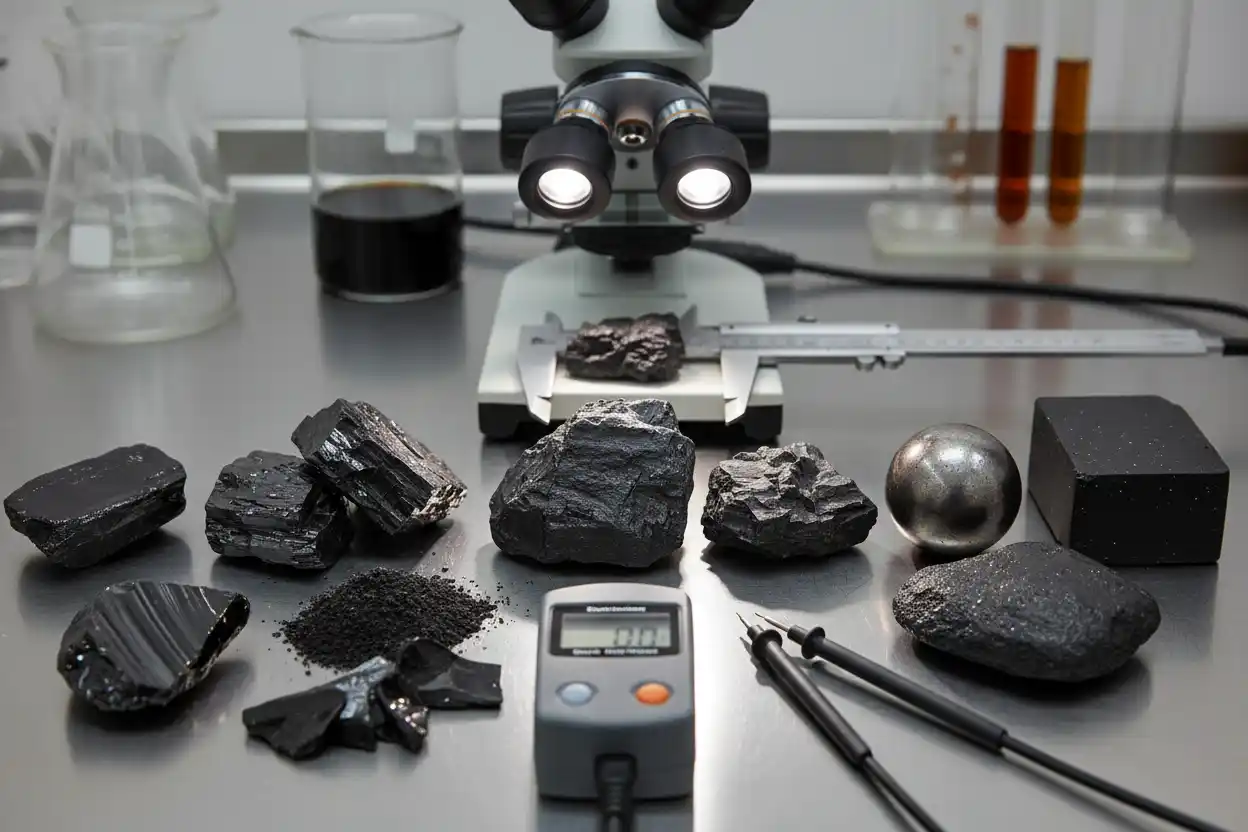
Real vs Fake Shungite: Carbon, Conductivity and Stone Tests
Real shungite is a carbon-bearing geological material best known from Paleoproterozoic rocks in Karelia, northwestern Russia. It is not one uniform crystal species with a fixed chemical formula. Instead, commercial shungite can contain carbonaceous matter mixed with quartz, mica, feldspar, pyrite and other mineral components in widely varying proportions.
That variability creates an identification challenge. One genuine sample may be dull black, massive and only moderately conductive. Another high-carbon vein material may appear silvery, brittle and noticeably conductive. Polished carvings can look smoother and more uniform than rough pieces.
Imitations and substitutes include coal, anthracite, graphite, jet, obsidian, black tourmaline, hematite, painted rock, resin, ceramic and carbon-filled composites. Genuine shungite can also be polished, coated, stabilized, glued or assembled.
A simple conductivity test may expose plastic, but it cannot prove Karelian origin, a particular deposit or a precise carbon percentage. Reliable identification combines appearance, density, mineral texture, carbon analysis, Raman spectroscopy, X-ray diffraction and provenance.
This page owns the direct authenticity workflow. The completed treated and synthetic shungite guide retains coatings, stabilization, composites and misleading manufactured-product terminology.
Genuine Shungite vs Common Lookalikes
| Feature | Genuine carbon-rich shungite rock | Coal or anthracite | Graphite-rich material | Obsidian or glass | Resin or painted stone |
|---|---|---|---|---|---|
| Material | Carbon–mineral geological composite | Carbon-rich sedimentary or metamorphosed fuel rock | Carbon mineral or carbon-rich rock | Natural or manufactured glass | Polymer or coated substrate |
| Typical origin claim | Karelia, especially the Lake Onega region | Many coal basins worldwide | Many geological localities | Volcanic or manufactured | Factory or workshop |
| Appearance | Dull black to silvery metallic, commonly heterogeneous | Black, banded, sooty or bright depending on rank | Gray-black with metallic or greasy luster | Glassy, smooth or conchoidal | Uniform, molded or painted |
| Carbon content | Highly variable among rocks and types | Variable but commonly high | High in graphite-rich material | Little or no elemental carbon | Pigment-dependent |
| Conductivity | Variable and strongly related to carbon network and mineral content | Variable | Often conductive | Usually poor electrical conductor | Usually poor unless carbon-filled |
| Density | Variable with carbon, quartz, pyrite and porosity | Commonly lower | Variable | Commonly around glass ranges | Usually lower unless filled |
| Surface and fracture | Massive, granular, irregular or conchoidal in high-carbon material | Cleated, layered or crumbly | Flaky, platy or greasy | Smooth glass fracture | Seams, bubbles, chips or coating |
| Laboratory signature | Disordered carbon plus mineral phases | Coal petrographic and chemical signature | Graphitic carbon signature | Amorphous silicate glass | Polymer or substrate spectrum |
| Best confirmation | Raman, XRD, elemental analysis and credible provenance | Coal analysis | Raman and mineral analysis | Optical and Raman testing | Polymer and coating analysis |
Electrical conductivity is one property, not an exclusive fingerprint.
What Is Genuine Shungite?
The completed shungite meaning guide owns geological history, symbolism and broader material context.
The word shungite has been used in more than one way. It may refer to carbonaceous matter itself or to Karelian rocks containing that carbonaceous component.
Commercial sellers commonly use shungite for a range of black carbon-bearing rocks from the Lake Onega region.
The material developed from ancient organic-rich deposits that underwent burial, alteration and metamorphism. The resulting carbon is structurally disordered rather than ordinary well-crystallized graphite.
Silicate minerals and sulfides can remain dispersed through the carbonaceous matrix. Consequently, two genuine pieces can differ markedly in weight, hardness, polish and conductivity.
Shungite Is a Rock, Not One Pure Mineral
A mineral has a sufficiently defined composition and crystal structure.
Most commercial shungite is better understood as a carbon–mineral rock or mineraloid-bearing rock rather than a single pure crystal.
Quartz, mica, albite or other feldspar, pyrite and additional minerals can occur alongside the carbonaceous phase.
White veins may be quartz. Metallic brass-colored grains may be pyrite. Brown alteration can reflect iron-bearing minerals.
Those natural variations do not automatically mean the specimen is contaminated or fake.
A seller claiming “100% pure shungite crystal” is using imprecise terminology unless laboratory analysis supports an unusually carbon-rich material.
Karelian Provenance
Shungite is most strongly associated with Karelia in northwestern Russia, particularly the Lake Onega region.
Commercial names often reference Shunga, Zazhogino, Maksovo and other locations or deposits.
Appearance alone cannot establish one deposit. A dull black stone from elsewhere can resemble Karelian material, while genuine Karelian samples vary considerably.
Credible provenance may include a mine or deposit name, supplier records, geological documentation and traceable invoices.
A generic card stating “authentic Russian shungite” can be printed for any black object. It supports only the seller’s claim unless the supply chain is verifiable.
Ordinary and High-Carbon Shungite
Commercial sellers frequently separate dull ordinary shungite from bright, elite or noble high-carbon material.
Ordinary material commonly appears matte to submetallic, dark gray to black and mixed with visible mineral matter.
High-carbon vein material may show a brighter silvery or metallic luster, irregular curved fracture and lower apparent proportion of pale minerals.
The boundaries are not standardized consistently across retail markets. Terms such as Type I, Type II, elite and noble can represent different carbon thresholds depending on the seller.
A marketing grade should not substitute for laboratory carbon analysis.
The completed types-of-shungite guide owns the commercial and geological classification boundary.
Natural Color and Luster
Genuine shungite is normally black, dark gray or silvery black.
Dull material may resemble charcoal or ordinary black stone. High-carbon surfaces can show a brighter metallic or satin luster.
Polishing can make lower-carbon material appear smooth and glossy. Therefore, high shine does not prove elite grade.
A resin coating may create an unnaturally wet or plastic-like gloss. Inspect chips, drill holes and carving recesses to determine whether the shine is superficial.
Metallic paint can make an imitation look silvery. Wear along corners may expose a pale or different-colored base.
Natural Texture
Ordinary shungite may be massive, fine-grained, granular, veined or irregular.
Quartz veins and other mineral areas can cross the black matrix.
High-carbon pieces can fracture into irregular sharp-edged fragments. They may be brittle and unsuitable for highly detailed carving without stabilization.
Polished spheres, pyramids and beads are fashioned shapes. Their geometry is not a natural crystal habit.
A perfect pyramid should not be promoted as a naturally grown shungite crystal.
The completed raw-versus-polished crystal guide explains the distinction between geological form and lapidary shaping.
Carbon Content
Published scientific analyses show that shungite-bearing rocks span a broad range of carbon contents.
The amount of carbon influences color, density, electrical behavior and industrial suitability, but mineral distribution matters as well.
A seller cannot determine an exact carbon percentage by looking at polish or measuring one resistance value with a household meter.
Elemental combustion analysis, thermogravimetric methods or other laboratory techniques are needed for quantitative carbon content.
Claims such as exactly 98% carbon should be supported by a report tied to the specific batch or specimen.
Conductivity
Carbon-rich shungite can conduct electricity.
Conductivity depends on the continuity of its carbon network, mineral content, porosity, moisture, specimen geometry and how the electrodes contact the surface.
One point on a stone may conduct better than another. A polished waxed surface can interfere with meter contact, while sharp probes can penetrate a coating and change the reading.
High-carbon material often conducts more readily than ordinary low-carbon shungite, but ranges overlap.
Graphite, metal-filled resin, carbon composite and several other materials also conduct.
A conductivity result can support identification; it cannot prove shungite or Russian origin by itself.
How to Use a Multimeter Safely
Use a basic resistance or continuity setting only on a dry, loose object.
Clean two small contact areas with a dry cloth. Do not grind or scrape the specimen.
Place probes a short, consistent distance apart and repeat the measurement on several surfaces.
A very high or open-circuit reading does not automatically prove fake material. Low-carbon shungite, quartz-rich zones, coatings and poor contact can prevent current flow.
A low resistance reading does not prove authenticity because graphite and carbon-filled polymers can also conduct.
Never connect the stone directly to mains electricity or a high-voltage source.
Shungite Versus Coal and Anthracite
Coal and anthracite are natural carbon-rich rocks.
Anthracite can be hard, black, shiny and electrically responsive enough to resemble selected shungite.
Coal may show bedding, cleats, plant-related structure, sooty surfaces or characteristic fracture, although high-rank material can become compact and bright.
Provenance is crucial because coal occurs worldwide and is far more common.
Raman spectroscopy, petrographic examination, volatile content, elemental ratios and mineral phases distinguish coal from Karelian shungite.
A piece does not become shungite merely because it is black and carbonaceous.
Shungite Versus Graphite
Graphite is a crystalline carbon mineral.
It commonly has a gray-black color, metallic or greasy luster and excellent electrical conductivity. Flaky graphite can mark paper and separate into thin plates.
Shungite carbon is more structurally disordered and normally occurs with a mixed mineral matrix.
A graphite-rich rock may conduct better than ordinary shungite and can defeat a basic multimeter test.
Raman spectroscopy distinguishes graphitic order and disordered carbon through their characteristic bands and intensity relationships.
Shungite Versus Jet
Jet is an organic gem material derived from altered wood.
It is lightweight, comparatively soft and can take a warm black polish.
Jet commonly feels lighter than an equal-size mineral-rich shungite piece. It may show woody or organic structure under magnification.
Both are black carbon-bearing materials, so color and a vague organic description are insufficient.
Raman, infrared and density testing separate them.
The planned where-to-buy-real-jet guide owns jet-specific seller checks.
Shungite Versus Obsidian
Obsidian is natural volcanic glass.
It normally has a glassy luster and smooth conchoidal fracture. Thin edges may transmit brown, gray or greenish light.
Shungite is a carbon–mineral material and is generally more granular, dull or metallic.
Obsidian is not normally an effective electrical conductor under an ordinary low-voltage test.
The completed black-tourmaline-versus-obsidian-versus-onyx guide places several common black stones in context.
Shungite Versus Onyx
Onyx is chalcedony, usually sold as polished black material after dyeing.
It has quartz-range hardness, does not normally conduct electricity and takes a smooth glassy-to-waxy polish.
Shungite is commonly softer or more variable because of its mixed composition and carbonaceous structure.
The recently drafted real-versus-fake onyx guide owns black chalcedony, glass and resin identification.
A polished black bead cannot be identified as shungite or onyx by color alone.
Shungite Versus Black Tourmaline
Black tourmaline commonly forms elongated striated crystals.
Its natural prism faces, lengthwise grooves and triangular cross-sectional tendencies differ from massive shungite rock.
Tourmaline has higher hardness and a distinct borosilicate composition.
Broken or polished black tourmaline can lose obvious crystal form, requiring Raman or refractive testing.
Neither material’s spiritual reputation is an identification test.
Shungite Versus Hematite
Hematite is iron oxide.
Polished hematite can appear metallic gray-black and feel notably heavy.
Its red-brown streak and much greater density distinguish it from most shungite.
Magnetic imitation hematite, often manufactured from ferrite material, adds another category.
A metallic black luster is not enough to identify either material.
The planned where-to-buy-hematite guide retains hematite-specific marketplace boundaries.
Shungite Versus Pyrite-Rich Black Rock
Pyrite can occur naturally within shungite-bearing rock.
Brass-colored grains or veins do not automatically indicate fabrication.
A specimen dominated by metallic pyrite, however, should not be sold as high-purity carbon material.
The recently drafted real-versus-fake pyrite guide explains iron-sulfide identification and oxidation.
Mineral proportions should be described honestly because they affect conductivity, weight and water stability.
Resin and Plastic Imitations
Resin can be colored black, mixed with carbon powder and cast into beads, pyramids, pendants and phone plates.
Carbon-filled resin may conduct electricity, defeating a simple continuity test.
Look for mold seams, casting bubbles, repeated surface patterns, soft scratches and a polymer-like interior at chips.
A clear or glossy binder may be visible between black particles.
Plastic can also be weighted with mineral powder, making hand-heft comparisons unreliable.
A hot-needle or flame test should not be used because it damages the object and releases fumes.
Painted and Coated Stones
An ordinary rock can be painted black or coated with carbon-rich material.
Inspect worn corners, drill holes and scratches for a lighter interior.
Paint may pool in recesses or display brush, spray or dipping texture.
A conductive coating can create a low-resistance surface even when the interior is unrelated stone.
Measure more than one face if conducting a non-destructive meter screen, but do not scratch through a coating deliberately.
The completed treatment page owns surface-modification details.
Reconstructed and Composite Shungite
Shungite powder or fragments can be combined with resin, cement or another binder.
Such products may contain genuine shungite while lacking one continuous natural rock structure.
Pyramids, plates and decorative tiles are particularly suitable for composite manufacture.
Magnification may reveal fragment boundaries, clear polymer, bubbles or an evenly manufactured texture.
A composite can have practical decorative or industrial use when disclosed. It should not be sold as a solid piece of high-carbon vein shungite.
Does Synthetic Shungite Exist?
Carbon-rich and shungite-inspired composites can be manufactured.
However, the word shungite includes geological origin and a specific natural carbon–mineral history. A factory-made carbon composite is not a laboratory-grown counterpart in the same sense as synthetic ruby.
Listings using synthetic shungite should state the actual composition: resin composite, carbon ceramic, carbon-filled polymer or another material.
A product can contain shungite powder without being one natural shungite stone.
The Fullerene Claim
Shungite marketing frequently emphasizes C₆₀ fullerenes.
Fullerenes or fullerene-like carbon structures have been investigated scientifically, but their reported abundance, extraction and significance are not a practical consumer authentication test.
A seller cannot prove a stone genuine by printing a fullerene diagram on its packaging.
Even if a laboratory detects trace fullerenes, that result does not establish a particular retail grade or health effect.
Raman spectroscopy and broader carbon characterization are more useful for identifying the carbon structure present.
EMF Claims Do Not Authenticate Shungite
Conductive carbon materials can interact with electromagnetic radiation under controlled conditions, geometries, frequencies and thicknesses.
That scientific fact does not prove that a small pendant neutralizes a room, protects the whole body or changes radiation biologically.
A phone signal test is especially unreliable because device power, orientation, network conditions, case design and the user’s hand alter reception.
Metal, graphite and carbon-filled plastic can also attenuate signals without being shungite.
An EMF claim should never replace mineral analysis or provenance.
Density and Weight
Shungite density varies because carbon, quartz, sulfides, pores and other minerals occur in different proportions.
High-carbon material can be lighter than quartz-rich ordinary shungite.
Resin is often lighter, but dense fillers can imitate a stone-like feel.
Coal, graphite and jet occupy their own overlapping ranges.
Hydrostatic measurement can provide useful characterization, but no one density value proves every genuine shungite category.
Streak and Surface Marks
Some carbon-rich shungite can leave a dark mark on paper or an unglazed surface.
Graphite, coal, carbon pigment and several imitations do the same.
A polished ordinary shungite bead may leave little or no visible mark.
Streak testing removes material and can damage a finished object. It should not be treated as a universal authenticity method.
Hardness
Shungite does not have one fixed Mohs hardness because it is a heterogeneous material.
Carbonaceous regions, quartz veins and sulfide grains respond differently.
High-carbon pieces can be brittle, while quartz-rich rock resists scratching more strongly.
That variability makes scratch tests difficult to interpret.
A coating or resin can also change surface response without revealing the interior.
Raman Spectroscopy
Raman spectroscopy is one of the most useful shungite tests.
Disordered carbon produces characteristic D and G bands whose positions, widths and intensity relationships describe structural order.
Graphite, coal, carbon black and shungite can all show carbon bands, but their complete spectra and associated mineral phases differ.
Raman analysis can also identify quartz, pyrite, hematite, glass and polymer in the same object.
Interpretation should compare the specimen with suitable geological references rather than merely confirming that carbon exists.
X-Ray Diffraction
X-ray diffraction identifies crystalline mineral phases within the rock.
Quartz, mica, feldspar, pyrite and other components can be detected even when the black carbonaceous matrix dominates visually.
Poorly ordered carbon may create broad rather than sharp diffraction features.
XRD helps distinguish shungite-bearing rock from glass, resin and unrelated black minerals.
It does not provide exact carbon content by itself.
Elemental and Carbon Analysis
X-ray fluorescence, electron microscopy with elemental analysis, combustion analysis and related methods can determine mineral chemistry and carbon proportion.
These tests are more reliable than retail grades for claims such as 30%, 70% or 98% carbon.
Trace-element analysis can also reveal metals and sulfides relevant to handling or water use.
The report should identify whether the tested result represents one specimen, a powdered subsample or an entire commercial batch.
Certificates and Seller Documentation
A retailer certificate should state the seller, source, batch, testing method and result.
A generic “certificate of authenticity” without laboratory name or data has limited evidentiary value.
The completed gemstone-certification guide explains identification documents.
Use how to read a gem-lab report to determine whether a report confirmed carbon-rich Karelian rock, measured carbon content or merely described a black object.
Water-Purification Claims
Shungite-derived materials have been studied as adsorbents under controlled scientific and industrial conditions.
That research does not mean an unknown retail stone should be placed directly in drinking water.
Natural specimens may contain pyrite, other sulfides, trace metals, dust, polishing compounds, glue, dye or resin.
Adsorbent performance also depends on particle preparation, surface area, contact time, contaminant type and post-treatment filtration.
Use certified water-treatment products designed and tested for potable-water applications instead of crystal-shop stones.
The completed crystal water-safety guide owns the broader safety boundary.
A Safe Home Screening Sequence
Start with provenance. Record the claimed deposit, grade and supplier.
Inspect the object with a loupe. Look for mixed mineral texture, quartz veins, pyrite grains, coating, bubbles, mold seams and resin.
Compare luster and fracture with coal, graphite, glass and plastic expectations.
Use a multimeter only as a supporting screen. Repeat measurements on several dry surfaces and treat both conductive and non-conductive results cautiously.
Check whether an alleged high-carbon specimen is implausibly uniform, molded or coated.
Do not burn, grind, taste, dissolve or place the specimen in drinking water.
When identity matters, obtain Raman, XRD and elemental analysis.
The completed crystal-identification guide provides the wider non-destructive workflow.
Buying Genuine Shungite
The completed where-to-buy-real-shungite guide owns seller selection and provenance checks.
Ask for the exact deposit or regional source, product construction and whether the piece is solid rock or composite.
For carbon-percentage claims, request a batch-specific test rather than accepting a generic chart.
Exact-item photographs should include the back, drill holes and any natural fractures.
Use how to buy gemstones online and retain enough time for independent inspection.
Cleaning and Storage
Dry brushing and wiping are safer than soaking.
Keep specimens away from high humidity, particularly when pyrite or other sulfides are visible.
Avoid acids, saltwater, steam, ultrasonic cleaners and aggressive polishing compounds.
A resin-bound object may require different care from raw high-carbon material.
Belief-based practices belong in the completed shungite cleansing guide and should remain physically safe.
Review the completed toxic-crystals safety list before cutting or grinding unknown carbon-rich rock.
Frequently Asked Questions
1. What is genuine shungite?
It is a natural carbon-bearing geological material strongly associated with Paleoproterozoic rocks in Karelia, Russia.
2. Is shungite a mineral?
Commercial shungite is usually better described as a carbon–mineral rock or mineraloid-bearing rock rather than one pure mineral species.
3. Does every real shungite stone conduct electricity?
No. Conductivity varies with carbon content, mineral distribution, surface contact and specimen geometry.
4. Does conductivity prove a stone is shungite?
No. Graphite, metal, carbon-filled resin and other materials can also conduct.
5. Is elite or noble shungite always 98% carbon?
High-carbon material can approach very high carbon contents, but retail grade thresholds vary. A specific percentage requires laboratory analysis.
6. Can ordinary shungite look polished and shiny?
Yes. Lapidary polishing or coating can make ordinary material glossy, so shine alone does not establish a high-carbon grade.
7. How is shungite distinguished from coal?
Provenance, petrographic texture, Raman spectra, mineral phases and elemental analysis provide stronger evidence than color or conductivity.
8. How is shungite distinguished from graphite?
Graphite has a more ordered crystalline carbon structure and often a flaky or greasy texture. Raman and X-ray testing separate them.
9. Can resin imitate conductive shungite?
Yes. Carbon-filled resin can look black and conduct electricity, making microscopy and spectroscopy important.
10. Do fullerenes prove shungite authenticity?
No. A fullerene claim on packaging is not an identification test or proof of a particular grade.
11. Should shungite be placed in drinking water?
No unknown retail stone should be used directly for potable-water treatment because mineral content, trace elements, dust and treatments may be uncontrolled.
12. Which tests provide the strongest shungite identification?
Raman spectroscopy, X-ray diffraction, elemental or carbon analysis and credible Karelian provenance provide the strongest combined evidence.
Real shungite cannot be authenticated by one electrical beep, one silvery surface or one fullerene claim. Genuine material is heterogeneous, and its carbon, quartz, sulfides, density and conductivity vary. A reliable conclusion combines geological provenance with microscopic texture, carbon characterization and mineral-phase analysis while treating health and EMF marketing as separate claims rather than identification evidence.
Shungite appears in Crystals That Start With S and Gemstones That Start With S.
Shungite healing, detoxification and EMF-protection claims are not gemological authentication methods or established medical treatment. Do not ingest shungite, inhale generated dust or use an unknown retail specimen directly to prepare drinking water.