9 Real Spinel Benefits: Helpful Uses, Evidence, Safe Use & Clear Limits
Spinel benefits begin with a gemstone that combines excellent durability, bright color, strong brilliance, natural transparency, fascinating history, and a remarkable range of hues. Natural spinel is a magnesium aluminum oxide with the ideal formula MgAl2O4, crystallizes in the isometric system, and ranks 8 on the Mohs scale, making it one of the more practical colored gemstones for rings, earrings, pendants, bracelets, and other jewelry.
For centuries, red spinel was confused with ruby because both can display rich chromium-related red coloration and can occur in the same gem-producing regions. Famous historical stones once described as rubies were later identified as spinel, including the Black Prince’s Ruby in the British Imperial State Crown. Scientific separation of spinel and ruby became an important step in the development of modern mineral and gem identification.
Modern gemstone traditions add vitality, resilience, confidence, motivation, emotional renewal, and personal strength to spinel benefits. These associations can give jewelry personal meaning, but spinel does not medically increase physical energy, treat fatigue, alter hormones, strengthen the immune system, or change emotional health through ordinary contact.
9 Spinel Benefits at a Glance
The nine points below focus first on measurable gemstone qualities and then on symbolic uses that can remain meaningful without becoming medical claims.
- Mohs hardness 8 gives spinel excellent resistance to ordinary scratching and makes it suitable for many types of jewelry.
- Good toughness and lack of easy cleavage provide practical durability for rings, pendants, earrings, and bracelets.
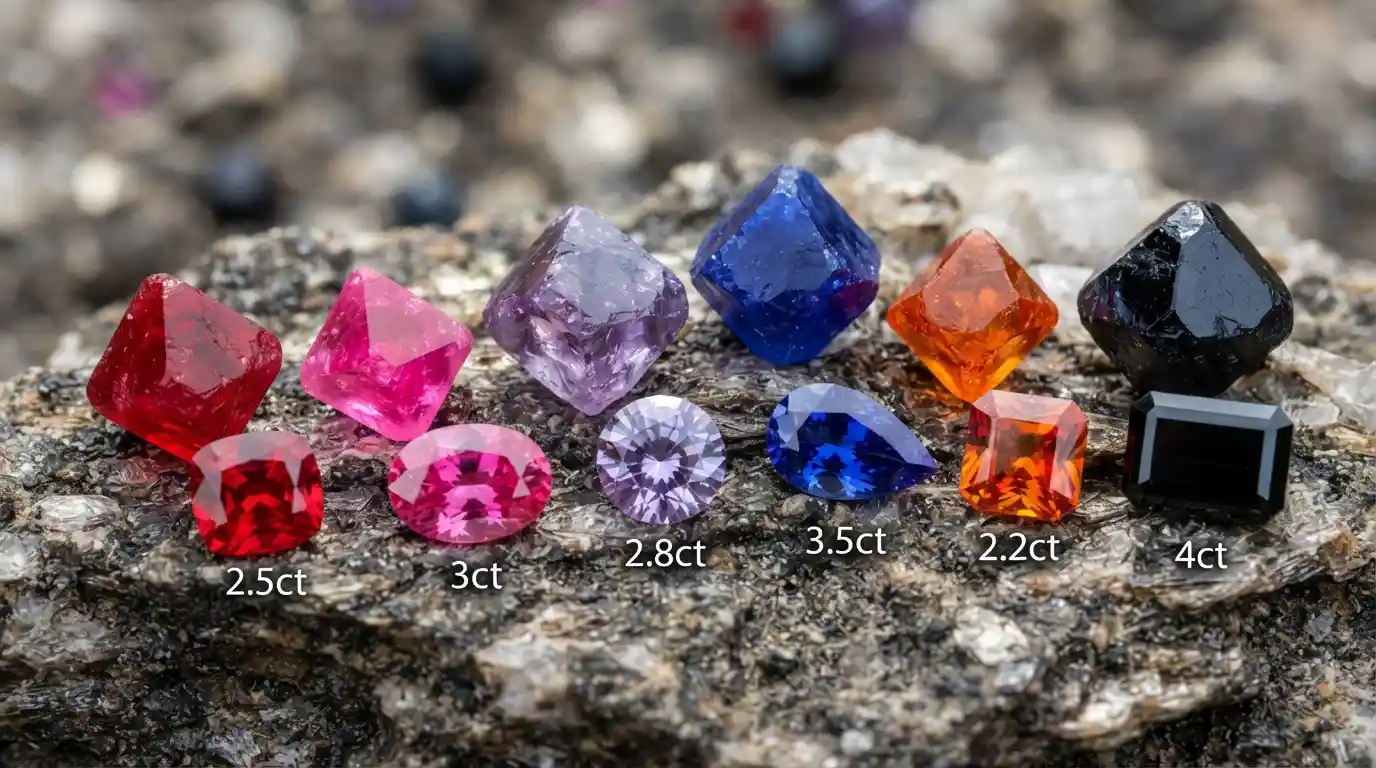
- Red, pink, orange, purple, blue, gray, black, and other colors offer substantial aesthetic variety.
- Isometric crystal structure makes spinel singly refractive, supporting clean brilliance in transparent gems.
- Natural octahedral crystals provide strong collector and mineralogical appeal.
- Historical confusion with ruby gives spinel an unusually important place in the development of gem identification.
- Modern resilience and confidence symbolism can represent perseverance and prepared action without implying biological effects.
- Limited routine treatment compared with many colored gems can make natural spinel especially appealing when disclosure is clear.
- Straightforward cleaning and strong durability make spinel practical for owners who want a colorful natural gemstone that can tolerate regular wear.
Spinel Benefits Begin With Strong Gemstone Durability
One of the most practical spinel benefits is durability. At Mohs 8, spinel is harder than quartz and most common ornamental stones, although still softer than sapphire, ruby, and diamond. GIA describes spinel as having good toughness and enough durability for all types of jewelry when normal care is used.
Spinel also lacks the easy cleavage seen in gemstones such as topaz, fluorite, or sphene. This reduces the risk of a stone splitting along a preferred structural plane, although any gemstone can chip if a strong blow strikes an exposed facet edge.
These characteristics make spinel suitable for rings much more readily than many collector gems. A well-set natural stone can handle routine wear when the owner removes it for heavy manual work, impact-prone activities, and situations involving abrasive surfaces.
Durability does not make spinel indestructible, but it gives the gem a practical advantage that extends well beyond color or symbolism.
Spinel Technical Properties
The table below summarizes the physical qualities that make natural spinel useful in jewelry and gemological study.
| Property | Spinel |
|---|---|
| Ideal formula | MgAl2O4 |
| Crystal system | Isometric |
| Mohs hardness | 8 |
| Cleavage | None to indistinct |
| Toughness | Good |
| Refractive index | Around 1.718 |
| Birefringence | None, normally singly refractive |
| Common colors | Red, pink, orange, purple, blue, gray, black |
| Common crystal habit | Octahedral |
| Typical uses | Rings, earrings, pendants, bracelets, collector gems |
| Major strengths | Durability, color, brilliance, historical importance |
This combination explains why spinel can serve both as a collector gemstone and as practical jewelry. It is hard enough for regular wear while remaining optically attractive and available in far more colors than the red stones that dominate its historical reputation.
Spinel Offers an Exceptional Range of Natural Colors
Color variety is one of the strongest spinel benefits. Natural spinel occurs in bright red, rose red, hot pink, orange-red, lavender, violet, purple, gray, blue, and black, with many intermediate shades.
Chromium is the principal color-producing trace element in many red and pink spinels, while cobalt can contribute vivid blue in certain stones. Iron can influence blue, gray, violet, and darker colors, sometimes interacting with other trace elements to create complex appearances.
The gemstone’s range allows buyers to choose spinel for personal preference rather than one traditional color. A vivid red stone may appeal to someone seeking an alternative to ruby, while lavender, gray, or cobalt-blue spinel offers an entirely different appearance.
Color also strongly influences value. The principles behind spinel quality grading therefore place color alongside clarity, cut, carat weight, transparency, treatment status, and overall appearance rather than judging every spinel by one standard.
Red Spinel Has an Exceptional Historical Story
The history of red spinel is one of the most interesting benefits for collectors. For centuries, many red spinels were called rubies because early observers lacked modern mineralogical tests and both gems could appear together in gem gravels.
The Black Prince’s Ruby in Britain’s Imperial State Crown is actually red spinel. The historic Timur Ruby is also spinel, and large Central Asian stones known as Balas rubies circulated among royal courts for centuries before mineralogical study established that ruby and spinel were different species.
The distinction became clear through advances in crystallography and mineral science during the eighteenth century. Ruby is chromium-bearing corundum, Al2O3, while spinel is magnesium aluminum oxide, MgAl2O4.
This history gives spinel benefits that go far beyond beauty. The gemstone represents one of the classic examples of how scientific identification can correct centuries of mistaken assumptions.
Octahedral Crystals Give Spinel Strong Collector Appeal
Natural spinel commonly forms attractive octahedral crystals, often with sharply defined triangular faces. Well-formed crystals can be collectible even when they are not transparent enough for faceting.
Crystal form also played a role in distinguishing spinel from ruby historically. The two gemstones can share similar red colors, but their crystal structures and physical properties differ significantly.
Some spinel crystals also show twinning, unusual surface patterns, or internal inclusions reflecting octahedral growth. These features can add scientific and aesthetic interest rather than simply being treated as imperfections.
Collectors therefore judge natural crystals differently from faceted jewelry stones. Crystal shape, locality, associated minerals, surface condition, transparency, and provenance may matter as much as color.
Spinel Benefits From Strong Brilliance Without Double Refraction
Spinel belongs to the isometric crystal system and is normally singly refractive. Light passing through the gemstone therefore does not split into the strong doubled images seen in sphene, zircon, or other highly birefringent gems.
This optical simplicity can support crisp facet reflections in a well-cut transparent stone. GIA notes that properly proportioned spinel can display excellent brilliance, especially when transparency and polish are strong.
Cut still matters substantially. A deeply cut gem may appear dark, while a shallow stone can show windowing through the center. Good proportions allow light to return evenly across the face of the gemstone.
This is why an attractive spinel should be judged by how it actually performs under light rather than by carat weight alone.
Spinel Is Practical for Everyday Jewelry
Hardness 8 and good toughness give spinel a major advantage over many colorful collector gems. Rings, earrings, necklaces, bracelets, and pendants can all be realistic uses when the stone is secure and free from serious fractures.
Warm soapy water is a safe cleaning method for normal spinel. GIA notes that ultrasonic and steam cleaning are usually acceptable for sound stones, although significant fractures or fillers require more cautious treatment.
High heat can affect certain colors, so jewelry repair should be handled by a jeweler who understands colored gemstones. A known fracture-filled stone should receive especially gentle cleaning because filler can respond differently from the spinel itself.
For most owners, routine care is simple: avoid severe impact, store the jewelry separately, and clean it with mild soap and water when necessary.
Natural Spinel Often Requires Less Routine Enhancement
Another attractive spinel benefit is that many natural stones reach the market without the extensive routine treatment commonly associated with several other colored gems. Fine natural color can therefore be particularly appealing to collectors who value untreated stones.
This does not mean spinel is never treated. Heat treatment exists, fracture filling has been encountered, and modern laboratories have identified diffusion-treated blue-to-green spinel involving nickel. Significant purchases therefore deserve accurate disclosure and professional testing when necessary.
Treatment status can influence value, especially for high-quality stones. A buyer should not assume that every spinel is untreated simply because treatments are less common than in some other gem categories.
Clear documentation protects both value and buyer expectations.
Synthetic Spinel Makes Identification Important
Synthetic spinel has been manufactured for many decades and is widely used in jewelry and as an imitation for other gemstones. Laboratory-grown spinel has essentially the same basic crystal structure and chemistry as natural spinel but forms through human-controlled processes rather than natural geology.
This makes accurate identification important. Color alone cannot separate natural and synthetic stones, and some laboratory-grown spinel can be very clean and visually attractive.
Anyone planning to buy spinel at a significant price should obtain clear seller disclosure and consider independent laboratory testing for valuable stones. A report can determine whether the gem is natural or laboratory-grown and may also identify detectable treatments.
Natural origin is a geological fact, while beauty is an aesthetic judgment. A synthetic stone can still be attractive, but it should be sold honestly as synthetic.
Spinel Price Depends Strongly on Color and Rarity
The spinel price can range dramatically according to color, saturation, transparency, clarity, cut, carat weight, origin, treatment status, and market demand. Fine vivid red, cobalt-blue, hot pink, and certain orange spinels can command substantial prices, especially as size increases.
Large fine stones are uncommon. GIA notes that high-quality spinel becomes increasingly scarce above about five carats, so large vivid stones can rise sharply in value.
The spinel price per carat should therefore never be interpreted as a fixed number for the entire species. A pale commercial stone, a fine red gem, and a rare cobalt-blue spinel occupy very different parts of the market.
Value should be assessed from the actual gemstone rather than from a generic color name or seller grade such as AAA.
Resilience as a Modern Spinel Symbol
Resilience is one of the most natural modern symbolic spinel benefits because the gemstone itself combines high hardness with good toughness. That physical durability can inspire a personal interpretation involving persistence, recovery, or maintaining direction under pressure.
A person may choose spinel jewelry to mark completion of a difficult project, recovery from a setback, or a major professional transition. The gem can become a durable reminder of what the owner accomplished.
Spinel does not physically transfer resilience into the wearer. Human resilience develops through experience, support, health, decision-making, and adaptation.
The gemstone simply provides a lasting object connected with that experience.
Confidence and Motivation Without Biological Claims
Bright red, orange, and pink spinels are often connected symbolically with confidence, enthusiasm, and motivation. Their saturated colors can feel visually energetic, making these associations easy to understand.
A person may wear spinel during an important presentation, examination, performance, or personal milestone because the jewelry has become associated with preparation and achievement.
The gem does not increase adrenaline, dopamine, stamina, metabolism, or hormonal activity through ordinary contact. The useful effect comes from the owner’s interpretation and routine.
Confidence becomes more reliable when supported by preparation, knowledge, and repeated practice rather than expectation that a stone will remove uncertainty.
Emotional Renewal as Personal Symbolism
Spinel may also represent renewal, especially when purchased or received during a new stage of life. A gemstone can mark a new relationship, career, home, educational achievement, or personal decision.
The wide color range allows this symbolism to become very individual. Red may represent passion or determination, pink may represent affection, blue may represent calm focus, while lavender may simply reflect the owner’s preferred color.
These interpretations do not create measurable psychological effects. The emotional value develops through memory, choice, and experience.
A gemstone can be meaningful without acting as treatment.
Healing Claims Need Clear Limits
Modern crystal traditions sometimes attribute spinel benefits to circulation, fertility, immunity, physical energy, emotional healing, pain relief, or recovery from illness. These claims are not established medical effects of MgAl2O4.
Chromium, cobalt, iron, magnesium, or aluminum inside a gemstone do not enter the body in therapeutic doses simply because the stone touches the skin. Mineral chemistry should not be confused with nutrition or medicine.
Spinel jewelry can accompany meditation, prayer, journaling, or a personal wellness routine, but persistent physical or psychological symptoms require appropriate professional care.
The gemstone’s genuine strengths already include durability, beauty, history, and mineralogical interest without assigning it unsupported medical functions.
Safe Use and Long-Term Care
Spinel is one of the easier valuable colored gemstones to maintain. Warm water, mild soap, and a soft brush or cloth are suitable for ordinary cleaning, while separate storage protects the polished surface from harder diamonds and prevents the spinel from scratching softer stones.
Owners should still inspect settings periodically, particularly in frequently worn rings. A strong gemstone can be lost if a prong becomes loose even when the stone itself remains undamaged.
Heat exposure during jewelry repair deserves professional care, especially when treatment status is uncertain. Fracture-filled stones require gentler handling because the filler may not respond like natural spinel.
Good care preserves brilliance while allowing the gem’s durability to remain one of its strongest practical advantages.
Conclusion
Spinel benefits include Mohs 8 hardness, good toughness, excellent brilliance, extensive natural color variety, attractive octahedral crystals, fascinating royal history, and practical suitability for regular jewelry. Resilience, confidence, motivation, and renewal can provide meaningful personal symbolism, but spinel should not be treated as a medical, hormonal, nutritional, or psychological therapy.
FAQs
What are the main spinel benefits?
Spinel benefits include strong durability, attractive brilliance, excellent color variety, jewelry versatility, collector appeal, and historical importance. Modern traditions also connect the gemstone with resilience, confidence, motivation, and personal renewal.
Is spinel durable enough for everyday rings?
Yes. Spinel ranks 8 on the Mohs scale and has good toughness, making it suitable for rings and other frequently worn jewelry when protected from severe impact.
Is spinel the same as ruby?
No. Ruby is chromium-bearing corundum with the formula Al2O3, while spinel is magnesium aluminum oxide, MgAl2O4. Red stones from the two species were historically confused because they can look very similar.
What colors does natural spinel occur in?
Natural spinel can occur in red, pink, orange, purple, lavender, blue, gray, black, and other shades. Trace elements such as chromium, cobalt, and iron contribute to many of these colors.
Is the Black Prince’s Ruby actually spinel?
Yes. The famous red gem in the British Imperial State Crown traditionally called the Black Prince’s Ruby is natural red spinel.
Is spinel usually treated?
Many natural spinels are sold without enhancement, although heat treatment, fracture filling, and diffusion treatments have been identified. Significant stones should be purchased with clear disclosure and professional testing when appropriate.
Is synthetic spinel real spinel?
Synthetic spinel has essentially the same basic composition and crystal structure as natural spinel but is grown in a laboratory. It should be clearly disclosed as laboratory-grown rather than sold as natural.
Does spinel improve confidence or energy?
There is no scientific evidence that spinel changes confidence, stamina, hormones, or neurological function. It can still serve as a personal symbol connected with preparation, achievement, or resilience.
Can spinel have personal meaning?
Yes. Spinel can represent resilience, a relationship, family gift, graduation, career milestone, jewelry tradition, collecting interest, or personal renewal. Personal symbolism does not require one universal metaphysical explanation.
Disclaimer: Resilience, confidence, motivation, renewal, healing, vitality, chakra, emotional, and energetic descriptions of spinel reflect spiritual beliefs and personal practices. Spinel is not a medical, hormonal, nutritional, or psychological treatment and should not replace professional healthcare.