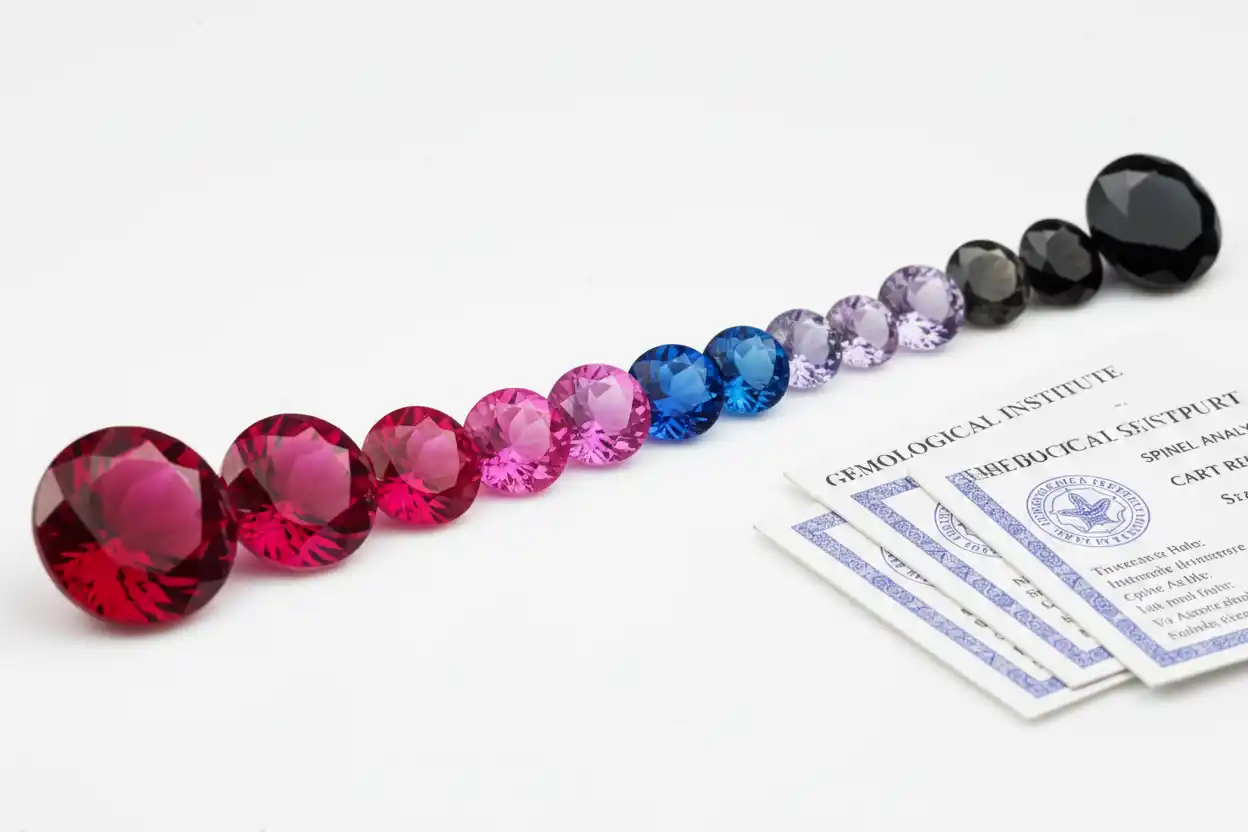
Spinel Price Guide: Value and Cost in 2026
Natural Spinel prices in 2026 range from under $10 per carat for ordinary opaque black material to more than $20,000 per carat for exceptional cobalt-blue, vivid red and neon-pink gems. Most attractive transparent jewelry Spinels sell between approximately $200 and $5,000 per carat.
Color creates the largest market divisions. Red, cobalt blue and vivid hot pink occupy premium categories, while lavender, gray, purple, orange and black Spinel generally remain more affordable.
Spinel Price per Carat in 2026
The following ranges provide broad U.S. and international retail expectations for loose natural Spinel.
| Spinel category | Typical characteristics | Approximate 2026 retail price |
|---|---|---|
| Black or dark commercial Spinel | Opaque black, gray-black or heavily included material | $5–$75 per carat |
| Commercial pastel Spinel | Pale pink, lavender, gray, purple or weak blue | $75–$500 per carat |
| Good red, pink or blue Spinel | Attractive color, eye-clean appearance and competent cutting | $500–$2,000 per carat |
| Fine vivid red, hot pink or saturated blue | Strong color, good clarity, rare size and excellent cutting | $1,500–$7,500 per carat |
| Premium cobalt blue or top red | Exceptional saturation, rare origin, major report and size premium | $5,000–$20,000 per carat |
| Exceptional collector quality | Major cobalt-blue, Namya red or neon Mahenge gem | $15,000–$30,000+ per carat |
These ranges overlap because one exceptional pink Spinel can cost more than a mediocre red stone, while a vivid iron-colored blue can be more valuable than a weak stone containing measurable cobalt.
The broader relationship among color, size, origin and demand appears in How Gemstone Prices Are Determined.
What Is Spinel?
Spinel is a magnesium aluminum oxide mineral that crystallizes in the cubic system.
It occurs in red, pink, orange, purple, violet, blue, greenish blue, gray, black and near-colorless varieties.
For centuries, red Spinel was confused with Ruby. Several historic “Rubies” in royal collections were later identified as Spinel.
The completed Spinel guide owns its mineralogy, history and traditional symbolism.
The completed Types of Spinel page owns the complete color and variety structure.
This guide remains focused on price and market hierarchy.
Color Is the Main Value Factor
GIA identifies vivid red and cobalt blue as Spinel’s most valuable colors.
Hot pink, neon pink, orange-red and certain intense purple stones also command strong premiums.
Pastel lavender, gray and mauve Spinel has developed a modern designer market, although prices generally remain below top red and blue material.
Brown, dull gray and excessively dark modifiers reduce value.
A fine Spinel should retain its color in ordinary indoor lighting. Stones that look vivid only under a spotlight or through backlighting belong to lower tiers.
The broader markets appear in Red Gemstones, Blue Gemstones, Pink Gemstones and Purple Gemstones.
Red Spinel Prices
Fine red Spinel commonly ranges from approximately $1,000 to $10,000 per carat.
Commercial red stones with purple, brown or dark modifiers may cost $300 to $1,500 per carat.
Vivid “stoplight” red material with strong transparency and minimal gray can reach $5,000 to $15,000 per carat.
Exceptional stones from Myanmar or other prestigious deposits may exceed $20,000 per carat, particularly above three or five carats.
Red Spinel should be evaluated separately from Ruby. The two may overlap visually, but Spinel is singly refractive, normally untreated and has its own market.
Current Ruby prices appear in the Ruby Price Guide, while the detailed identification boundary belongs to Ruby vs Spinel.
Pink and Mahenge Spinel Prices
Pink Spinel ranges from pale blush to vivid magenta, neon pink and pinkish red.
Commercial pastel stones may cost $100 to $800 per carat.
Fine hot-pink material commonly reaches $1,000 to $5,000 per carat. Exceptional neon-pink gems can cost $5,000 to $20,000 per carat.
Mahenge, Tanzania, became famous for highly saturated pink, red-pink and neon stones.
Top Mahenge material can show an internal glow comparable with fine Ruby while remaining distinctly Spinel.
The locality name should not replace quality. Pale or included Mahenge stones remain below the premium tier.
Cobalt-Blue Spinel Prices
Fine cobalt-blue Spinel belongs to the rarest and most expensive Spinel markets.
Commercial gray-blue or iron-colored blue stones may cost $200 to $1,500 per carat.
Vivid blue material containing enough cobalt to create strong saturation commonly ranges from $2,000 to $10,000 per carat.
Exceptional clean stones above one or two carats can reach $10,000 to $30,000 per carat.
Vietnam’s Luc Yen region is particularly associated with cobalt-blue Spinel. Tanzania and other sources have also yielded cobalt-bearing blue material.
Color itself matters more than a simple cobalt result. GIA notes that the presence of cobalt does not automatically make a stone valuable if the face-up blue is weak or gray.
Gray and Lavender Spinel Prices
Gray, lavender, lilac and mauve Spinel occupy a growing designer-jewelry market.
Commercial stones may cost $75 to $400 per carat.
Fine clean gems with balanced lavender, blue-gray or violet-gray color commonly range from $300 to $1,200 per carat.
Large precision cuts can cost more when the stone has an unusual tone and strong brilliance.
Gray Spinel should remain intentional rather than dull or muddy. Attractive cool steel-gray and lavender-gray stones often appeal more than brownish dark material.
These colors generally lack the steep scarcity premiums of vivid red and cobalt blue, providing better visual size for the price.
Purple and Violet Spinel
Purple Spinel ranges from pale lilac to saturated violet and reddish purple.
Commercial material may cost approximately $100 to $600 per carat.
Fine vivid stones commonly reach $500 to $2,000 per carat, while rare strongly saturated gems with cobalt or chromium influence may cost more.
Excessive gray lowers value. Strong red or blue secondary hues can increase demand when they produce an unusual neon appearance.
Purple Spinel is often eye-clean and available in useful sizes, making cutting quality especially important.
Orange Spinel
Orange, orange-red and flame-colored Spinel is less common than pink and red material.
Commercial stones may cost $200 to $1,000 per carat.
Vivid orange-red and saturated flame Spinel can reach $1,000 to $5,000 per carat.
Brown modifiers lower value, while clean pure orange or strong reddish orange receives a premium.
Some orange-red stones sit near the red-Spinel market and can be priced accordingly when their color remains bright.
Black Spinel Prices
Black Spinel is usually opaque and widely available.
Loose calibrated stones commonly cost approximately $2 to $30 per carat, while precision-cut or unusually large gems may reach $30 to $100 per carat.
Its value comes from polish, durability, cut and use in jewelry rather than transparency or rare color.
Black Spinel is often marketed as an alternative to Black Onyx or Black Diamond.
The price should not be compared with transparent red or blue Spinel simply because all share the same mineral name.
Clarity and Inclusions
Pastel Spinel is generally expected to be eye-clean.
Vivid red, pink and blue Spinel receives greater inclusion tolerance because strongly saturated rough is scarce.
Possible natural inclusions include crystals, fingerprints, octahedral growth features and healed fissures.
A few characteristic inclusions can support natural identity, but large black crystals, dense clouds and surface-reaching fractures reduce value.
Eye-clean premium stones above two or three carats receive strong premiums.
Synthetic Spinel can also appear extremely clean, so clarity alone does not establish natural origin.
Cut Quality
Spinel can display excellent brilliance when cut to suitable proportions.
Cushions and ovals are common because they preserve natural octahedral rough efficiently. Rounds require more weight loss and can command premiums.
A shallow stone may window and appear pale. Excessive depth can create dark extinction and hidden weight.
Fine Spinel should return light evenly across most of the face.
Because high-quality rough is scarce, cutters may use nonstandard outlines or slightly uneven proportions to preserve weight. Minor compromises are understandable, but severe bulging and poor symmetry reduce value.
Detailed inspection belongs to the Spinel Buying Guide.
Spinel Prices by Carat Weight
Fine Spinel receives steep size premiums because large vivid crystals are scarce.
| Carat weight | Commercial quality | Fine vivid quality | Exceptional quality |
|---|---|---|---|
| Under 1 ct | $50–$750 per carat | $750–$3,000 per carat | $2,000–$8,000 per carat |
| 1–2 ct | $100–$1,000 per carat | $1,000–$5,000 per carat | $4,000–$12,000 per carat |
| 2–3 ct | $150–$1,500 per carat | $1,500–$7,500 per carat | $5,000–$18,000 per carat |
| 3–5 ct | $200–$2,000 per carat | $2,500–$10,000 per carat | $7,500–$25,000 per carat |
| Above 5 ct | Individually evaluated | $4,000–$15,000+ per carat | $10,000–$30,000+ per carat |
These ranges apply mainly to transparent red, pink, blue and premium colors.
Black, gray and pale Spinel follow much lower size premiums.
Myanmar Spinel
Myanmar’s Mogok and Namya regions produce red, pink, purple, blue and other Spinel colors.
Fine Burmese red Spinel has strong historical recognition and can command substantial premiums.
Namya is associated with vivid red Spinel that may show a luminous appearance and strong chromium-related color.
Commercial Myanmar material also exists. Origin cannot compensate for dark tone, inclusions or poor cutting.
A respected laboratory origin opinion becomes useful when Burmese or Namya provenance adds thousands of dollars per carat.
Mahenge and Tanzanian Spinel
Mahenge Spinel changed the modern market by introducing exceptionally vivid pink, magenta and red-pink material.
Fine stones can show neon saturation and strong fluorescence-like brightness.
Prices rose sharply as the original supply became limited and international demand increased.
Tanzania also produces blue, purple, gray and other Spinel varieties outside the most famous Mahenge pink market.
The country name alone should not create a premium. The value lies in the actual saturation, clarity, size and cut.
Vietnamese Cobalt Spinel
Vietnam’s Luc Yen area is the source most closely associated with vivid cobalt-blue Spinel.
Fine stones are commonly small, making clean one-carat gems rare and two-carat stones exceptional.
The blue should appear rich and saturated rather than gray or inky.
Trace-element analysis and spectroscopy can establish the role of cobalt, but visible color remains the commercial driver.
Major purchases should carry a report because synthetic blue Spinel and other blue gems can imitate the appearance.
Sri Lankan, Tajik, Madagascan and Other Spinel
Sri Lanka produces pink, purple, blue, gray and near-colorless Spinel from alluvial deposits.
Tajikistan has supplied pink-to-red stones, while Madagascar produces red, pink, purple, gray and blue varieties.
Afghanistan, Pakistan and Vietnam also contribute to the modern market.
Origin premiums are strongest for specific exceptional categories rather than ordinary stones. Color and quality usually outweigh country in the commercial market.
Spinel Treatment
Most natural Spinel is sold without routine treatment.
This untreated norm strengthens its appeal relative to Ruby and Sapphire, where heat treatment is common.
However, heat-related experiments, fracture healing and surface modification have been documented.
GIA has identified a nickel-related treatment that produced blue-to-green color in pale Spinel while also creating artificial fracture healing.
Such treatments remain unusual but show why expensive stones should not be assumed untreated solely because Spinel traditionally receives little enhancement.
The broader framework appears in Gemstone Treatments Explained.
Synthetic Spinel
Synthetic Spinel has been manufactured for decades and appears in many colors.
Some laboratory products imitate Sapphire, Aquamarine, Tourmaline and other gemstones rather than natural Spinel specifically.
Synthetic material is generally inexpensive and should be clearly disclosed.
Natural versus synthetic separation may require magnification, refractive testing, spectroscopy or laboratory analysis.
The broader distinction appears in Lab-Grown vs Natural Gemstones.
Spinel vs Ruby, Garnet and Sapphire
Red Spinel can resemble Ruby and Garnet.
The three-way comparison belongs to Ruby vs Garnet vs Spinel.
Blue Spinel can resemble Sapphire, while Pink Spinel may overlap with Pink Sapphire and Tourmaline.
Current Sapphire pricing appears in the Sapphire Price Guide.
Identity must be established before applying a premium market. A vivid blue synthetic Spinel should not be priced as natural cobalt Spinel or Sapphire.
Star and Color-Change Spinel
Some Spinel displays asterism, chatoyancy or a color change.
Star Spinel commonly appears gray, purple, blue or dark, with four- or six-rayed effects depending on inclusion orientation.
Fine centered stars can attract collectors, though the market is smaller than Star Ruby or Star Sapphire.
Color-change Spinel may shift between blue, violet, purple or reddish tones under different lighting.
The premium depends on the strength and attractiveness of both colors. A weak change does not justify a substantial markup.
Spinel Jewelry Prices in 2026
| Jewelry type | Broad international retail range |
|---|---|
| Silver jewelry with black or commercial Spinel | $50–$500 |
| Gold pendant or earrings with pastel Spinel | $500–$4,000 |
| One-carat fine red or pink Spinel ring | $3,000–$15,000 |
| One-carat cobalt-blue Spinel ring | $5,000–$30,000+ |
| Three- to five-carat premium Spinel jewel | $20,000–$150,000+ |
| Signed high-jewelry collector piece | Hundreds of thousands or more |
The center gem normally dominates the price in fine transparent Spinel jewelry.
Style-specific selection belongs to the Spinel Ring Guide, Spinel Earrings Guide, Spinel Necklace Guide and Spinel Bracelet Guide.
Spinel is also recognized as an August birthstone, discussed in the August Birthstone Guide.
Certification and Origin Reports
A laboratory report becomes important when natural origin, cobalt coloration, geographic origin or premium color materially affects the price.
A useful report can state:
- Natural or laboratory-grown origin
- Spinel identity
- Color and measurements
- Detectable treatment
- Geographic origin for qualifying stones
- Trace-element or spectroscopic findings relevant to cobalt
GIA evaluates Spinel but does not issue a universal retail quality grade.
Seller grades such as AAA and AAAAA remain company-specific.
The Gemstone Certification Labs comparison explains report scope.
Durability and Care
Spinel has a Mohs hardness of 8 and good toughness, making it suitable for everyday rings.
It can still chip at exposed corners or existing fractures.
Warm soapy water is generally safe. Ultrasonic and steam cleaning may be appropriate for intact untreated stones but should be avoided when filling or fractures are present.
Complete maintenance guidance belongs to How to Clean Spinel Jewelry Safely.
Does Spinel Hold Its Value?
Fine natural Spinel has developed a strong collector market.
Top red, Mahenge pink and cobalt-blue stones have shown particularly strong demand.
The best resale position belongs to vivid, eye-clean gems with rare size, major laboratory reports and credible origin.
Black, pale and ordinary gray Spinel generally resells below retail.
A premium gem can remain illiquid, and auction commissions or dealer margins reduce actual proceeds.
The broader framework appears in Do Gemstones Hold Their Value?.
Price Guide vs Buying Guide
This page owns Spinel’s 2026 family-level prices and color-specific value factors.
The buying guide owns detailed stone inspection, report verification and seller comparison.
Online purchasers should request neutral-light videos, exact dimensions, treatment disclosure and direct report verification through How to Buy Gemstones Online Without Getting Scammed.
The Gemstones That Start With S and Crystals That Start With S directories connect Spinel with the alphabetical structure.
The Buying & Value hub connects Spinel pricing with Ruby, Sapphire, treatment, certification and resale content.
Frequently Asked Questions
1. How much is Spinel worth per carat in 2026?
Spinel ranges from under $10 per carat for ordinary black material to more than $20,000 per carat for exceptional red or cobalt-blue gems.
2. What Spinel color is most valuable?
Vivid red and cobalt blue generally receive the strongest prices, followed by neon pink and exceptional orange-red material.
3. How much is red Spinel worth?
Commercial red Spinel may cost $300 to $1,500 per carat. Fine vivid stones commonly range from $1,500 to $10,000 per carat or more.
4. How much is cobalt-blue Spinel worth?
Fine cobalt-blue material commonly ranges from $2,000 to $10,000 per carat. Exceptional stones may reach $10,000 to $30,000 per carat.
5. How much is Mahenge Spinel?
Good pink or red Mahenge material may cost $1,000 to $5,000 per carat, while top neon stones can reach five-figure prices per carat.
6. Is black Spinel valuable?
Black Spinel is usually affordable, commonly costing approximately $5 to $75 per carat.
7. Does Spinel become more expensive at larger sizes?
Yes. Fine red, pink and cobalt-blue stones above two, three and five carats receive steep premiums.
8. Is Spinel normally treated?
Most natural Spinel is untreated, although uncommon heat, color modification and fracture-healing treatments have been documented.
9. Is synthetic Spinel common?
Yes. Synthetic Spinel has been manufactured for decades and may imitate several different gemstones.
10. Is Spinel more valuable than Ruby?
Usually not at the highest level, but exceptional red and cobalt-blue Spinel can rival or exceed the prices of some natural Rubies.
11. Does Spinel need a laboratory report?
A report is advisable for expensive red, cobalt-blue, Mahenge or origin-sensitive stones.
12. Is Spinel a good investment?
Exceptional natural Spinel has strong collector demand, but quality, documentation, liquidity and purchase price determine its resale potential.
Spinel Pricing Begins With the Color Category
A black Spinel, a pastel lavender stone, a vivid Mahenge pink and a cobalt-blue Vietnamese gem share one mineral identity but belong to entirely different markets.
In 2026, attractive transparent Spinel commonly falls between $500 and $5,000 per carat. Higher prices become defensible when vivid color, rare size, minimal treatment, respected origin and laboratory evidence align in the same stone.